
Every master beekeeper and high-volume honey processor has faced the “Wet Harvest” crisis. You have managed the colonies perfectly, and the bees have captured the fleeting, ethereal essence of a specific bloom—Lavender, Orange Blossom, Manuka, or rare Highland nectars. But environmental humidity is high, the honey is “thin” (exceeding 20% moisture), and the threat of fermentation looms.
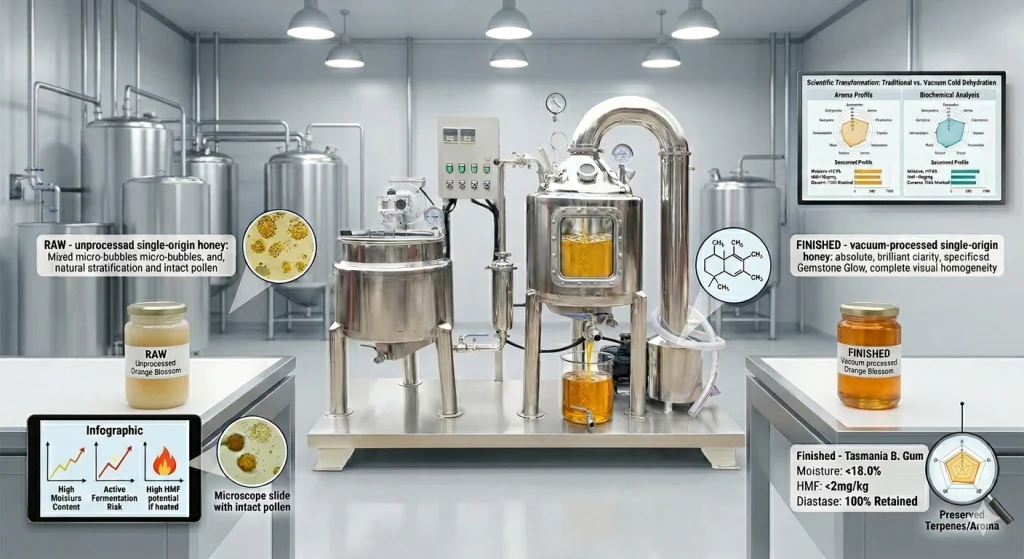
In professional circles, the debate is often polarized: “Do I sell it runny and risk a total loss via fermentation, or do I ‘cook’ it and kill the soul of the honey?” To the connoisseur, honey is a living, aromatic jewel. To the global distributor, it must be a stable, consistent product that meets rigorous lab standards. The bridge between these two worlds is not raw heat—it is Precision Physics. Working in tandem with a specialized, low-temperature মধু ছেঁকার যন্ত্র, Monofloral Honey Aroma Protection depends on the -0.092 MPa vacuum threshold to keep the “Raw” heart beating while achieving global shelf stability.
From a sensory and psychological perspective, the “nose” or bouquet is the first indicator of quality. Before a consumer even tastes the sweetness, they experience the volatile top notes. Traditional dehydration methods are, quite literally, “Scent Thieves.”
In an open-air heating room or a standard flash-evaporator, water does not evaporate in isolation. It forms a co-boiling bond with the honey’s delicate volatile esters. This is a natural Steam Distillation process. If your processing facility smells like a blooming garden during production, it is a diagnostic alarm: your most valuable asset—the scent—is being discharged into the atmosphere as waste.
Through Vacuum Cold Dehydration, we create an engineered environment that defies standard evaporation logic. By utilizing a precision depth of -0.092 এমপা, we manipulate the phase equilibrium of the liquid.
অনুযায়ীClausius-Clapeyron relation, the relationship between pressure and boiling point is mathematically absolute:
ln(P₂ / P₁) = –(ΔHᵥₐₚ / R) × (1/T₂ – 1/T₁)
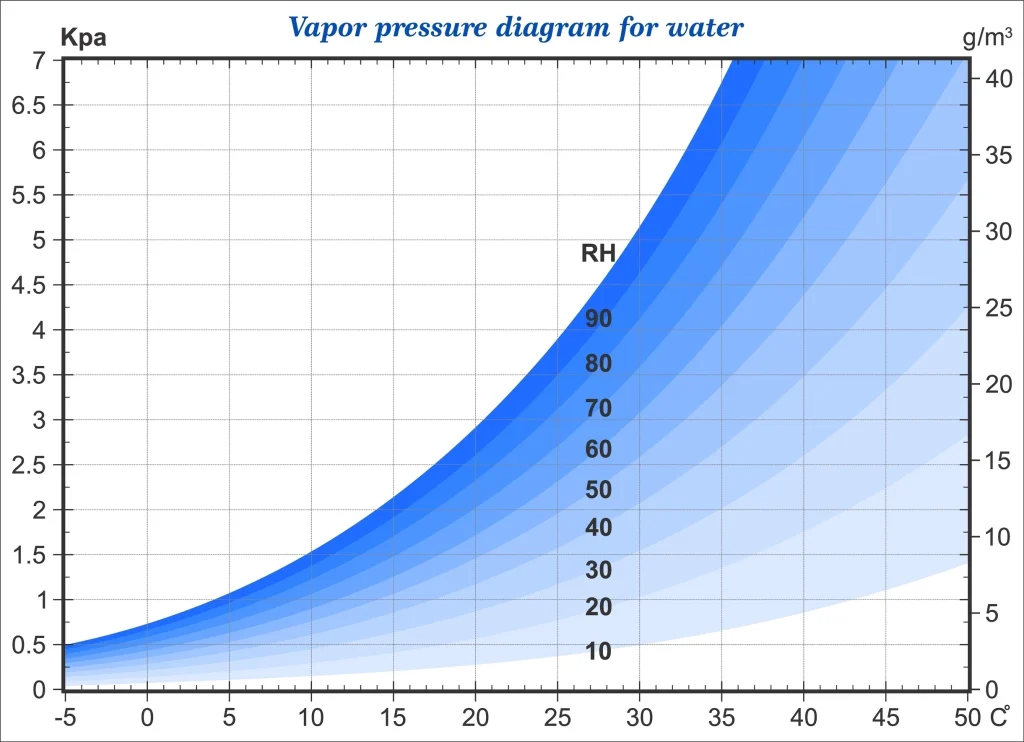
This formula proves that at -0.092 MPa, water reaches its boiling threshold at a hive-natural 38°C (100.4°F). In this state, water molecules are gently coaxed out, while the heavier, flavor-dense aromatic molecules lack the energy to cross the evaporation threshold. They remain “locked” within the sugar matrix.
| Pressure Environment | Boiling Point of Water | Processing Impact | Aroma Protection Level |
| Atmospheric (0 MPa) | 100°C | Severe Carbonization | 0% (Scent Destroyed) |
| Low Vacuum (-0.05 MPa) | ~80°C | High Thermal Damage | 20% (Caramelized) |
| Mid Vacuum (-0.08 MPa) | ~60°C | Enzyme Degradation | 50% (Scent Fades) |
| Panchi Deep Vacuum (-0.092 MPa) | 38°C | Hive-Natural Mimicry | 95% – 100% (Perfect Lock) |
For the high-end market, “Raw” is not merely a marketing label; it is a chemical and biological standard. To maintain this, a facility must transition to Zero-Thermal-Impact Processing Honey.
Silencing the “Caramel Noise”
When honey is heat-stressed, it produces HMF (Hydroxymethylfurfural). Beyond being a regulatory red flag for export, HMF creates what we call “Caramel Noise”—a heavy, burnt-sugar taste that masks the light, sophisticated floral notes of monofloral nectars. By keeping processing temperatures under 40°C, we ensure the “floral melody” of the original bloom is heard clearly by the palate without the interference of heat-induced chemical byproducts.
Aromatic compounds like Linalool (Lavender) or Limonene (Citrus) are the chemical fingerprints of the flower. These terpenes are highly sensitive to oxidative stress. Traditional processing ruin these molecules by stripping them away. By operating at -0.092 MPa, we preserve the chemical integrity of these terpenes, ensuring the “floral melody” remains vibrant and recognizable to the connoisseur.
The sophisticated honey user values the “living” properties of honey. Enzymes like ডায়াস্টেজএবংইনভার্টেজ are heat-sensitive proteins added by the bees. These enzymes are the biological proof of quality. Using our vacuum system, we ensure a 100% Bio-active Retention Rate. If the enzymes are preserved, the laboratory status remains “Raw,” allowing the producer to command a significant price premium.
| মেট্রিক | Traditional Dehydration | Panchi Vacuum System | Export Standard (EU/Japan) |
| HMF (Hydroxymethylfurfural) | 25 – 50 mg/kg | < 2 mg/kg | < 40 mg/kg |
| Diastase Activity | Drops by 40%+ | 100% Retained | > 8 Schade Units |
| Aroma Volatiles | 40% – 60% Loss | > 95% Retention | N/A (Sensory Peak) |
| Visual Appearance | Clouded/Darkened | Gemstone Clarity | Typical Varietal Color |
Consumers shop with their eyes first. Cloudy honey or honey with a layer of foam is perceived as “spoiled,” “industrial,” or “old.” However, micro-bubbles are more than an aesthetic nuisance; they are Oxygen Reservoirs.
Oxygen is the primary catalyst for the oxidative degradation of aromatic terpenes. A honey full of incorporated air will undergo rapid flavor change. The vibrant, citrusy scent of Orange Blossom honey, for example, can turn into a flat, stale sweetness within months if exposed to internal oxidation.
As part of our Vacuum Cold Dehydration workflow, the system forcefully extracts these micro-bubbles. This creates an anaerobic (oxygen-free) environment inside the liquid, effectively vacuum-sealing the fragrance. The result is a brilliant transparency—the “Gemstone Glow”—which serves as a visual promise of a pure, unaltered experience.
Modern consumers are instinctively wary of “industrialized” food. They seek a direct connection from the hive to the table. When a user experiences a sudden “bloom” of fresh floral aroma upon opening a jar, it triggers a powerful neurological pleasure response. This is the Return on Investment (ROI) of quality.
| Beekeeper/Processor Fear | Traditional Consequence | Panchi Strategic Value | Economic Result |
| Loss of “Raw” Status | Reclassified as “Processed” | Certified Zero-Thermal | 200% – 300% Price Markup |
| Scent Loss | Commodity Sugar Taste | Aroma Signature Lock | High Customer Loyalty |
| Export Rejection | HMF/Enzyme Failure | Massive Safety Buffer | Access to High-End Markets |
| Shelf Decay | Oxidation/Discoloration | Anaerobic Stabilization | Reduced Returns/Waste |
Q: Is a vacuum as deep as -0.092 MPa truly necessary?
A: es. Physics is uncompromising. If the vacuum is insufficient, the boiling point remains too high. If the boiling point is high, you must add more heat. That specific pressure depth is the lifeline for Monofloral Honey Aroma Protection.
Q: Does this process work for high-viscosity honeys?
A: Yes. Thick honeys trap air easily and suffer from uneven heat transfer. Deep vacuum environments allow for “low-temperature boiling,” ensuring uniform heat transfer and superior degassing without the need for aggressive agitation.
Q: Does the degassing process remove the smell?
A: No. Aromatic compounds are typically “heavier” (higher molecular weight) than atmospheric gases. Our system is tuned to extract lightweight gases while the heavier scent molecules stay bound to the sugar matrix.
At Zhengzhou Panchi Machinery, we believe the best honey technology should be “invisible.” The machine should not change the honey; it should act as a guardian, blocking heat, oxygen, and time from eroding the scent.
By mastering the science of Monofloral Honey Aroma Protection, we allow the beekeeper’s hard work and the bee’s natural artistry to reach the consumer’s table exactly as nature intended—pure, potent, and deeply aromatic.
Don’t let your hard work evaporate with the steam. Preserve its soul with Panchi Machinery.

ওয়াটসঅ্যাপ

ওয়েচাট
অ্যাপ্লিকেশন:+৮৬১৫৭৩৬৭৬৮১২৯
ইমেল:inquiry@panchimachinery.com
ঠিকানা: ঝেংঝো, হেনান প্রদেশ, চীন
অটোমেটিক ভ্যাকুয়াম হানি প্রসেসিং ও ফিল্টারিং মেশিন
ভ্যাকুয়াম নিম্নতাপমাত্রার তরল নিষ্কাশন ও সংকোচন ইউনিট
কাস্টম স্টিম ডিস্টিলেশন ও হিট রিফ্লাক্স প্রকৌশলী তেল সরঞ্জাম
এসএস৩০৪/৩১৬এল কম তাপমাত্রার ভ্যাকুয়াম স্ক্রেপার কনসেনট্রেটর
কিউএন গোলাকার ভ্যাকুয়াম কনসেনট্রেটর ও অ্যালকোহল পুনরুদ্ধার ইউনিট
বহুমুখী স্টেইনলেস স্টিল ভ্যাকুয়াম ডিস্টিলেশন এবং এক্সট্রাকশন ইউনিট
হট রিফ্লাক্স ভ্যাকুয়াম তরল নির্গমন ও ঘনত্বকারী ইউনিট
একক-প্রভাব বাহ্যিক পরিবেষ্টন ভ্যাকুয়াম কনসেনট্রেটর
এসজেএন সিরিজ ডাবল-অ্যাকশন বাইরের পরিবেশে চলমান ভ্যাকুয়াম বাষ্পীভবন যন্ত্র
আমরা এক কর্মদিবসের মধ্যে আপনার সাথে যোগাযোগ করব। অনুগ্রহ করে আপনার ইমেইলের দিকে নজর দিন।
অটোমেটিক ভ্যাকুয়াম হানি প্রসেসিং ও ফিল্টারিং মেশিন
ভ্যাকুয়াম নিম্নতাপমাত্রার তরল নিষ্কাশন ও সংকোচন ইউনিট
কাস্টম স্টিম ডিস্টিলেশন ও হিট রিফ্লাক্স প্রকৌশলী তেল সরঞ্জাম
হোয়াটসঅ্যাপ: +৮৬১৫৭৩৬৭৬৮১২৯
ইমেল: inquiry@panchimachinery.com
ঠিকানা:জেংঝোউ, হেনান প্রদেশ, চীন


কপিরাইট© ২০২৬ঝেংঝৌ পাঞ্চি যন্ত্রপাতি সংস্থা, লিমিটেড|গোপনীয়তা নীতি