
In the competitive landscape of the 2026 global honey market, the definition of “quality” has evolved from a subjective taste preference to a rigid set of laboratory-certified benchmarks. For generations, Honey Sun Drying was the standard for small-scale apiaries in tropical regions, relying on the abundance of solar heat to reduce moisture. However, as international trade barriers rise and consumer demand for “Raw” and “Bio-active” honey surges, traditional methods have become a significant liability for exporters.
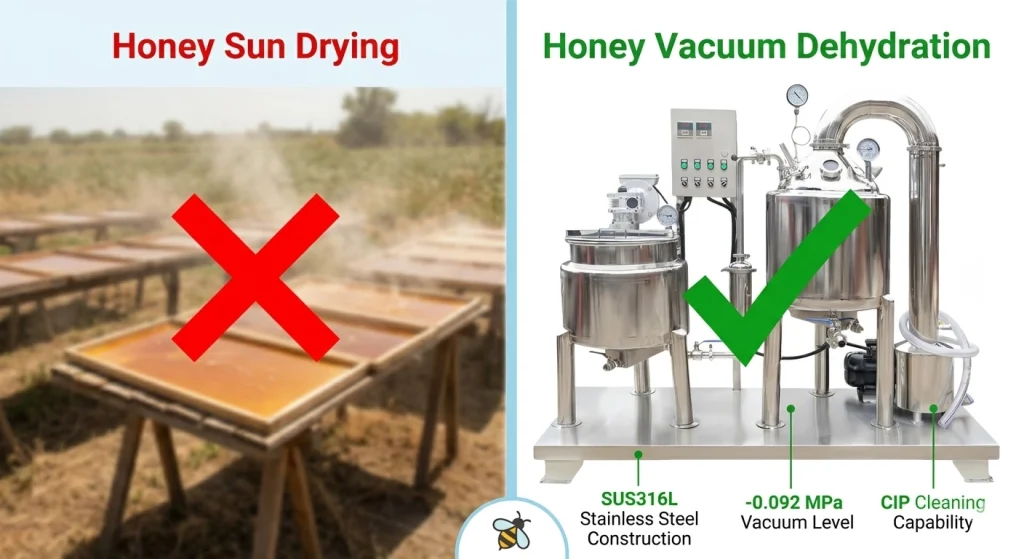
Today, the industry faces a critical “Heat vs. Quality” paradox. Professional Honey Vacuum Dehydration has emerged not merely as an alternative, but as a mandatory requirement for any producer aiming for the premium shelves of Europe, North America, or the Middle East. This guide explores the scientific, economic, and operational reasons why moving away from the sun and into the vacuum is the most profitable decision a honey processor can make.
The most frequent technical question among processors on platforms like কোরাএবংRedditহ্যাঁ“If honey is natural, why can’t I just use the sun to dry it?” The answer lies in the delicate thermal limits of honey’s biological compounds.
At standard atmospheric pressure (101.3 kPa), water boils at 100°C. Exposing honey to such heat triggers the “Maillard Reaction,” causing instant darkening and a permanent spike in এইচএমএফ (হাইড্রক্সিমেথিলফুরফুরাল) levels.
By utilizing a professional মধু ডিহাইড্রেটর যন্ত্র, we fundamentally change the physics of evaporation. By creating a high-vacuum environment of -0.092 এমপা, the boiling point of water drops to approximately ৩৮°C – ৪০°C. This is known as the “Magic Number” because it mimics the natural temperature maintained by bees within a hive. This allows for rapid moisture removal without “cooking” the enzymes or destroying the delicate aromatic profile.
Molecular Evaporation vs. Surface Boiling
Honey Sun Drying relies on surface evaporation, which is slow, weather-dependent, and inconsistent. Often, the top layer of honey forms a “skin,” trapping moisture beneath and allowing osmophilic yeasts to thrive. In contrast, the -০.০৯২ এমপিএ ভ্যাকুয়াম pulls moisture from the entire molecular structure of the honey simultaneously. This ensures a uniform final moisture content (typically 17%–18%) that is essential for long-term shelf stability and preventing fermentation during trans-oceanic shipping.
Honey is naturally acidic, with a pH ranging from 3.4 to 6.1. This acidity presents a significant challenge for equipment longevity and food safety.
To transition from a workshop to a factory, a disciplined Standard Operating Procedure (SOP) is required.
Most honey arrives at the processing facility crystallized or semi-solid. To move it through filters, it must be liquefied safely.
Once the honey reaches the concentration tank and the vacuum stabilizes at -0.092 এমপা, the dehydration begins.
Hygiene is the foundation of EEAT and international food safety certifications like HACCP or ISO 22000.
Beekeepers often ask: “Is the investment worth it?” The following table illustrates the operational ROI:
| বৈশিষ্ট্য | Honey Sun Drying | Honey Vacuum Dehydration (-0.092 MPa) |
| Processing Time | 3–5 Days | 2–4 Hours |
| HMF Control | Unpredictable / High Risk | Precise / Low Risk |
| Labor Cost | High (Manual Handling) | Low (Automated) |
| Market Value | Local / Bulk Grade | Premium / Export Grade |
| Profit Margin | Thin / Commodity Prices | High / Value-Added Prices |
Investing in a মধু ডিহাইড্রেটর যন্ত্র allows a processor to handle higher volumes with fewer staff, while opening doors to the most lucrative markets in the world.
Exporters must understand the requirements of their target markets.
Enzyme Retention: High-value varieties like Manuka or Longan honey rely on MGO or Diastase activity for their price premium. Vacuum technology preserves these heat-sensitive biomarkers.
HMF Limits: The EU typically rejects honey with HMF > 40mg/kg. Honey Sun Drying can push fresh honey past this limit in a single afternoon. Honey Vacuum Dehydration keeps HMF change negligible, often adding less than 5mg/kg.
Effective মধু মেশিন রক্ষণাবেক্ষণ separates a high-performance factory from a struggling one.
Q: Does vacuum dehydration affect the “Raw” status or flavor profile of my honey?
A: No, it actually protects it better than any other method. Traditional Honey Sun Drying exposes honey to fluctuating temperatures and oxidation, which can strip away delicate floral aromas. By creating a Honey Vacuum of -0.092 এমপা, water boils at just ৩৮°C – ৪০°C. Since this mimics the natural internal temperature of a beehive, the honey’s heat-sensitive aromatic compounds and essential enzymes remain intact. Because the process operates below the critical threshold for enzyme denaturation (typically 45°C), vacuum-dehydrated honey maintains its “Raw” biological status, which is a key selling point for premium markets.
Q: Why should I invest in a vacuum dehydrator if I already have a hot room or sun-drying setup?
A: The primary reasons are precision, efficiency, and final product quality. Honey Sun Drying is weather-dependent and presents a high risk of এইচএমএফ (হাইড্রক্সিমেথিলফুরফুরাল) spikes, whereas a Honey Vacuum system provides precise, repeatable results regardless of ambient humidity. While sun drying or hot rooms can take 3–5 days to reach the desired moisture level, a Honey Vacuum Dehydration Machine can achieve a target moisture of 17% in just 2–4 hours. Additionally, vacuum technology removes moisture and micro-bubbles simultaneously, resulting in a crystal-clear product that looks significantly more professional on retail shelves than honey dried in open air.
Q: Can the vacuum system handle highly crystallized honey directly?
A: Yes, provided the system includes professional pre-heating and agitation stages. Crystallized honey should first be heated to a “Goldilocks Zone” of ৫৫°C using a jacketed tank to melt glucose crystals without inducing thermal damage or darkening the honey. During this phase, the use of PTFE স্ক্রেপার (Teflon scrapers) is critical. These scrapers continuously wipe the tank walls to prevent “hot spots” where honey could scorch, ensuring the entire batch is liquefied and dehydrated uniformly.

ওয়াটসঅ্যাপ

ওয়েচাট
অ্যাপ্লিকেশন:+৮৬১৫৭৩৬৭৬৮১২৯
ইমেল:inquiry@panchimachinery.com
ঠিকানা: ঝেংঝো, হেনান প্রদেশ, চীন
অটোমেটিক ভ্যাকুয়াম হানি প্রসেসিং ও ফিল্টারিং মেশিন
ভ্যাকুয়াম নিম্নতাপমাত্রার তরল নিষ্কাশন ও সংকোচন ইউনিট
কাস্টম স্টিম ডিস্টিলেশন ও হিট রিফ্লাক্স প্রকৌশলী তেল সরঞ্জাম
এসএস৩০৪/৩১৬এল কম তাপমাত্রার ভ্যাকুয়াম স্ক্রেপার কনসেনট্রেটর
কিউএন গোলাকার ভ্যাকুয়াম কনসেনট্রেটর ও অ্যালকোহল পুনরুদ্ধার ইউনিট
বহুমুখী স্টেইনলেস স্টিল ভ্যাকুয়াম ডিস্টিলেশন এবং এক্সট্রাকশন ইউনিট
হট রিফ্লাক্স ভ্যাকুয়াম তরল নির্গমন ও ঘনত্বকারী ইউনিট
একক-প্রভাব বাহ্যিক পরিবেষ্টন ভ্যাকুয়াম কনসেনট্রেটর
এসজেএন সিরিজ ডাবল-অ্যাকশন বাইরের পরিবেশে চলমান ভ্যাকুয়াম বাষ্পীভবন যন্ত্র
আমরা এক কর্মদিবসের মধ্যে আপনার সাথে যোগাযোগ করব। অনুগ্রহ করে আপনার ইমেইলের দিকে নজর দিন।
অটোমেটিক ভ্যাকুয়াম হানি প্রসেসিং ও ফিল্টারিং মেশিন
ভ্যাকুয়াম নিম্নতাপমাত্রার তরল নিষ্কাশন ও সংকোচন ইউনিট
কাস্টম স্টিম ডিস্টিলেশন ও হিট রিফ্লাক্স প্রকৌশলী তেল সরঞ্জাম
হোয়াটসঅ্যাপ: +৮৬১৫৭৩৬৭৬৮১২৯
ইমেল: inquiry@panchimachinery.com
ঠিকানা:জেংঝোউ, হেনান প্রদেশ, চীন


কপিরাইট© ২০২৬ঝেংঝৌ পাঞ্চি যন্ত্রপাতি সংস্থা, লিমিটেড|গোপনীয়তা নীতি