
In the global botanical extraction industry, refining high-purity volatile fractions from underground plant structures presents severe chemical and fluid-dynamic challenges. Unlike aerial flora, underground botanical matrices naturally accumulate high concentrations of high-molecular-weight starches, complex plant polysaccharides, and dense mucilage. During downstream thermal processing, these non-volatile co-extractives undergo rapid physical and chemical transitions, leading to boundary layer fouling, thermal degradation of delicate aroma compounds, and severe filtration compromises.
This technical paper analyzes the underlying fluid mechanics of Roots Materials essential oil Purification and Rhizomes Materials essential oil Purification. By examining the thermodynamic limitations of traditional atmospheric processing, this document outlines an engineered framework utilizing High-Viscosity Roots Materials Reflux Purification combined with variable-frequency mechanical shear and continuous pneumatic mesh regeneration to optimize industrial factory yields, preserve volatile compound integrity, and meet strict international purity benchmarks.
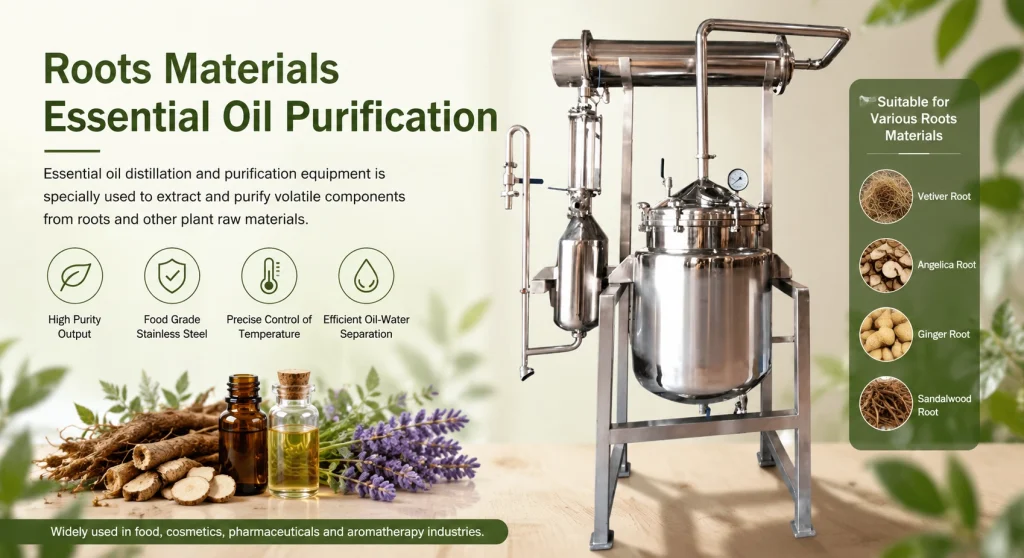
To successfully implement this fluid-mechanics framework on the factory floor, choosing advanced industrial hardware is a critical step. A modern, automated ইসেনশিয়াল অয়েল পরিশোধন যন্ত্র allows factory operators to handle these thick plant mixtures without manual boiling risks. This engineering setup keeps the internal vacuum pressure stable and controls the temperature with high precision. By using this reliable system design, processing lines can achieve continuous operation while delivering the exact chemical purity that global buyers demand.
The global market for high-grade essential oils demands pure products. Major buyers in Europe and North America test every incoming batch using chemical analysis tools. These tests easily detect if the oil was overheated during processing. Overheating leaves a burnt or smoky smell in the oil. If the oil shows any signs of heat damage, buyers will reject the entire batch.
For factory owners, a rejected batch is a major financial loss. Raw materials make up about 70% of a factory’s running costs. If a batch is ruined, the factory loses its investment. Leaving valuable oil trapped inside the plant waste also wastes potential income. To survive in the market, factories must stop using high-temperature open boiling. They must switch to controlled low-temperature separation systems.
How do these market demands connect to daily factory work? The challenge starts with the structure of the plants themselves.
Overcoming the processing bottlenecks of underground plant parts requires engineers to evaluate the distinct structural differences between standard roots and specialized rhizomes. While closely related in botanical classifications, their physical behaviors under thermal and mechanical stress differ significantly during industrial refining.
True structural roots function as anchors and deep-soil water conduits. They display a dense physical makeup. They have highly developed xylem vessels surrounded by tough, fibrous lignocellulose walls. Because the target volatile oil cells are deeply embedded within these tightly packed fibrous layers, raw materials must undergo intense physical reduction prior to extraction.
The primary processing challenge arises during downstream concentration, where specialized Roots Materials essential oil Purification protocols must be established. Roots release massive reserves of complex, high-molecular-weight carbohydrates. These carbohydrates complicate standard separation physics, making generic distillation setups highly inefficient for professional operations.
When root materials heat up in an aqueous or solvent-rich environment, the intermolecular bonds of the starch granules break down. Water molecules wedge into the structure. The temperature rises toward standard atmospheric boiling points (100°C to 120°C). These starch granules absorb water. They swell irreversibly. This process is called starch gelatinization. It causes a portfolio of sudden transformations in the fluid dynamics of the extraction tank.
The clean solvent volatilizes and leaves the vessel. The remaining fluid shifts rapidly from a free-flowing liquid into a highly viscous, sticky paste. In a standard extraction vessel without specialized agitation, this dense paste creates a stagnant fluid boundary layer directly against the internal heated jacket of the machine. These thickened starches exhibit extremely poor thermal conductivity. They act as an insulative blanket.
To maintain boiling, operators often mistakenly increase jacket steam pressure. This action causes the localized temperature at the stainless steel interface to skyrocket. It results in immediate crust formation, burning, and severe thermal cracking of the adjacent volatile oil molecules.
Rhizomes are modified, horizontally growing subterranean stems rather than true roots. They function primarily as specialized storage organs. Rhizomes possesses thin-walled parenchymal tissue engineered to store vast amounts of dense, low-molecular-weight sugars, active oleoresins, and complex phyto-mucilage. Lignified fiber is less dominant in rhizomes.
This unique concentration of sticky mucilage introduces a major mechanical obstacle during filtration and purification, requiring a dedicated approach to Rhizomes Materials essential oil Purification.
Phyto-mucilage is a highly hydrophilic, gelatinous substance. It consists of branched polysaccharides. During the initial extraction and milling stages, this mucilage dissolves into the crude liquid extract. As the volatile solvents are stripped away during the essential oil purification phase, the mucilage rapidly dehydrates. It forms an elastic, impermeable, gel-like film.
When a pump pushes this sticky slurry through industrial filtration screens or micron-rated separation meshes, the gelatinous film spreads across the surface. It instantly seals the pores. This phenomenon is called filter blinding. It blocks fluid passage. It causes immediate pressure spikes across the filtration manifold.
In a standard factory configuration, this pressure forces an immediate, unprogrammed shutdown. Operators must halt production. They must vent system pressure. They must drain the lines. They must manually wash or replace the clogged screens. This repetitive process disrupts factory efficiency. It increases labor costs. Given these systemic vulnerabilities to high heat and static filtration, how can an industrial facility re-engineer its processing line to achieve both purity and continuity?
Overcoming the twin challenges of starch gelatinization and mucilage filter blinding requires an engineered approach. This approach integrates precise thermal management with automated mechanical intervention. By modernizing the machinery array, advanced Roots Materials essential oil Purification can be performed successfully. A specialized system addresses these fluid-dynamic bottlenecks, moving the operation forward into a scalable technical solution.
To resolve the core rheological problems, a system optimized for High-Viscosity Roots Materials Reflux Purification must be fully deployed. This shifts the processing paradigm from open manual boiling to an automated, closed-loop technical solution.
The purification process begins before the material even enters the extraction vessel. Standard high-speed industrial hammer mills generate significant localized friction heat during operation. This heat can volatilize the most delicate top-note terpenes before they ever reach the condenser. This permanently diminishes the oil’s aromatic profile.
The system utilizes an automated, low-RPM, high-torque crushing profile. This profile applies intense mechanical crushing force at a controlled speed to break down the plant material’s cellular structure without generating friction heat. It ensures that the entire volatile terpene profile remains securely trapped within the cool botanical pulp prior to vacuum charging.
To completely eliminate the risk of carbohydrate scorching and starch gelatinization, the extraction chamber is completely isolated from atmospheric pressure. A high-capacity liquid-ring vacuum pump system paired with automated pressure-regulating valves draws the internal operating pressure down to a deep vacuum. This vacuum ranges from -0.08 MPa to -0.085 MPa.
Instead of requiring temperatures above 100°C to induce vaporization, the entire distillation loop stays at a safe, ultra-low temperature range of 38°C to 42°C. At this thermal tier, native starches remain well below their active gelatinization thresholds. They maintain a predictable fluid viscosity. Plant sugars and resins do not melt or char against the stainless steel walls. This ensures that the extraction fluid behaves like a predictable, low-viscosity medium throughout the cycle.
To handle highly concentrated slurries during High-Viscosity Roots Materials Reflux Purification, the core vessel uses a heavy-duty, customized counter-rotational scraping agitator. A Variable Frequency Drive (VFD) drives this agitator. The system’s control PLC uses torque-sensing algorithms. These algorithms continuously monitor the motor’s current draw.
When conducting High-Viscosity Roots Materials Reflux Purification, the extraction fluid concentrates and its viscosity increases. The VFD automatically adjusts the torque output and paddle rotational profile. The specialized PTFE scraper blades closely sweep the mirror-polished 316L stainless steel internal walls. This action continuously breaks up the fluid boundary layer. It forces the thick root slurry away from the heat exchange surface back into the center of the vessel. This choice optimizes thermal transfer efficiency. It prevents the formation of an insulative crust on the vessel walls.
To counter the persistent threat of filter blinding from sticky phyto-mucilage, this design replaces traditional static filtration screens with an automated, inline pneumatic back-blow filtration assembly. Digital differential pressure transmitters continuously track the pressure drop across the separation mesh.
During standard Rhizomes Materials essential oil Purification, mucilage begins to build up and blind the filter pores. The pressure upstream rises. The moment the differential pressure reaches a programmed threshold, the PLC triggers an automated cleaning cycle without interrupting the overall process flow.
The system manipulates automated pneumatic valves to briefly isolate the fouled filter segment. It directs a rapid, high-pressure pulse of clean, compressed gas or recycled vapor backward through the mesh. This sudden reverse kinetic blast shatters the gelatinous mucilage film. It ejects the accumulated solids off the screen into a collection hopper. The filter mesh is instantly restored to its maximum open area. This allows continuous, round-the-clock factory operation. To substantiate these mechanical assertions, we must examine the underlying thermodynamic and physical equations that govern low-temperature vacuum separation.
Engineers use two fundamental thermodynamic and physical principles to validate the performance of low-temperature vacuum extraction over traditional atmospheric processing. These principles are the Clausius-Clapeyron Equation and the Mass Balance Principle.
The operational physics of the deep-vacuum system follow the Clausius-Clapeyron Equation. This equation defines the non-linear relationship between a fluid’s vapor pressure and its temperature. By mathematically manipulating the ambient system pressure, engineers can precisely dictate the exact thermal energy required to induce vaporization.
ln(P2 / P1) = – (dHvap / R) * (1 / T2 – 1 / T1)
The variables mean:
In traditional systems operating at atmospheric pressure (P1 = 0.1 MPa), the temperature required for distillation (T1) exceeds 100°C. This high temperature causes starch gelatinization and carbohydrate scorching.
The vacuum system lowers the internal operating pressure to P2 = 0.015 MPa (corresponding to a vacuum reading of -0.085 MPa). The required boiling temperature (T2) drops to a controlled range of 38°C to 42°C. This mathematical relationship demonstrates how mechanical vacuum controls can eliminate thermal degradation at the molecular level.
To ensure processing efficiency and accurate cost accounting, every extraction sequence must adhere to the strict law of conservation of mass. The total solvent mass entering the system must equal the total mass exiting across all waste and recovery streams:
Total Solvent In = Recovered Liquid Solvent + Vapor Losses + Solvent Left in Waste
In poorly engineered atmospheric systems, high vapor losses and high solvent retention in the discarded root cake cause significant financial waste.
An integrated dual-stage condenser array optimizes this equation. The primary vertical dephlegmator stays at a precise temperature of 25°C to condense and remove heavy botanical waxes and lipids. The remaining refined vapor then passes into a sub-zero terminal condenser operating at 4°C. This step flashes the volatile terpenes into a pure liquid oil.
Combining this multi-stage cooling array with secondary vacuum steam-sweeping of the spent root cake reduces the solvent left in the waste to under 1.5%. This design achieves a total system solvent recovery rate of 95% or higher. How do these theoretical calculations perform when tested against actual factory floor production metrics?
The quantitative advantages of low-temperature vacuum reflux processing over traditional atmospheric boiling show up clearly during comparative industrial testing. Pilot plants running identical configurations of highly concentrated root slurries revealed stark operational contrasts during internal testing protocols designed to simulate continuous factory operations. The following matrix details the performance differences observed during these trials:
| Technical Performance Metric | Traditional Atmospheric Boiling | New Low-Temp Vacuum Reflux |
| Extraction/Purification Efficiency | 1.0% to 3.0% (Significant oil left in cake) | 3.0% to 5.0% (Complete extraction) |
| Finished Essential Oil Purity (GC-MS) | Below 90.0% (Cloudy with heavy waxes) | 95.0% or higher (Clear, premium grade) |
| Process Fluid Core Temperature | ১০০°সেলসিয়াস থেকে ১২০°সেলসিয়াস (অপরিবর্তিত) | 38°C to 42°C (Vacuum protected) |
| Total Processing Batch Time | 6.0 to 8.0 hours (Poor heat transfer) | 4.0 to 6.0 hours (Rapid reflux loops) |
| Active Aroma Molecule Retention | Severely damaged (Burnt, smoky notes) | 90.0% or higher (True-to-nature profile) |
| Filter Blind Downtime Per Day | 2 to 3 manual cleaning stops required | Zero stops (Continuous pneumatic pulse) |
| Overall Energy Consumption | Baseline standard reference (100%) | Reduced by 25.0% via vacuum optimization |
Laboratory observations during these comparisons revealed that atmospheric boiling caused an immediate increase in fluid viscosity within the first 90 minutes. In contrast, the vacuum-refluxed slurry maintained a stable fluid state throughout the entire cycle. While these performance metrics demonstrate overwhelming processing advantages, executing this advanced technology requires a delivery method that minimizes facility disruption.
Transitioning an extraction facility from outdated equipment to advanced technology often introduces logistical challenges. These challenges include on-site engineering errors, long installation delays, and improper field welding that can compromise sanitary standards. To eliminate these field risks, new machinery delivers exclusively as a Modular Skid-Mounted Platform.
Every component builds onto a heavy-duty structural steel frame at the manufacturing plant. These components include the 316L mirror-polished purification vessel, the VFD agitation system, the differential pressure transmitters, the dual-stage condenser columns, the liquid-ring vacuum pumps, and the automated pneumatic back-blow manifolds. Before shipment, the entire system undergoes rigorous hydrostatic pressure testing, electrical continuity verification, and PLC software calibration in a controlled factory setting.
This system configuration provides the ideal foundation for executing high-yield Roots Materials essential oil Purification alongside complex Rhizomes Materials essential oil Purification.
Furthermore, the robust design of this hardware platform easily accommodates the extreme mechanical demands of High-Viscosity Roots Materials Reflux Purification without experiencing pump cavitation or drive failure. When the skid arrives at the client’s facility, it functions as a true plug-and-play production asset. The local installation team does not need to perform complex pipe routing. They do not need to make structural modifications.
The onsite deployment sequence is straightforward:
This modular engineering approach allows processing facilities to begin full production within hours of equipment delivery. It eliminates the typical multi-week delays associated with traditional industrial equipment installations. To see how this works in practice, we can review the official field performance logs from active processing plants.
A: A factory should upgrade to a specialized system designed for High-Viscosity Roots Materials Reflux Purification when extracting essential oils from underground structures that contain high amounts of starch and dense fibers. Standard extraction machines cannot break up the heavy fluid boundary layer that forms when starches gelatinize under heat. This failure leads to localized overheating and immediate burning of the raw material against the internal heating jacket. Implementing an automated vacuum reflux system prevents thermal degradation and keeps thick slurries moving uniformly throughout the distillation cycle.
A: Generic distillation setups cannot perform efficient Roots Materials essential oil Purification because they lack precise vacuum and rheological control mechanisms. Root materials naturally store complex carbohydrates that swell and form an insulative paste when heated past standard thresholds. Without a deep vacuum to lower the process boiling temperature to 38°C–42°C, and without automated scraper blades to continuous disrupt the fluid boundary layer, the raw extract will scorch, resulting in a burnt, ruined batch that international buyers will reject.
A: The primary operational bottleneck during standard Rhizomes Materials essential oil Purification is filter blinding caused by dehydrated phyto-mucilage. Rhizomes are dense storage organs packed with low-molecular-weight sugars and hydrophilic polysaccharides. When solvents are stripped away during the concentration phase, this mucilage quickly forms an elastic, waterproof film over standard filtration screens. This creates a rapid pressure spike that forces immediate, manual shutdowns. Overcoming this bottleneck requires switching from static meshes to an automated pneumatic back-blow assembly that clears the system instantly.

ওয়াটসঅ্যাপ

ওয়েচাট
অ্যাপ্লিকেশন:+৮৬১৫৭৩৬৭৬৮১২৯
ইমেল:inquiry@panchimachinery.com
ঠিকানা: ঝেংঝো, হেনান প্রদেশ, চীন
অটোমেটিক ভ্যাকুয়াম হানি প্রসেসিং ও ফিল্টারিং মেশিন
ভ্যাকুয়াম নিম্নতাপমাত্রার তরল নিষ্কাশন ও সংকোচন ইউনিট
কাস্টম স্টিম ডিস্টিলেশন ও হিট রিফ্লাক্স প্রকৌশলী তেল সরঞ্জাম
এসএস৩০৪/৩১৬এল কম তাপমাত্রার ভ্যাকুয়াম স্ক্রেপার কনসেনট্রেটর
কিউএন গোলাকার ভ্যাকুয়াম কনসেনট্রেটর ও অ্যালকোহল পুনরুদ্ধার ইউনিট
বহুমুখী স্টেইনলেস স্টিল ভ্যাকুয়াম ডিস্টিলেশন এবং এক্সট্রাকশন ইউনিট
হট রিফ্লাক্স ভ্যাকুয়াম তরল নির্গমন ও ঘনত্বকারী ইউনিট
একক-প্রভাব বাহ্যিক পরিবেষ্টন ভ্যাকুয়াম কনসেনট্রেটর
এসজেএন সিরিজ ডাবল-অ্যাকশন বাইরের পরিবেশে চলমান ভ্যাকুয়াম বাষ্পীভবন যন্ত্র
আমরা এক কর্মদিবসের মধ্যে আপনার সাথে যোগাযোগ করব। অনুগ্রহ করে আপনার ইমেইলের দিকে নজর দিন।
অটোমেটিক ভ্যাকুয়াম হানি প্রসেসিং ও ফিল্টারিং মেশিন
ভ্যাকুয়াম নিম্নতাপমাত্রার তরল নিষ্কাশন ও সংকোচন ইউনিট
কাস্টম স্টিম ডিস্টিলেশন ও হিট রিফ্লাক্স প্রকৌশলী তেল সরঞ্জাম
হোয়াটসঅ্যাপ: +৮৬১৫৭৩৬৭৬৮১২৯
ইমেল: inquiry@panchimachinery.com
ঠিকানা:জেংঝোউ, হেনান প্রদেশ, চীন


কপিরাইট© ২০২৬ঝেংঝৌ পাঞ্চি যন্ত্রপাতি সংস্থা, লিমিটেড|গোপনীয়তা নীতি