
In global food manufacturing, production margins and strict regulatory compliance are dictated by a single variable: process predictability. Whether processing low-viscosity organic juices, high-viscosity cliff honey purification systems, or complex culinary emulsions, investing in high-performance Mixing Tanks for Food processing is a critical exercise in fluid dynamics, thermodynamics, and microbiological risk mitigation.
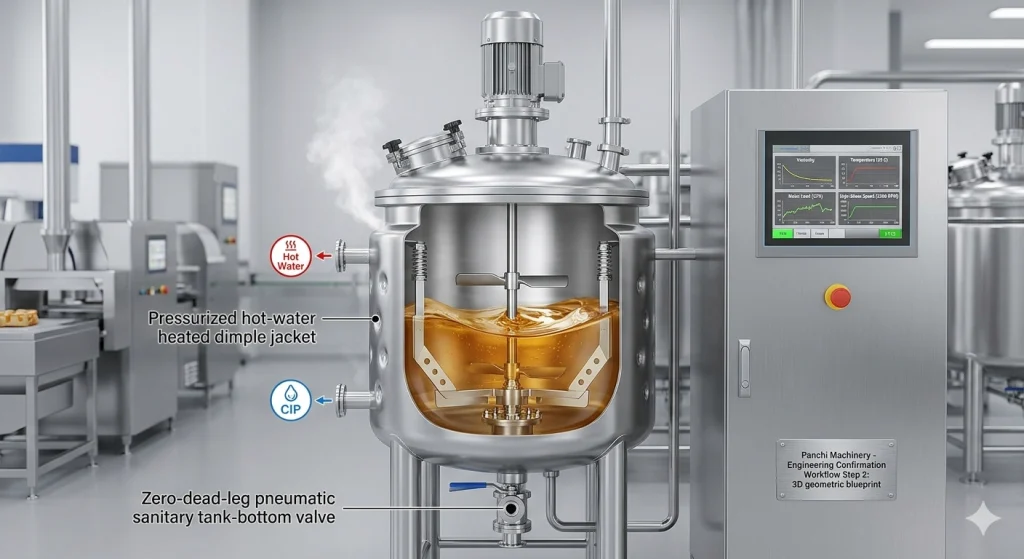
For corporate procurement officers and process engineers, upgrading to a custom-configured خزان خلط من الفولاذ المقاوم للصدأ can mean the difference between a zero-defect production run and a contaminated batch. Choosing an advanced Stainless Steel Mixing Tanks for Food production environment ensures that your plant maintains rigorous global sanitary standards while maximizing daily facility throughput and accelerating facility ROI.
The primary risk factor in food processing machinery is microscopic cross-contamination. Every surface anomaly or structural crevice serves as a sanctuary where bacterial strains shelter, proliferate, and establish resilient biofilms.
The SUS304 vs. SUS316L Engineering Selection
Metallurgy dictates equipment lifespan. While SUS304 is an excellent, cost-effective solution for handling neutral ingredients, milk fats, and pure water systems, it struggles when exposed to aggressive food formulations. For high-acid fruit concentrates, salty brines, or complex honey fluids undergoing thermal purification, a SUS316L خزان خلط من الفولاذ المقاوم للصدأ prevents microscopic iron leaching, protecting both product flavor and equipment longevity against aggressive organic food acids.
In high-purity food manufacturing, a surface that looks like a mirror to the naked eye can look like a mountain range under a scanning microscope. A rough wall profile (Ra > 0.8 micrometers) allows organic proteins and bacteria to anchor easily, resisting standard cleaning flushes.
By utilizing multi-stage mechanical abrasive polishing followed by electropolishing to reach an ultra-smooth finish of Ra <= 0.28 micrometers, the internal walls become micro-flushed. This design eliminates structural purchase points for biofilm anchor mechanisms, making standard washdown cycles highly effective.
To achieve absolute process efficiency, global producers must match the structural envelope of the vessel with their plant’s floor space and material entry requirements.
VESSEL STYLE SELECTION MATRIX
+————————+—————————————+—————————————+
| Component Profile | Engineering Structural Style | Best Target Fluid/Process Application |
+————————+—————————————+—————————————+
| Top Opening Design | – Open-Top with Hinged Lids | – Atmospheric blending, manual powder |
| | – Dished/Hemispherical Sealed Head | – Vacuum deaeration, pressure reaction|
+————————+—————————————+—————————————+
| Bottom Drainage Design | – Slanted Bottom (Flat-Slope) | – Low-viscosity fluids, rapid flushout|
| | – Conical Bottom (Cone) | – High-solid suspensions, slurries |
| | – Dished Head Bottom (Round End) | – High-pressure CIP sanitary sweeping |
+————————+—————————————+—————————————+
Layer Configurations
Multi-Layer Insulated Configuration: Outfitted with an active thermal layer to form a comprehensive Jacketed Mixing Tank assembly, allowing precise heating or cooling of complex ingredients.
Single-Layer Configuration: Engineered for simple atmospheric room-temperature blending, material buffering, intermediate product holding, and standard fluid dispersion where heat exchange is not required.
A critical operational hazard during large-scale food blending is the introduction of dry bulk powders—such as starch, sugar, or dairy whey—into the liquid phase. Rapid powder dumping generates airborne combustible dust inside the vessel headspace, creating a high risk of dust explosions from electrostatic charges.
To eliminate this bottleneck, specialized Mixing Tanks for Food integrate negative-pressure powder induction ports or closed vacuum pneumatic conveying lines. By loading powders beneath the liquid level under active vacuum, dust generation is completely suppressed, and materials dissolve instantly without forming agglomerates, ensuring absolute factory floor safety.
Agitator designs must be carefully matched to the material’s specific viscosity and flow characteristics to ensure efficient blending across your Mixing Tanks for Food production lines.
VISCOSITY-MATCHED AGITATOR CHOICES
+——————–+————————-+——————————————+
| Viscosity Range | Food Product Examples | Recommended Agitator Style |
+——————–+————————-+——————————————+
| 1 – 500 cps | Juices, Milk, Syrups | Marine Propeller, High-Speed Turbine |
+——————–+————————-+——————————————+
| 500 – 10,000 cps | Sauces, Honey Extracts | Multi-Stage Paddle, Frame Agitator |
+——————–+————————-+——————————————+
| 10,000+ cps | Pastes, Thick Gels | Anchor Agitator with Teflon Wall-Scrapers|
+——————–+————————-+——————————————+
Many food products exhibit shear-thinning behavior, meaning their viscosity drops as you stir them faster. Process engineers must calculate target power requirements using the baseline engineering fluid power formula to prevent mechanical strain:
Power (P) = Power Number (Np) * Density (rho) * Rotational Speed Cubed (n^3) * Impeller Diameter to the Fifth Power (d^5)
For materials that change viscosity during the production cycle—such as starches that thicken when heated—advanced processing tanks use dual-shaft systems. A low-speed anchor agitator with Teflon scrapers keeps thick material moving uniformly along the walls of the Jacketed Mixing Tank, while a high-speed central turbine or a heavy-duty مستحلب ذو قوى تأثير عالية breaks down lumps and disperses ingredients thoroughly.
Selecting how you transfer heat into your Jacketed Mixing Tank depends on your product’s sensitivity and your factory’s utility infrastructure.
For modern food producers, profit margins are heavily impacted by product retention during batch discharge and extended downtime during sanitation flushes.
Traditional ball valves or simple threaded pipe outlets create a small recess at the base of the tank where material escapes active agitation. High-grade Mixing Tanks for Food processing solve this with pneumatic Sanitary Tank-Bottom Diaphragm Valves. The valve plunger shuts off completely flush with the interior radius of the tank floor, ensuring that 100% of the product enters the mixing zone and allows clean, fast drainage without yield loss.
Food production overhead can be mathematically evaluated through a standardized operational efficiency model:
Total CIP Cost = Water Volume Cost + Chemical Agent Cost + Production Downtime Losses
Shifting from manual washing layouts to automated Jacketed Mixing Tank systems featuring multi-axis rotary spray balls significantly reduces baseline expenses. Driven by fluid pressure, these spray heads project high-impact streams across the polished interior walls, removing stubborn soils quickly, reducing total water usage by up to 35%, and cutting chemical neutralization costs.
When exporting industrial equipment to global markets—ranging from Central Asia and Southeast Asia to Europe and North America—strict compliance with local electrical safety regulations is essential for every خزان خلط من الفولاذ المقاوم للصدأ deployed in high-throughput lines.
ELECTRICAL REGULATORY & PROTECTION SCHEME
+————————+—————————————+—————————————+
| Market / Grid Region | Common Voltage & Frequency Standards | Standard Protection Rating Demanded |
+————————+—————————————+—————————————+
| Southeast Asia / China | – 380V / 415V, 3-Phase, 50Hz | – IP55 Washdown / NEMA 4X Waterproof |
| North America (US) | – 230V / 460V, 3-Phase, 60Hz | – UL listed Components, NEMA Control |
| High-Dust / Alcohol | – Universal Industrial Grid Inverters | – Ex-proof Flame-Resistant Motors |
+————————+—————————————+—————————————+
Regular high-pressure hot-water washdowns across Mixing Tanks for Food processing facilities require all motor shells, wiring enclosures, and PLC control cabinets to feature a minimum of IP55 or IP65 ingress protection ratings to prevent moisture faults.
Furthermore, if your specific recipe inside the Stainless Steel Mixing Tanks for Food production line involves volatile organic compounds, dry sugar powder loading, or high-proof alcohol extraction, the entire assembly can be configured with specialized explosion-proof (Ex-proof) motors and spark-isolated control panels. This ensures that your custom Mixing Tanks for Food infrastructure remains fully compliant with international factory safety codes while operating under demanding ambient stress.
To ensure that any maintenance engineer can source vital replacements immediately within their domestic markets, Panchi Machinery builds all control topologies using open-architecture international standards:
Q: What regulatory compliance certifications must a custom stainless steel food blending vessel meet for international markets?
A: A sanitary خزان خلط من الفولاذ المقاوم للصدأ must comply with FDA CFR 21 Part 177, USP Class VI, ASME Section VIII, and the European CE-PED directive to pass international audits. All interior fluid contact alloys must match FDA material specifications to guarantee that zero chemical leaching occurs when processing acidic concentrates or brines. Gaskets and elastomer components require certified USP Class VI biocompatibility validation. Structurally, pressurized heating jackets must be fabricated and stamped in full accordance with ASME Section VIII design codes for North America, or carry a valid CE-PED declaration for European Union territories, ensuring structural integrity under thermal stress.
Q: How does an integrated bottom-mounted High-Shear Emulsifier reduce water overhead during facility CIP flushes?
A: An integrated bottom-mounted مستحلب ذو قوى تأثير عالية reduces cleaning wastewater overhead by up to 35% by completely preventing the formation of unhydrated powder clumps (“fish-eyes”) that stick to vessel walls. The intense localized hydraulic shear ensures absolute homogenization of high-viscosity substances, allowing the core batch to drain completely flush through the bottom valve with near 100% product recovery. Because wall scaling and product buildup are minimized at the end of a run, Clean-In-Place (CIP) dynamic spray balls can thoroughly rinse internal surfaces in shorter operational cycles, dramatically cutting both water volume usage and downstream chemical neutralization costs.
Q: How do you select the correct agitator configuration for a high-viscosity non-Newtonian food product to prevent motor stall?
A: Selecting the right agitator configuration for non-Newtonian Mixing Tanks for Food requires matching the impeller geometry to the fluid’s specific rheological profile. For high-viscosity, shear-thinning materials like cliff honey or thick purees, a low-speed anchor agitator with spring-loaded Teflon wall-scrapers is essential. This structural design constantly sweeps the thermal boundary layer to maximize heat transfer efficiency. To prevent motor stalls caused by localized apparent viscosity spikes during thermal processing, engineers must pair this setup with a high-torque gearbox and a Variable Frequency Drive (VFD) that monitors live electrical load, self-adjusting torque output smoothly under mechanical strain.
When requesting a competitive technical quotation for custom-built Mixing Tanks for Food processing, ready your procurement teams with the following baseline design brief to accelerate blueprint generation:
Selecting an inappropriately configured vessel leads to frequent cleaning delays, inconsistent product textures, and unexpected maintenance costs. Investing in well-engineered Stainless Steel Mixing Tanks for Food applications protects your raw ingredients, simplifies regulatory compliance, and ensures a uniform product batch after batch. By focusing on premium materials like SUS316L, smooth Ra <= 0.28 um internal surfaces, uniform jacketed heating, and flexible automated controls, your facility will be well-equipped to meet growing market demands and scale production efficiently.

واتساب

ويشات
واتساب+٨٦١٥٧٣ Lime الق ٦٨١٢٩
البريد الإلكتروني:inquiry@panchimachinery.com
العنوان: تشنغتشو، مقاطعة خنان، الصين
آلة المعالجة والترشيح التلقائية للعسل باستخدام المكنسة الكهربائية
وحدة استخلاص وتركيز السوائل المنخفضة الحرارة باستخدام الفراغ
معدات التقطير بالبخار المخصص وإعادة التسخين لاستخلاص الزيوت الأساسية
مركز تركيز المِمحَاة الفراغي منخفض الدرجة لSS304/316L
وحدة تركيز الفراغ الكروية (QN) ووحدة استعادة الكحول
وحدة التقطير والتخليص بالتفريغ من الفولاذ المقاوم للصدأ متعددة الوظائف
وحدة الاستخلاص بالشفط الحراري بالمنيوم السائل والتركيز
مُكثِّف فراغ الدائرة الخارجية ذو تأثير واحد
مجفف تبخير فراغي ذو تأثير مزدوج من سلسلة SJN بالدورة الخارجية
سنقوم بالاتصال بك خلال يوم عمل واحد. يرجى الانتباه إلى بريدك الإلكتروني.
واتساب: +٨٦١٥٧٣ Lime الق ٦٨١٢٩
البريد الإلكتروني: inquiry@panchimachinery.com
عنوان:ووهان، مقاطعة خنان، الصين


حقوق النشر © 2026شركة شنغتشو بانشي للمعدات الآلية المحدودة|سياسة الخصوصية