
Modern food factories require highly specialized raw materials. Standard vegetable grinding techniques can no longer meet strict requirements for rapid cell absorption and uniform texture. Because of this major technical shift, manufacturing plants worldwide are choosing high-quality dry vegetable ultra-fine powder made using advanced, low-temperature mechanical crushing.
Grinding dried organic vegetables to a strict 500-mesh specification creates micro-particles that are only 25 microns wide. This innovative process successfully turns crops into a functional, free-flowing product. However, producing premium 500-mesh vegetable powder introduces serious machine operational risks. Factories often face clumped materials, lost vitamins due to friction heat, static electricity buildup, and blocked machine components.
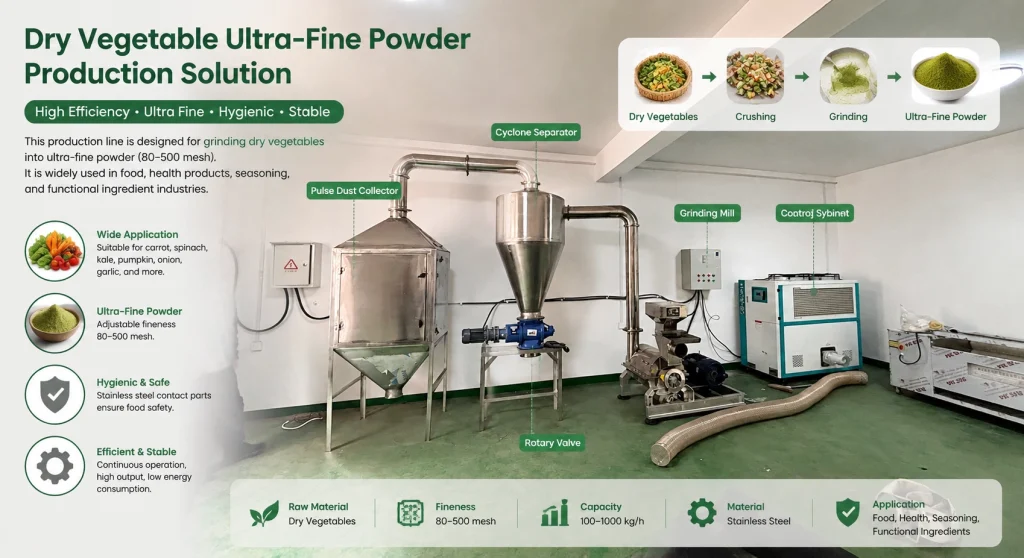
To resolve these systemic bottlenecks, engineering teams must implement specialized fluid dynamics. This deep technical white paper explains the particle physics behind advanced botanical milling and details how a modern screenless vegetable powder machine runs smoothly all day and night without unexpected production stops.
We collected and answered the most urgent technical questions from food engineers and factory managers across global manufacturing forums.
The Scientific Cause: When factories reduce dehydrated botanical materials to a premium 500-mesh vegetable powder, the aggregate surface area grows very large. This highly exposed surface acts like a powerful sponge for moisture. When the finished material touches even a small amount of damp air, the individual micro-particles stick together. These wet bonds quickly dry and turn into solid crystalline structures, which makes the loose product clump into a hard brick.
During laboratory tests, we monitored unstable powder samples inside a room with 45 percent humidity. The tiny particles formed hard clumps in exactly 180 seconds. This severe clumping completely ruined the smooth quality and flowability of the final product. To solve this critical problem for global shipping, factories must grind and transport the high-grade dry vegetable ultra-fine powder inside a sealed, airtight machine system that keeps out all humid air.
The Heat Problem: Dehydrated root vegetables, squashes, and onions contain high amounts of natural sugars and pectins. These natural sugars melt at very low temperatures, often between 15℃ and 40℃. Standard grinding mills use high-speed parts that create intense friction heat. This friction easily pushes temperatures inside the machine above 65℃.
As soon as the machine gets hotter than the melting point of the vegetable sugar, the brittle vegetable chips melt. They turn into a sticky, rubbery paste. This sweet paste glues itself to the spinning machine parts and overloads the motor. To stop this from happening, the grinding machine must use built-in cooling systems to keep temperatures low.
The Flow Problem: Automated capsule machines and industrial packaging lines require bulk material that flows smoothly like dry sand. Coarse powders flow easily because of gravitational forces. However, the particles in a fine 500-mesh vegetable powder are so light that gravity no longer helps them move down the chute. Instead, static electricity and surface forces cause the tiny particles to stick together. The material develops a steep angle of repose, clots inside the hopper throat, and causes uneven filling weights.
Our laboratory tests showed that altering the shape of the particles fixes this issue. When machines grind vegetables into smooth, round micro-spheres instead of sharp, jagged shards, the particles slide past each other easily. This step drastically improves powder flow and ensures steady packaging weights.
The Safety Answer: This is an essential question for international quality control teams. Grinding organic crops into a fine 500-mesh vegetable powder does not alter the total quantitative amount of heavy metals or pesticide residues already present in the crop. However, because the process completely breaks open the thick plant cell walls, it allows the human stomach to absorb everything inside much faster. This includes both healthy vitamins and potential contaminants.
For this reason, processing factories must use a two-step defense plan. First, they must buy crops only from clean, verified farms. Second, they must place powerful magnets inside the production lines to catch any tiny metal wear particles from the farm tools or primary crushers.
The Machine Failure: Vegetables contain tough, elastic fibers made of cellulose. When high-speed blenders hit these fibers, they do not shatter into clean powder. Instead, they shred into long, cotton-like threads. In a traditional mill with a wire screen, these flat threads lay across the screen holes and weave together into a thick mat.
This fibrous mat blocks all air from moving through the machine. Within minutes, internal air pressure builds up, the grinding chamber overheats, and workers must stop the whole factory line to clean the screen by hand. To avoid this waste of time, modern factories must switch to a screenless vegetable powder machine that separates particles using dynamic air currents instead of wire mesh.
To understand how a vegetable leaf or root changes at the micro-level, we must look at how tiny particles behave in moving air.
A single plant cell is usually 40 to 100 microns wide. Old hammer mills only crack large pieces along their natural weak spots. They leave the microscopic cell walls completely unbroken. To get the hidden vitamins out of these whole cells, factories must use chemical solvents or boil the plants in hot water.
When a factory implements an advanced screenless vegetable powder system, the machine uses ultra-fast air currents and intense shockwaves. This force breaks the vegetable down below 25 microns, which is smaller than the plant cell itself. This process breaks open every single cell wall, achieving a certified cellular wall disruption rate higher than 99 percent for delicate spore elements. The rigid outer shields shatter, which instantly unblocks the healthy vitamins inside. The final dry vegetable ultra-fine powder is ready for the human body to absorb immediately without any chemical treatment.
The speed at which a particle settles to the bottom of a liquid is described by Stokes’ Law. This law states that the settling speed depends directly on the square of the particle’s radius. The standard math formula is written as:
v = (2 * g * (Dp – Df) * r^2) / (9 * n)
In this formula:
When you shrink the average particle size from a standard 120-mesh profile down to a precise dry vegetable ultra-fine powder (25 microns), the settling speed drops by exactly 25 times. At this tiny size, the downward pull of gravity is too weak to overcome the natural movement of the liquid molecules. The finished material stays suspended and floating in the liquid for an extended time without settling into an uneven, gritty layer. This science lets food companies create clean-label, smooth healthy drinks without adding any chemical thickeners.
Choosing the right machine layout determines a factory’s long-term profits, energy bills, and product quality.
| Crucial Engineering Metric | Traditional Hammer / Pin Mill | Advanced Jet Milling Loops | Active Dynamic Air Classifier Mill |
| Achievable Fineness Threshold | Hard mechanical cut-off at 150 Mesh | 325 Mesh – 600 Mesh | Ultra-Wide Range: 10 Mesh to 5000 Mesh |
| Sieve/Screen Architecture | Physical Mesh Screen (Prone to Blinding) | Screen-less (High gas-cyclone cost) | Screen-less (Active Centrifugal Classifier) |
| Chamber Processing Climate | Rapid heat accumulation (65℃ – 95℃) | Cryogenic cooling gas required | Sustained Sub-Ambient (Self-Cooling + Water Jacket) |
| Raw Material Moisture Inputs | Highly restricted (Must be below 5% moisture) | Extreme restrictions (Bone-dry inputs) | High Moisture Tolerance Dry Grinding (Up to 12% H2O) |
| Mechanical Blade Tooling | Single-axis dull impact hammers | No blades (Relies entirely on gas-to-gas wear) | Advanced Twin-Blade Setup (T-Blades + Alloy Knives) |
| Systemic Production Continuity | Frequent stops for manual screen clearing | Intermittent batch limitations | Non-stop 24/7 Continuous Industrial Run |
| Phytochemical Color Retention | Poor; high thermal browning oxidation | Moderate to High | Excellent (Maintains authentic vivid hues) |
| Final Product Output Yield | Low (80% – 85% due to screen residue traps) | Moderate (90% – 94% due to cyclone loss) | Guaranteed 99% Yield with Zero Waste Left Behind |
Turning raw crops into high-purity dry vegetable ultra-fine powder opens up new, profitable product lines for multiple global industries.
(Technical Figure: Schematic Balance of Inward Aerodynamic Drag Force and Outward Centrifugal Inertia Within the Micronization Zone)
To achieve a true 500-mesh vegetable powder without physical screens, a processing line must control the balance between two opposing physical forces inside an active fluid airstream. These forces are centrifugal force and aerodynamic drag force.
Inside the classification zone of a screenless vegetable powder mill, a high-speed rotor spins the air into an intense vortex. When fractured vegetable particles enter this spinning chamber, the centrifugal force drives the heavy, oversized particles outward toward the grinding liner for further reduction. The centrifugal force formula is written as:
Fc = (4 / 3) * pi * r^3 * Dp * w^2 * R
In this formula:
Simipultaneously, the main system fan creates an inward drag force that pulls air toward the interior exit. This force obeys the principles of fluid drag resistance and uses the following formula:
Fd = 6 * pi * n * r * vr
In this formula:
Because the outward centrifugal force changes with the cube of the particle radius (r^3) while the inward aerodynamic drag changes linearly with the radius (r), the system establishes a precise cut-off point known as the d97 Particle Size Cut-off. Particles that have successfully reached a fine 25-micron profile are dominated by the inward drag force, allowing them to escape into the collection system as a premium dry vegetable ultra-fine powder.
Conversely, heavier, un-milled cell clusters are thrown outward by centrifugal inertia. They face another round of high-impact shattering by the internal twin-knife system. This continuous, real-time balancing act eliminates the need for wire screens, ensuring zero mesh blinding and zero production pauses when using a dynamic screenless vegetable powder system to process difficult botanical crops. By adjusting the fluid velocity, operators can easily change the parameters to maintain a perfectly uniform 500-mesh vegetable powder output.
To process tough crops at a small size without stopping, a factory needs a machine that overcomes the natural defenses of the plant. The advanced industrial milling design relies heavily on a high-efficiency screenless vegetable powder solution to solve these exact manufacturing bottlenecks.
Unlike rigid old crushers, the system can change its output size from 10 mesh coarse granulations all the way up to an extreme 5000 mesh sub-micron execution. Machine operators change the size instantly by touching a computer PLC screen. The machine adjusts the speed of its internal spinning wheel against the air currents to switch between different product sizes in seconds without changing any metal hardware, making it ideal for continuous 500-mesh vegetable powder processing.
Standard fine-milling machines require crops to be dried in expensive ovens until they hold less than 5% moisture. If the crops are damp, they turn into paste inside the machine. This advanced system completely removes this step. It easily processes fresh, damp, or oily crops because its unique air design separates water moisture instantly on the fly. This system reliably supports industrial processing to deliver nutrient-dense dry vegetable ultra-fine powder from dehydrated crops containing up to 12% residual water moisture. This allows factories to remove large drying ovens, which slashes factory energy bills.
To insulate highly thermo-sensitive carotenoids, chlorophylls, and active botanical enzymes from friction-generated degradation, the milling chamber is completely enclosed within a high-pressure active refrigeration jacket. This design ensures that the inside of the screenless vegetable powder machine stays strictly below ambient room temperature. The cooling loop continuously removes friction heat in real time, which stops the powder from turning brown and keeps the original fresh aroma intact.
The best feature of this machine is its screenless vegetable powder design. It replaces breakable wire screens with a spinning air-classification wheel. Computer sensors watch the grinding zone constantly. If the machine senses a clog forming from sticky sugars or tough fibers, it runs an Intelligent Real-Time Auto-Purge Sequence. The system changes internal air pressures to blast the clog away instantly without stopping the motor, keeping the production line running 24/7.
At a 25-micron size, vegetable particles build up intense static electricity from rubbing against steel walls. This static makes the screenless vegetable powder stick to the sides of bins and form an arch that blocks the exit door. The system line solves this by using a sealed air system that keeps out damp room air. At the same time, copper grounding wires pull static electricity away from the metal walls continuously to keep the powder flowing like water.
Furthermore, to fully eliminate post-milling thermal oxidation and nutrient decay caused by the expanded surface area, the system incorporates an optional Closed-Loop Nitrogen (N2) Gas Circuit. By displacing atmospheric oxygen within the entire pneumatic conveying and packaging loop, the system guarantees that the hyper-reactive, cell-wall-lysed nutrients remain perfectly stable and unoxidized until hermetic sealing is complete.
(Laboratory Standard Plot: Representative Single-Peak Particle Size Distribution Curve for Optimized 500-Mesh Botanical Fractions)
For global quality assurance directors managing international medical and food ingredient supply chains, claiming a powder is “500-mesh” requires rigorous laboratory proof. Traditional sieve analysis cannot verify particles at this sub-micron scale, making laser diffraction the globally accepted standard for particle size verification.
When verifying a high-grade dry vegetable ultra-fine powder, the sample is dispersed in a clean dry air stream and analyzed using laser diffraction technology. The machine measures the angle of scattered light as the particles pass through a laser beam, compiling a precise Particle Size Distribution (PSD) curve. An optimized milling cycle yields a narrow, single-peak distribution curve characterized by three critical quality benchmarks:
Achieving a tight span, calculated as (D90 – D10) / D50, below 1.5 proves that the internal fluid dynamics of the screenless vegetable powder system are operating with zero internal fluid turbulence, ensuring absolute batch consistency for automated downstream processing.
| Engineering Parameter / Machine Spec | Mid-Scale Industrial Execution | Heavy-Scale Industrial Execution | Maximum-Scale Industrial Execution |
| Output Fineness Selectivity | 60 – 5000 Mesh | 60 – 5000 Mesh | 60 – 5000 Mesh |
| Systemic Power Demands | 15 – 18.5 kW | 18.5 – 22 kW | 22 – 30 kW |
| Operational Rotor Speed | 3900 r/min | 3900 r/min | 3900 r/min |
| Total Structural Mass | 1000 kg | 1200 kg | 1500 kg |
| Physical Dimensions (L * W * H in meters) | 4.0 * 1.55 * 2.8 | 4.2 * 1.65 * 3.0 | 4.3 * 1.75 * 3.0 |
| Sieve Mesh Requirement | 100% Screenless | 100% Screenless | 100% Screenless |
| Moisture Input Capability | Up to 12% Moisture | Up to 12% Moisture | Up to 12% Moisture |
| Compliance & Validation | Full Installation Qualification (IQ), Operational Qualification (OQ), and Performance Qualification (PQ) standard layouts ready | Full Installation Qualification (IQ), Operational Qualification (OQ), and Performance Qualification (PQ) standard layouts ready | Full Installation Qualification (IQ), Operational Qualification (OQ), and Performance Qualification (PQ) standard layouts ready |
A: This failure is governed by the material’s Glass Transition Temperature (Tg). Dehydrated crops rich in sucrose or natural pectins possess an inherently low Tg. During high-velocity impacts, nearly 95% of kinetic energy is converted into friction heat, easily pushing chamber temperatures above 65℃. If this thermal accumulation exceeds the Tg threshold, the material transitions from a brittle solid into a rubbery, cohesive paste, blinding the machine parts. Successfully producing a vibrant dry vegetable ultra-fine powder requires continuous sub-ambient cooling via active refrigeration jackets to keep the processing climate safely below the specific glass transition point.
A: At a strict 500-mesh reduction, the cumulative surface-area-to-volume ratio expands exponentially, leaving highly reactive, polar hydroxyl groups (-OH) completely exposed. These open zones act as powerful chemical sponges for ambient moisture. Upon absorbing micro-layers of water vapor, surface sugars dissolve to create localized liquid bridges between independent particles. Under compaction pressure, these liquid junctions recrystallize into solid chemical bonds—a phenomenon known as moisture bridging. This forces free-flowing 500-mesh vegetable powder to clump into a solid brick, requiring a sealed, negative-pressure pneumatic loop to isolate the material from atmospheric humidity.
A: When particles drop below 30 microns, gravitational forces are completely overwhelmed by surface static charges. These charges are generated through intensive particle-to-wall friction, a process known as triboelectric charging. These un-grounded charges cause micro-particles to violently adhere to vertical stainless-steel walls, forming a structural arch over the discharge throat—a phenomenon called hopper bridging—which halts gravity feeding on automated packaging lines. Resolving this bottleneck requires an advanced screenless vegetable powder system equipped with an integrated copper grounding network to continuously drain static charges to the earth, paired with a narrow Particle Size Distribution (PSD) span to optimize bulk powder rheology.

व्हाट्सएप

वीचैट
व्हाट्सएप्प:+8615736768129
ईमेल:inquiry@panchimachinery.com
पता: झेंग्झौ, हेनान प्रांत, चीन
स्वचालित वैक्यूम शहद प्रसंस्करण और छानने की मशीन
वैक्यूम निम्न-तापमान द्रव्य निष्कर्षण और सांद्रण इकाई
कस्टम स्टीम डिस्टिलेशन और हीट रिफ्लक्स आवश्यक तेल उपकरण
एसएस 304/316एल कम तापमान वेल्वुम स्क्रैपर कंसन्ट्रेटर
QN वृत्तीय निर्वात संग्राहक एवं शराब पुनःप्राप्ति इकाई
मल्टी-फंक्शन स्टेनलेस स्टील वैक्यूम डिस्टिलेशन एवं एक्सट्रैक्शन यूनिट
गर्म रिफ्लक्स वाक्यूम लिक्विड एक्सट्रैक्शन और कंसंट्रेशन यूनिट
हम आपसे एक कार्यदिवस के भीतर संपर्क करेंगे। कृपया अपने ईमेल पर ध्यान दें।
स्वचालित वैक्यूम शहद प्रसंस्करण और छानने की मशीन
WhatsApp: +8615736768129
ईमेल: inquiry@panchimachinery.com
पता:झेंग्झौ, हुनान प्रांत, चीन


कॉपीराइट© 2026झेंगझोउ पंची मशीनरी उपकरण有限公司|गोपनीयता नीति