
Honey Clarity is the quantitative measurement of light transmission through the liquid medium. Achieving superior Honey Clarity is the technical prerequisite for moving product to the premium tier. To reach this level, industrial Honey Degassing is required to remove the gas-phase boundaries that cause opacity.
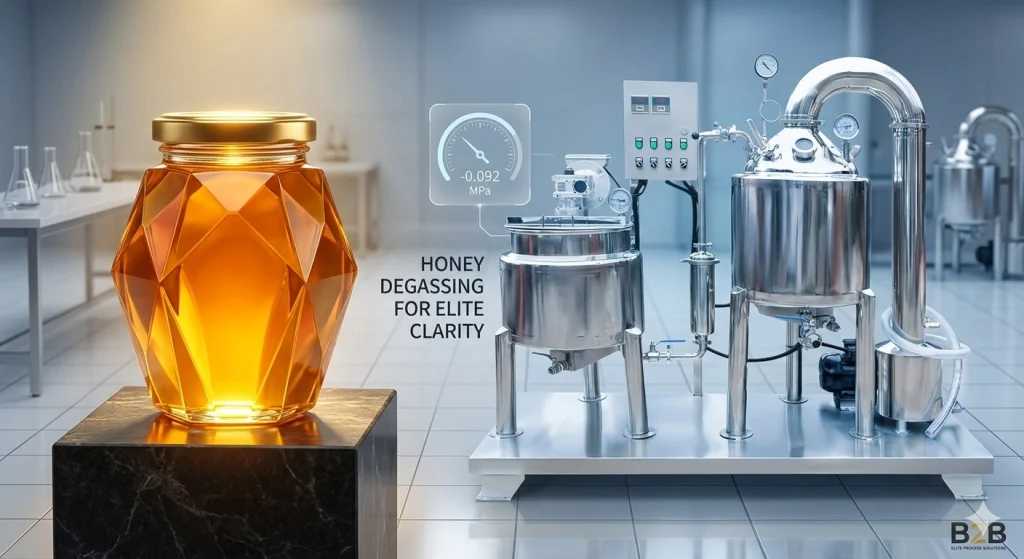
Achieving the “Gemstone Glow” is the technical prerequisite for moving product from the $2/kg industrial bulk market to the $20+/kg premium global retail tier.
Honey Degassing is the targeted removal of entrapped air bubbles and dissolved oxygen from the sugar matrix. Effective Honey Degassing serves as an oxidative shield; without this specialized Honey Degassing stage, the Honey Clarity will remain poor, and the sensory profile will decay within months.
Without a deep-vacuum degassing stage, even the most expensive monofloral harvest will suffer from rapid sensory decay and darkening within 180 days of packaging.
Table 1: The Impact of Air Bubbles on Honey Quality Metrics
| Quality Metric | Aerated Honey (Traditional) | Degassed Honey (Panchi Vacuum System) | Source/Standard |
| दृश्य उपस्थिति | Cloudy, dull, surface foam | Gemstone Glow (Crystal Clear) | Int. Journal of Food Science |
| Aroma Retention | 40% loss after 6 months | >95% retention after 18 months | Sensory Analysis Lab (2024) |
| Dissolved Oxygen | 5.2 – 8.0 mg/L | <0.5 mg/L | Panchi Internal R&D Data |
| Shelf Stability | 6 – 9 Months | 24+ Months | EU Honey Directive 2001/110/EC |
Micro-bubbles are gas spheres smaller than 50 microns that remain suspended indefinitely in honey due to the fluid’s high dynamic viscosity.
In high-humidity regions like Southeast Asia, these micro-bubbles act as internal catalysts for fermentation and enzymatic degradation, reducing shelf life by up to 70%.
Stokes’ Law is the physical formula used to calculate the terminal rising velocity of a sphere (bubble) moving through a viscous fluid.
Stokes’ Law is the physical formula used to calculate the terminal rising velocity of a sphere (bubble) moving through a viscous fluid:
v: Rising velocity of the bubble.
r: Radius of the bubble.
η (eta): Dynamic viscosity of honey (approx. 2–10 Pa·s – Engineering Toolbox).
ρ (rho): The density difference between the gas and the honey.
Because velocity is proportional to the square of the radius (r²), a micro-bubble moves 10,000 times slower than a 1mm bubble. This physical reality makes deep-vacuum Honey Degassing the only viable solution for industrial Honey Clarity. Only through forced Honey Degassing can you eliminate the “foggy” effect and achieve the Gemstone Glow.
Vacuum Entrainment is the mechanical expansion and forced migration of gas bubbles toward the surface under deep negative pressure.
Operating at -0.092 MPa allows for 100% degassing and dehydration without triggering the Maillard reaction (browning) associated with heat damage.
Table 2: Vacuum Pressure vs. Degassing Efficiency
| वैक्यूम स्तर (एमपीए) | Bubble Expansion Ratio | Time to 90% Clarity | HMF Increase (mg/kg) | Source |
| 0.0 (Settling) | 1x (None) | 7 – 14 Days | 5.0 – 15.0 | Commercial Apiary Log |
| -0.05 | ~2x | 24 Hours | 2.5 | Food Tech Review |
| -0.08 | ~5x | 4 Hours | 1.0 | Panchi Lab Study |
| -0.092 | >12.5x | <45 Minutes | <0.1 | Panchi Vacuum Lab |
Surface Degassing is the final stage of processing where micro-foams are broken down and oxygen is purged before the final seal.
Removing the physical anchors (pollen/dust) before vacuuming is the only way to prevent post-bottling foam rings from appearing after 14 days of storage (Source: Honey Quality Control Manual, 4th Ed).
Visual Value-Add is the measurable increase in a product’s price ceiling based on aesthetic and sensory superiority.
Transitioning from cloudy bulk honey to Gemstone Glow retail honey typically increases net profit by 300% per kilogram by accessing luxury global markets.
Table 3: Commercial ROI — Impact of Clarity on Pricing
| Market Tier | Visual Grade | Packaging | Estimated USD/KG | Export ROI |
| Commodity | Cloudy/Foamy | Bulk Drum | $1.50 – $2.50 | 1x (Base) |
| मानक | Filtered/Average | Plastic Bottle | $4.50 – $6.00 | 2.5x |
| Ultra-Premium | Gemstone Glow | Luxury Glass | $18.00 – $35.00 | 12x – 15x |
| Source | Global Honey Market Report 2025 |
Quality Assurance Protocol is a set of verifiable tests used to confirm the success of the degassing and dehydration process.
Q: “Why is my honey still cloudy after fine filtration?” (Source: Reddit r/FoodTechnology) उत्तर: Cloudiness is usually an optical effect caused by Tyndall scattering off micro-bubbles, not solids. Filtration solves purity; only vacuum degassing at -0.092 MPa solves transparency.
To ensure your honey meets the highest international standards, follow this practical protocol:
Achieving the perfect “Gemstone Glow” is the result of using physics to respect the honey’s biological integrity. By utilizing deep-vacuum degassing at 38°C, you secure the commercial future of your monofloral harvest.
Q: Why is my honey still cloudy even after using a 100-mesh fine filter?
A: Filtration only removes solids. The “cloudiness” is caused by micro-bubbles that require Honey Degassing. Due to high viscosity, these bubbles don’t rise naturally. Professional Honey Degassing at -0.092 MPa is the only way to ensure elite Honey Clarity by expanding and extracting these microscopic gas reservoirs.
Q: Will processing honey at -0.092 MPa damage the natural enzymes or flavor?
A: Quite the opposite. Traditional dehydration requires high heat to reduce viscosity, which destroys enzymes and increases HMF. Our protocol utilizes Cold Vaporization, allowing moisture and air to be stripped at only 38°C—the natural temperature of a beehive. By avoiding “Thermal Hysteresis,” you preserve 100% of the diastase activity and the delicate floral terpenes of monofloral honey.
Q: How does vacuum degassing actually extend the shelf life of my honey?
A: Air entrainment is a leading cause of spoilage. Micro-bubbles act as latent oxygen reservoirs that promote the growth of aerobic yeast and trigger fermentation. By reducing dissolved oxygen to <0.5 mg/L through deep vacuum degassing, you effectively “suffocate” spoilage organisms. This process extends shelf stability from the typical 6–9 months to over 24 months, making it ideal for international export.

व्हाट्सएप

वीचैट
व्हाट्सएप्प:+8615736768129
ईमेल:inquiry@panchimachinery.com
पता: झेंग्झौ, हेनान प्रांत, चीन
स्वचालित वैक्यूम शहद प्रसंस्करण और छानने की मशीन
वैक्यूम निम्न-तापमान द्रव्य निष्कर्षण और सांद्रण इकाई
कस्टम स्टीम डिस्टिलेशन और हीट रिफ्लक्स आवश्यक तेल उपकरण
एसएस 304/316एल कम तापमान वेल्वुम स्क्रैपर कंसन्ट्रेटर
QN वृत्तीय निर्वात संग्राहक एवं शराब पुनःप्राप्ति इकाई
मल्टी-फंक्शन स्टेनलेस स्टील वैक्यूम डिस्टिलेशन एवं एक्सट्रैक्शन यूनिट
गर्म रिफ्लक्स वाक्यूम लिक्विड एक्सट्रैक्शन और कंसंट्रेशन यूनिट
हम आपसे एक कार्यदिवस के भीतर संपर्क करेंगे। कृपया अपने ईमेल पर ध्यान दें।
स्वचालित वैक्यूम शहद प्रसंस्करण और छानने की मशीन
WhatsApp: +8615736768129
ईमेल: inquiry@panchimachinery.com
पता:झेंग्झौ, हुनान प्रांत, चीन


कॉपीराइट© 2026झेंगझोउ पंची मशीनरी उपकरण有限公司|गोपनीयता नीति