
In global botanical processing, standard micronization no longer satisfies the rigorous dissolution, bioavailability, and mechanical parameters of modern pharmaceutical, medical, and high-end nutraceutical formulations. As global regulatory bodies tighten constraints on chemical residue limits, manufacturers are transitioning from chemical solvent extractions to clean-label, mechanical, whole-leaf reduction.
Achieving this threshold turns Camellia sinensis from a raw agricultural material into an active, suspension-stable biomaterial. However, reducing a resilient, fibrous, and thermo-sensitive plant leaf to 13 microns introduces severe mechanical risks—including thermal degradation of polyphenols, leaf fiber matting, static agglomeration, material bridging, and sieve blinding.
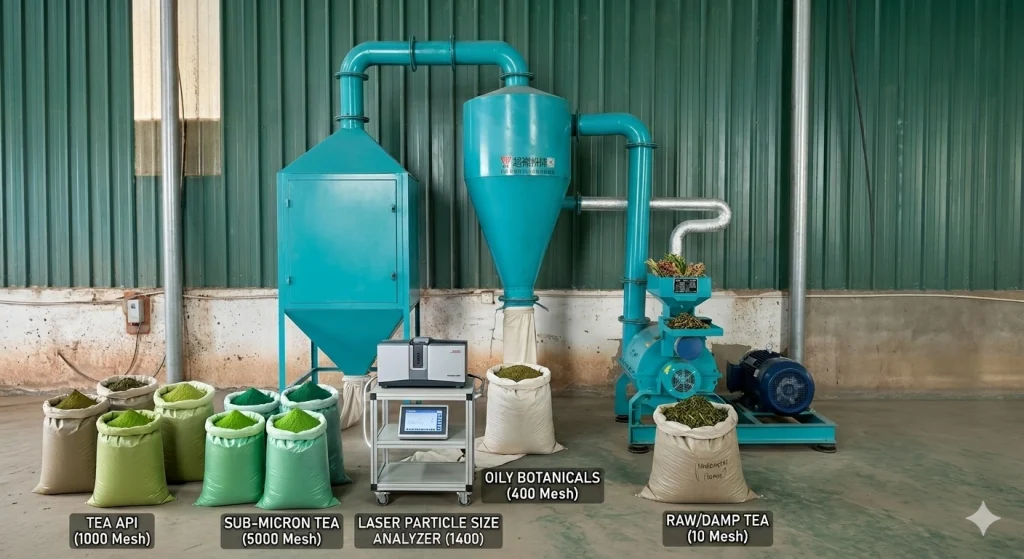
This technical blueprint dissects the physics of ultra-fine botanical processing, maps out the applications across specialized global industries, and establishes the operational parameters required to achieve absolute cell-wall disruption. We explore how an advanced 1000-mesh tea grinding mill introduces a revolutionary milling matrix that completely eliminates moisture limitations, pre-drying infrastructure, and operational downtime to consistently produce high-purity tea ultra-fine powder.
To establish a baseline for this engineering analysis, we synthesized the most urgent processing questions raised by chemical engineers, plant managers, and R&D formulation scientists across manufacturing platforms.
The Root Cause: Traditional mechanical mills generate intense kinetic friction. The internal processing temperature frequently spikes above 65°C to 80°C. This triggers rapid thermal oxidation of chlorophyll, turning a bright green product into an unappealing, brownish-yellow matrix. More critically, high heat breaks down volatile aromatic oils and degrades delicate amino acids like L-theanine and vital anti-oxidative catechins required to make high-quality tea ultra-fine powder.
The Root Cause: Tea leaves contain high-tenacity lignified cellulose and structural matrix fibers. Traditional mills rely on physical mesh sieves to control output particle size. Under high velocity, these elastic leaf fibers do not shatter; instead, they shred into a cotton-like mass. This cottonization creates a tight mat across the screen apertures. The resulting sieve blinding stops airflow, causes rapid heat spikes, and leads to mechanical strain or complete motor failure, halting the generation of premium botanical fractions.
The Engineering Reality: Yes, but only when the average particle size drops below the 13-micron threshold. At this particle diameter, the settling velocity dictated by gravity is countered by ambient fluid thermal energy, triggering near-Brownian motion. Traditional 120–200 mesh powders drop out of solution within seconds, forming an unpleasant grit. In contrast, 1000-mesh tea powder achieves a stable, homogeneous, colloidal-like suspension that remains perfectly distributed over extended shelf lives without settling.
When configuring a high-efficiency 1000-mesh tea grinding mill, engineers must design for the drastic physical and behavioral changes that occur when botanical structures drop below 20 microns.
The average cell diameter of a Camellia sinensis leaf ranges from 20 to 50 microns. Coarse milling merely chops the leaves into fragments, leaving the rigid, cellulose cell walls intact. To extract the active pharmaceutical ingredients inside, manufacturers must use chemical solvents or long thermal extraction cycles.
At 1000-mesh, the maximum particle diameter is roughly 13 microns. Because the particle size is smaller than the cell itself, the mechanical forces achieve mechanical lysis. The rigid cell walls are shattered, instantly exposing 100% of the intracellular matrix—including catechins, polyphenols, L-theanine, and trace minerals—without requiring chemical intervention or thermal degradation. This makes the resulting 1000-mesh tea powder instantly bioavailable and highly potent. While our processing platform possesses an ultra-wide engineering capacity spanning from 10 mesh up to an extreme 5000 mesh, the 1000-mesh specification represents the scientifically optimized sweet spot for botanical cell-wall extraction.
The behavior of micronized materials in liquids is governed by Stokes’ Law. The settling velocity of a spherical particle embedded within a fluid matrix decreases exponentially as the radius shrinks.
Because the velocity is directly tied to the square of the particle radius, dropping the particle diameter from 75 microns to 13 microns decreases the settling velocity by a factor of over 130 times. The gravitational pull becomes negligible compared to the liquid’s surface tension and molecular kinetic currents, preventing sedimentation and producing a perfectly smooth mouthfeel for tea ultra-fine powder applications. At this sub-micron interface, our pneumatic engineering explicitly limits particle agglomeration and shortens the angle of repose. By producing a highly uniform particle matrix with a narrow span width, we overcome the downstream bridging obstacles common to pharmaceutical hoppers while delivering an emulsifier-free 1000-mesh tea powder matrix.
To optimize procurement decisions, factory owners must evaluate how different milling mechanisms interact with the unique physical and botanical properties of raw tea leaves.
| Operational Metric | Britador de Martelo Tradicional | Jet Milling Systems | ZY-C Dynamic Air Classifier Mill |
| Achievable Fineness Range | Hard cut-off at 200 Mesh | 400 – 800 Mesh | Ultra-Wide 10 Mesh to 5000 Mesh |
| Sieve/Screen Mechanism | Physical Mesh Screen | Screen-less (Gas-cyclone) | Screen-less (Centrifugal Classifier) |
| Core Processing Temp | High Temp (60°C-90°C) | Cryogenic gas required | Sub-Ambient Temp (Below room temp) |
| Moisture Input Limits | High restrictions | Extreme restrictions | Unlimited Range (Wet/Damp/Oily) |
| Leaf Fiber Grinding Capacity | Fails; creates cotton matting | Moderate; high gas cost | Excellent; high-velocity shear |
| Production Continuity | Frequent stops for manual clearing | Intermittent batch limits | Non-stop 24/7 Continuous Run |
| Color Preservation | Poor (High oxidation) | Moderate to High | Excellent (Maintains emerald hue) |
| Yield/PSD Span | 85% – Wide particle curve | 95% – Moderate span | 99.9% – Ultra-narrow curve |
A primary advantage of utilizing an advanced 1000-mesh tea grinding mill is the breadth of high-margin industrial markets it unlocks for botanical processing factories worldwide.
To process botanical leaves efficiently, a machine must directly counteract the material’s innate physical defenses. The ZY-C Series Industrial Grinding Mill uses a targeted mechanical-pneumatic approach.
Unlike single-tier devices, this system covers an unprecedented output spectrum ranging from 10 mesh coarse cutting up to 5000 mesh sub-micron execution. Plant operators can instantly recalibrate the active classification profile via the computerized PLC interface without changing mechanical hardware.
Conventional mills require pre-drying to below 5% moisture. This specialized 1000-mesh tea grinding mill completely removes this limitation, processing fresh or semi-fermented leaves regardless of their wet, damp, or oily states. This eliminates auxiliary drying systems, cutting CapEx and removing substantial energy costs.
Powered by an advanced active refrigerant jacket, the internal grinding mechanism operates strictly below ambient temperature (sub-room temperature). This cold-milling process prevents the browning reaction entirely and safeguards volatile aromatic fractions.
Traditional systems suffer from frequent line stoppages. The ZY-C system features a completely screen-less architecture combined with an integrated Active Real-Time Auto-Purge Mechanism. If any rheological resistance occurs, the machine clears blockages on the fly without stopping the motor, enabling true, non-stop 24/7 continuous industrial production.
At 13 microns, particles are highly susceptible to static accumulation. The ZY-C system uses a hermetic, negative-pressure pneumatic transport loop combined with built-in copper-bridge grounding filaments to drain static electricity dynamically, keeping the output free-flowing.
To satisfy pharmaceutical standards, all contact zones are constructed from mirror-polished SUS316L stainless steel (Ra ≤ 0.4μm). The milling chamber utilizes a quick-clamp, bolt-less design that can be fully opened in under three minutes for complete sterilization.
| Parâmetro Técnico | ZY-C System Operational Specification |
| Mechanical Output Fineness | Adjustable from 10 Mesh to 5000 Mesh |
| Raw Material Input Moisture | Unlimited Range (Accepts raw, damp, wet, or oily) |
| Auxiliary Drying Requirement | None (Zero CapEx for pre-drying systems) |
| Processing Temperature | Sustained strictly below ambient temperature |
| Production Continuity | Unrestricted (Engineered for non-stop 24/7) |
| Blockage Clearing | Intelligent Real-Time Auto-Purge (Zero-downtime) |
| Yield/Recovery Rate | Greater than or equal to 99.9% |
A: The adjustment relies on balancing competing vector forces within an active centrifugal classification matrix. To achieve ultra-fine cuts up to 5000 mesh, the PLC frequency inverter increases the wheel velocity to heighten the outward centrifugal force field. Conversely, lowering the tip speed allows larger, coarser fractions (down to 10 mesh) to bypass the barrier.
A: In a standard mill, high impact forces cause interstitial liquid phase transformation, resulting in structural pasting. Our system addresses this by incorporating high-velocity negative-pressure displacement. The expanding air stream drops internal vapor pressures, forcing moisture separation on the fly and rendering pre-drying obsolete.
A: As particle size scales down, the surface-area-to-volume ratio expands exponentially, causing electrostatic charges to dwarf the effects of gravity. The ZY-C architecture stops this by running a fully grounded pneumatic loop. Grounding filaments channel static out dynamically, maintaining a free-flowing discharge output.
A: Conventional water jackets rely on static conduction, which cannot keep pace with friction-generated thermal energy. To sustain continuous sub-ambient processing, our mill couples a pressurized refrigerant jacket with high-volume chilled air intake, balancing internal energy metrics in real time.
A: When inline PLC sensors detect a drop in negative pressure, the system activates an Intelligent Auto-Purge Sequence. This creates a brief localized high-pressure pulse that disintegrates blockages instantly without requiring mechanical disassembly or stopping continuous operations.
Transitioning to premium botanical formulations requires replacing outdated screen-based mills with screen-less, active dynamic air classification technology capable of operating across a vast 10 to 5000 mesh range.
Do not leave your manufacturing precision or machine investments to chance.
Contact our B2B Application Engineering Division today to evaluate our advanced 1000-mesh tea grinding mill for your production facility. We guarantee that our system will deliver the finest quality your customers demand.


Whatsapp:+8615736768129
Email:inquiry@panchimachinery.com
Endereço: Zhengzhou, Província de Henan, China
Máquina Automática de Processamento e Filtragem de Mel por Vácuo
Unidade de Extração e Concentração de Líquidos de Baixa Temperatura por Vácuo
Equipamento de Destilação a Vapor Personalizado com Refluxo de Calor para Óleos Essenciais
Concentrador a Espanha de vácuo de baixa temperatura SS304/316L
Concentrador de Vácuo Esférico QN e Unidade de Recuperação de Álcool
Unidade de Destilação a Vácuo e Extração de Aço Inoxidável de Multifunções
Unidade de Extração Líquida por Refluxo a Vácuo, Aquecimento e Concentração
Concentrador de Vácuo de Circulação Externa de Efeito Único
Evaporador de Câmara Tripla de Duplo Efeito com Circulação Externa Série SJN
Reator Químico de Aço Inoxidável a Vácuo de Alta Temperatura
Tanque de Precipitação de Álcool a Vácuo 304SS
Panela de Cozimento com Aquecimento a Vapor de Dupla Camada 304SS
Panela de cozimento com aquecimento elétrico e jaqueta
Caldeira de Cozimento com Casco para Aquecimento por Gás de Alta Eficiência
Entraremos em contato com você dentro de um dia útil. Por favor, fique atento ao seu e-mail.
Máquina Automática de Processamento e Filtragem de Mel por Vácuo
Unidade de Extração e Concentração de Líquidos de Baixa Temperatura por Vácuo
Equipamento de Destilação a Vapor Personalizado com Refluxo de Calor para Óleos Essenciais
WhatsApp: +8615736768129
Email: inquiry@panchimachinery.com
Endereço:Zhengzhou, Província de Henan, China


DIREITOS AUTORAIS© 2026Zhengzhou Panchi Machinery Equipment Co., Ltd.|Política de Privacidade