
No mundo do processamento botânico e da fabricação farmacêutica, a terminologia usada para descrever a finura pode muitas vezes ser confusa. Os profissionais frequentemente perguntam: “Malha vs. Micron: Como realmente é uma malha de 1000-mesh?Compreender essa distinção não é meramente uma questão de semântica; é a chave para desbloquear a máxima biodisponibilidade nas ervas medicinais. Quando um pó atinge o limite de 1000 mesh, ele passa de uma substância granular para um estado “semelhante à fumaça”, onde as partículas são tão finas que podem penetrar nas barreiras celulares com facilidade.
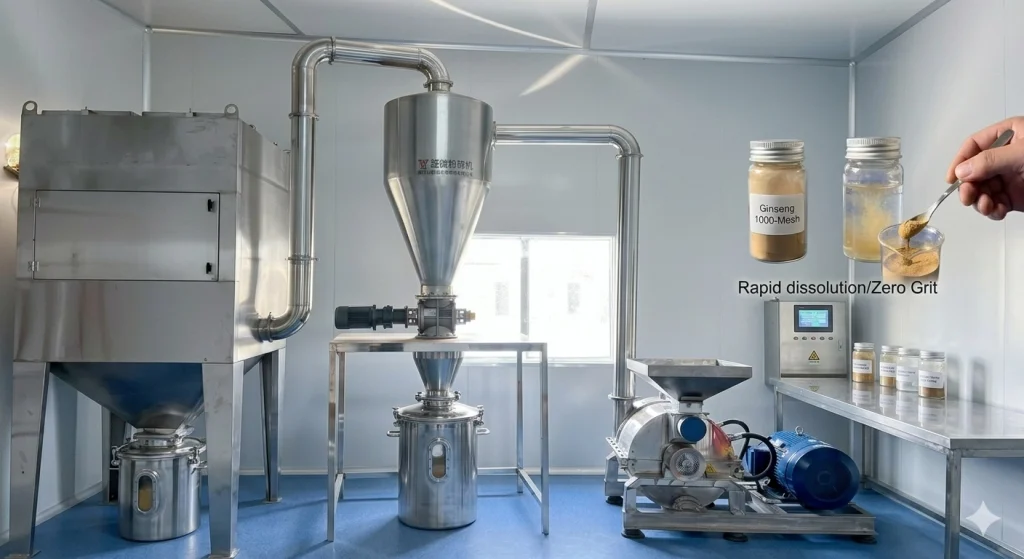
Debates em plataformas comor/MedicinaHerbal do RedditeCiência dos Materiais do Quoraas seções frequentemente destacam a dificuldade de alcançar uma micronização consistente. Moedores tradicionais frequentemente falham porque dependem de telas físicas que entopem ou quebram. Para realmente entenderMalha vs. Micron: Como realmente é uma malha de 1000-mesh?, devemos analisar a física da classificação do fluxo de ar utilizada naPanchiMoinho de Pó Ultra-Fino para Ervas Medicinais, que atinge essas especificações extremas sem as limitações das telas de malha tradicionais.
Para visualizar essas medidas, ajuda compará-las a objetos familiares. O termo "Mesh" refere-se ao número de aberturas por polegada linear em uma tela, enquanto "Micron" (micrômetro) é uma unidade absoluta de comprimento igual a um milionésimo de metro.
À medida que o número de malha aumenta, o tamanho das partículas (micra) diminui.
Se você segurasse um pó de malha 1000, perceberia várias propriedades físicas únicas:
A principal razão para buscar uma meta de malha 1000 é aTaxa de ruptura da parede celular de 99%Em plantas como Panax Notoginseng ou esporos de Cogumelo Reishi, os princípios ativos (APIs) estão presos atrás de paredes resistentes de celulose ou quitina.
A moagem padrão apenas quebra o material vegetal em pedaços menores de "gaiolas". No entanto, aMoinho Ultra-Fino Panchiutiliza um princípio de pulverização de lâmina dupla sem tela para estilhaçar essas caixas microscópicas. Alcançar uma finura de malha 1000 significa que a área de superfície é aumentada por milhares de vezes, levando a:
Absorção Superior:Os nutrientes são liberados imediatamente ao serem ingeridos, bypassando a necessidade de uma digestão mecânica extensa. O mel mantém sua cor translúcida original e compostos voláteis florais que de outra forma escapariam para a atmosfera.
Dissolução Rápida:O pó dissolve ou suspende instantaneamente em líquidos.
Ao visar a marca de 1000 malhas, geralmente surgem dois obstáculos principais: calor e entupimento.
| Desafio | Impacto na Qualidade | Solução Panchi |
| Degradação térmica | Queimaduras por fricção em alta velocidade vaporizam óleos voláteis e mudam de cor. | Arrefecimento por Ar IntegradoAr condicionado por ar forçado e jaquetas d'água opcionais mantêm a usina resfriada. |
| Entupimento da Rede | Ervas oleosas ou açucaradas (como o Olíbano) entopem a tela. | Design sem tela:Utiliza a classificação de fluxo de ar interno para separar partículas por peso, não por tamanho. |
Ao eliminar a tela física, aFábrica Panchipode produzir de forma confiável pó de malha 1000 (e até 5000) sem o tempo de inatividade associado à limpeza ou substituição de telas quebradas.
CompreensãoMalha vs. Micron: Como realmente é uma malha de 1000-mesh?é o primeiro passo para aprimorar seus padrões de produção. No cenário competitivo de 2026 de nutracêuticos e medicina veterinária “Verde”, a capacidade de fornecer um pó “quebrado na parede” é um grande diferencial de mercado.
Ao utilizar oPanchi Moedor de Ervas Medicinais Ultra-FinoVocê não está apenas tornando o pó menor; você está tornando-o mais eficaz. Seja preparando pós orais clínicos ou cosméticos botânicos de alta qualidade, dominar o limite de malha de 1000 garante que cada miligrama de sua matéria-prima entregue seu potencial terapêutico completo.
P: É malha 1000 muito fina para todas as ervas?
Resposta:Necessariamente, mas é mais benéfico para materiais com paredes celulares resistentes ou aqueles destinados à permeabilidade rápida da pele em cosméticos. Para misturas simples de chá, uma malha mais grossa de 60-100 geralmente é suficiente.
Pergunta: Como você mede a malha 1000 se não houver uma tela?
Resposta:A medição é feita por meio de analisadores de difração a laser para tamanho de partículas. O controlador de classificação interno do moinho é ajustado para alterar a velocidade do fluxo de ar, o que determina exatamente quais pesos de partículas são permitidos a sair da câmara.
P: A moagem ultrafina causa mais poeira na fábrica?
Resposta:O sistema Panchi é uma unidade totalmente isolada, de pressão negativa. Isso significa que a “fumaça” de malha 1000 é capturada diretamente em um coletor de pó de jato pulsante, garantindo um ambiente de trabalho livre de poeira e em conformidade com as Boas Práticas de Fabricação (BPF).


Whatsapp:+8615736768129
Email:inquiry@panchimachinery.com
Endereço: Zhengzhou, Província de Henan, China
Máquina Automática de Processamento e Filtragem de Mel por Vácuo
Unidade de Extração e Concentração de Líquidos de Baixa Temperatura por Vácuo
Equipamento de Destilação a Vapor Personalizado com Refluxo de Calor para Óleos Essenciais
Concentrador a Espanha de vácuo de baixa temperatura SS304/316L
Concentrador de Vácuo Esférico QN e Unidade de Recuperação de Álcool
Unidade de Destilação a Vácuo e Extração de Aço Inoxidável de Multifunções
Unidade de Extração Líquida por Refluxo a Vácuo, Aquecimento e Concentração
Concentrador de Vácuo de Circulação Externa de Efeito Único
Evaporador de Câmara Tripla de Duplo Efeito com Circulação Externa Série SJN
Reator Químico de Aço Inoxidável a Vácuo de Alta Temperatura
Tanque de Precipitação de Álcool a Vácuo 304SS
Panela de Cozimento com Aquecimento a Vapor de Dupla Camada 304SS
Panela de cozimento com aquecimento elétrico e jaqueta
Caldeira de Cozimento com Casco para Aquecimento por Gás de Alta Eficiência
Entraremos em contato com você dentro de um dia útil. Por favor, fique atento ao seu e-mail.
Máquina Automática de Processamento e Filtragem de Mel por Vácuo
Unidade de Extração e Concentração de Líquidos de Baixa Temperatura por Vácuo
Equipamento de Destilação a Vapor Personalizado com Refluxo de Calor para Óleos Essenciais
WhatsApp: +8615736768129
Email: inquiry@panchimachinery.com
Endereço:Zhengzhou, Província de Henan, China


DIREITOS AUTORAIS© 2026Zhengzhou Panchi Machinery Equipment Co., Ltd.|Política de Privacidade