
In the international botanical extract and essential oil trade, procurement standards enforced by multinational cosmetic giants, premium aromatherapy brands, and pharmaceutical enterprises are tighter than ever. Buyers no longer evaluate batch quality solely via gas chromatography-mass spectrometry (GC-MS) purity percentages; they now heavily scrutinize long-term shelf stability (no precipitation or cloudiness)औरregulatory compliance (zero phototoxic compounds). For any commercial processing plant, mastering a high-tier Citrus Peels essential oil Purification workflow is the ultimate prerequisite for securing high-value global contracts.
However, when processing high-volume citrus crops—such as Sweet Orange Peel (Citrus sinensis), Lemon Peel (Citrus limon), Bergamot (Citrus bergamia), and Grapefruit Peel—the target volatile aromatic molecules (predominantly Limonene) are tightly bound within the micro-vessels of the outer flavedo alongside massive volumes of dense plant pectins, heavy macromolecular botanical waxes, and highly phototoxic furanocoumarins.
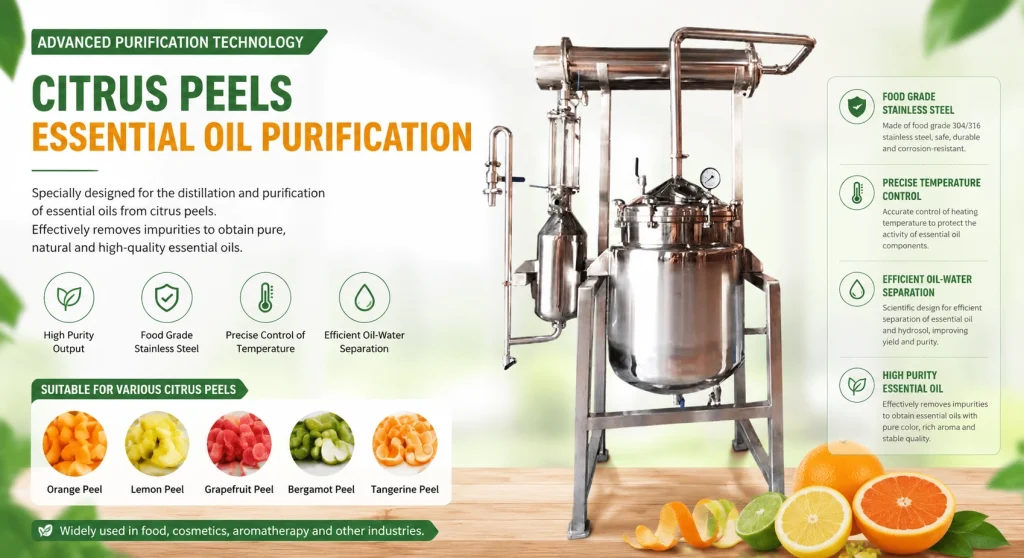
Standard cold-pressing yields a crude oil that suffers from dark discoloration, extreme oxidation risks, and room-temperature turbidity. Meanwhile, traditional 100°C atmospheric distillation causes severe thermal degradation of the fragile limonene. To permanently break this industrial bottleneck, processing facilities must implement a specialized Vacuum Citrus Peel essential oil Distillation System. Only by utilizing this multi-dimensional engineering upgrade can a factory consistently manufacture high-premium, export-ready oils through flawless Furanocoumarin-Free Citrus oil Purification.
How can processing plants transition from these volatile raw materials to highly stabilized, market-ready products without losing delicate aromatic profiles? Industry experience reveals that deploying an advanced आवश्यक तेल शोधन मशीन enables five key mechanical and thermodynamic interventions that reshape the extraction landscape by converting multi-functional reflux parameters into tangible cost savings and purity safeguards.
On chemical engineering subreddits (r/chemicalengineering) and industrial processing forums on Quora, distillery managers frequently ask a common troubleshooting question: “Why does my citrus peel oil turn dark and develop a plastic, scorched back-note after a few months of storage?” This defect represents a classic process failure resulting from unrefined Citrus Peels essential oil Purification.
Limonene, which accounts for over 90% of most citrus oils, is a highly heat-sensitive monoterpene hydrocarbon. Prolonged exposure to standard atmospheric steam distillation at 100°C triggers rapid thermal rearrangement and oxidation, replacing the crisp, vibrant fresh-fruit top note with a flat, chemical, or “cooked” aroma that causes automatic batch rejection during international quality audits.
Furthermore, as these light fractions vaporize, their kinetic upward force physically entrains heavy plant lipids and sticky pectins into the vapor stream. To sever this contamination chain, modern processing plants must swap basic boilers for a multi-stage fractional Vacuum Citrus Peel essential oil Distillation System, shifting the vapor-liquid equilibrium to achieve reliable Furanocoumarin-Free Citrus oil Purification without compromising the oil’s fragile molecular spectrum.
While understanding this scientific conflict explains why traditional distillation fails, managing it effectively requires a precise recalibration of internal system physics through reduced operating pressures.
Manipulating system pressure remains the only physical method to lower operating temperatures and protect heat-sensitive compounds. According to Vapor-Liquid Equilibrium (VLE) principles, deepening the vacuum inside a sealed environment systematically lowers the boiling point of the processing solvent, a mechanism fully supported by our industrial extraction parameters.
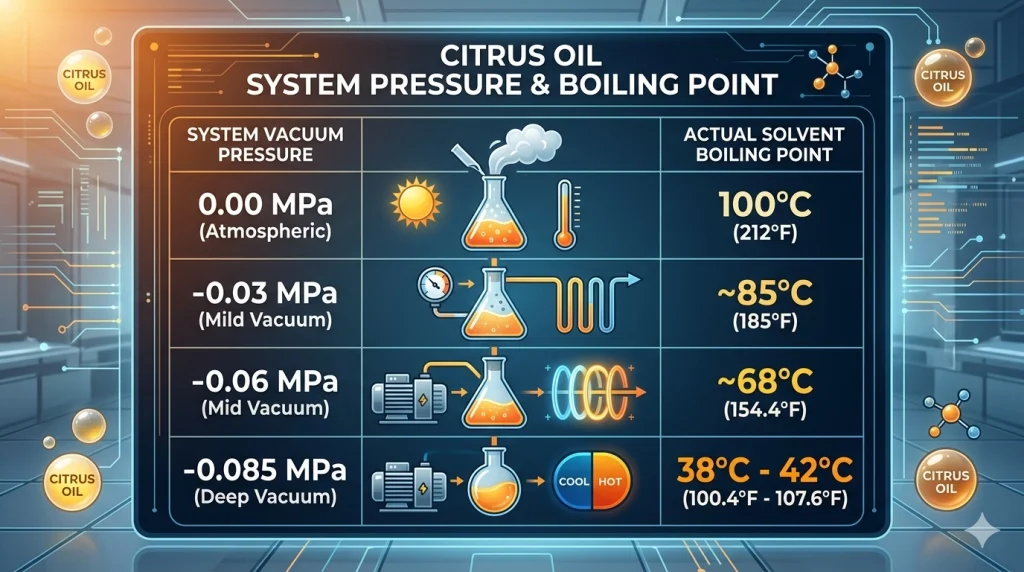
By engineering an extraction environment capable of pulling and holding a stable, deep negative pressure of -0.085 MPa, the boiling point of the liquid matrix drops into a safe zone between 38°C and 42°C.
Implementing this exact negative pressure baseline yields major advantages for Citrus Peels essential oil Purification:
Once the thermal parameters are suppressed to lock out thermal degradation, how do processors address the physical lipids that naturally squeeze out during the initial peel processing?
Crude, cold-pressed citrus oils are saturated with long-chain botanical waxes. While these lipids remain dissolved during hot summer processing, they rapidly crystallize and precipitate when exposed to cold winter transit or shelf storage in northern export markets (such as Europe and North America). This creates an unsightly cloudiness that drives high commercial return rates from global B2B buyers.
The traditional remedy is external “winterization”—dissolving the oil in ethanol, chilling it down to -20°C for up to 48 hours, and pressing it through a plate-and-frame filter. However, this process demands heavy capital investment, incurs high solvent losses, and risks dulling the oil’s fresh aromatic profile through air exposure.
By deploying an advanced Vacuum Citrus Peel essential oil Distillation System, processing lines execute In-Situ Fractionation directly inside the vapor column by leveraging integrated heat reflux dynamics.
As the essential oil vapor travels upward, a precise temperature gradient along the fractional column cools the heavier, high-boiling-point botanical waxes. These lipids condense early into micro-droplets and reflux back down to the bottom vessel, while pure, low-boiling-point limonene gas freely passes through the column head into the main condenser. By executing this separation internally in a single step, processors eliminate the need for secondary winterization equipment, driving down production costs per kilogram and maximizing the efficiency of the Citrus Peels essential oil Purificationलाइन।
This dynamic column control not only isolates heavy waxes but also lays the technical groundwork for eliminating the invisible, chemical hazards found in raw citrus oils.
Furanocoumarins (such as Bergapten found in Bergamot oil) represent a major liability in cosmetic manufacturing. These heterocyclic compounds are highly phototoxic; when applied to skin exposed to ultraviolet sunlight, they trigger severe photodermatitis, hyperpigmentation, and chemical burns. Consequently, international bodies like the International Fragrance Association (IFRA) and the US FDA enforce strict residual limits on these compounds in skincare formulations.
As a result, Furanocoumarin-Free (FCF) citrus oils command massive price premiums—often selling for 2 to 3 times the price of crude oils. Establishing a reliable Furanocoumarin-Free Citrus oil Purification line is therefore the quickest way for an extraction plant to elevate its profit margins.
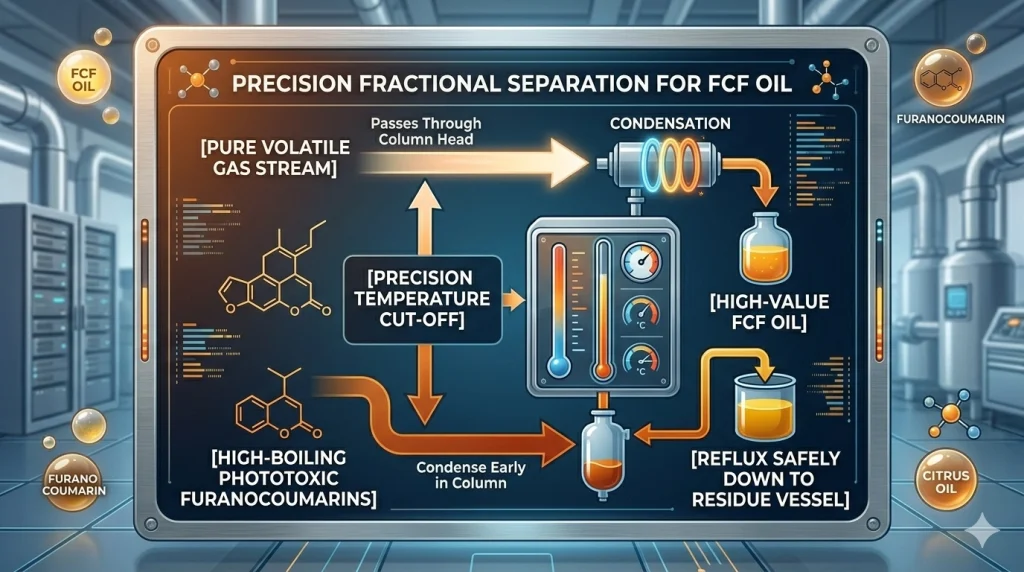
Because furanocoumarins feature much higher molecular weights and boiling points than volatile monoterpenes, they exhibit vastly different vaporization profiles. In a custom-engineered Vacuum Citrus Peel essential oil Distillation System, operators utilize automated column-head temperature controls to execute precise “fraction cutting.”
Under a stable -0.085 MPa deep vacuum, the system allows only the light, skin-safe aromatic compounds to carry over into the collection tanks, while locking the dangerous, phototoxic furanocoumarins inside the boiling chamber’s waste residue. This physical separation requires no chemical additives, decolorizing agents, or absorbing clays, producing clean FCF oils that easily satisfy global safety standards during Furanocoumarin-Free Citrus oil Purification.
While isolating these heavy molecular compounds purifies the chemical profile of the oil, keeping the physical mechanics of the equipment clean presents an entirely different structural challenge.
Citrus peels are packed with natural pectins—complex structural polysaccharides that act as strong gelling agents when heated in moisture-rich environments. In standard distillation setups operating at 100°C, these pectins quickly undergo thermal dehydration, cooking into a sticky, tar-like gel that coats internal heating elements and vessel walls.
This sticky accumulation introduces two major operational hazards:
By running the process inside a high-performance Vacuum Citrus Peel essential oil Distillation System, the core processing temperature is kept safely at 38°C – 42°C.
This temperature sits far below the activation threshold required for pectin hydrolysis and gelation. The pectin matrix remains in a loose, fluid, non-viscous state throughout the cycle. This maintains constant thermal efficiency, slashes utility bills, and enables the automated Clean-in-Place (CIP) systems to easily flush the system with warm water between batches—completely eliminating the need for manual chamber scraping and ensuring a fast, short-cycle operational rhythm.
Beyond preventing structural buildup inside the cooker, maintaining batch purity requires absolute visual control over the final separation stage.
Purified citrus essential oils are characterized by their clear transparency or ultra-pale yellow hue. Because of this, even minor water fractions carried over into the final packaging can cause hydrolytic rancidity and microbial growth during long-distance maritime shipping, ruining an otherwise successful Citrus Peels essential oil Purificationदौड़ो।
Traditional stainless steel separation boxes hide the internal liquid interface line. Because the specific gravity of citrus oil (approximately 0.84 – 0.85) is very close to water, operators working with opaque viewports often rely on guesswork. This human error either flushes valuable essential oils down the drain or allows wastewater fractions to enter the clean storage carboys.
To eliminate this vulnerability, the final stage of the Vacuum Citrus Peel essential oil Distillation System features a high-clarity Borosilicate Glass Sight-Cylinder Separator designed specifically for real-time monitoring of volatile oil recovery.
| इंजीनियरिंग पैरामीटर | Realized B2B Commercial Advantage |
| Stable -0.085 MPa Vacuum | 100% preservation of fresh fruit top notes with zero thermal shock. |
| In-Situ Column Reflux | Automatic wax trapping; saves thousands on external winterization. |
| 316L Low-Carbon Steel | Complete resistance to organic acids; guarantees zero metal leaching. |
| 360° Borosilicate Glass | Visual tracking of the fluid meniscus; increases oil recovery by 15%. |
This structural configuration provides processing engineers with full 360-degree optical visibility of the distinct meniscus dividing the pure oil from the underlying hydrosol water. Paired with a micro-draining sanitary needle valve, operators can isolate the clear citrus oil down to the exact milliliter, ensuring zero water contamination and maximum batch yields.
How do these component choices hold up under long-term exposure to the harsh chemical realities of large-scale citrus processing?
A critical engineering factor often overlooked during equipment procurement for a Citrus Peels essential oil Purification facility is the corrosive nature of the raw crop matrix. Citrus peels contain highly active organic acids (such as citric and ascorbic acids) that volatilize under negative pressure and steam.
If an extraction plant utilizes standard 304 stainless steel for its internal boiling chamber or vapor lines, these organic acids will slowly etch the metal surfaces over time, creating microscopic pits (Pitting Corrosion).
This pitting introduces two severe commercial risks:
To ensure strict compliance with US FDA, European GMP, and ISO sanitation mandates, any premium Vacuum Citrus Peel essential oil Distillation Systemज़रूरी है उपयोग करना316L Stainless Steel (Low Carbon Stainless Steel) for all product-contact surfaces. The inclusion of molybdenum within the 316L alloy matrix delivers excellent resistance to organic acid etching, protecting your equipment lifecycle and guaranteeing a contamination-free end product during Furanocoumarin-Free Citrus oil Purification.
When unexpected variables arise during factory shifts, engineers can consult the following practical field matrix to maintain these high standards of compliance.
In the highly competitive global landscape of plant volatile extracts, your processing equipment directly dictates your market price. Relying on unrefined cold-pressing or high-heat atmospheric boilers leaves valuable profits trapped in raw materials or lost to thermal degradation.
By applying advanced Citrus Peels essential oil Purification protocols—leveraging a stable -0.085 MPa vacuum system for low-temperature vaporization, integrating smart in-situ fractionation to lock out heavy botanical waxes, and utilizing low-carbon 316L stainless steel metallurgy—commercial manufacturers can scale production safely and efficiently. Investing in a highly optimized processing framework remains a direct strategy for achieving flawless Furanocoumarin-Free Citrus oil Purification, safeguarding your delicate aromatic compounds, and delivering premium, therapeutic-grade oils that easily conquer international purity standards every single time.
A: Our equipment utilizes low-carbon 316L stainless steel for all product-contact surfaces, resisting organic acid etching and eliminating micro-cavities where residues can lodge. Additionally, operating at a low temperature of 38°C – 42°C keeps natural pectins fluid rather than baking them onto elements. This allows the automated Clean-in-Place (CIP) system to completely flush the unit with warm water between shifts, ensuring an ultra-pure, zero-contamination Citrus Peels essential oil Purificationकार्यप्रवाह।
A: Traditional winterization requires dissolving oil in ethanol, 48-hour chilling, and filter-press loops that incur heavy solvent losses and capital costs. By deploying our advanced Vacuum Citrus Peel essential oil Distillation System, processing lines execute in-situ fractionation directly inside the vapor column in a single step. Heavy macromolecular plant waxes rapidly condense due to their high boiling points and reflux back down, while pure monoterpenes pass to the condenser, saving thousands on filtration hardware and preserving fresh fruit top notes.
A: Phototoxic compounds feature much higher molecular weights and boiling points than volatile monoterpenes. In our custom-engineered Vacuum Citrus Peel essential oil Distillation System, automated column-head temperature controls execute precise fraction cutting under a stable negative pressure. This physical separation locks dangerous phototoxic furanocoumarins inside the boiling chamber’s waste residue while allowing skin-safe aromatic gases to pass freely. The result is 100% compliant Furanocoumarin-Free Citrus oil Purification with zero chemical additives.

व्हाट्सएप

वीचैट
व्हाट्सएप्प:+8615736768129
ईमेल:inquiry@panchimachinery.com
पता: झेंग्झौ, हेनान प्रांत, चीन
स्वचालित वैक्यूम शहद प्रसंस्करण और छानने की मशीन
वैक्यूम निम्न-तापमान द्रव्य निष्कर्षण और सांद्रण इकाई
कस्टम स्टीम डिस्टिलेशन और हीट रिफ्लक्स आवश्यक तेल उपकरण
एसएस 304/316एल कम तापमान वेल्वुम स्क्रैपर कंसन्ट्रेटर
QN वृत्तीय निर्वात संग्राहक एवं शराब पुनःप्राप्ति इकाई
मल्टी-फंक्शन स्टेनलेस स्टील वैक्यूम डिस्टिलेशन एवं एक्सट्रैक्शन यूनिट
गर्म रिफ्लक्स वाक्यूम लिक्विड एक्सट्रैक्शन और कंसंट्रेशन यूनिट
हम आपसे एक कार्यदिवस के भीतर संपर्क करेंगे। कृपया अपने ईमेल पर ध्यान दें।
स्वचालित वैक्यूम शहद प्रसंस्करण और छानने की मशीन
WhatsApp: +8615736768129
ईमेल: inquiry@panchimachinery.com
पता:झेंग्झौ, हुनान प्रांत, चीन


कॉपीराइट© 2026झेंगझोउ पंची मशीनरी उपकरण有限公司|गोपनीयता नीति