
В секторе фармацевтического синтеза с повышенной точностью способность к молоть волокнистые и липкие травы is the ultimate benchmark of operational efficiency. While conventional equipment succumb to mechanical blinding, modern engineering now provides a revolutionary “single-pass” solution for these recalcitrant materials. Whether you are addressing tough cellulosic matrices or lipid-rich residues, achieving a stable 800-mesh granulometry is no longer an industrial bottleneck. For manufacturers, the objective is to reach extreme micronization without compromising the molecular integrity of the plant-based active ingredients.
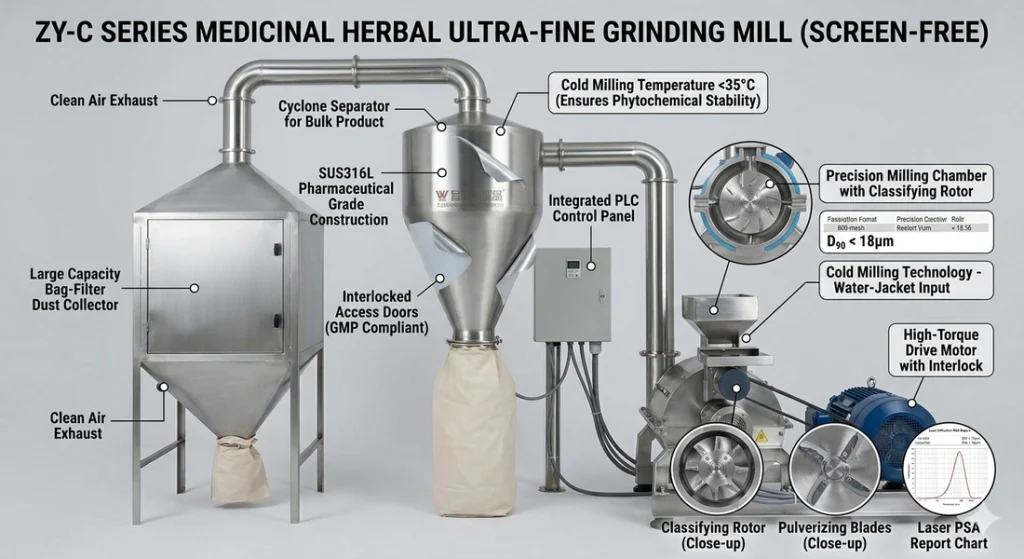
Это руководство анализирует стратегический сдвиг в сторону мельение без экрана— единственный надежный метод преобразования твердых ботанических веществ в аморфный, шелковистый порошок. Интегрируя высокоэффективную Лечебная травяная мельница ультратонкого помола, процессоры наконец могут добиться экстремального снижения частиц без системного времени простоя.
Стандартные молотковые мельницы по существу плохо справляются с высокой устойчивостью ботанических материалов по причине трех важнейших инженерных недостатков:
Серия ZY-C переопределяет методологию ультратонкого измельчения, полностью устраняя физический экран. В мельение без экрана, разделение частиц осуществляется внутренним воздушным классификатором, который сортирует порошки по аэродинамическому диаметру, а не по физическим размерам.
Сохранение летучих ароматических соединений, пока вы молоть волокнистые и липкие травы требует продвинутых навыков технология холодной фрезеровкиЧтобы предотвратить тепловой ожог, наша архитектура включает два слоя термического управления:
Для проверки наших протоколов обработки сложных ботанических веществ мы провели эмпирический эксперимент с сушеным шпинатом — субстратом, известным своей высокой прочностью волокон и чувствительностью к хлорофиллу.
Технические наблюдения:
Требование снизить размер ботанических веществ до субмикронного масштаба связано с фармакокинетикой. Добившись такой величины, мы обеспечиваем Разрушение клеточной стенки (лизис), что увеличивает фактическую площадь поверхности более чем на 1200%. Это оптимизирует:
Требование снизить размер ботанических веществ до субмикронного масштаба связано с фармакокинетикой. Добившись такой величины, мы обеспечиваем Разрушение клеточной стенки (лизис), что увеличивает фактическую площадь поверхности более чем на 1200%. Это оптимизирует:
В регулируемой производственной среде оборудование должно соответствовать строгим санитарным стандартам. Конструкция устройства из нержавеющей стали SUS316L обеспечивает отсутствие перекрестного загрязнения при максимизации долговечности.
| Технический параметр | Традиционная молотковая мельница | Мельница серии ZY-C |
| Метод разделения | Физическая сетка (склонна к ослеплению) | Мельница без экрана (Аэродинамический) |
| Тепловое управление | Неконтролируемый (Риск ожога) | Технология холодного фрезерования (Изотермический) |
| Цельная крупность | 150 – 250 Microns (60-80 Mesh) | Менее 18 микрон (сетка 800-1000) |
| Выработка материала | 85% – 90% | 99.5% – 99.9% |
Успешно овладев способностью к молоть волокнистые и липкие травы на промышленном уровне требует объединения гидродинамики и материаловедения. В Панчи Машинери, мы обеспечиваем инженерную инфраструктуру, необходимую для преодоления разрыва между пилотными опытами и полномасштабным производством фармацевтических препаратов с помощью наших современных технологий Лечебная травяная мельница ультратонкого помола.
В: Какой основной узкий место при измельчении волокнистых и липких трав?
A: Узким местом обычно являются засоры и опаливание. Волокнистые субстраты засоряют сетки, в то время как клейкие смолы плавятся из-за тепла, вызванного сдвигом. Наши мельение без экрана и технология холодной фрезеровки нейтрализуйте эти переменные, управляя аэродинамикой и температурой одновременно.
В: Как влияет технология холодного фрезерования на пропускную способность масличных материалов?
A: By maintaining the substrate below its lipid melting point, it prevents “clumping” on the beaters. This maintains a high velocity of pulverization, allowing the machine to молоть волокнистые и липкие травы с более высокой эффективностью и более длительным временем работы без перерыва, чем неохлаждаемые системы.
В: Совместима ли система с мокрым измельчением?
A: Да. Интегрированная с прецизионными механическими уплотнениями и коррозионностойкими сплавами, наша мельница разработана для того, чтобы молоть волокнистые и липкие травы как в сухом, так и в слоистом виде, предлагая по-настоящему универсальное бимодальное решение для обработки.


Вичат
WhatsApp: +8615736768129
Электронная почта: [email protected]
Адрес: Цзэнчжоу, провинция Хэнань, Китай
Automatic Vacuum Honey Processing & Filtering Machine
Vacuum Low-Temperature Liquid Extraction & Concentration Unit
Custom Steam Distillation & Heat Reflux Essential Oil Equipment
Концентратор вакуумного скребка низкой температуры SS304/316L
QN Spherical Vacuum Concentrator & Alcohol Recovery Unit
Multi-function Stainless Steel Vacuum Distillation & Extraction Unit
Hot Reflux Vacuum Liquid Extraction & Concentration Unit
Одноэффектный внешний циркуляционный вакуум-концентратор
Серия SJN Вакуумный испаритель с внешней циркуляцией и двойным эффектом
Химический реактор из нержавеющей стали вакуумного нагрева при высоких температурах
304SS вакуумный промежуточный осаждающий бак для спирта
304SS двухслойочный паровой кухонный горшок
Электрическая отопительная кастрюля с жаропрочной обшивкой
Высокопроизводительный газовый нагревающийся котёл с жаропрочной емкостью
Мы свяжемся с вами в течение одного рабочего дня. Пожалуйста, проверяйте вашу электронную почту.
Автоматическая вакуумная машина для обработки и фильтрации меда
Установка для вакуумной экстракции жидкостей низкотемпературным методом и концентрирования
WhatsApp: +8615736768129
Электронная почта: [email protected]
Address: Цзэнчжоу, провинция Хэнань, Китай


АВТОРСКОЕПРАВО© 2026 Ценчжоу Панчжи Машинери Экипмент Ко., Лтд. | Политика конфиденциальности

Наша команда ответит в течение 24 часов.
Спасибо! Мы свяжемся с вами в течение 24 часов.
Проверьте свой почтовый ящик (и папку спам) на наличие нашего ответа.