
今日のグローバル市場では、高純度の天然製品に対する需要が数十億ドル規模の産業セクターへと進化しており、最大限の生産効率と絶対的な化学純度が求められています。しかし、多くのプロジェクトマネージャーや調達担当者は、標準的なジャケット付き加熱タンクや簡易な蒸気蒸留装置がすべての植物種に対して普遍的に処理できると誤解し、コストのかかる誤った考えに陥っています。実際には、揮発性化合物のバルク密度、レオロジープロファイル、分子構造は種によって大きく異なります。設備設計を正確な熱力学的飽和点に合わせることに失敗すると、繊細なトップノートの不可逆的な熱分解、ひどいフィルターの詰まり、または天文学的な溶媒の損失につながり、それが産業運営を破綻させることになります。
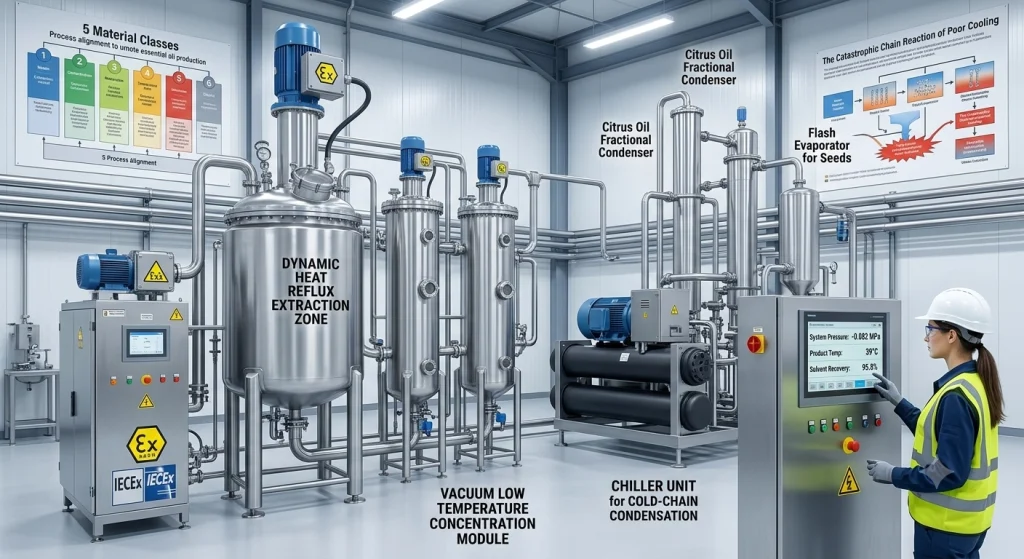
世界的に競争力のある高収益の生産工場を構築するためには、エンジニアは基本的な機械だけでなく、高度な化学分離の視点から製造を捉える必要があります。このガイドは、世界の植物資源が五つの主要な素材カテゴリーに分けられている方法を厳密に分析し、それぞれの分類における独特の物理的挙動、工学的ボトルネック、熱力学的境界線について検討しています。原料の特性と自動流体制御および最適化されたパラメータを正確に一致させることで、この設計図は国際的なバイヤーが操業規模を拡大し、交差汚染を排除し、最高の効率を達成するのに役立ちます。産業用流体抽出および下流エッセンシャルオイルの精製ワークフローの利用低温抽出真空プラットフォーム
国際的な市場動向を工学分野や産業指標の観点から分析すると、いくつかの重要な課題が繰り返し浮上します。世界中の起業家や工場管理者はもはや「エッセンシャルオイルをどうやって作るか?」という基本的な質問をしていません。代わって、産業規模の拡大、規制遵守、そして最適化された方法による経済的持続可能性に深い関心を寄せています。産業用流体抽出 plant layout.
The most common inquiries from serious global buyers include:
To answer these global questions, an extraction facility must move away from crude atmospheric boiling. It must transition toward 低温抽出真空—a methodology that leverages physics to bypass the destructive nature of high heat. By incorporating these thermal principles into the overarching plant layout, manufacturers can execute a reliable エッセンシャルオイルの精製 process to extract highly fragile compounds without altering their molecular structure. Below, we break down how this technology applies to the five primary botanical profiles traded on the global commodities market.
Before finalizing the operational plant blueprint for any high-volume factory, industrial procurement officers must evaluate competing technological platforms. While supercritical carbon dioxide (CO2) systems are often discussed in academic literature, their astronomical Capital Expenditure (CAPEX) and extreme mechanical operating pressures (often exceeding 30 MPa) make them commercially restrictive for many global botanical operations.
Conversely, traditional atmospheric steam distillation fails entirely when processing thermosensitive compounds due to high-heat thermal cracking. The table below outlines the core economic and technical trade-offs between these systems within a standard 1-ton-scale 産業用流体抽出 framework:
| Engineering Parameter | Traditional Atmospheric Steam | Supercritical CO2 Systems | Panchi Vacuum Low Temperature Extraction |
| Initial CAPEX (Equipment Cost) | Low baseline | Extremely High (Custom high-pressure alloy) | Moderate (Optimized ROI scaling) |
| Daily OPEX (Energy Utility Load) | High (Continuous high-pressure boilers) | Moderate (High electrical compressor draw) | Low (Balanced thermodynamic vacuum recycling) |
| Thermal Degradation Risk | Severe (Constant 100C atmospheric exposure) | Zero (Operates at sub-critical temps) | Zero (Controlled at 38C to 45C under vacuum) |
| Solvent Recovery Efficiency | Not Applicable (Water-based waste streams) | High (Gas expansion recycling) | 95% or greater liquid-phase condensation |
| Cross-Contamination Prevention | Difficult (Porous gasket residue) | Moderate (Complex valve micro-cavities) | Absolute (Integrated automated CIP loops) |
By opting for an engineered 低温抽出真空 system, manufacturers achieve the pristine chemical purity of supercritical platforms at a fraction of the initial capital investment, unlocking rapid profitability and securing a clean エッセンシャルオイルの精製 baseline across all five botanical material classes.
[BOTANICAL RAW MATERIALS]
│
├──> [Aromatic Woods] ──> Dense Lignin Fiber ──> Dynamic Heat Reflux & Micro-Crushing
│
├──> [Roots & Rhizomes] ──> High Starch/Viscosity ──> VFD Shearing Agitation & Back-Blow
│
└──> [Flowers & Leaves] ──> Thermosensitive Trichomes ──> Vacuum Cold Boiling & Demisting
This category represents some of the most expensive raw materials in the entire global market, with high-quality agarwood (Oud) oil commanding premium prices per kilogram. Physically, these materials are characterized by an extremely dense, rigid lignocellulosic matrix.
The volatile oils—predominantly high-boiling-point sesquiterpenes and aromatic resins—are deeply embedded within the micro-capillary wood fibers, often formed as a defense mechanism deep within the heartwood. To successfully separate these heavily locked fractions, the initial step of the エッセンシャルオイルの精製 process must crack this physical defense without scorching the underlying matrix, which demands customized 産業用流体抽出 parameters.
Because the cellular structure is so rigid, traditional passive soaking releases these heavy sesquiterpenes at an exceptionally slow rate. Under standard static extraction conditions, the surrounding solvent quickly reaches its thermodynamic saturation point, which stalls the manufacturing workflow. Once equilibrium is met, mass transfer ceases entirely.
If a factory attempts to push the extraction by simply increasing the run time or raising the temperature, a massive loss of high-value yield occurs. Therefore, an optimized 産業用流体抽出 configuration is required to maintain dynamic fluid flow parameters as follows:
[Raw Aromatic Wood] ──> [0.5mm-1mm Non-Shear Crushing] ──> [Dynamic Heat Reflux Extractions] ──> [Continuous Fresh Solvent Spraying]
Once liquefied, this pure, completely unsaturated, heated fresh solvent is continuously sprayed through an omnidirectional deluging manifold over the top of the wood bed, ensuring a continuous essential oil purification process.
Roots and rhizomes are harvested from beneath the soil, meaning their biological function is resource storage. Consequently, their cellular architecture is highly complex, packed with dense networks of starches, complex plant polysaccharides, mucilage, and oleoresins. Suspended within this thick organic matrix are highly valuable, intensely pungent, and deeply volatile oils which are highly sensitive to thermal degradation if not handled by a dedicated エッセンシャルオイルの精製 plant.
This group represents a classic complex rheological challenge for chemical engineers executing large-scale processing. As this mixture enters the concentration phase and the solvent begins to volatilize via 低温抽出真空, the relative concentration of these polysaccharides spikes exponentially. The liquid shifts from a free-flowing fluid to a highly viscous, sticky paste.
This paste adheres to the internal jacketed heating surfaces of the vessel, causing immediate localized overheating, charring, and scorching. This completely ruins the organoleptic profile of the oil, introducing a permanent burnt, smoky off-flavor that destroys the integrity of the target extract. To bypass this problem, the 産業用流体抽出 baseline requires:
[Viscous Root Extract] ──> [High-Torque VFD Agitation (Breaks Boundary Layer)] ──> [Sintered Mesh Filter] ──> [Pneumatic Back-Blow (0.05 MPa Air)]
Unlike roots or heartwood, the essential oils in flowers and delicate leaves are stored in highly fragile, superficial structures located on the exterior of the plant tissue, such as glandular trichomes or modified secretory cavities. The chemical profiles of these oils are dominated by light, low-boiling-point monoterpene alcohols, aldehydes, and delicate esters.
These molecules are the definition of highly thermosensitive materials that require precise protective protocols. To protect fragile glandular trichomes, the initial flooding velocity must be highly regulated within the 産業用流体抽出 platform, maintaining a soft fluid flow of less than 0.5 meters per second at a conservative liquid-to-solid ratio of 5:1, preventing mechanical bruising before the thermal phase begins.
The engineering challenge here is two-fold: chemical fragility and fluid dynamics. If these delicate tissues are exposed to traditional steam distillation at atmospheric pressures, the delicate ester bonds undergo rapid thermal hydrolysis, completely destroying the authentic fragrance profile.
However, when engineers attempt to solve this by pulling a deep vacuum to lower the boiling point within the 産業用流体抽出 plant, a secondary mechanical problem arises: priming (foaming over). Because leaves and flower petals have an extremely low bulk density, pulling a sudden vacuum causes the fluid to flash-boil violently, lifting massive walls of foam and lightweight leaf fragments.
[Delicate Floral Vapor + Foam] ──> [Mesh Demister (Inertial Interception)] ──> [Pure Gas Phase] ──> [Low-Temp Condenser]
| Dimension | Standard Industrial Value |
| Target Compound | d-Limonene & Citral |
| Primary Impurity Group | Fruit Pectins & Carotenoids |
| Heavy Wax Extraction Level | High-yield co-extraction risk |
Citrus essential oils are found in large, spherical oil glands located within the colored flavedo of the fruit. Chemically, these oils are incredibly rich in d-limonene, along with highly characteristic aldehydes like citral. Deploying a professional 低温抽出真空 system allows operators to target these specific cells while leaving non-volatile skin components behind.
However, during any commercial run, the solvent simultaneously dissolves large quantities of non-volatile heavy compounds from the peel, specifically:
While cold-pressing is widely used for low-grade juice byproducts, producing a premium, pharmaceutical-grade citrus oil requires complete isolation of the volatile terpenes from these heavy co-extracted matrixes. If these plant waxes are left within the oil, the product suffers from cold turbidity during refrigeration and phototoxicity when exposed to sunlight.
Therefore, an advanced fractionation strategy is mandatory within the 産業用流体抽出 platform to remove these heavy fractions down to strict regulatory parts per million (ppm) limits. The multi-stage dephlegmator must maintain a precise vapor velocity of 12 to 15 meters per second through the internal tube bundle. This ensures that the heavy wax fractions are stripped by gravity while the light-phase d-limonene remains entrained in the gas phase.
[Citrus Vapor Blend] ──> [Stage 1 Condenser (High Temp/Pulls Waxes)] ──> [Stage 2 Condenser (Low Temp/Pulls Pure Oil)]
Rather than executing a crude, single-stage condensation, the machinery must deploy a series of vertical condensing columns operating under a tight, automated temperature gradient. By precisely tuning the thermal jacket of the first-stage fractional dephlegmator, the heavy waxes and lipids cross their condensation threshold and liquefy, while remaining hot enough to keep the pure d-limonene completely in its gaseous state.
The liquefied waxes are continuously drained from the base of the first column, while the pure, wax-free aromatic gas travels upward into the second-stage sub-zero condenser, completing a flawless isolation sequence that refines the entire essential oil purification process and sets a high benchmark for 低温抽出真空プラットフォーム
Seeds and spice fruits represent the evolutionary survival packages of plants, meaning they are structurally incredibly dense. Chemically, they present a highly challenging dual-oil matrix, containing high percentages of ultra-potent volatile essential oils bound alongside massive volumes of heavy, non-volatile fixed oils (fatty oils and triglycerides).
The processing plant must configure:
When executing processing runs on spice seeds using standard organic solvents, the laws of chemical solubility dictate that the solvent will safe-indiscriminately dissolve both the volatile essential oil and the heavy fixed fatty oils.
The core engineering challenge of this specific essential oil purification process is not getting the oil out of the seed; it is getting the volatile oil out of the heavy oil. Without proper separation, the finished product will carry a heavy, vegetable oil undertone that completely overpowers the sharp, clean spice notes, undermining the value of the 産業用流体抽出 run.
[Dual-Oil Blend (Fixed + Volatile)] ──> [Instant High-Energy Vacuum Chamber] ──> [Volatile Gas Out] / [Heavy Fixed Oil Drops]
Operating under a strict 低温抽出真空 profile, the system exploits the vast divergence in latent heat of vaporization between the two oil groups. The light-fraction volatile essential oils instantly flash into a pure gas phase and are evacuated horizontally by the vacuum stream into a dedicated sub-cooled condensation circuit.
Moving from a theoretical laboratory process to a highly profitable, 1-ton-scale global manufacturing plant requires a transition from basic chemistry to disciplined chemical engineering. Every valve, pipe diameter, and utility supply line must be designed around the immutable laws of mass balance and thermodynamics to support a high-throughput 産業用流体抽出 platform.
| Botanical Category | Primary Target Compound | Primary Engineering Bottleneck | Core Process Solution | Required Operating Pressure (Vacuum) | Optimal Processing Temp | Required Condenser Fluid Temp |
| 1. Woods & Resins | Sesquiterpenes | Slow diffusion; residual oil trap | Dynamic Heat Reflux; 0.5mm micro-crushing | minus 0.05 to minus 0.07 MPa | 50 to 55 ℃ | 12 to 15 ℃ |
| 2. Roots & Rhizomes | Oleoresins | Viscous wall-sticking; filter blinding | High-Torque VFD scrapers; Pneumatic back-blow | minus 0.06 to minus 0.075 MPa | 45 to 50 ℃ | 8 to 10 ℃ |
| 3. Flowers & Leaves | Monoterpene Esters | Thermal hydrolysis; vacuum priming | Ultra-low boiling points; Mesh wire demisters | minus 0.08 to minus 0.085 MPa | 38 to 42 ℃ | 3 to 5 ℃ |
| 4. Citrus Peels | d-Limonene & Citral | Cold turbidity; phototoxic wax carryover | Fractional multi-stage condensation dephlegmator | minus 0.075 to minus 0.083 MPa | 40 to 44 ℃ | 5 ℃ (Stage 1: 25℃) |
| 5. Seeds & Spices | Volatile Aromatics | Oil-in-Oil separation failure | Post-extraction secondary flash evaporation | minus 0.082 to minus 0.086 MPa | 42 to 46 ℃ | 2 to 4 ℃ |
One of the most heavily debated topics across industrial procurement channels is the claimed solvent recovery rate. When operating an organic solvent line, the true mass balance equation must be written cleanly in text as follows:
Total Solvent Input = Recovered Liquid Solvent + Vapor Vent Losses + Solid Dregs Retention
An engineered extraction plant running a high-efficiency configuration can easily guarantee a liquid-phase condensation recovery rate equal to or greater than 95 percent. This ensures a clean essential oil purification process without unexpected losses. This means that 95 percent of the solvent that is successfully transformed into a gaseous phase within the concentration chambers will be perfectly liquefied and returned to the clean solvent storage tanks. However, the remaining portion represents a physical engineering challenge that occurs outside the condenser: Solid Dregs Retention.
[Wet Botanical Dregs in Tank]
│
├──> Close Liquid Discharge Valves
├──> Inject Live Saturated Steam Under Bed
└──> Pull High Vacuum via Vapor Headspace
│
▼
[Flash Evaporate Residual Solvent] ──> [Final Dregs Solvent Level < 1.5%]
Once the liquid extract has been fully drained to the concentration sector, the dregs discharge valve remains tightly sealed. The system introduces live, direct saturated steam into the base of the extraction bed while simultaneously pulling a deep vacuum within the headspace to initiate a targeted vapor purge via a secondary 低温抽出真空 loop.
This engineered sub-process effectively slashes the solvent retention level within the final discarded dregs down to less than 1.5 percent, protecting the manufacturer’s solvent balance sheet while ensuring a completely dry, safe, and eco-friendly solid waste byproduct ready for agricultural composting, validating the sustainability of the 産業用流体抽出 facility.
A devastating mistake made by many global buyers—particularly those operating in tropical processing hubs across Southeast Asia, Central America, and Sub-Saharan Africa—is underestimating the thermal energy equations required for condensation during low-heat recovery operations within an 産業用流体抽出 line.
During high-throughput vacuum concentration within the processing line, the system is converting massive volumes of liquid solvent into high-velocity gas every minute. To transform that gas back into a liquid, the condenser must instantaneously strip away the solvent’s latent heat of vaporization.
If the facility is located in a region where the ambient summer temperature causes local water supplies to hover between 28 ℃ and 35 ℃, the temperature differential between the solvent vapor (boiling at 38 ℃ under vacuum) and the cooling water is virtually non-existent, creating a massive bottleneck for 低温抽出真空 units.
[Warm Factory Water Supply]
▼
[Condenser Surface Dynamic Thermal Loss]
▼
[Solvent Vapor Bypasses Chiller Coils]
▼
[Gas Condenses Volatiles Inside Sealing Fluid]
▼
[Vacuum Pump Cavitation & Internal Seal Rupture]
▼
[Total System Vacuum Drop & Boiling Point Spike]
▼
[Immediate Scorching of Plant Material Oils]
To achieve absolute process stability, an industrial facility must decouple its condensation loop from ambient weather conditions. The condenser lines must be tied to a dedicated, closed-loop industrial screw chiller unit running a water-glycol mixture to safeguard the overarching エッセンシャルオイルの精製 process.
For delicate floral and leaf processing, the chiller must be sized to deliver a continuous, high-volume fluid flow maintained strictly between 3 ℃ and 5 ℃.
This massive, engineered thermal gradient guarantees that 100 percent of the solvent vapor is instantaneously collapsed into a liquid state the millisecond it touches the condenser tubes. This shields the vacuum pumps from vapor carryover, locks the essential oil purification process system into a rock-steady vacuum profile, and ensures optimal concentration yields hour after hour, regardless of external tropical weather.
In the international pharmaceutical, nutraceutical, and premium cosmetics sectors, preventing cross-contamination within the main pipelines is a strict legal and regulatory requirement. When a multi-functional processing facility switches production from a highly aromatic wood resin like agarwood to a delicate leaf like peppermint, any residual terpene carryover will instantly contaminate the entire subsequent batch, ruining its sensory profile and failing quality control validation.
To guarantee complete compliance with global Good Manufacturing Practice (GMP) protocols, the entire extraction architecture must be supported by an automated, multi-zone Clean-in-Place (CIP) engineering system integrated directly into the liquid processing skid. This automation helps maintain an advanced 低温抽出真空 workflow across all batch cycles:
[Extraction Vessel Zone]
└──> [Omnidirectional Rotary Spray Balls (0.4 MPa Pressure)]
└──> [316L Mirror-Polished Tubing (Ra < 0.4 microns)]
└──> [Zero-Dead-Leg Pneumatic Diaphragm Valves]
Operating a large-scale commercial factory utilizing high-volume organic solvents means that the entire processing floor must be legally classified as a highly hazardous, explosive environment. When hundreds of liters of volatile solvents are moving through a system under vacuum and thermal cycles, the slightest electrical anomaly can result in a catastrophic industrial explosion. True industrial-grade machinery must be designed from the ground up to prevent disaster, utilizing advanced explosion-proof safety engineering integrated with all mechanical frameworks to secure the 産業用流体抽出 line:
[EXPLOSION-PROOF SAFETY MATRIX]
│
├──> [Flameproof Systems] ──> Ex d II B T4 Drive Motors (<135C Surface Heat)
├──> [Intrinsically Safe] ──> Ex i Circuit Arrays (Eliminates Thermal Sparks)
└──> [Purged Enclosures] ──> Ex p Positive N2 Supply (Expels Volatile Gas)
Before the main electrical breaker can be ignited, the system runs an automated purge cycle to completely expel any potentially trapped flammable gases. During operation, the cabinet maintains a continuous positive internal pressure relative to the factory floor, physically preventing any external ambient solvent vapors from leaking into the enclosure where live contactors and relays operate.
Mastering plant processing at a global, industrial scale requires a shift away from low-cost, unscientific equipment toward rigorous chemical engineering. As demonstrated, the physical and chemical differences between aromatic woods, starch-heavy roots, delicate flowers, waxy citrus fruits, and dual-oil spice seeds require entirely distinct mechanical and thermal solutions to guarantee a flawless エッセンシャルオイルの精製 process.
By deploying advanced solutions such as dynamic heat reflux, high-torque VFD boundary scraping, inertial mesh demisting, fractional dephlegmation, and secondary vacuum flash evaporation, processing facilities can maximize extraction yields while keeping solvent losses to a minimum. This complete technological framework forms the backbone of a modern 産業用流体抽出 plant designed for maximum efficiency.
For global enterprises seeking to scale their production, systems must be engineered using a highly disciplined, integrated skid-mounted architecture. The entire system—including the extraction block, concentration units, shell-and-tube condensers, explosion-proof vacuum arrays, and industrial electrical centers—is constructed on a heavy, structural steel frame at the manufacturing plant.
Every weld, pressure test, and electrical certification is completed and verified before the system is packed into sea containers. When the equipment arrives at a facility in Europe, the Americas, Africa, or Southeast Asia, it requires zero on-site welding or complex pipeline fabrication.
The local team simply bolts the structural skid to the floor, connects pre-sized utility lines (power and chiller fluid), and immediately begins commercial production, making full use of modern 低温抽出真空 and advanced separation advantages.
Q: How does vacuum low temperature extraction prevent the thermal degradation of delicate floral esters?
A: Traditional atmospheric extraction at 100 ℃ rapidly destroys fragile monoterpene esters via thermal hydrolysis. By maintaining a continuous deep vacuum between minus 0.08 MPa and minus 0.085 MPa, our plant utilizes 低温抽出真空 to drastically suppress system vapor pressure. This drops the thermodynamic boiling point of the ethanol solvent matrix to a safe window of 38 to 42 ℃. Operating within this low-temperature zone preserves the delicate top notes and molecular integrity of botanical compounds, ensuring a premium, unburnt aromatic oil profile that strictly satisfies international fragrance standards.
Q: What engineering designs ensure absolute cross-contamination prevention in a multi-functional plant?
A: To achieve strict GMP compliance when switching between distinct botanical profiles during the essential oil purification process, the plant layout eliminates manual cleaning in favor of an automated Clean-in-Place (CIP) system. The core architecture utilizes grade 316L stainless steel pipelines with an ultra-smooth internal surface roughness average (Ra) of less than 0.4 microns, preventing plant polysaccharides or waxes from adhering. Furthermore, standard T-valves are replaced with zero-dead-leg pneumatic diaphragm valves throughout the fluid processing skid, combined with omnidirectional rotary spray balls operating at 0.4 MPa.
Q: Why is standard electrical equipment prohibited on an industrial solvent extraction factory floor?
A: Processing high-volume organic solvents like 95 percent ethanol creates a hazardous vapor environment where a single electrical arc can trigger explosions. Therefore, a professional 産業用流体抽出 plant must integrate certified ATEX/IECEx safety architecture. All heavy drive motors utilize flameproof Ex d II B T4 enclosures to restrict maximum surface heat below 135 ℃ under full load. Submerged sensors deploy intrinsically safe Ex i low-energy circuits to eliminate thermal spark risks, while main electrical cabinets use Ex p positive-pressure nitrogen purging to physically block external solvent gases from entering live enclosures.