
Honey is often celebrated as the only food that truly lasts forever. Archaeologists have famously discovered pots of honey in ancient Egyptian tombs that are still edible after 3,000 years. However, for the modern commercial producer, honey is a delicate biological matrix that is highly susceptible to spoilage if not managed with scientific precision.
Across global platforms like Reddit,クオラ、とYouTube, beekeepers and exporters share the same recurring nightmare: “My honey jars are leaking,” “There is a thick white foam on top of my product,”または“My premium harvest now tastes like vinegar.”
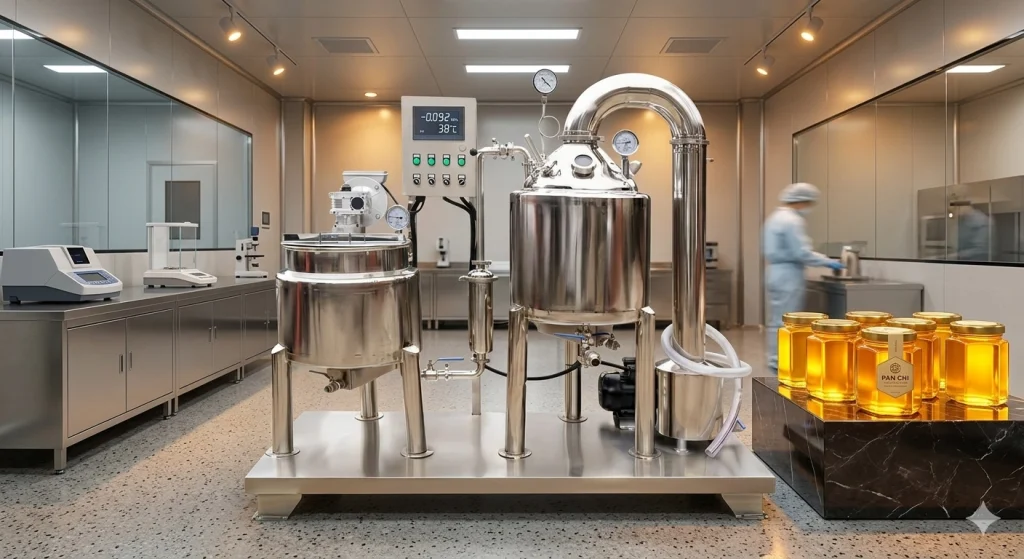
The culprit is almost always excessive moisture. Honey dehydration is not merely an industrial process; it is a critical preservation science. In this 1,500-word definitive guide, we will explore why moisture control is the bridge between a simple agricultural commodity and a high-end global superfood brand. We will specifically analyze why -0.092 MPa vacuum technology is the only “proven” method to achieve export-grade stability while protecting the “soul” of the honey.
To master honey dehydration, one must first understand the relationship between sugar, water, and micro-organisms at a molecular level. Understanding the mechanics of Honey Fermentation is the first step for any industrial producer. It is not merely a storage issue; it is a battle against omnipresent yeast spores.
Honey naturally contains wild, osmophilic (sugar-tolerant) yeasts. In thick, concentrated honey, these yeasts are kept in a state of “osmotic shock”—the high sugar concentration pulls water out of the yeast cells, keeping them dormant. However, honey is hygroscopic, meaning it actively absorbs moisture from the atmosphere.
When the moisture content rises above 20%, the “Water Activity” (aw) reaches a threshold where yeasts can hydrate and begin the fermentation process. They consume the glucose and fructose, triggered by the reaction:
C6H12O6 → 2C2H5OH + 2CO2
The “Bursting Bottle” and Brand Destruction
The byproduct of this reaction is Ethanol and CO2. In a sealed retail jar, the gas buildup creates immense pressure. To combat this, professional Honey Moisture Control must be implemented immediately after extraction to ensure the sugars do not break down into ethanol and gas.
Table 1: Honey Stability vs. Moisture Levels
| Moisture Content (%) | Water Activity (aw) | Yeast Status | Commercial Risk |
| > 21.0% | > 0.65 | Exponential Growth | Critical: Spoilage within weeks. |
| 19.0% – 20.0% | 0.60 – 0.64 | Active/Unstable | ハイ: Risk of fermentation in retail. |
| 18.0% – 19.0% | 0.55 – 0.59 | Inhibited | Medium: Stable if stored < 20°C. |
| < 18.0% | < 0.55 | Dormant | Safe: International Export Grade. |
If you are a producer looking to sell in London, New York, or Dubai, your honey must meet strict physicochemical benchmarks. For exporters, mastering Honey Moisture Control is often the difference between a successful shipment and a total loss at customs.
While some local markets accept honey at 20% moisture, the global premium market demands 17.5% to 18.5%. This provides a “safety buffer” against humidity changes during maritime shipping.
Beyond moisture, international buyers use two primary markers to see if you “cheated” during the honey dehydration process by using too much heat:
Table 2: Global Honey Standards Comparison
| メトリック | EU (2001/110/EC) | USA (USDA Grade A) | Codex Alimentarius |
| Max Moisture | ≤ 20.0% | ≤ 18.6% | ≤ 20.0% |
| HMF(熱損傷) | ≤ 40 mg/kg | Industry Std < 40 | ≤ 40 mg/kg (Tropics ≤ 80) |
| ジアスターゼ(酵素) | ≥ 8 Schade units | N/A | ≥ 8 Schade units |
The greatest challenge in honey dehydration has always been the “Heat vs. Quality” paradox. To evaporate water, you traditionally need heat. But heat kills honey.
In standard atmospheric pressure, water boils at 100°C. However, by using a high-vacuum pump to create an environment of -0.092 MPa, the boiling point drops to 38°C (100.4°F). This specific type of Vacuum Dehydration allows the water to evaporate at temperatures that do not denature the delicate proteins.
A natural beehive is maintained by the bees at roughly 35°C–38°C. By performing honey dehydration at exactly 38°C, we are mimicking the natural evaporation process that happens inside the hive. This ensures:
Enzyme Survival: Over 95% of Diastase and Invertase remain active.
香り保持: The delicate floral notes don’t “boil away.”
The use of Vacuum Dehydration also provides a critical visual benefit. Under a -0.092 MPa vacuum, the physics of gas expansion takes over. Micro-bubbles expand to over 10 times their original size, becoming highly buoyant.
This process, known as Vacuum Dehydration degassing, removes the “foggy” look common in raw honey. This results in a brilliant, gemstone-like clarity that commands a premium shelf price and justifies higher retail positioning.
One of the loudest complaints on クオラ is that industrial honey “tastes like burnt sugar.” This is the result of the メイラード反応—a chemical reaction between amino acids and reducing sugars that occurs at high temperatures.
Color: Light honeys retain their pristine, pale gold color.
Aroma: A closed-loop system traps volatile aromatic oils that normally evaporate during open heating.
Investing in Honey Moisture Control is a profit strategy, not an expense. It is the core differentiator between a “bulk agricultural product” and a “luxury wellness brand.”
Table 3: Business Impact and ROI Analysis
| Profit Driver | Bulk Sales (22%+) | Premium Export (<18%) | ROI Impact |
| Wholesale Price | $3.00 – $5.00 / kg | $15.00 – $25.00 / kg | +300% Margin |
| Shelf Life | 3 – 6 Months | 24ヶ月以上 | Reduced Recalls |
| Market Access | Local Only | Global (EU/US/UAE) | Infinite Scale |
To achieve consistent, world-class results, follow this Proven SOP (Standard Operating Procedure):
Before dehydration, honey must be filtered at roughly 40-50 microns to remove wax cappings, bee parts, and large crystals. This ensures the vacuum heat distribution is even.
Never “pour” honey into a tank. Use the vacuum pressure of the machine to “suck” the honey in through a sealed pipe. This prevents the introduction of new air bubbles and environmental dust.
Gradually raise the temperature to exactly 38°C. Our sensors ensure that no part of the honey touches a surface hotter than 40°C, preventing localized “hot spots” that increase HMF.
Once stabilized, the high-vacuum pump is engaged. You will see the honey begin to “breathe” as water vapor is pulled from the molecular structure without the need for high heat.
The water vapor is pulled into a cold condenser, where it turns back into liquid water and is collected in a separate tank. This allows you to measure exactly how many liters of water have been removed.
Never rely on guesswork. Sample the honey every 30 minutes using a digital refractometer to ensure you hit the target (usually 17.5%) before stopping the cycle.
Once the target moisture is reached, the honey is discharged directly into a bottling line. Because the honey is still at 38°C, it flows perfectly, requiring no additional “re-heating” for the filling stage.
The global honey market is bifurcating. On one side is “commodity syrup”—cheap, overheated, and nutritionally dead. On the other side is “Authentic Raw Wellness”—stable, enzyme-rich, and visually stunning honey.
By mastering honey dehydration at -0.092 MPa, you are choosing the latter. You are fulfilling the ultimate promise of the beekeeper: delivering a product that is exactly as nature intended, but with the scientific stability required for the modern global shelf.
Ready to upgrade your harvest to export standards? Contact our technical team for a customized ROI audit of your production line.
Q: How does vacuum dehydration affect the Diastase number?
A: Traditional honey dehydration often uses high heat (>50°C), which destroys sensitive proteins. By using a high vacuum of -0.092 MPa, we lower the boiling point of water to just 38°C. This hive-level temperature preserves over 95% of Diastase and Invertase activity, ensuring your product meets the strict “Raw Honey” requirements of the EU Council Directive 2001/110/EC.
Q: Why is managing aw more important than moisture %?
A: Total moisture is a standard metric, but aw (Water Activity) determines actual spoilage risk. High moisture levels raise aw above 0.60, allowing osmophilic yeasts to activate. These yeasts trigger Honey Fermentation via the following reaction: The resulting CO2 gas causes the “white foam” and “bursting bottle” syndrome seen in unstable honey. Precision dehydration at -0.092 MPa locks aw below 0.55, putting yeasts into permanent dormancy and ensuring your product never ferments on the shelf.
Q: Can vacuum dehydration improve honey clarity?
A: Yes, through a process called Vacuum Degassing. Under a -0.092 MPa vacuum, trapped micro-bubbles expand exponentially, rise to the surface, and collapse. This eliminates the “cloudy” or foggy appearance common in raw honey, resulting in “Gemstone Glow” clarity—a premium visual indicator that justifies a higher retail price.