ホーム

知識

The Future of Sanitary Liquid Storage Solutions: Strategic Engineering Guide 2026


The Future of Sanitary Liquid Storage Solutions: A Strategic Guide for Modern Processing Industries


In the high-stakes environment of global manufacturing—spanning pharmaceuticals, food and beverage, and cosmetics—storage is never a passive stage. It is a dynamic process that must safeguard product integrity, comply with stringent international regulations, and optimize operational flow. Today, the 縦型ステンレス鋼製貯蔵タンク has become the cornerstone of high-performance Sanitary Liquid Storage Solutions, evolving from a simple containment vessel into a sophisticated engineering system that defines the efficiency and safety of a modern production line.

The Technical Gap: Why Precision Engineering Matters

When browsing professional forums like Reddit’s engineering communities or Quora’s industrial manufacturing threads, a common theme emerges: savvy buyers are moving away from “low-cost tanks” in favor of systems that offer long-term reliability within an Aseptic Processing Equipment framework. Based on 14 years of manufacturing data, we have observed that even a 0.1mm misalignment in weld seams can create a sanctuary for bacterial colonies. This guide is built on cumulative field data, focusing on the technical nuances that separate a standard tank from a professional-grade sanitary vessel.


Defining the Standard for Sanitary Liquid Storage Solutions

What differentiates a sanitary solution from a standard industrial tank? According to ASME BPE standards, a true sanitary solution must be “biologically cleanable.” This means every surface in contact with the product must be inert and non-porous. As a critical part of Hygienic Fluid Handling, the vessel must be capable of being sterilized without degradation.

The Future of Sanitary Liquid Storage Solutions: Strategic Engineering Guide 2026

To ensure absolute transparency, we provide a certified Material Traceability Report (MTR) with every vessel, guaranteeing that the metallurgy meets global safety benchmarks for Aseptic Processing Equipment.

特徴SUS304 (AISI 304)SUS316L (AISI 316L)
Best ForHoney, Dairy, BeveragesEssential Oils, Saline, Pharma
耐腐食性HighSuperior (Anti-pitting)
炭素含有量標準Ultra-Low (≤ 0.03%)

Material Excellence and Chemical Stability

The choice of metallurgy is the first line of defense in Hygienic Fluid Handling. While many see stainless steel as a singular category, the molecular difference between grades determines the vessel’s lifespan in aggressive processing environments.

Passivation Standards: Every vessel undergoes a controlled citric or nitric acid passivation process, thickening the protective chromium-oxide layer to ensure zero metallic ion transfer into your high-purity product.

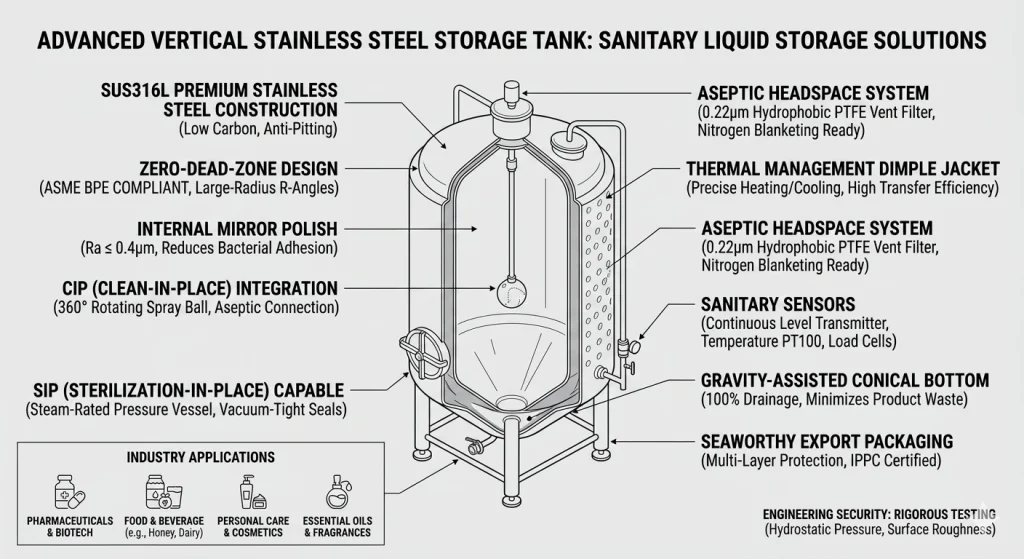
The Molybdenum Advantage: SUS316L contains 2-3% Molybdenum, an element that creates a robust passive layer against chloride-induced pitting. This is a non-negotiable requirement for Sanitary Liquid Storage Solutions handling saline-based pharmaceuticals or acidic juices.

Preventing Sensitization: The “L” in 316L (Low Carbon, ≤ 0.03%) is critical during the TIG welding process. High-carbon steel undergoes “carbide precipitation” at the heat-affected zone, leading to intergranular corrosion. Our low-carbon construction ensures that the vessel remains chemically inert for over 25 years, even under the stress of repeated thermal cycling in Aseptic Processing Equipment.


Engineering the “Zero-Dead-Zone” Environment

In Aseptic Processing Equipment, what you cannot see can harm your brand. Traditional industrial tanks often harbor “shadow zones” where cleaning fluids cannot reach with sufficient velocity, leading to the rapid formation of biofilms.

  • Surface Topography (Ra Factor): We mirror-polish internal walls to Ra ≤ 0.4µm. To the naked eye, this is a mirror finish; microscopically, it means the “peaks and valleys” of the metal surface are smaller than most common bacteria. This smooth topography reduces the mechanical bonding of proteins and fats, increasing cleaning efficiency by up to 90%.
  • The Geometry of Hygiene: 90-degree corners are “bacteria traps.” Our Sanitary Liquid Storage Solutions utilize large-radius R-angles (Radius ≥ 10mm) at all junctions. This geometry ensures that when CIP fluids enter the tank, they maintain a turbulent flow (Reynolds number > 4000). This turbulence provides the necessary mechanical shearing force to lift residues and prevent the invisible buildup of organic matter.
  • Flush-Mounted Fittings: All ports, including the manhole and sensors, use flush-mounted or tri-clamp aseptic designs to eliminate crevices where stagnant liquid might settle.

Automation: The ROI of CIP and SIP Systems

Modern Total Cost of Ownership (TCO) analysis proves that the most expensive part of a tank is not its purchase price, but the operational downtime required for maintenance within Hygienic Fluid Handling workflows.

  • Dynamic Clean-In-Place (CIP): Utilizing 360-degree high-impact rotating spray balls, our systems ensure full coverage with optimized impingement force. Data from integrated facilities shows that automated CIP reduces water and detergent consumption by 35% to 55% compared to manual scrubbing, while providing a validated 10^-6 microbial log-reduction.
  • Sterilization-In-Place (SIP) Integrity: For the biotech and vaccine sectors, “clean” is secondary to “sterile.” Our tanks are designed as ASME-rated pressure vessels capable of withstanding saturated steam at 2.1 bar. The engineering focus here is on Thermal Expansion Management: ensuring that vacuum-tight seals and gaskets remain intact during rapid temperature swings exceeding 100°C.
  • Smart Integration: By equipping Sanitary Liquid Storage Solutions with PT100 temperature sensors and high-accuracy load cells, the system provides real-time feedback to your PLC, allowing for a fully traceable, “human-error-free” sterilization cycle.

Field-Proven Industry Applications & Export Excellence

Honey & Edible Oils

Vertical sanitary tanks with えくぼジャケット allow for precise heat transfer, maintaining a steady 40°C (104°F) with a temperature deviation of less than ±1°C. This precision is vital for the Sanitary Liquid Storage Solutions used in high-viscosity food production.

Pharmaceuticals & Personal Care

Tanks are fitted with 0.22µm hydrophobic PTFE vent filters to block 99.9999% of airborne contaminants, a standard practice in Aseptic Processing Equipment to ensure a sterile headspace during drawdown.

Global Delivery Standards

For our international clients, the solution is not finished until the tank arrives in “factory-fresh” condition. We utilize Seaworthy Packaging (IPPC-certified) and provide full documentation including Hydrostatic Pressure Test Certificates, Surface Roughness Reports, and CE Compliance Declarations.


Ensuring Long-Term Production Security

With 14 years of manufacturing excellence, our engineering team focuses on providing “production security.” By integrating superior Sanitary Liquid Storage Solutions into your facility, we ensure every vessel undergoes a rigorous Factory Acceptance Test (FAT), allowing you to focus on scaling without the hidden costs of equipment failure.


Common Inquiries from the Field

Q: Why is the “Zero-Dead-Zone” design so critical for biological processing?

A: 90-degree corners are breeding grounds for biofilms. We utilize large-radius arcs (Radius >= 10mm) to ensure CIP fluids maintain turbulent flow (Reynolds > 4000). This eliminates microbial traps and achieves a validated 10^-6 log-reduction in bacteria, preventing cross-batch contamination.

Q: How do SUS304 and SUS316L impact your long-term ROI?

A: SUS316L contains 2-3% Molybdenum, specifically engineered for high-salinity or acidic environments. While the initial investment is higher, its superior resistance to pitting corrosion extends the vessel’s lifespan to 25+ years, preventing catastrophic batch losses and lowering the Total Cost of Ownership (TCO).

Q: What is the economic advantage of a Conical Bottom in Hygienic Fluid Handling?

A: The conical structure leverages gravity for 100% zero-residue discharge. For high-value liquids like essential oils or pharmaceutical slurries, this eliminates product waste (the “heel”) and significantly reduces the time and chemicals required for the cleaning cycle.


メール WhatsApp