
Every master beekeeper và high-volume honey processor has faced the “Wet Harvest” crisis. You have managed the colonies perfectly, và the bees have captured the fleeting, ethereal essence of a specific bloom—Lavender, Orange Blossom, Manuka, or rare Highland nectars. But environmental humidity is high, the honey is “thin” (exceeding 20% moisture), và the threat of fermentation looms.
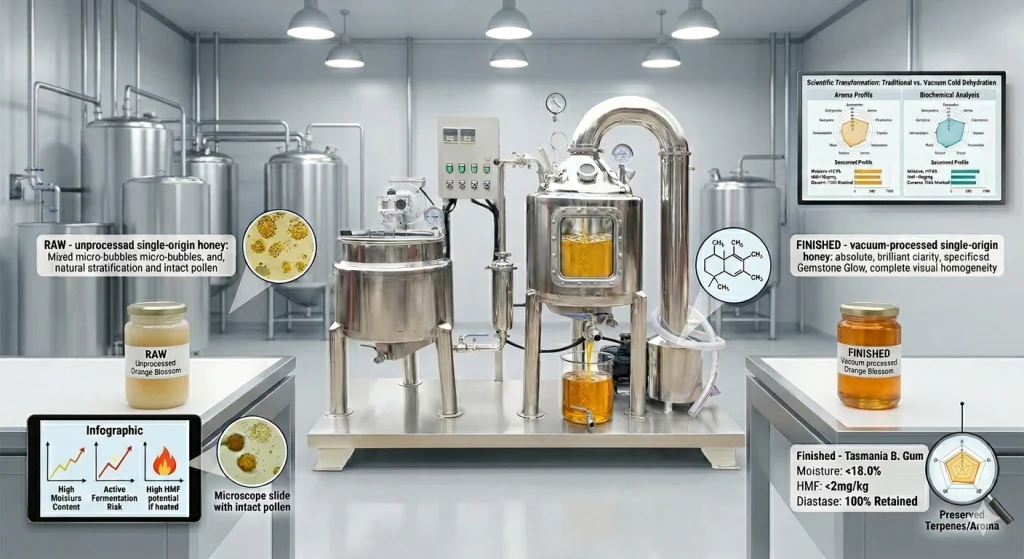
In professional circles, the debate is often polarized: “Do I sell it runny và risk a total loss via fermentation, or do I ‘cook’ it và kill the soul of the honey?” To the connoisseur, honey is a living, aromatic jewel. To the global distributor, it must be a stable, consistent product that meets rigorous lab standards. The bridge between these two worlds is not raw heat—it is Precision Physics. Working in tandem with a specialized, low-temperature máy lọc mật ong, Bảo vệ Hương thơm Mật ong đơn hoa depends on the -0.092 MPa vacuum threshold to keep the “Raw” heart beating while achieving global shelf stability.
From a sensory và psychological perspective, the “nose” or bouquet is the first indicator chất lượng. Before a consumer even tastes the sweetness, they experience the volatile top notes. Traditional dehydration methods are, quite literally, “Scent Thieves.”
Trong một phòng sưởi ngoài trời hoặc một bộ bay hơi nhanh tiêu chuẩn, nước không bay hơi một cách độc lập. Nó tạo thành một liên kết sôi chung với các este dễ bay hơi tinh tế của mật ong. Đây là một quá trình tự nhiên Chưng cất hơi nước quá trình. Nếu cơ sở xử lý của bạn có mùi thơm như một khu vườn đâm chồi trong quá trình sản xuất, đó là báo động chẩn đoán: tài sản quý giá nhất của bạn—hương thơm—đang bị xả ra môi trường như chất thải.
Thông qua Khử nước lạnh chân không, chúng tôi tạo ra một môi trường được tối ưu hóa vượt qua logic bay hơi tiêu chuẩn. Bằng cách sử dụng độ sâu chính xác của -0.092 MPa, chúng tôi điều chỉnh cân bằng pha của chất lỏng.
Theo Mối liên hệ Clausius-Clapeyron, mối quan hệ giữa áp suất và nhiệt độ sôi là tuyệt đối về mặt toán học:
ln(P₂ / P₁) = –(ΔHᵥₐₚ / R) × (1/T₂ – 1/T₁)
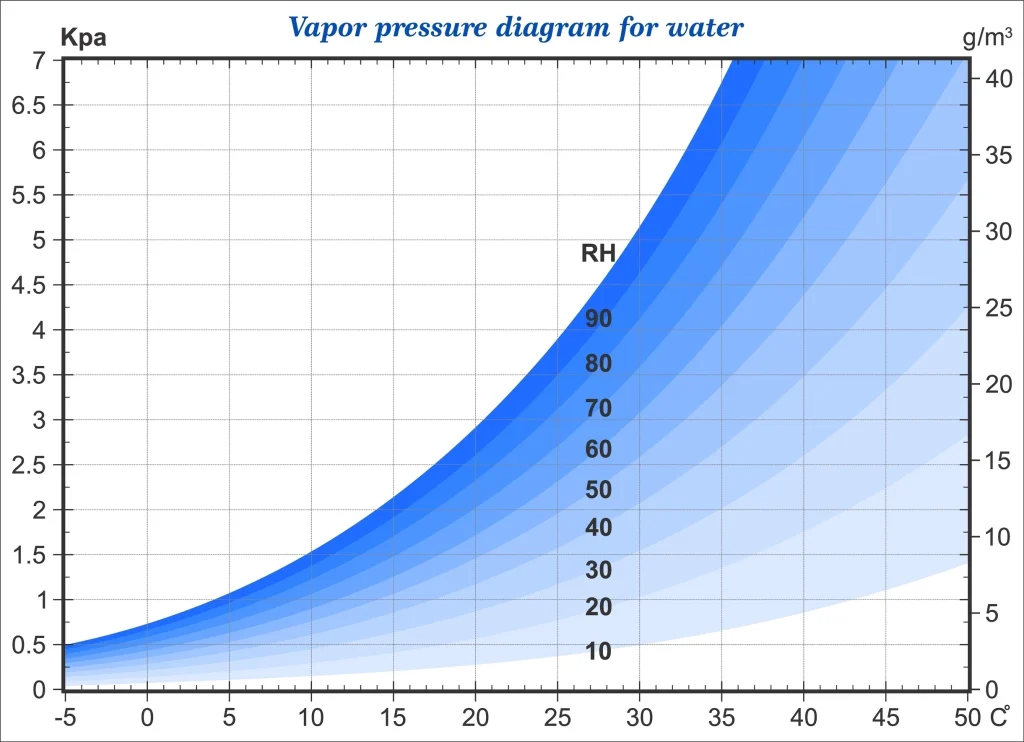
Công thức này chứng minh rằng ở -0,092 MPa, nước đạt tới ngưỡng sôi tự nhiên của tổ ong. 38°C (100,4°F). In this state, water molecules are gently coaxed out, while the heavier, flavor-dense aromatic molecules lack the energy to cross the evaporation threshold. They remain “locked” within the sugar matrix.
| Môi trường áp lực | Điểm sôi của nước | Tác động xử lý | Mức độ Bảo vệ Hương thơm |
| Khí quyển (0 MPa) | 100°C | Hỏa hoạn nặng | 0% (Mùi hương đã bị phá hủy) |
| Chân Không Thấp (-0,05 MPa) | ~80°C | Tổn Thương Nhiệt Cao | 20% (caramen) |
| Chênh áp trung bình (-0,08 MPa) | Khoảng 60°C | Sự phân hủy enzyme | 50% ( Mùi hương phai nhạt ) |
| Máy hút chân không Panchi Deep (-0.092 MPa) | 38°C | Hive-Natural Mô Phỏng | 95% – 100% (Perfect Khóa) |
For the high-end market, “Raw” is not merely a marketing label; it is a chemical và biological standard. To maintain this, a facility must transition to Mật ong xử lý không gây tác động nhiệt.
Silencing the “Caramel Noise”
Khi mật ong bị stress nhiệt, nó sẽ sinh ra HMF (Hydroxymethylfurfural)Ngoài việc là một dấu hiệu cảnh báo về quy định để xuất khẩu, HMF tạo ra những gì chúng tôi gọi là “Caramel Noise”—a heavy, burnt-sugar taste that masks the light, sophisticated floral notes of monofloral nectars. By keeping processing temperatures under 40°C, we ensure the “floral melody” of the original bloom is heard clearly by the palate without the interference of heat-induced chemical byproducts.
Các hợp chất thơm như Linalool (Oải hương) hoặc Limonene (Citrus) are the chemical fingerprints of the flower. These terpenes are highly sensitive to oxidative stress. Traditional processing ruin these molecules by stripping them away. By operating at -0.092 MPa, we preserve the chemical integrity of these terpenes, ensuring the “floral melody” remains vibrant và recognizable to the connoisseur.
The sophisticated honey user values the “living” properties of honey. Enzymes like Diastase và Invertase là các protein nhạy nhiệt do ong thêm vào. Các enzyme này là bằng chứng sinh học về chất lượng. Sử dụng hệ thống chân không của chúng tôi, chúng tôi đảm bảo một Tỷ lệ giữ hoạt tính sinh học 100%. If the enzymes are preserved, the laboratory status remains “Raw,” allowing the producer to command a significant price premium.
| Chỉ số | Mất nước truyền thống | Hệ Thống Bụi Vacuum Panchi | Tiêu Chuẩn Xuất Khẩu (EU/Nhật Bản) |
| HMF (Hydroxymethylfurfural) | 25 – 50 mg/kg | < 2 mg/kg | < 40 mg/kg |
| Hoạt độ enzyme diastase | Giảm hơn 40% | Hoàn toàn giữ lại | 8 Đơn vị Schade |
| Hương Thơm Bay Hương | 40% – 60% Loss | Giữ chân 95% | Không áp dụng (Đỉnh cảm giác) |
| Ngoại hình trực quan | Ám/Đen tối | Độ trong suốt của đá quý | Màu sắc điển hình của loại giống |
Consumers shop with their eyes first. Cloudy honey or honey with a layer of foam is perceived as “spoiled,” “industrial,” or “old.” However, micro-bubbles are more than an aesthetic nuisance; they are Các Kho Dự Trữ Oxy.
Oxy là chất xúc tác chính cho quá trình phân hủy oxy hoá các hợp chất terpen thơm vòng. Mật ong chứa đầy khí không khí sẽ nhanh chóng thay đổi hương vị. Ví dụ, mùi hương sảng khoái, cam quýt của mật ong Nhân tố Cam có thể trở nên nhạt nhòa, ngọt ngào cũ kỹ chỉ trong vài tháng nếu bị tiếp xúc với quá trình oxy hóa bên trong.
Là một phần của chúng tôi Khử nước lạnh chân không workflow, the system forcefully extracts these micro-bubbles. This creates an anaerobic (oxygen-free) environment inside the liquid, effectively vacuum-sealing the fragrance. The result is a brilliant transparency—the “Gemstone Glow”—which serves as a visual promise of a pure, unaltered experience.
Modern consumers are instinctively wary of “industrialized” food. They seek a direct connection from the hive to the table. When a user experiences a sudden “bloom” of fresh floral aroma upon opening a jar, it triggers a powerful neurological pleasure response. This is the Lợi tức đầu tư (ROI) chất lượng.
| Sợ hãi của người nuôi ong/xử lý ong | Hệ quả truyền thống | Giá trị Chiến lược của Panchi | Kết quả kinh tế |
| Loss of “Raw” Status | Reclassified as “Processed” | Được chứng nhận Không nhiệt | 200% – 300% Price Markup |
| Mất mùi thơm | Vị Ngọt của Hàng Hóa | Chữ ký Hương thơm Khóa | Sự trung thành cao của khách hàng |
| Từ chối xuất hàng | Hỏng hóc HMF/Enzyme | Dự trữ an toàn lớn | Tiếp cận Thị trường Cao Cấp |
| Sự mục nát của kệ | OXHỈ/HỦY MÀU | Ổn định kỵ khí | Giảm Lợi nhuận/Phế phẩm |
Hỏi: Liệu việc tạo chân không sâu đến -0,092 MPa có thực sự cần thiết không?
A: Vật lý không khoan nhượng. Nếu chân không không đủ, điểm sôi vẫn quá cao. Nếu điểm sôi cao, bạn phải thêm nhiều nhiệt hơn. Mức độ áp suất cụ thể đó là sống còn đối với Bảo vệ Hương thơm Mật ong đơn hoa.
Q: Quá trình này có hiệu quả đối với mật ong có độ nhớt cao không?
A: Yes. Thick honeys trap air easily và suffer from uneven heat transfer. Deep vacuum environments allow for “low-temperature boiling,” ensuring uniform heat transfer và superior degassing without the need for aggressive agitation.
Q: Quá trình thoát khí có loại bỏ mùi không?
A: No. Aromatic compounds are typically “heavier” (higher molecular weight) than atmospheric gases. Our system is tuned to extract lightweight gases while the heavier scent molecules stay bound to the sugar matrix.
Tại Zhengzhou Panchi Machinery, we believe the best honey technology should be “invisible.” The machine should not change the honey; it should act as a guardian, blocking heat, oxygen, và time from eroding the scent.
Bằng cách thành thạo khoa học của Bảo vệ Hương thơm Mật ong đơn hoa, chúng tôi cho phép công sức của người nuôi ong và khả năng nghệ thuật tự nhiên của ong đến bàn của người tiêu dùng chính xác như thiên nhiên đã định—tinh khiết, đậm đặc và vô cùng thơm ngát.
Don’t let your hard work evaporate with the steam. Preserve its soul with Panchi Machinery.


WhatsApp: +8615736768129
Email: [email protected]
Địa chỉ: Trịnh Châu, tỉnh Hà Nam, Trung Quốc
Automatic Vacuum Honey Processing & Filtering Machine
Vacuum Low-Temperature Liquid Extraction & Concentration Unit
Custom Chưng cất hơi nước & Heat Reflux Essential Oil Equipment
Tập trung khí chân không nhiệt độ thấp SS304/316L
QN Spherical Vacuum Concentrator & Alcohol Recovery Unit
Multi-function Stainless Steel Vacuum Distillation & Extraction Unit
Hot Reflux Vacuum Liquid Extraction & Concentration Unit
Chưng Cất Hơi Xuyên Bên Ngoài Hiệu Ứng Đơn
Máy bay hơi chân không tuần hoàn ngoài dòng SJN Series kiểu hiệu đôi
Chúng tôi sẽ liên hệ với bạn trong vòng một ngày làm việc. Vui lòng chú ý đến email của bạn.
Máy xử lý và lọc mật ong tự động bằng chân không
Bộ Tách và Tinh Chế Lỏng Nhiệt Độ Thấp trong Không Khí Vacuum
Thiết bị chưng cất hơi nước tùy chỉnh và hệ thống hồi nhiệt để chiết xuất dầu essential
WhatsApp: +8615736768129
Email: [email protected]
Address: Thành phố Trịnh Châu, tỉnh Hà Nam, Trung Quốc


BẢO HÀNH © 2026 Công ty TNHH Máy móc Thiết bị Panchi Trịnh Châu | Chính sách Bảo mật

Nhóm của chúng tôi sẽ phản hồi trong vòng 24 giờ.
Cảm ơn! Chúng tôi sẽ liên hệ lại với bạn trong vòng 24 giờ.
Kiểm tra hộp thư đến (và thư rác) của bạn để nhận phản hồi của chúng tôi.