
Every master beekeeper y high-volume honey processor has faced the “Wet Harvest” crisis. You have managed the colonies perfectly, y the bees have captured the fleeting, ethereal essence of a specific bloom—Lavender, Orange Blossom, Manuka, or rare Highland nectars. But environmental humidity is high, the honey is “thin” (exceeding 20% moisture), y the threat of fermentation looms.
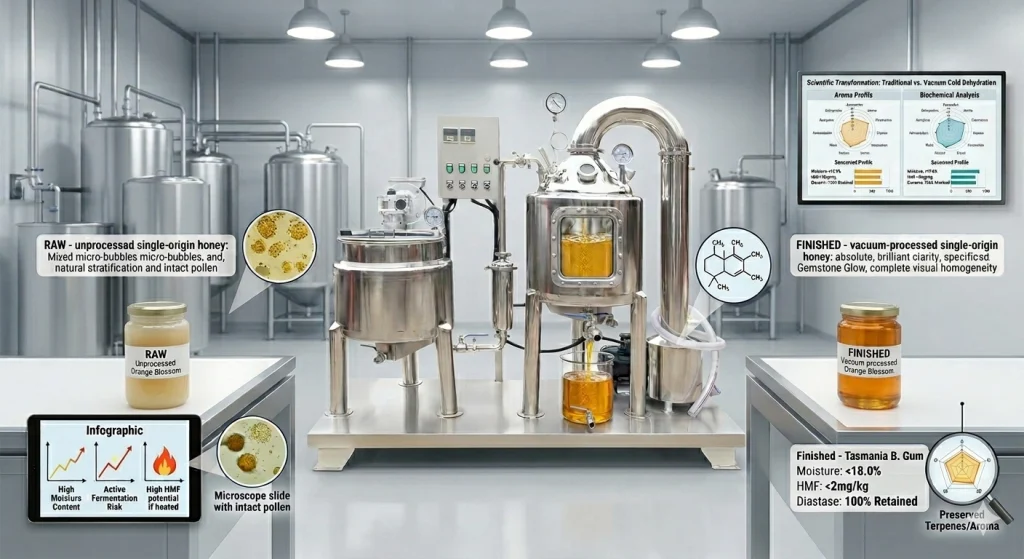
In professional circles, the debate is often polarized: “Do I sell it runny y risk a total loss via fermentation, or do I ‘cook’ it y kill the soul of the honey?” To the connoisseur, honey is a living, aromatic jewel. To the global distributor, it must be a stable, consistent product that meets rigorous lab standards. The bridge between these two worlds is not raw heat—it is Precision Physics. Working in tandem with a specialized, low-temperature máquina filtradora de miel, Protección del Aroma de Miel Monofloral depends on the -0.092 MPa vacuum threshold to keep the “Raw” heart beating while achieving global shelf stability.
From a sensory y psychological perspective, the “nose” or bouquet is the first indicator de calidad. Before a consumer even tastes the sweetness, they experience the volatile top notes. Traditional dehydration methods are, quite literally, “Scent Thieves.”
En una habitación de calefacción al aire libre o en un evaporador de destello estándar, el agua no se evapora en aislamiento. Forma un vínculo de co-efervescencia con los delicados ésteres volátiles de la miel. Esto es natural. Destilación por vapor proceso. Si su planta de procesamiento huele como un jardín en plena floración durante la producción, es una alarma diagnóstica: su activo más valioso—el aroma—está siendo liberado a la atmósfera como residuo.
A través de Deshidratación en frío por vacío, creamos un ambiente diseñado que desafía la lógica estándar de evaporación. Al utilizar una profundidad de precisión de -0.092 MPa, manipulamos el equilibrio de fases del líquido.
Según el Relación de Clausius-Clapeyron, la relación entre la presión y el punto de ebullición es matemáticamente absoluta:
ln(P₂ / P₁) = –(ΔHᵥₐₚ / R) × (1/T₂ – 1/T₁)
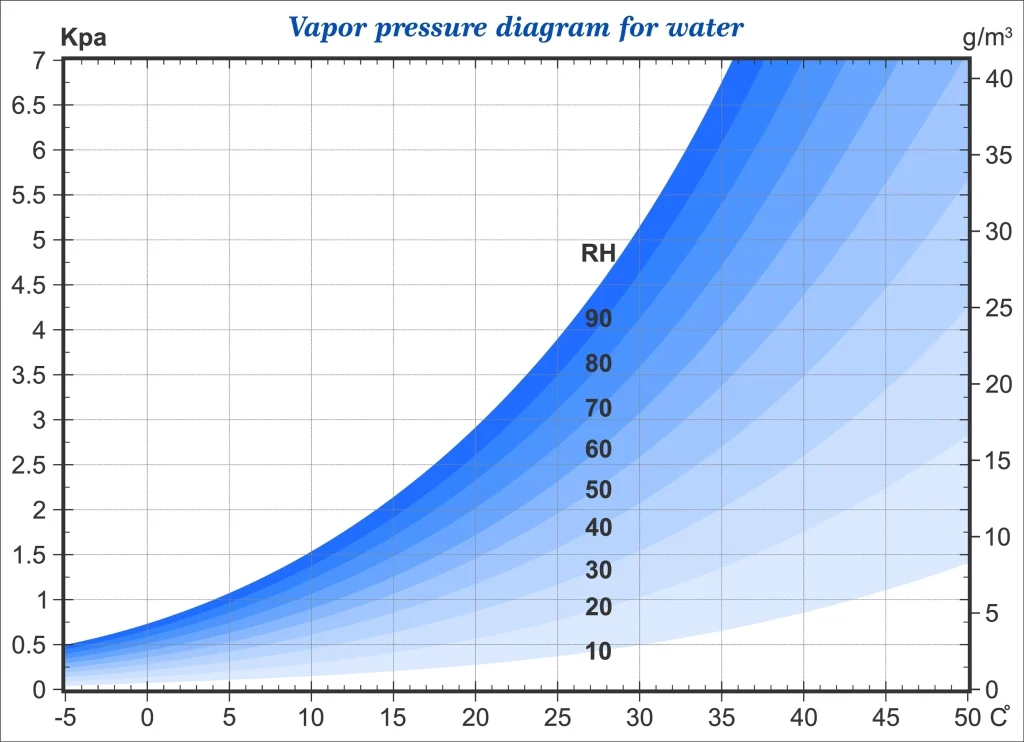
Esta fórmula demuestra que a -0,092 MPa, el agua alcanza su umbral de ebullición en una colmena natural. 38°C (100.4°F). In this state, water molecules are gently coaxed out, while the heavier, flavor-dense aromatic molecules lack the energy to cross the evaporation threshold. They remain “locked” within the sugar matrix.
| Entorno de Presión | Punto de ebullición del agua | Impacto del procesamiento | Nivel de Protección de Aroma |
| Atmosférico (0 MPa) | 100°C | Carbonización severa | 0% (Fragancia Destruida) |
| Bajo vacío (-0,05 MPa) | ~80°C | Daño Térmico Alto | 20% (Caramelizado) |
| Meta en vacío (-0,08 MPa) | ~60°C | Degradación de Enzimas | 50% (El olor desaparece) |
| Panchi Vacuum Profundo (-0,092 MPa) | 38°C | Imitación natural de Hive | 95% – 100% (Perfect Cerradura) |
For the high-end market, “Raw” is not merely a marketing label; it is a chemical y biological standard. To maintain this, a facility must transition to Miel de procesamiento sin impacto térmico.
Silencing the “Caramel Noise”
Cuando la miel está sometida a estrés por calor, produce HMF (Hidroximetilfurfural)Más allá de ser una señal de advertencia regulatoria para la exportación, HMF crea lo que llamamos “Caramel Noise”—a heavy, burnt-sugar taste that masks the light, sophisticated floral notes of monofloral nectars. By keeping processing temperatures under 40°C, we ensure the “floral melody” of the original bloom is heard clearly by the palate without the interference of heat-induced chemical byproducts.
Compuestos aromáticos como Linalool Lavanda) o Limoneno (Citrus) are the chemical fingerprints of the flower. These terpenes are highly sensitive to oxidative stress. Traditional processing ruin these molecules by stripping them away. By operating at -0.092 MPa, we preserve the chemical integrity of these terpenes, ensuring the “floral melody” remains vibrant y recognizable to the connoisseur.
The sophisticated honey user values the “living” properties of honey. Enzymes like Díastase y Invertasa son proteínas sensibles al calor añadidas por las abejas. Estas enzimas son la prueba biológica de calidad. Usando nuestro sistema de vacío, aseguramos un Tasa de Retención 100% de Bioactividad. If the enzymes are preserved, the laboratory status remains “Raw,” allowing the producer to command a significant price premium.
| Métrica | Deshidratación tradicional | Sistema de vacío Panchi | Estándar de Exportación (UE/Japón) |
| HMF (Hidroximetilfurfural) | 25 – 50 mg/kg | < 2 mg/kg | < 40 mg/kg |
| Actividad de la diastasa | cae más del 40% | 100% Retenido | 8 unidades de Schade |
| Aromas volátiles | 40% – 60% Loss | Retención del 95% | N/A (Pico Sensorial) |
| Apariencia visual | Nublado/Oscurecido | Claridad de la piedra preciosa | Color típico de la variedad |
Consumers shop with their eyes first. Cloudy honey or honey with a layer of foam is perceived as “spoiled,” “industrial,” or “old.” However, micro-bubbles are more than an aesthetic nuisance; they are Reservorios de oxígeno.
El oxígeno es el principal catalizador de la degradación oxidativa de los terpenos aromáticos. Una miel llena de aire incorporado se someterá a un cambio rápido en su sabor. Por ejemplo, el aroma vibrante y cítrico de la miel de flor de azahar puede convertirse en una dulzura insípida y pasada en cuestión de meses si se expone a la oxidación interna.
Como parte de nuestro Deshidratación en frío por vacío workflow, the system forcefully extracts these micro-bubbles. This creates an anaerobic (oxygen-free) environment inside the liquid, effectively vacuum-sealing the fragrance. The result is a brilliant transparency—the “Gemstone Glow”—which serves as a visual promise of a pure, unaltered experience.
Modern consumers are instinctively wary of “industrialized” food. They seek a direct connection from the hive to the table. When a user experiences a sudden “bloom” of fresh floral aroma upon opening a jar, it triggers a powerful neurological pleasure response. This is the Retorno de la inversión (ROI) de calidad.
| Miedo del apicultor/procesador | Consecuencia Tradicional | Valor Estratégico de Panchi | Resultado Económico |
| Loss of “Raw” Status | Reclassified as “Processed” | Certificado Cero-Térmico | 200% – 300% Price Markup |
| Pérdida de fragancia | Azúcar de producto sabor | Firma de Aroma Cerradura | Alta lealtad de los clientes |
| Rechazo de Exportación | Fallo de HMF/Enzima | Amplio margen de seguridad | Acceso a mercados de alta gama |
| Decaimiento de la estantería | Oxidación/Descoloración | estabilización anaeróbica | Devoluciones/Desperdicio reducido |
¿Es realmente necesario un vacío tan profundo como -0,092 MPa?
A: La física no hace concesiones. Si el vacío es insuficiente, el punto de ebullición permanece demasiado alto. Si el punto de ebullición es alto, debes agregar más calor. Esa profundidad de presión específica es la línea de vida para Protección del Aroma de Miel Monofloral.
¿Este proceso funciona para mieles de alta viscosidad?
A: Yes. Thick honeys trap air easily y suffer from uneven heat transfer. Deep vacuum environments allow for “low-temperature boiling,” ensuring uniform heat transfer y superior degassing without the need for aggressive agitation.
¿El proceso de desgasificación elimina el olor?
A: No. Aromatic compounds are typically “heavier” (higher molecular weight) than atmospheric gases. Our system is tuned to extract lightweight gases while the heavier scent molecules stay bound to the sugar matrix.
En Zhengzhou Panchi Machinery, we believe the best honey technology should be “invisible.” The machine should not change the honey; it should act as a guardian, blocking heat, oxygen, y time from eroding the scent.
Al dominar la ciencia de Protección del Aroma de Miel Monofloral, permitimos que el arduo trabajo del apicultor y el arte natural de la abeja lleguen a la mesa del consumidor exactamente como la naturaleza lo diseñó: puro, potente y profundamente aromático.
Don’t let your hard work evaporate with the steam. Preserve its soul with Panchi Machinery.


WhatsApp: +8615736768129
Correo electrónico: [email protected]
Dirección: Zhengzhou, Provincia de Henan, China
Automatic Vacuum Honey Processing & Filtering Machine
Vacuum Low-Temperature Liquid Extraction & Concentration Unit
Custom Destilación por vapor & Heat Reflux Essential Oil Equipment
Concentrador de Cuchara de Vacío a Baja Temperatura SS304/316L
QN Spherical Vacuum Concentrator & Alcohol Recovery Unit
Multi-function Stainless Steel Vacuum Distillation & Extraction Unit
Hot Reflux Vacuum Liquid Extraction & Concentration Unit
Concentrador de vacío de circulación externa de efecto único
Evaporador de vacío de circulación externa de doble efecto Serie SJN
Nos pondremos en contacto contigo dentro de un día hábil. Por favor, estate atento a tu correo electrónico.
Máquina automática de procesamiento y filtración de miel para aspiradoras
Unidad de Extracción y Concentración de Líquidos a Baja Temperatura en Vacío
Equipo de Destilación de Vapor Personalizada y Reflujo de Calor para Aceites Esenciales
WhatsApp: +8615736768129
Correo electrónico: [email protected]
Address: Zhengzhou, provincia de Henan, China


DERECHOS DE AUTOR© 2026 Zhengzhou Panchi Machinery Equipment Co., Ltd. | Política de Privacidad

Nuestro equipo responderá en 24 horas.
¡Gracias! Nos pondremos en contacto contigo en las próximas 24 horas.
Revisa tu bandeja de entrada (y la carpeta de spam) para nuestra respuesta.