
In the world of botanical processing y pharmaceutical manufacturing, the terminology used to describe fineness can often be confusing. Professionals frequently ask, “Malla vs. Micrón: ¿Cómo se ve realmente una malla de 1000?” Entendiendo this distinction is not merely a matter of semantics; it is the key to unlocking maximum bioavailability in medicinal herbs. When a powder reaches the 1000-mesh threshold, it transitions from a granular substance into a “smoke-like” state, where the particles are so fine they can penetrate cellular barriers with ease.
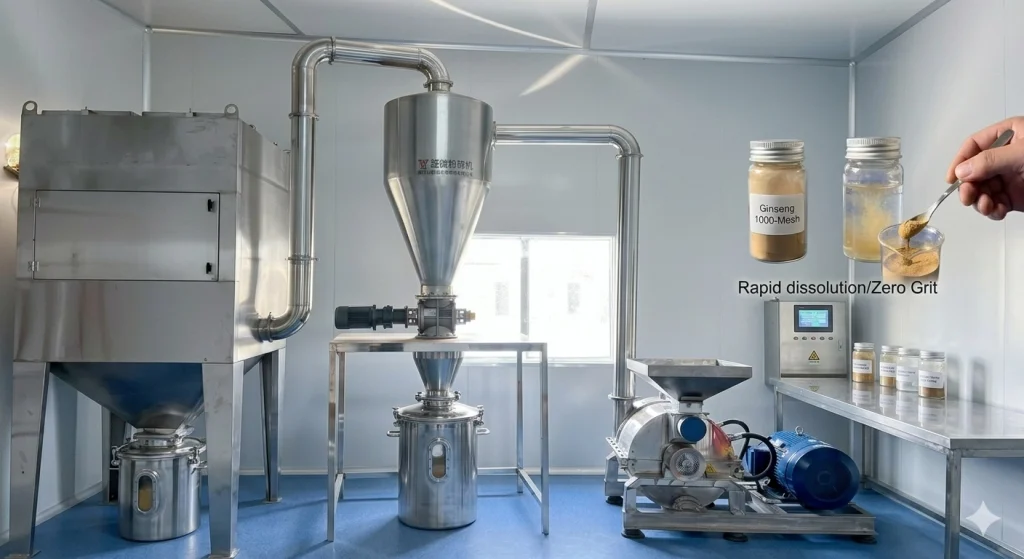
Discusión en plataformas como Reddit’s r/HerbalMedicine y Quora’s Materials Science las secciones a menudo destacan la lucha por lograr una micronización consistente. Los molinillos tradicionales a menudo fallan porque dependen de pantallas físicas que se obstruyen o rompen. Para entender verdaderamente Malla vs. Micrón: ¿Cómo se ve realmente una malla de 1000?, debemos analizar la física de la clasificación del flujo de aire utilizada en la Panchi Molino de molienda ultrafina para hierbas medicinales, que logra estas especificaciones extremas sin las limitaciones de las pantallas de malla tradicionales.
To visualize these measurements, it helps to compare them to familiar objects. The term “Mesh” refers to the number of openings per linear inch in a screen, while “Micron” (micrometer) is an absolute unit of length equal to one-millionth of a meter.
A medida que aumenta el número de malla, el tamaño de las partículas (micrones) disminuye.
Si sostuvieras polvo de malla 1000, notarías varias propiedades físicas únicas:
La razón principal para perseguir un objetivo de malla de 1000 es el Tasa de ruptura de la pared celular del 99%En botánicos como Panax Notoginseng o esporas de hongo Reishi, los ingredientes activos farmacéuticos (APIs) están atrapados detrás de paredes resistentes de celulosa o quitosano.
Standard grinding only breaks the plant material into smaller chunks of “cages.” However, the Molino Ultra-Fino Panchi utiliza un principio de pulverización de doble hoja sin pantalla para romper estas cáscaras microscópicas. Lograr una finura de malla de 1000 significa que la superficie se incrementa en miles de veces, lo que conduce a:
Absorción superior: Los nutrientes se liberan inmediatamente al ingerirlos, evitando la necesidad de una digestión mecánica extensa. La miel mantiene su color translúcido original y los compuestos volátiles florales que de otra manera escaparían hacia la atmósfera.
Disolución rápida: El polvo se disuelve o suspende instantáneamente en líquidos.
Cuando se busca alcanzar la marca de malla 1000, generalmente surgen dos obstáculos principales: el calor y el taponamiento.
| Desafío | Impacto en la calidad | Solución Panchi |
| Degradación Térmica | Las quemaduras por fricción de alta velocidad volatilizan los aceites y cambian de color. | Enfriamiento de aire integrado: El aire forzado y las chaquetas de agua opcionales mantienen el molino frío. |
| Atascamiento de malla | Hierbas aceitosas o azucaradas (como la Mirra) obstruyen la pantalla. | Diseño sin pantallas: Utiliza una clasificación de flujo de aire interno para separar las partículas por peso, no por tamaño. |
Al eliminar la pantalla física, la Panchi Mill puede producir de manera confiable polvo de malla 1000 (y hasta de malla 5000) sin el tiempo de inactividad asociado con la limpieza o reemplazo de mallas rotas.
Entendiendo Malla vs. Micrón: ¿Cómo se ve realmente una malla de 1000? is the first step in upgrading your production standards. In the competitive 2026 landscape of nutraceuticals y “Green Veterinary” medicine, the ability to provide a “wall-broken” powder is a major market differentiator.
Al aprovechar la forma en que... Molino de molienda ultrafina de hierbas medicinales Panchi, you aren’t just making powder smaller; you are making it more effective. Whether you are preparing clinical oral powders or high-end botanical cosmetics, mastering the 1000-mesh threshold ensures that every milligram of your raw material delivers its full therapeutic potential.
¿Es la malla de 1000 fina demasiado para todas las hierbas?
Answer: No necesariamente, pero es más beneficioso para materiales con paredes celulares duras o aquellos destinados a una rápida permeabilidad en la piel en cosméticos. Para mezclas de té simples, generalmente es suficiente una malla más gruesa de 60-100.
¿ Cómo se mide una malla de 1000 si no hay pantalla?
Answer: Measurement is done via laser diffraction particle size analyzers. The mill’s internal classification controller is adjusted to change the air-flow velocity, which determines exactly which particle weights are allowed to exit the chamber.
¿La molienda ultrafina causa más polvo en la fábrica?
Answer: The Panchi system is a fully enclosed, negative-pressure unit. This means the 1000-mesh “smoke” is captured directly into a pulse-jet dust collector, ensuring a dust-free y GMP-compliant workspace.


WhatsApp: +8615736768129
Correo electrónico: [email protected]
Dirección: Zhengzhou, Provincia de Henan, China
Automatic Vacuum Honey Processing & Filtering Machine
Vacuum Low-Temperature Liquid Extraction & Concentration Unit
Custom Steam Distillation & Heat Reflux Essential Oil Equipment
Concentrador de Cuchara de Vacío a Baja Temperatura SS304/316L
QN Spherical Vacuum Concentrator & Alcohol Recovery Unit
Multi-function Stainless Steel Vacuum Distillation & Extraction Unit
Hot Reflux Vacuum Liquid Extraction & Concentration Unit
Concentrador de vacío de circulación externa de efecto único
Evaporador de vacío de circulación externa de doble efecto Serie SJN
Nos pondremos en contacto contigo dentro de un día hábil. Por favor, estate atento a tu correo electrónico.
Máquina automática de procesamiento y filtración de miel para aspiradoras
Unidad de Extracción y Concentración de Líquidos a Baja Temperatura en Vacío
Equipo de Destilación de Vapor Personalizada y Reflujo de Calor para Aceites Esenciales
WhatsApp: +8615736768129
Correo electrónico: [email protected]
Address: Zhengzhou, provincia de Henan, China


DERECHOS DE AUTOR© 2026 Zhengzhou Panchi Machinery Equipment Co., Ltd. | Política de Privacidad

Nuestro equipo responderá en 24 horas.
¡Gracias! Nos pondremos en contacto contigo en las próximas 24 horas.
Revisa tu bandeja de entrada (y la carpeta de spam) para nuestra respuesta.