
Dalam hierarki superfood global, madu tidak lagi sekadar pemanis; ia adalah makanan fungsional bersertifikat farmasi. Madu Manuka dari Selandia Baru dan madu Biji Hitam (Nigella Sativa) dari Mesir dan Levant memerintahkan harga premium karena profil antimikroba mereka yang unik—Methylglyoxal (MGO) dalam Manuka dan Thymoquinone dalam madu Biji Hitam. Untuk mempertahankan senyawa halus ini, diperlukan proses khusus Pengolahan Madu Bioaktif diperlukan, memastikan bahwa sifat obat alami tidak terganggu oleh suhu yang terlalu tinggi atau penanganan yang tidak tepat selama proses produksi.
However, for producers, these honeys present a “Technical Paradox.” Their value lies in their complexity, yet that complexity is incredibly fragile. On platforms like Reddit r/Perlebahan, ketakutan yang paling umum adalah: “Why did my lab-certified activity drop by 30% after processing?” Jawaban hampir selalu adalah degradasi termal. Untuk memastikan Pelestarian Kualitas Manuka, seseorang harus menguasai Dekontaminasi non-termal pada vakum presisi dari -0,092 MPa.
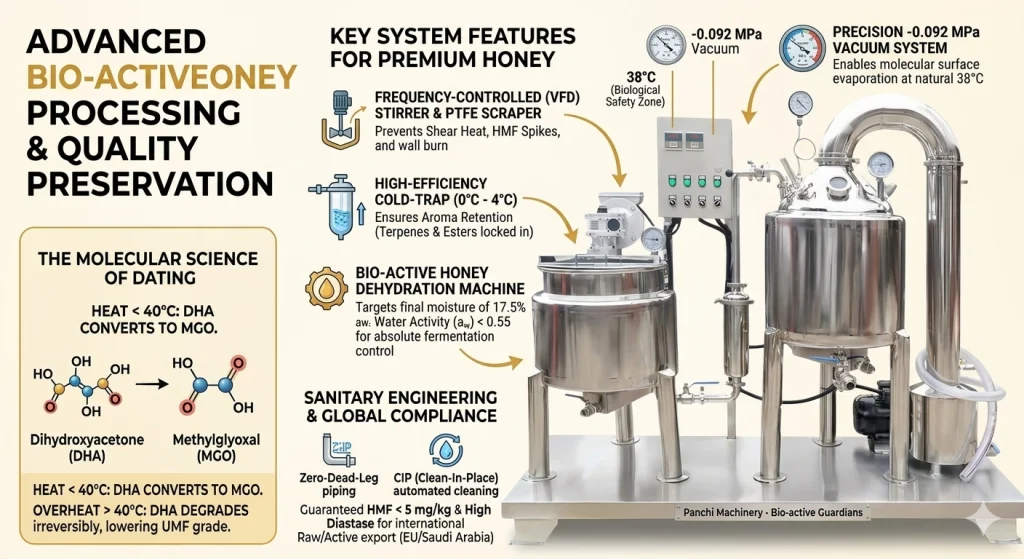
Untuk menjembatani kesenjangan antara panen mentah dan produk bersertifikasi bernilai tinggi, pilihan peralatan adalah faktor yang paling menentukan. Sebuah peralatan khusus Mesin Pengering Madu acts as a safeguard for these biological assets. Unlike generic evaporators, a precision-engineered machine allows for the removal of excess moisture while operating within the “biological safety zone.” By investing in the right technology, producers can ensure that their honey meets the strict export standards for HMF dan Diastase, effectively turning a raw agricultural commodity into a premium, medical-grade pharmaceutical asset.
Nilai Manuka ditentukan oleh nya UMF (Faktor Manuka Unik). But the industry secret is that MGO isn’t at its peak at harvest; the honey contains DHA (Dihydroxyacetone), pendahulu dari MGO.
Jendela Pematangan
Dekontaminasi non-termal protects this chemical “potential energy,” ensuring the honey matures into a higher-value product after bottling.
To remove water without “cooking” the honey, we must manipulate the boiling point of water. Pada standard pressure, water boils at 100°C—a temperature that instantly “kills” the biological integrity of Black Seed dan Manuka honey.
Evaporasi Permukaan vs. Pendidihan Hebat
Dalam Pengolahan Madu Bioaktif, kita harus menghindari “Bumping” (gelembung mendidih yang keras). Penyebab benturan:
Dengan mempertahankan vakum yang konstan dari -0,092 MPa, molekul air keluar dari matriks madu tepat pada 38°C (100.4°F). This mimics the natural temperature inside a healthy, active beehive. This is the only way to achieve moisture reduction while keeping the honey in its “Raw” state.
Madu Biji Hitam dihargai karena aromanya yang menyengat dan berobat, didukung oleh terpen volatil. Quora, many buyers complain that processed honey “tastes like sugar syrup.” This is because traditional vacuum systems suck out the aromatic esters along with the water vapor.
Untuk mengunci profil sensorik madu premium:
Fisika: Ini menciptakan perbedaan tekanan uap yang besar. Uap air mengembun secara instan, tetapi minyak aromatik yang lebih berat dan terpen tetap terhambat untuk keluar dan tetap larut dalam madu.
Teknologi: Sebuah unit dehidrasi profesional harus menggunakan a pengumpul dingin air cair (0°C hingga 4°C).
Madu dengan aktivitas tinggi sering memiliki kadar air awal yang tinggi (22%-24%). Jika tidak dikurangi, ragi osmotrofik akan memicu fermentasi:
Presisi Pengendalian Kelembapan Madu menuju pada tingkat 17,2% sampai 17,5%, yang menurunkan the Aktivitas Air (aw) di bawah 0.55Di tingkat ini, ragi memasuki masa dormansi permanen, dan stabilitas kimia dari penanda bioaktif dimaksimalkan tanpa perlu pasteurisasi.
Manuka dan banyak madu dengan aktivitas tinggi adalah Thixotropic—mereka berwujud gel saat diam tetapi mengalir saat diaduk. Ini menciptakan bahaya tersembunyi: Pemanasan Geser.
Jika bilah pengaduk berputar terlalu cepat dalam madu berviskositas tinggi, gesekan menghasilkan panas lokal. Termometer di tangki utama Anda mungkin membaca aman 38°C, tetapi di ujung bilah, bisa melonjak hingga 50°C.
Solusi: Profesional Pengolahan Madu Bioaktif Peralatan menggunakan Penggerak Frekuensi Variabel (VFD) dan bilah berkemiringan khusus untuk memastikan pergerakan volume tinggi dengan gesekan kecepatan rendah, menghilangkan risiko kehilangan aktivitas yang disebabkan oleh geseran.
Untuk Pelestarian Kualitas Manuka, proses linier tidak cukup. Kami merekomendasikan gradien 4 tahap:
| Tahap | Tingkat Vakum | Suhu Madu | Kegelisahan | Tujuan |
| Saya: Pemanasan | Lingkungan | 32°C – 35°C | Rendah | Kristal glukosa yang mencair secara seragam |
| II: Pengeluaran gas | -0,05 MPa | 35°C | Sedang | Cegah busa permukaan |
| III: Dehidrasi | -0,092 MPa | 38°C | Dioptimalkan | Penguapan permukaan molekuler |
| IV: Stabilisasi | -0.08 MPa | 30°C | Rendah | Aromatik Lock |
Dalam industri bio-aktif, satu batch residu yang terkontaminasi silang dapat merusak pesanan ekspor sebesar 10 ton.
Pembeli internasional, terutama di Uni Eropa dan Arab Saudi, memiliki batasan ketat pada HMF (Hydroxymethylfurfural) dan Diastase.
Dengan menggunakan Dekontaminasi non-termal technology, you can guarantee HMF levels di bawah 5 mg/kg. This is the “passport” for your honey to enter the most lucrative markets in the world.
Pasar madu bioaktif tidak lagi sekadar tentang pemeliharaan lebah; ini tentang rekayasa presisi. Apakah Anda sedang menangani kekhawatiran tentang Reddit tentang fermentasi atau memastikan madu Anda memenuhi UMF 20+ standar untuk sebuah butik di Dubai, teknologi tetap sama: -0,092 MPa adalah standar emas.
Pada Mesin Panchi, kami menyediakan alat untuk mengubah hasil panen mentah menjadi aset aktif bernilai tinggi. Melindungi DHA, menstabilkan MGO, dan mempertahankan aroma adalah ilmu pengetahuan kami.
Mengapa pelestarian DHA lebih penting daripada kadar MGO langsung selama proses?
A: Dalam profesional Pengolahan Madu Bioaktif, prioritasnya adalah DHA, prekursor yang secara alami matang menjadi MGO inside the jar. This conversion is highly thermo-sensitive. If temperatures exceed 40°C, DHA decomposes instead of converting, destroying the honey’s potential to reach higher UMF grades. Dengan menggunakan a -0,092 MPa vacuum to maintain the process at 38°C, we protect this chemical “battery.” This ensures the honey continues to increase in potency dan market value long after processing, securing your long-term profit through scientific maturation.
Q: How does the combination of a -0,092 MPa vacuum dan a 4°C Cold Trap prevent a “Bland Taste”?
A: Aroma madu berasal dari terpen dan ester yang mudah menguap. Dalam sistem standar, zat-zat ini keluar bersama uap air, meninggalkan rasa sirup yang umum. Kunci untuk Pelestarian Kualitas Manuka adalah a Chilled-Water Cold Trap (0°C – 4°C). This creates a massive temperature differential that snaps water vapor into liquid instantly. Simultaneously, the freezing barrier strips kinetic energy from aromatic oils, inhibiting their escape dan locking them back into the honey matrix. This thermodynamic shield preserves the complex, medicinal “terroir” that premium consumers demand.
Q: What is the mechanical necessity of the PTFE Scraper in preventing “Hidden HMF Spikes”?
A: Madu dengan aktivitas tinggi bersifat thixotropic (kental). Tanpa Pengikis PTFE, lapisan stagnan menempel pada dinding tangki yang dipanaskan. Bahkan jika suhu bulk menunjukkan 38°C, lapisan tipis ini dapat menyentuh suhu di atas 50°C, yang menyebabkan peningkatan HMF (penanda kerusakan akibat panas). Dekontaminasi non-termal relies on these scrapers to constantly wipe the interior walls, ensuring total thermal uniformity dan preventing “hot spots.” This mechanical exchange keeps HMF levels di bawah 5 mg/kg, essential for passing strict international inspections dan maintaining “Raw” certification.


WhatsApp: +8615736768129
Email: [email protected]
Alamat: Zhengzhou, Provinsi Henan, China
Automatic Vacuum Honey Processing & Filtering Machine
Vacuum Rendah-Temperature Liquid Extraction & Concentration Unit
Custom Steam Distillation & Heat Reflux Essential Oil Equipment
Konsentrator Pengikis Vakum Suhu Rendah SS304/316L
QN Spherical Vacuum Concentrator & Alcohol Recovery Unit
Multi-function Stainless Steel Vacuum Distillation & Extraction Unit
Hot Reflux Vacuum Liquid Extraction & Concentration Unit
Kami akan menghubungi Anda dalam satu hari kerja. Mohon perhatikan email Anda.
Mesin Pengolahan dan Penyaringan Madu Vakum Otomatis
Unit Ekstraksi dan Konsentrasi Cairan Suhu Rendah Vakum
Peralatan Distilasi Uap Khusus dan Refluks Panas untuk Minyak Atsiri
WhatsApp: +8615736768129
Email: [email protected]
Address: Zhengzhou, Provinsi Henan, Tiongkok


HAK CIPTA© 2026 Zhengzhou Mesin Panchi Equipment Co., Ltd. | Kebijakan Privasi

Tim kami akan merespons dalam waktu 24 jam.
Terima kasih! Kami akan segera menghubungi Anda dalam waktu 24 jam.
Periksa kotak masuk (dan folder spam) untuk balasan kami.