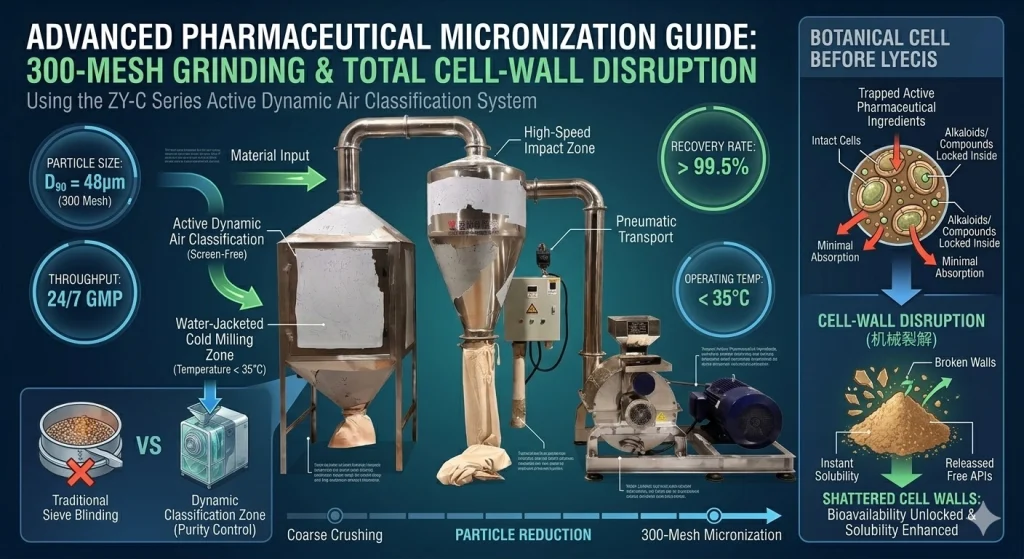
The global pharmaceutical and nutraceutical sectors are witnessing a profound shift from traditional crushing to extreme micronization. In 2026, the standard for high-end botanical products is no longer just “fine powder” but “bioactive precision.” As the efficacy of natural products becomes tied to their molecular release rates, the demand for equipment capable of handling “un-grindable” materials—specifically the notoriously fibrous and oily Areca Nut (Betel Nut)—has reached an all-time high.

The core challenge lies in the material’s innate resistance to reduction. Traditional methods often compromise the chemical integrity of the alkaloids or fail to reach the particle size necessary for true Cell-Wall Disruption. This analysis explores the physics of botanical pulverization and demonstrates why the ZY-C Series 医療用ハーブ超微粒子粉砕機 is the definitive solution for reaching 300-mesh (48μm) and beyond without compromising material integrity.
To solve the challenges of Areca Nut Grinding, we must first address the mechanical and thermal failure points inherent in legacy systems. Understanding these “points of failure” is essential for any engineer looking to optimize production efficiency and product quality.
Areca nuts possess a dense, wood-like fibrous structure consisting of complex cellulose and lignin chains. Traditional hammer mills rely on a physical sieve to control particle size, which acts as a passive filtration method.
Areca nuts contain delicate alkaloids, primarily Arecoline, and various polyphenols that are highly sensitive to thermal spikes.
To quantify the advantages of advanced micronization, the following tables outline the technical benchmarks required for successful industrial processing.
| 特徴 | 伝統的ハammerミル | ZY-C Ultra-Fine Mill |
| Particle Size (Mesh) | 80 – 120 Mesh | 300 – 800 Mesh |
| Material Discharge | Passive Sieve / Screen | Active Dynamic Classifier |
| Fiber Handling | Causes “Cottonization” | Total Pulverization |
| Heat Management | High (Up to 80°C+) | Low (Below 35°C) |
| Cell-Wall Disruption | Minimal (< 15%) | Maximum (> 95%) |
| Alkaloid Preservation | Low (Thermal Damage) | High (Cold Milling) |
| Recovery Rate | 85% – 92% | 99.5% – 99.9% |
| Target Mesh | Micron Size (μm) | Application Level | Bioavailability Effect |
| 100 Mesh | 150 μm | Standard Culinary | Low (Cells intact) |
| 200 Mesh | 75 μm | Basic Health Supplement | Moderate Release |
| 300 Mesh | 48 μm | Pharmaceutical Grade | High (Cell-Wall Disruption) |
| 500 Mesh | 25 μm | Advanced Extraction | Instant Solubility |
| 800 Mesh | 18 μm | Nano-Botanical APIs | Peak Molecular Absorption |
The ZY-C Series solves the aforementioned issues by replacing the passive physical sieve with Active Dynamic Air Classification. This represents a paradigm shift in how we approach the grinding of fibrous materials.
The high-speed Classifying Rotor creates a precise centrifugal field within the mill. This eliminates the mechanical bottleneck of the sieve.
Maintaining a low-temperature environment is critical for preserving the bioactivity of the Areca Nut.
Achieving 300-mesh is not just an aesthetic choice; it is a biological necessity for Cell-Wall Disruption. This process is the key to unlocking the true medicinal value of the plant material.
Most medicinal compounds are locked within rigid cell walls made of cellulose. Traditional grinding (80-120 mesh) merely breaks the plant into smaller “chunks,” leaving the majority of individual cells intact.
By shattering the cellular barrier, the resulting powder offers instantized solubility. When consumed or used in extraction:
Investing in ultra-fine Areca Nut Grinding technology is a strategic business decision that impacts the entire production lifecycle.
With high-value medicinal herbs, material waste is a direct hit to the bottom line.
Modern manufacturing requires strict adherence to hygiene protocols.
Q: How does ZY-C prevent “cottonization” during Areca Nut Grinding?
A: Traditional mills shred fibers into a cotton-like mass that clogs sieves. ZY-C utilizes high-velocity impact and immediate air removal to pulverize fibers into fine shards in milliseconds. By removing the material from the grinding zone the moment it reaches the target size, it prevents the mechanical friction and “matting” that characterizes legacy systems.
Q: Why is 300-mesh critical for Cell-Wall Disruption?
A: Standard 80-mesh grinding leaves plant cells intact, effectively “locking” active compounds away from the consumer. At 300-mesh (48μm), the particle size is fine enough to achieve Mechanical Lysis, shattering the rigid cellulose walls. This liberates alkaloids and APIs, significantly increasing bioavailability and solubility.
Q: Can the system achieve finer results, such as 800-mesh?
A: Yes. The ZY-C Series is highly adaptable. By increasing the classifying rotor RPM and adjusting the air volume via the PLC, the system creates a stronger centrifugal field. This allows for the precision discharge of particles as small as 15-20μm (800-mesh) while maintaining a tight D90 distribution, which is essential for uniform dosing in pharmaceutical applications.
そのAreca Nut Grinding of tenacious botanicals to a 300-mesh standard is now a validated industrial process. As global regulations tighten and consumer expectations for “high potency” products grow, the transition from traditional crushing to Ultra-Fine Micronization is a vital strategic move.
By combining the precision of Dynamic Air Classification with the thermal protection of Cold Milling Technology, the ZY-C Series empowers manufacturers to unlock the full potential of their botanical raw materials through absolute Cell-Wall Disruption. It provides the reliability, recovery rates, and purity required to lead the market in 2026 and beyond.