
Publié par :Équipe mondiale d'ingénierie et de conformité
Revue Technique :Ingénieur Principal en Systèmes Alimentaires (Spécialiste du Traitement du Miel)
Dernière mise à jour :20 avril 2026 |Vérifié par :Division des Normes de Qualité Internationale
Pour les producteurs de miel des ceintures tropicales du Vietnam, de la Thaïlande et de l'Indonésie, l'Union européenne (UE) est la récompense ultime. Cependant, c'est aussi un marché protégé par les plus stricts contrôles de biosécurité et de qualité au monde. Pour réussir, les exportateurs doivent maîtriser leExigences d'importation de miel de l'UE pour 2026, qui sont devenues de plus en plus strictes en ce qui concerne les marqueurs chimiques et la traçabilité.
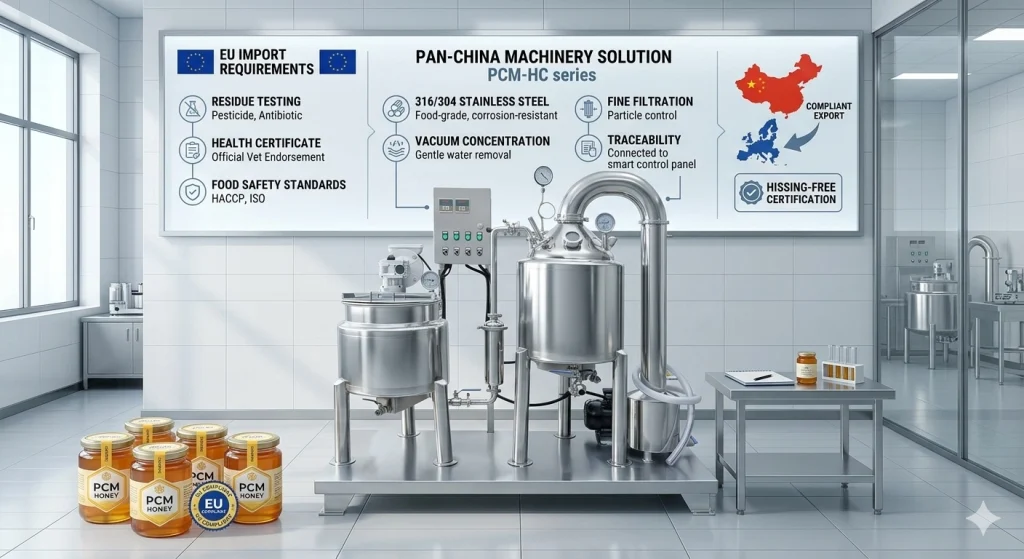
Chaque année, des centaines de tonnes de miel de haute qualité d'Asie du Sud-Est sont rejetées dans des ports comme Hambourg et Anvers. Si vous parcourezReddit’s r/Beekeeping, vous trouverez des tragédies récurrentes : des exportateurs perdant des milliers de dollars parce que leur envoi a échoué à un test en laboratoire d'une fraction de milligramme. Ce guide fournit un plan de référence selon la norme 2026 pour l'utilisationtraitement du miel à basse températurepour garantir que votre produit soit « prêt à l'exportation »
L'Union européenne considère le miel comme un produit biologique, et pas seulement comme un édulcorant. En vertu deAnnexe II de la directive 2001/110/CE, le miel ne doit rien avoir ajouté ou enlevé. Cela crée un paradoxe pour ceux qui traitent avecRéduction de l'humidité du miel tropicalComment sécher le miel sans violer l'exigence de "naturel" ?
La solution réside dans la distinction entre « traitement industriel » et « préparation standardisée ». Les douaniers européens utilisent trois empreintes chimiques principales pour déterminer la qualité :Humidité, HMF et diastasique.
SurQuora, une question courante est :Pourquoi mon miel a-t-il été rejeté pour une teneur en humidité de 21 % ?Dans des environnements à forte humidité comme Dak Lak, les abeilles ferment souvent les alvéoles avant que l'humidité ne diminue. En Indonésie, le miel brut peut atteindre28 % d'humiditéÀ ces niveaux, les levures osmophiles prospèrent, ce qui conduit àfermentation du miel à haute teneur en humidité.
Le défi :Le chauffage traditionnel cause l'oxydation. La norme actuelle de l'industrie est lemachine automatique de déshydratation du miel, qui élimine l'eau tout en préservant la délicate bio-structure du miel.
La ligne dure de l'UE :La limite légale est≤ 18 %.
Le défi :Le chauffage traditionnel cause l'oxydation. La norme actuelle de l'industrie est lemachine automatique de déshydratation du miel, qui élimine l'eau tout en préservant la délicate bio-structure du miel.
HMF est l'indicateur ultime des dommages causés par la chaleur. Bien qu'il augmente lentement avec l'âge, il atteint un pic lorsque le miel est surchauffé. Des laboratoires de premier plan commeQSI AllemagneetIntertekutiliserNiveaux de HMF dans le mielprouver si un produit a été « cuit ».
L'un des outils les plus efficaces pour 2026 est leConcentrateur de miel sous videCette technologie repose sur le principe selon lequel le point d’ébullition des liquides diminue à mesure que la pression diminue.
En créant un environnement à haute-vacuum (−0,092 MPa), nous pouvons atteindreRéduction de l'humidité du miel tropicalà peine38 °C à 40 °C.
NotrePrix de l'usine de traitement de miel de 0,5Tles modèles utilisent un échangeur de chaleur à coquille et à tubes à plusieurs étages. Contrairement aux chauffe-eau traditionnels, cela garantit uneCoefficient de transfert de chaleur uniforme, empêchant la surchauffe localisée. Construit à partir deacier inoxydable SUS316L, ces unités répondent aux plus hautsTraitement du miel conforme à l'HACCPnormes.
Les douanes européennes analysent souvent les comptages de pollen pour assurerVérification d'origineVotre ligne de fabrication doit inclure un système à double étape :
En utilisant des filets en acier inoxydable calibrés, vous obtenez un produit "éclatant de clarté" tout en conservant la signature de pollen requise par laNorme du miel du Codex Alimentarius.
Avec la stratégie « De la ferme à la fourchette » de l’UE, la traçabilité n’est plus un luxe. Nos modèles de 2026 disposent dePlante d'abeilles contrôlée par PLCintégration etDiagnostic à distance de l'Internet des objetsCe système enregistre automatiquement les températures de traitement et les niveaux de vide, supportant leCertificat phytosanitaire électronique (ePhyto)exigences. Lorsque vous fournissez à un acheteur une preuve numérique detraitement du miel à basse température, tu deviens un/uneCertification du fournisseur de miel B2Bleader.
Un fil conducteur récurrent surr/PetiteEntreprisedemande à propos de laretour sur investissement de l'entreprise de transformation du mielExaminons la réalité financière d'une coopérative en utilisant uneUnité de concentration sous vide de 0,5T – 1T.
| Métrique | Miel brut en vrac (local) | Miel prêt à l'exportation (marché européen) |
| Prix du marché par KG | 2,50 $ – $ 3,00$ | 5,50 – 7,00$ |
| Teneur en humidité | 25% – 28% | 17.5% – 18% |
| Statut du marché | Marché local | Exportation mondiale certifiée |
Avec un coût de traitement inférieur à 0,20 $ par kg, un professionnelPrix de l'usine de traitement de miel de 0,5TLe modèle s'amortit en 4 à 6 mois. Vous n'achetez pas simplement une machine ; vous sécurisezAssurance de marché.
Se lancer sur le marché européen, c'est avoir un meilleur contrôle. Passer à une approche modulaireConcentrateur de miel sous videest une impulsion stratégique qui transforme une matière première risquée en un ingrédient standardisé de grande valeur. En 2026, les exportateurs qui réussiront sont ceux qui considèrent la transformation du miel comme une science et adhèrent auNorme du miel du Codex Alimentarius.
1. La concentration sous vide compte-t-elle comme « traitement » devant être déclaré ?Sous leNorme du miel du Codex Alimentarius, éliminer l'eau pour respecter les limites légales est une « préparation standard ». Tant que vous n'ajoutez pas de sucre, cela resteMiel 100 % Pur Naturel.
2. Comment l'équipement gère-t-il l'exportation de miel de fleurs de café ?Le miel de café possède un profil sucré spécifique. NotrePlante d'abeilles contrôlée par PLCpermet de sauvegarder des profils personnalisés, garantissant le délicat arôme deMiel de fleur de caféiern'est jamais perdu à cause de la chaleur.
3. Quel est l'impact de l'acier inoxydable SUS316L sur la qualité ?Utilisationacier inoxydable SUS316Lempêche la contamination métallique souvent présente dans les machines moins coûteuses. Ceci est essentiel pour réussir les tests de métaux lourds requis parCertification du fournisseur de miel B2Baudits.


WhatsApp:+8615736768129
Email :inquiry@panchimachinery.com
Adresse : Zhengzhou, Province du Henan, Chine
Machine automatique de traitement et de filtration du miel par vide
Unité d'extraction et de concentration de liquides à basse température sous vide
Équipement personnalisé de distillation à la vapeur et de reflux thermique pour huiles essentielles
Concentrateur à grattoir sous vide à basse température SS304/316L
Concentrateur sphérique sous vide QN et unité de récupération d'alcool
Unité de distillation sous vide multifonction en acier inoxydable et d'extraction
Unité d'extraction liquide sous vide à reflux chaud et de concentration
Concentrateur à circulation externe à effet unique sous vide
Evaporateur à vide à circulation externe à double effet de la série SJN
Réacteur chimique en acier inoxydable sous vide à haute température
Citerne de précipitation d'alcool à vide en acier inoxydable 304SS
Pot de cuisson à double couche en acier inoxydable 304SS à chauffage par vapeur
Marmite de cuisson électrique avec veste chauffante
Marmite de cuisson à haute efficacité avec chauffage au gaz et cuve isolée
Nous vous contacterons dans un délai d'un jour ouvrable. Veuillez surveiller votre courriel.
Machine automatique de traitement et de filtration du miel par vide
Unité d'extraction et de concentration de liquides à basse température sous vide
Équipement personnalisé de distillation à la vapeur et de reflux thermique pour huiles essentielles
WhatsApp : +8615736768129
Email : inquiry@panchimachinery.com
Adresse :Zhengzhou, province du Henan, Chine


DROITS D'AUTEUR© 2026Zhengzhou Panchi Machinery Equipment Co., Ltd.|Politique de confidentialité