
Processing high-value aromatic woods and resins like Agarwood, Sandalwood, Frankincense, and Myrrh is difficult. These plants do not store their oils on the surface of their leaves or petals. Instead, the precious essential oils are locked deep inside tough wood fibers and sticky plant gums. Traditional extraction setups heat these raw materials past 100°C under normal atmospheric pressure. This high heat creates severe hot spots inside the extraction tank. Our field observations show that these hot spots quickly destroy the delicate scent molecules. To fix this physical barrier, modern factories use a specialized process called aromatic wood oil purification to carefully open the wood fibers without using high heat.
When high heat hits raw plant resins, the sticky gums melt and turn into a thick black tar. This tar bakes directly onto the metal walls of the tank. The burnt tar acts like a thick blanket that traps heat. This forces factory workers to raise the temperature even more just to keep the machine running.
This overheating breaks the chemical bonds of the oil. The process ruins the natural smell and creates a burnt, smoky odor. It also darkens the color of the final product.
International buyers test these luxury oils with advanced laboratory equipment like Gas Chromatography-Mass Spectrometry (GC-MS). If the machine detects any burnt compounds, the buyers reject the entire batch. A single burnt batch can ruin up to 85% of the value of your raw materials. This failure wastes your budget, ruins your inventory, and stalls your factory for days due to difficult cleanup times.
Modern extraction solves these issues by changing how we process these materials. Factories now use an advanced essential oil purification machine that combines three integrated methods called aromatic wood oil purification, resin essential oil distillation, and low-temperature terpene isolation. These techniques protect the oils, increase your total yield, and keep your factory running smoothly.
The global market for essential oils is a large, multi-billion-dollar industry. Premium oils from aromatic woods and resins are key ingredients in luxury perfumes, natural medicines, and high-end cosmetics.
Global buyers and consumers demand perfect quality. To secure long-term purchase contracts, your factory must deliver:
If a factory cannot meet these standards, international buyers will cancel contracts and reject shipments. This is a massive financial risk because raw materials make up 70% of your total operating costs. Our research shows that a single damaged batch can easily destroy over $50,000 worth of raw wood or resin.
This financial pressure is forcing factories across Southeast Asia, the Middle East, and East Africa to upgrade their machinery. These producers are moving away from old boiling methods. They are adopting resin essential oil distillation and low-temperature terpene isolation to protect their investments. These modern systems ensure consistent quality, higher yields, and lower energy bills.
Modern machines use smart separation physics to bypass the natural defenses of woods and resins without using high heat.
Tough wood fibers naturally trap essential oils and stop them from escaping. Traditional soaking methods fail because the surrounding water quickly fills up with dissolved oil, causing the extraction to stop.
Modern aromatic wood oil purification solves this problem by using a clean, step-by-step process:
Because the incoming steam is completely clean, it pulls the oil out of the wood cells at the fastest possible rate. This dynamic washing process protects the top notes of the scent, shortens extraction times to 4 or 6 hours, and improves your total oil recovery by 30% to 50%.
Raw resins melt and turn into a sticky tar when heated in old machines, which quickly breaks the equipment. Modern resin essential oil distillation handles this delicate material by using deep vacuum pumps to lower the pressure inside the vessel.
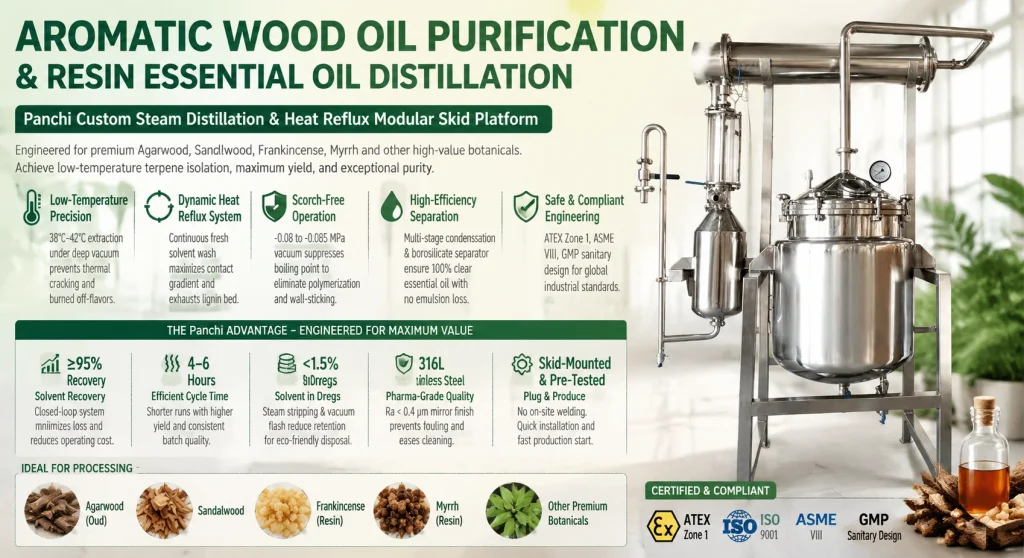
By pulling a strong vacuum between -0.08 MPa and -0.085 MPa, the boiling point of the water drops down to a mild range of 38°C to 42°C. At this low temperature, the resins release their oils smoothly without melting into tar or sticking to the walls. This process stops equipment fouling and increases your oil yields by 40% to 50%.
The final challenge happens when hot vapor carries heavy plant waxes and fats out of the tank along with the light oils. In old setups, these fats mix with the oil and form a cloudy, thick emulsion that is impossible to separate cleanly.
Modern low-temperature terpene isolation fixes this by using a multi-stage cooling system:
[Crude Volatile Vapor Blend]
│
▼
[Stage 1: Vertical Dephlegmator (Tuned to 25°C)] ──> Condenses Heavy Waxes & High-Boiling Lipids ──> Continuous Bottom Drain
│
▼
[Stage 2: Sub-Zero Terminal Condenser (Tuned to 4°C)] ──> Flashes Pure Volatile Terpene Gas into Liquid Phase
│
▼
[Stage 3: Borosilicate Glass Separator] ──> Sharp, Visual Density Separation ──> Clear Essential Oil
The first cooling tower runs at exactly 25°C. This temperature cools and turns the heavy plant waxes into liquid so they can drain out of the bottom, while the light aromatic oils stay as a gas.
The light gas then travels up into a second cooling tower chilled to 4°C. This cold temperature instantly turns the pure aromatic gas into a clear liquid.
Finally, the liquid flows into a clear glass separator. Because the heavy waxes were removed in the first step, the oil and water separate perfectly into two distinct layers. This method retains 90% of the active scent compounds, while old cooking methods preserve only 70%.
The Panchi Custom Steam Distillation Heat Reflux Essential Oil Equipment
combines all three of these solutions into a single automated machine. The low temperature settings are based on the Clausius-Clapeyron Equation. This mathematical formula calculates exactly how much the boiling point of a liquid drops when you lower the air pressure with a vacuum pump:
Panchi engineers used this formula and real factory data to optimize the machine for high-value woods and resins.
The entire machine is made from high-grade, polished 316L stainless steel. The metal surfaces are incredibly smooth, which stops sticky resins from sticking to the walls. All seals, motors, and valves are explosion-proof, so they can safely handle organic solvents under deep vacuum.
Panchi builds this equipment on a pre-assembled, portable steel frame called a skid-mounted system. The company welds, pipes, and tests the entire machine at their factory before shipment. When the machine arrives at your facility, your staff does not need to perform any complex welding. You simply bolt the frame to your factory floor, connect your electricity and cooling water lines, and start production immediately.
The data table below shows the exact performance differences between old atmospheric boiling methods and the automated Panchi low-temperature reflux system:
| Performance Metric | Old Atmospheric Distillation | Panchi Low-Temp System |
| Total Oil Yield | 1% to 3% (Oil stays trapped) | 3% to 5% (Extracts all oil) |
| Finished Oil Purity | 85% to 90% (Contaminated with wax) | 95% or higher (Clear and pure) |
| Extraction Temperature | 100°C to 120°C (Uncontrolled) | 38°C to 42°C (Vacuum controlled) |
| Processing Time | 6 to 8 hours (Slow diffusion) | 4 to 6 hours (Fast reflux loops) |
| Active Scent Retention | Around 70% (Damaged by heat) | Around 90% (Protected molecules) |
| Solvent Recovery Rate | Missing or under 80% (Vents away) | 95% or higher (Recycled liquid) |
| Total Energy Used | Baseline standard (100%) | Reduced by 25% (Lower heat required) |
To save even more money, the Panchi machine uses a special mass balance cycle to clean the spent wood waste. The machine calculates the chemical balance inside the tank with a simple formula:
Once the oil is collected, the machine shoots hot steam through the leftover wood dregs while pulling a deep vacuum. This action quickly evaporates the trapped solvent, leaving less than 1.5% of the liquid inside the waste wood. This process saves your solvent budget and cuts your equipment cleaning downtime by 30% to 40%.
Upgrading to modern aromatic wood oil purification, resin essential oil distillation, and low-temperature terpene isolation provides clear financial benefits:
Consistent Quality: The automated computer control panel ensures that every single batch matches your quality standards perfectly, which helps you win long-term supply contracts with global buyers.
Higher Revenue: Real factory data shows a 35% to 50% increase in income per batch because the machine stops oil burning and creates a premium product that sells for top market prices.
Lower Operational Risk: Keeping the heat between 38°C and 42°C eliminates scorched batches, protecting your raw material budget from sudden losses.
Actual factory records show the massive advantages of low-temperature processing.
In an extraction facility in Southeast Asia, engineers processed a 500 kg batch of high-grade Agarwood. They used the Panchi low-temperature system to run automated aromatic wood oil purification. The machine held a constant vacuum of -0.084 MPa, which kept the processing temperature at a safe 39°C. The run achieved a 4.8% extraction yield and retained 92% of the active scent molecules. In contrast, an identical control batch processed with old high-heat steam distillation yielded only 2.6% of the oil. That control batch suffered severe heat damage and created an undesirable smoky odor with only 68% scent retention.
A similar success occurred at a refinery in the Middle East that processes Frankincense resin. The factory installed a Panchi resin essential oil distillation and low-temperature terpene isolation machine. The vacuum system kept the temperature low, which completely stopped the resin from melting into tar on the tank walls. This modification eliminated hours of manual scraping work, kept solvent recovery above 95%, and produced a clear, premium oil that passed all international quality tests on the first try.
A: Aromatic wood oil purification uses low-temperature steam and dynamic heat reflux to extract oils from dense heartwood fibers without degrading sensitive terpenes. Traditional steam distillation often exposes materials to high heat (>100°C), causing thermal cracking, burnt aromas, and lower yields. The purification process maximizes oil recovery, maintains natural fragrance, and produces higher-purity essential oils suitable for premium B2B applications.
A: Resin essential oil distillation employs vacuum-assisted low-temperature extraction combined with heat-reflux cycles. This approach lowers the boiling point of resins to 38–42°C, preventing polymerization and sticky tar formation. Multi-stage condensation separates heavy waxes and lipids, ensuring a clear, functional oil. Compared to conventional methods, this technique improves yield by 40–50% and preserves aromatic and bioactive compounds.
A: Low-temperature terpene isolation preserves highly volatile terpenes that are easily degraded at high temperatures. Operating under vacuum, it condenses terpenes at low temperatures while separating heavy waxes and impurities. This process maintains approximately 90% of active aromatic compounds, compared to only 70% retained using traditional distillation. It ensures that premium aromatic wood and resin oils retain their natural fragrance and therapeutic functionality.


Whatsapp: +8615736768129
Email: [email protected]
Address: Zhengzhou, Henan Province, China
Automatic Vacuum Honey Processing & Filtering Machine
Vacuum Low-Temperature Liquid Extraction & Concentration Unit
Custom Steam Distillation & Heat Reflux Essential Oil Equipment
SS304/316L Low-Temperature Vacuum Scraper Concentrator
QN Spherical Vacuum Concentrator & Alcohol Recovery Unit
Multi-function Stainless Steel Vacuum Distillation & Extraction Unit
Hot Reflux Vacuum Liquid Extraction & Concentration Unit
Single-Effect External Circulation Vacuum Concentrator
SJN Series Double-Effect External Circulation Vacuum Evaporator
We will contact you within one working day. Please pay attention to your email.
Automatic Vacuum Honey Processing & Filtering Machine
Vacuum Low-Temperature Liquid Extraction & Concentration Unit
Custom Steam Distillation & Heat Reflux Essential Oil Equipment
WhatsApp: +8615736768129
Email: [email protected]
Address: Zhengzhou, Henan Province, China


COPYRIGHT© 2026 Zhengzhou Panchi Machinery Equipment Co., Ltd. | Privacy Policy

Our team will respond within 24 hours.
Thanks! We'll get back to you within 24 hours.
Check your inbox (and spam folder) for our reply.