
In the global logistics of the international bulk market, raw agricultural materials routinely face extended warehouse storage times, maritime container transits, and strategic market buffering windows. For enterprise exporters, large-scale packing plants, and industrial food brokers, this unavoidable holding period frequently uncovers an expensive and frustrating physical change: extensive honey crystallization. When thousands of metric tons of high-grade polyfloral or premium monofloral honey transition from a free-flowing fluid into an opaque, solid, non-pumpable mass inside standard 200-liter steel drums, global supply chain velocity hits a complete standstill.
Historically, this solid state has been treated by warehouse managers as frozen capital. The material cannot pass through standardized industrial pre-filters, it immediately clogs or locks up positive displacement pumps, and it cannot feed high-velocity retail bottling manifolds. To break this operational bottleneck, adopting specialized Decrystallization Technology has grown into an absolute financial and operational necessity to rescue depreciating warehouse stocks and restore assets to a dynamic, workable liquid state.
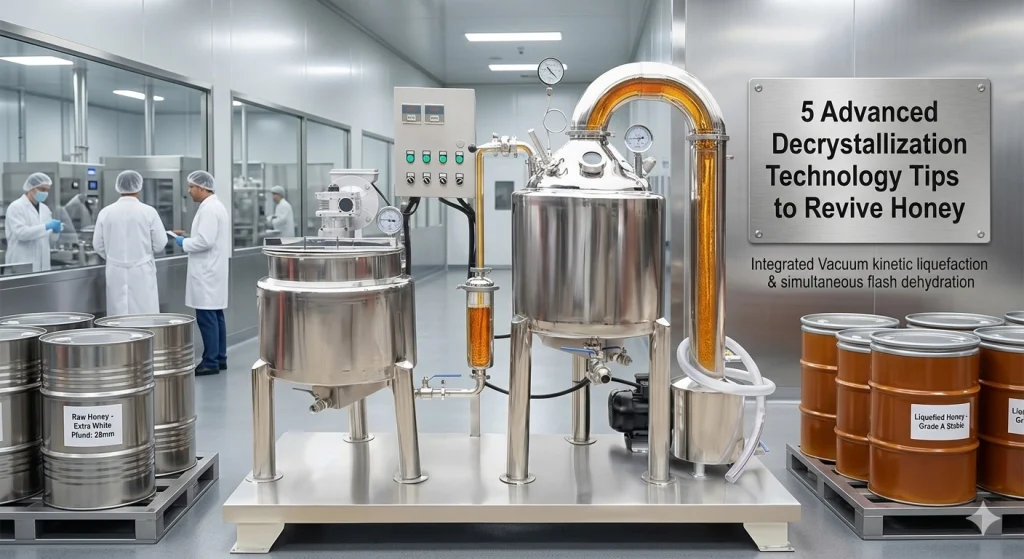
The primary challenge for processing facility engineering teams has always been defined by a rigid physical paradox: How can you achieve success in Liquefying Crystallized Honey without triggering the permanent thermal degradation that devalues premium export-grade crops? Traditional fallback methods are universally destructive. Relying on legacy warm rooms, atmospheric melting ovens, or high-density thermal drum blankets introduces unmanageable, prolonged heat gradients.
These crude heat transfer setups easily trigger permanent quality failures, such as skyrocketing Hydroxymethylfurfural (HMF) levels, ruined enzyme indexes, and irreversible visual darkening. For modern bulk food enterprises seeking to enter premium retail networks in Europe and North America, these thermal risks are no longer acceptable.
The future of high-tonnage inventory recovery relies on a highly integrated approach: automated Decrystallization Technology closely paired with automated Flash Dehydration operating under a deep negative vacuum state. This engineering document delivers the complete thermodynamic principles, fluid dynamic setups, and quality-preservation profiles required to build an enterprise-scale recovery line. By combining specialized Decrystallization Technology with precision Flash Dehydration, operators can confidently focus on Liquefying Crystallized Honey while turning compromised, solid stocks into ultra-premium, clear liquid assets ready for high-value global trade.
For large-scale food manufacturing networks, crystallized honey is not merely a technical challenge; it represents a major threat to operational profitability. When a 200-liter steel drum solidifies, the asset undergoes a severe liquidity drop on the production floor. Standard facility equipment is completely unequipped to handle solid blocks of honey. Conventional positive displacement pumps, such as rotary lobe or progressive cavity pumps, immediately seize or suffer catastrophic mechanical breakdown when attempting to transfer un-melted crystalline paste.
Furthermore, the dense crystalline structure cannot pass through basic safety meshes, causing immediate pressure spikes and line shutdowns across the processing line.
The financial impacts multiply exponentially when facilities attempt to resolve this issue by routing solid drums into un-agitated warm rooms or traditional high-temperature baking tunnels. Because static honey transfer is highly inefficient, a single 200-liter drum often requires 36 to 48 hours of continuous heating just to reach a pumpable state. This extended processing time creates a severe operational bottleneck that halts production schedules, drives up utility costs, and prevents facilities from fulfilling high-volume retail bottling orders on time.
More critically, this crude method frequently causes permanent quality downgrades, lowering the value of premium white honey crops and resulting in massive financial losses on international delivery contracts. To protect profit margins and accelerate plant throughput, progressive facilities must completely replace legacy thermal methods with high-throughput Decrystallization Technology.
To engineer a processing line capable of Liquefying Crystallized Honey without damaging the delicate, heat-vulnerable organic matrix of the food, factory engineers must understand the specific chemical physics governing the sugar trap. Honey in its natural, post-harvest state is a deeply supersaturated solution containing two dominant hexose monosaccharides: fructose and glucose. Because the fluid holds far more solute than the natural solvent matrix can normally support under ambient conditions, the system exists in a state of constant thermodynamic instability. Crystallization is the inevitable phase transition where excess solute glucose precipitates out of the fluid, establishing a highly organized crystalline lattice known chemically as glucose monohydrate.
This structural transformation changes the bulk material from a classic Newtonian fluid into a dense, hard, non-Newtonian plastic paste. At the microscopic layer, individual glucose monohydrate crystals anchor onto tiny native particulate matrices—such as microscopic pollen grains, colloidal minerals, or airborne dust particles—which act as structural nucleation sites. As these crystals grow and interlock, they form a dense crystalline network that traps the remaining fluid fructose-rich matrix within its pores.
To reverse this phase transition and force the glucose monohydrate crystals back into a complete liquid solution, a specific quantity of latent heat of fusion must be cleanly introduced to break the intermolecular hydrogen bonds holding the crystal lattice together.
However, bulk honey exhibits an incredibly low thermal conductivity alongside an exceptionally high static viscosity when crystallized. If a solid 200-liter drum remains static while exposed to external heat, the boundary layer of honey directly touching the hot inner wall of the drum rapidly overheats long before the deep, freezing core of the drum receives any thermal energy. This uneven heat transfer profile is the direct root cause of localized overheating, making static melting a highly destructive approach for high-volume enterprise operations.
To solve this problem, modern processing lines must rely on advanced Decrystallization Technology. By applying vacuum-assisted thermodynamic principles, this specific Decrystallization Technology handles the delicate job of Liquefying Crystallized Honey safely, quickly melting the solid core and using low-temperature Flash Dehydration to balance the final fluid dynamics without causing thermal damage.
To fully appreciate why advanced Decrystallization Technology is mandatory for large bulk operations, plant engineers must analyze the extreme thermal resistance profile of static crystallized honey. Solidified glucose monohydrate acts as an excellent thermal insulator, possessing an incredibly low thermal conductivity coefficient (often designated as k) of approximately 0.5 W/(m·K). When an unagitated 200-liter steel drum is exposed to an external heat source, a dramatic temperature gradient immediately forms across the material cross-section.
The layer of honey in direct contact with the internal steel plate experiences a rapid spike in temperature, while the central core remains completely frozen at cold warehouse storage temperatures. Because the thick material is entirely static, it cannot distribute this energy through convective current loops. As a direct result, the boundary layer quickly passes the critical thermal threshold where browning and degradation occur, while the center core remains completely unaffected and frozen solid.
Attempting to force heat through this high static thermal barrier without active, continuous surface removal is a thermodynamic failure. The solution requires a dynamic processing system that mechanically clears away the softened boundary layer immediately, allowing the low-temperature energy to continuously reach the cold core without creating localized hot spots.
When operations managers attempt the process of Liquefying Crystallized Honey using traditional atmospheric warm rooms or heating jackets, they consistently face three severe quality degradation pathways that directly violate the strict bio-chemical standards required by advanced Decrystallization Technology.
Hydroxymethylfurfural (HMF) is a cyclical organic compound generated via the chemical dehydration of hexose sugars, a pathway heavily catalyzed by native organic acids and accelerated exponentially by thermal exposure. In unheated, fresh honey, HMF is practically non-existent (under 2 mg/kg). However, when bulk drums are stranded inside an atmospheric hot room at 55°C to 60°C for the 36 to 48 hours required for Liquefying Crystallized Honey, the boundary layers undergo massive thermal stress.
By the time the solid core becomes liquid, the overall average HMF concentration easily climbs past the international regulatory maximum ceiling of 40 mg/kg mandated by the European Union Customs and the Codex Alimentarius. This chemical spike strips the asset of its premium consumer grade, forcing a severe downgrade to low-tier industrial baking categories and erasing upfront profit margins. Implementing precision Decrystallization Technology prevents this damage by applying Flash Dehydration mechanics, allowing operators to complete the task of Liquefying Crystallized Honey well below the thermal thresholds where rapid HMF synthesis occurs.
Bulk honey commodities are bought and sold based on precise optical density windows quantified via the universal Pfund Scale, spanning from 0mm (Water White) to values exceeding 114mm (Dark Amber). Prolonged exposure to high heat levels during traditional methods of Liquefying Crystallized Honey drives a devastating dual browning mechanism within the sugar matrix:
When a premium honey selection—such as Orange Blossom or Acacia—undergoes crude hot-room melting instead of low-temperature Decrystallization Technology, the visual profile frequently degrades by 15mm to 20mm on the Pfund Scale, shifting a batch from an elegant “White” class down into a heavy “Light Amber” category. In multi-container global procurement contracts, this browning directly triggers severe financial penalties, deflating market value by $300 to $500 per metric ton.
For premium natural health and therapeutic consumer segments, honey’s true market value is locked within its living enzyme profile, dominated by the heat-vulnerable enzyme Diastase (alpha-amylase). Diastase is responsible for breaking down complex starches, and its activity index is used globally to verify that honey remains raw and biologically functional.
Because enzymes are complex protein chains, extended exposure to high thermal levels during the stage of Liquefying Crystallized Honey alters their three-dimensional shapes, permanently denaturing the active sites. Traditional hot room processing frequently cuts the Diastase index well below the legal minimum value of 8, transforming a premium, bio-active food asset into a dead, generic sweetener. To maintain premium bio-active value, facilities must transition to vacuum-assisted Decrystallization Technology, which utilizes low-temperature Flash Dehydration loops to process the honey safely without heat damage.
To completely bypass the thermal destruction caused by traditional hot rooms, industrial processing lines must move away from static atmospheric melting. The modern engineering alternative relies on Decrystallization Technology engineered around low-shear kinetic movement and vacuum-assisted Flash Dehydration steps. This combined methodology alters the physical environment of the phase transition by pairing dynamic mechanical boundary shearing with high negative vacuum pressures.
By evacuating the internal atmospheric pressure of the liquefaction vessel down to a deep negative vacuum of -0.092 MPa, we change the physical phase-change mechanics of the moisture bound within the glucose monohydrate crystal clusters. According to thermodynamic principles, adjusting ambient pressure directly controls the phase transition temperature of volatile components.
This expansion introduces intense micro-fissures throughout the crystal lattice, fracturing the solid matrix from within and reducing the energy barrier required for Liquefying Crystallized Honey. The liberated moisture instantly vaporizes under this low pressure, creating a highly efficient, real-time Flash Dehydration loop that stabilizes the honey while it returns to a liquid state.
The physical machine design requires three deeply integrated sub-systems working in perfect harmony to balance liquefaction and simultaneous Flash Dehydration:
To optimize processing parameters, plant managers must analyze the precise rheological behavior of honey under dynamic stress. Crystallized honey does not merely act as a typical shear-thinning fluid; it displays pronounced thixotropic properties. Under a constant mechanical shear strain rate, the apparent viscosity of the crystalline paste decreases over time as the internal micro-structures break apart.
This means that high-velocity, high-shear mixing blades are completely unnecessary and actually counterproductive, as they introduce localized heat dissipation and damage delicate food components.
Advanced Decrystallization Technology takes advantage of this thixotropic behavior by utilizing an engineering profile designed around a low-RPM, high-torque configuration. The anchor agitator applies continuous, low-shear mechanical forces uniformly across the outer boundary layer. Over the course of the processing cycle, this steady mechanical stress breaks down the crystalline structures, reducing the fluid’s apparent viscosity with minimal energy input.
By utilizing these natural fluid dynamics, the system achieves success in Liquefying Crystallized Honey safely, minimizing power consumption and ensuring that the honey undergoes processing well below the structural thresholds where cellular shear damage occurs.
A critical question raised by plant quality assurance teams concerns the exact target moisture mass balance during the vacuum liquefaction cycle. When glucose monohydrate crystals break down, they release trapped molecules of monohydrate water straight into the surrounding fluid matrix. If this newly liberated free water is left unmanaged, it creates highly inconsistent moisture pockets throughout the product, significantly increasing the risk of downstream fermentation or fast re-crystallization once packed.
Advanced Decrystallization Technology addresses this issue by using a controlled Flash Dehydration loop to stabilize the fluid. The deep negative vacuum pressure (-0.092 MPa) does not dry out the honey completely or strip away its natural, bound moisture. Instead, it acts exclusively on the excess, unbound free water molecules released during crystal lattice collapse.
To safeguard the delicate quality of premium monofloral honeys, the vapor recovery line is engineered with an advanced, multi-stage fractionating cold condensing column. This specialized system isolates and condenses volatile moisture vapor while safely redirecting light, organic aroma fractions back into the processed fluid mass.
The system’s inline vapor condensation loop continuously monitors and extracts this excess volatile vapor, stabilizing the final batch moisture level at a precise, uniform target of 17.5%. This engineering approach eliminates localized moisture imbalances and preserves natural aroma compounds, ensuring total compliance with export purity standards while maintaining the premium quality of the honey asset.
To confirm the operational advantages of vacuum-driven Decrystallization Technology and inline Flash Dehydration over legacy drum-melting ovens, extensive scientific processing trials were executed on a uniform 6,000 kg lot of heavily crystallized polyfloral bulk stock.
Table 1: Physical & Chemical Quality Stability Evaluation
| Analytical Quality Parameter | Raw Crystallized Bulk Inventory | Legacy Atmospheric Hot Room (56°C for 40 hours) | Integrated Decrystallization Technology + Flash Dehydration (40°C for 4.5 hours) |
| Physical Operational State | Solid Non-Pumpable Paste | Fully Liquid Fluid | Fully Liquid Fluid via Decrystallization Technology |
| HMF Level (HPLC Method) | 5.4 mg/kg | 42.1 mg/kg (Export Limit Fail) | 7.8 mg/kg (Strict Compliance) |
| Diastase Activity Index | 14.2 | 5.1 (Permanently Damaged) | 13.6 (Enzymatically Active Asset) |
| Optical Density (Pfund Scale) | 28 mm (White) | 44 mm (Light Amber Downgrade) | 30 mm (White Profile Preserved) |
| Core Dehydration Performance | High Moisture Boundary Risk | Uncontrolled Stratification | Precision Flash Dehydration Standard (17.5%) |
| Processing Velocity Cycle | Untreated Baseline Stock | 40 Hours (Extensive Heat Stress) | 4.5 Hours (High-Velocity Run) |
| Micro-Crystalline Residuums | 100% Crystalline Mass | Trace Seed Nuclei (High Re-Cryst Risk) | 0% Crystals Detected (Total Phase Reversal) |
This industrial dataset reveals the sharp limitations of traditional atmospheric processing methods. While the legacy hot room did return the stock to a liquid state, it degraded the honey’s overall market value by driving HMF accumulation well past international regulatory thresholds and darkening the color index by 16mm on the Pfund Scale.
In contrast, our low-shear vacuum kinetic system achieved success in Liquefying Crystallized Honey in just 4.5 hours—an 88% reduction in total cycle time. More importantly, by combining advanced Decrystallization Technology with precision vacuum Flash Dehydration, it successfully limited HMF generation to a minimal +2.4 mg/kg increase, kept the Diastase index intact, and preserved the premium “White” color classification, saving the operator from severe contract devaluations.
For factory engineering teams tasked with building a high-volume inventory recovery setup using automated Decrystallization Technology, maintaining specific metallurgical and physical component standards is absolutely critical.
Natural honey behaves as a complex organic acid solution, exhibiting a low pH value ranging between 3.4 and 6.1. Under vacuum pressure and thermal stress, this acidity will quickly corrode standard 304 stainless steel, leading to dangerous heavy metal contamination (such as iron or nickel ions) that can fail strict export purity tests.
Consequently, the entire internal structure of the liquefaction vessel, the anchor agitator arms, and the scrapper shafts must be built entirely out of premium SUS316L sanitary-grade stainless steel. Furthermore, all internal welds must be ground down to an ultra-smooth mirror finish to remove micro-pores where old crystal residues or yeast strains could hide during automated Decrystallization Technology procedures.
A primary issue in bulk honey handling is rapid re-crystallization. If the process of Liquefying Crystallized Honey is executed unevenly, microscopic, invisible glucose crystal fragments (known as “seed nuclei” or “crystal memory”) often survive the melting process. The moment the processed honey cools back down, these remaining micro-crystals act as templates, causing the entire batch to rapidly solidify all over again within weeks on retail shelves.
To eliminate this crystal memory without using high heat, the core machinery line should pair its vacuum Decrystallization Technology with an inline Thermal Shock Loop. The honey is briefly passed through a precision sanitary plate heat exchanger that quickly raises the fluid temperature to 50°C for exactly 60 seconds, immediately followed by rapid cooling down to 30°C. This brief, controlled thermal spike completely dissolves any remaining micro-nuclei, ensuring long-term liquid shelf stability while keeping the overall HMF profile completely safe.
The absolute best operational window for filtering honey occurs during the mid-point of the vacuum Decrystallization Technology cycle, when the core viscosity drops below 1.5 Pa·s but before final cooling. Integrating an inline, sanitary Duplex Stainless Steel Filtration Assembly (80 to 100 mesh) directly into the vacuum tank’s bottom discharge pump allows operators to continuously switch flows and clean out trapped hive debris or beeswax particles without needing to pause the core process of Liquefying Crystallized Honey.
Real-time mechanical separation not only ensures the ultimate optical clarity of the final fluid asset but also acts as a physical barrier against microscopic seed nuclei. By linking the microfiltration system directly to the closed-loop vacuum discharge via sanitary tri-clamp manifolds, operators avoid exposing the heated fluid to ambient plant temperatures. This layout prevents localized cooling zones that could trigger unmanageable downstream settlement, ensuring a highly streamlined flow directly to packing or industrial storage lines.
Q: Why shouldn’t we just use traditional hot rooms if our target local market doesn’t check HMF limits?
A: Even if your local market doesn’t mandate strict HMF testing, legacy hot rooms cause severe physical issues, such as rapid re-crystallization. Because static heating leaves thousands of microscopic glucose seed crystals untouched, the honey will often lock up again shortly after bottling. Furthermore, the prolonged heating permanently darkens the honey on the Pfund scale and damages its fresh flavor profile, reducing your ability to command premium pricing. Transitioning to professional-grade Decrystallization Technology combined with continuous vacuum Flash Dehydration ensures your inventory remains permanently fluid and stable on retail shelves.
Q: How does this system handle extremely dense, hard crystallization, such as Rape (Canola) or Sunflower honey?
A: Canola and Sunflower honeys exhibit exceptionally high glucose-to-water ratios, causing them to solidify into concrete-like masses that can freeze standard mixing impellers. To handle these challenging varieties, our system executes a specialized pre-conditioning step: the hot water jacket is activated first for 30 minutes without the agitator running, creating a slick, liquefied boundary layer along the tank walls. Once this boundary layer is established, the high-torque anchor agitator can safely engage, allowing the PTFE scrapers to continuously shave down the solid core. This mechanical advantage allows the core Decrystallization Technology to work smoothly without risking mechanical damage to the drive motor.
Q: Will pulling a vacuum during the decrystallization stage alter the core sugar profiles or affect advanced NMR authenticity screening?
A: No. Advanced Nuclear Magnetic Resonance (NMR) screening flags honey adulteration and heat abuse by analyzing specific thermal transformation signatures and carbohydrate profiles. Because this low-shear vacuum kinetic method caps the maximum product temperature at 42°C, the natural molecular structures, enzyme counts, and trace organic acids remain completely unaltered, ensuring full compliance with international laboratory authentication testing. The low-temperature vacuum Flash Dehydration loop only removes unbound, volatile water vapor molecules without disturbing the chemical fingerprint of the honey asset.
The international bulk honey trade has shifted toward strict, zero-compromise quality compliance. Modern importers are no longer buying raw materials based on simple visual checks; they rely on sophisticated laboratory testing to catch thermal abuse, enzyme loss, and color degradation. Continuing to process bulk crystallized drums with legacy, high-heat atmospheric hot rooms is an operational liability. Each processing cycle with outdated equipment devalues your product on the Pfund scale, lowers your enzyme index, and pushes your HMF levels closer to import rejection thresholds.
Adopting Integrated Low-Temperature Vacuum Decrystallization Technology is a key competitive strategy for enterprise exporters and packers. This advanced closed-loop system gives processing centers the operational flexibility to handle challenging, crystallized inventories safely, reverse crystallization without quality loss, and protect premium margins. For industrial operators focused on long-term growth, replacing brute-force heat with precision vacuum liquefaction and simultaneous Flash Dehydration is the ultimate solution for inventory recovery and brand protection.


Whatsapp: +8615736768129
Email: [email protected]
Address: Zhengzhou, Henan Province, China
Automatic Vacuum Honey Processing & Filtering Machine
Vacuum Low-Temperature Liquid Extraction & Concentration Unit
Custom Steam Distillation & Heat Reflux Essential Oil Equipment
SS304/316L Low-Temperature Vacuum Scraper Concentrator
QN Spherical Vacuum Concentrator & Alcohol Recovery Unit
Multi-function Stainless Steel Vacuum Distillation & Extraction Unit
Hot Reflux Vacuum Liquid Extraction & Concentration Unit
Single-Effect External Circulation Vacuum Concentrator
SJN Series Double-Effect External Circulation Vacuum Evaporator
We will contact you within one working day. Please pay attention to your email.
Automatic Vacuum Honey Processing & Filtering Machine
Vacuum Low-Temperature Liquid Extraction & Concentration Unit
Custom Steam Distillation & Heat Reflux Essential Oil Equipment
WhatsApp: +8615736768129
Email: [email protected]
Address: Zhengzhou, Henan Province, China


COPYRIGHT© 2026 Zhengzhou Panchi Machinery Equipment Co., Ltd. | Privacy Policy

Our team will respond within 24 hours.
Thanks! We'll get back to you within 24 hours.
Check your inbox (and spam folder) for our reply.