
The global market for premium, therapeutic-grade essential oils is undergoing a massive shift. Multi-national cosmetics brands, pharmaceutical buyers, and high-end aromatherapy distributors no longer just test for basic purity—they utilize Gas Chromatography-Mass Spectrometry (GC-MS) to strictly analyze the chemical profile of every single batch. For commercial extractors specializing in Floral Materials essential oil Purification and Delicate Leaf Materials essential oil Purification, meeting these stringent testing requirements presents a significant technical hurdle.
When dealing with highly delicate, premium raw materials such as Damascus Rose, Lavender, Ylang Ylang, Peppermint, and Tea Tree, standard off-the-shelf atmospheric distillation setups frequently fail. For these specific crops, executing a precise Thermosensitive Botanical essential oil Purification protocol is critical. The combination of thermal degradation, unwanted chemical hydrolysis, and mechanical processing flaws like boiler priming can ruin entire high-value batches in minutes if your setup isn’t engineered correctly.
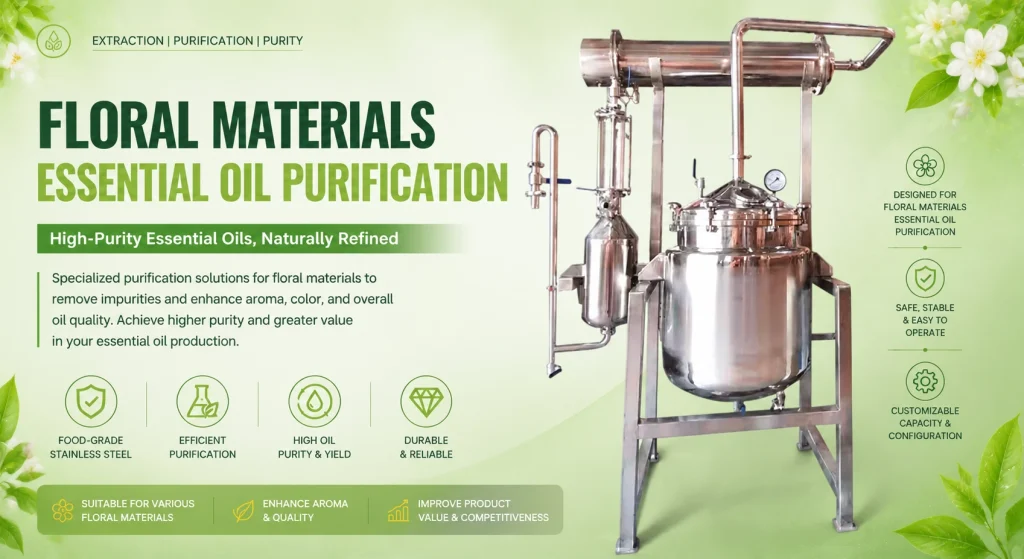
This comprehensive guide breaks down the multi-dimensional engineering strategies, vacuum thermodynamics, and fluid mechanical adjustments required to master Floral Materials essential oil Purification using a specialized Floral Materials essential oil Purification Machine, protecting vulnerable top notes, boosting your batch yield, and maximizing your industrial ROI.
A recurring question from distillery startup founders and plant managers is: “Why does my steam-distilled rose or peppermint oil smell flat, grassy, or slightly burnt compared to the fresh living plant?” The answer lies in the molecular vulnerability inherent to Thermosensitive Botanical essential oil Purification.
[Conventional Distillation: 100°C Applied Heat]
—> Molecular Hydrolysis & Oxidation
—> Thermal Degradation of Esters & Monoterpene Alcohols
—> Flat, Burnt Scent Profile (Rejected by GC-MS Testing)
[High-Vacuum Distillation: -0.085 MPa at 38°C – 42°C]
—> Low-Temperature “Cold Boiling”
—> Zero Thermal Shock to Volatile Compounds
—> Full Preservation of Delicate Top Notes (Therapeutic Grade)
Delicate flower and leaf materials owe their characteristic, vibrant aromagrams to highly volatile, heat-sensitive compounds like monoterpene alcohols and volatile esters. When exposed to conventional atmospheric steam distillation at 100°C or higher, these molecules reach a thermal tipping point. This makes standard methods highly inefficient for Floral Materials essential oil Purification, as the intense heat breaks down fragile ester bonds and triggers rapid oxidation. Instead of a vibrant, crisp top-note profile, you end up with an altered chemical profile that international B2B buyers will automatically reject.
To achieve successful Delicate Leaf Materials essential oil Purification, the operating temperature must be decoupled from standard atmospheric boiling points. Without a specialized approach to Thermosensitive Botanical essential oil Purification, extracting delicate plants will always result in diminished quality and lost profits.
+————————————————————+
| THERMODYNAMIC PROGRESSION TABLE |
+————————–+———————————+
| System Negative Pressure | Water/Solvent Boiling Point |
+————————–+———————————+
| 0.00 MPa (Atmospheric) | 100°C |
| -0.03 MPa (Mild Vacuum) | ~85°C |
| -0.06 MPa (Mid Vacuum) | ~68°C |
| -0.085 MPa (Deep Vacuum) | 38°C – 42°C |
+————————–+———————————+
By engineering a system capable of pulling and maintaining a consistent, deep negative pressure of -0.085 MPa, the boiling point of the extraction fluid drops into a safe zone: 38°C to 42°C. This exact methodology completely redefines how processors approach Floral Materials essential oil Purification.
Operating within this specific “Cold Boiling” window provides massive operational benefits for commercial processors:
While deep vacuum extraction solves the problem of thermal breakdown, it introduces a separate, major fluid mechanical challenge: boiler priming and foaming over (entrainment). This phenomenon is a constant obstacle during high-volume Delicate Leaf Materials essential oil Purification.
Under a negative pressure of -0.085 MPa, gas volumes expand exponentially. Lightweight leaf materials possess a very low bulk density. The high-velocity vapor streams easily lift these light solids and sticky natural saponins, generating a thick, rapidly rising foam blanket inside the extraction still. If left unmanaged, it completely disrupts the Delicate Leaf Materials essential oil Purification process by carrying raw plant matter, chlorophyll, and non-volatile waxes directly up into the vapor line, resulting in a cloudy final product.
[Rising High-Velocity Vapor + Sticky Leaves]
—> Creates Foaming Layer
—> Reaches Mechanical Demister (Tortuous Path Mesh)
—> Micro-Droplets Coalesce & Fall Back Down
—> Only Pure, Untainted Gas Passes to Condenser
To counteract this phenomenon and secure pristine results for both Delicate Leaf Materials essential oil Purification and Floral Materials essential oil Purification, a professional-grade extraction column must incorporate a robust mechanical demister integrated into the top of the vapor tower.
This engineered mesh pad forces the violent, foam-laden vapor stream to travel along a highly tortuous path. The light liquid droplets and plant fragments lose their upward momentum, coalesce, and continuously slide back down into the boiling vessel. Meanwhile, the pure, clean essential oil vapor slips through the mesh completely unobstructed, arriving at the cooling condenser completely free of particulates. This is a non-negotiable component for any facility focused on industrial Thermosensitive Botanical essential oil Purification.
For low-yield, high-value extractions such as Damascus Rose or Jasmine, standard gravity separation tanks are insufficient. A significant portion of precious essential oil components remains dissolved in the distilled water (hydrosol).
To maximize operational ROI, an advanced Thermosensitive Botanical essential oil Purification line integrates an automatic Hydrosol Reflux & Cohohobation System paired with a heavy-walled Borosilicate Glass Sight-Cylinder Oil-Water Separator.
For procurement managers and factory owners comparing capital equipment options, evaluating system architecture is critical. Below is an engineering-grade comparison matrix analyzing how different configurations handle delicate botanical challenges.
| Engineering Metrics | Standard Atmospheric Steam Distillation | Semi-Custom Medium-Vacuum Distillation | Panchi Custom High-Vacuum Heat Reflux Equipment |
| Primary Pressure Capability | 0.00 MPa (Atmospheric Only) | -0.03 MPa to -0.05 MPa | Strictly Stable -0.085 MPa |
| Core Operating Temperature | 100°C – 115°C | 70°C – 85°C | 38°C – 42°C (Ultra-Low Temperature) |
| Oil-Water Separation Method | Opaque Stainless Steel Gravity Tank (Blind Operation) | Standard Glass Viewport Separation | High-Precision Borosilicate Glass Sight-Cylinder Separator with Hydrosol Reflux |
| Floral Materials essential oil Purification | Poor; high risk of burnt or altered aromas | Moderate; noticeable loss of highly volatile fractions | Excellent; complete preservation of fragile aromagrams |
| Delicate Leaf Materials essential oil Purification | Low efficiency; extreme risk of oil degradation | Moderate; requires manual skimming and lower throughput | High efficiency; automated anti-priming design |
| Thermosensitive Botanical essential oil Purification | Unsuitable; destroys fragile active components | Limited; compromises purity on ultra-sensitive plants | Optimal; engineered specifically for heat-sensitive profiles |
| Foam & Priming Countermeasures | None; relies solely on reducing heat input | Basic wide-diameter pipe expansion | Integrated High-Density Mechanical Demister Array |
Sourcing extraction machinery for global markets requires absolute adherence to strict regulatory guidelines. Material integrity is the absolute foundation of your operational legitimacy when conducting high-end Floral Materials essential oil Purification.
Essential oils are naturally acidic and highly reactive. Under vacuum conditions and mild thermal stress, inferior alloys can leach micro-amounts of heavy metals into the distillate. While 304 Stainless Steel is excellent for external structural framing, 316L Stainless Steel (Low Carbon) is highly recommended for the primary internal boiling chamber, vapor tower, and the entire oil-water separation assembly used in Thermosensitive Botanical essential oil Purification.
To pass Good Manufacturing Practice (GMP) audits, your extraction line must completely avoid blind spots where organic matter can accumulate. Every single weld in a system dedicated to Floral Materials essential oil Purification or Delicate Leaf Materials essential oil Purification must be ground smooth to a food-grade sanitary finish, featuring integrated Clean-in-Place (CIP) spray balls to allow rapid, automated sterilization between alternating botanical batches.
To support your technical staff on the factory floor, keep this operational troubleshooting protocol handy during your purification runs.
In the competitive international market for essential oils, extraction efficiency and aroma purity are your primary differentiators. Investing in an advanced, custom-engineered processing platform is a direct strategy for scaling your business and securing long-term technical authority.
By integrating a deep -0.085 MPa vacuum system for low-temperature cold boiling, deploying top-tower mechanical demisters to block foam entrainment, and utilizing high-precision oil collection frameworks, commercial processors can completely overcome the traditional trade-off between yield and quality. Protect your top notes, eliminate production contamination, and deliver a pure, therapeutic-grade product that passes international testing every single time.
A: At atmospheric pressure (100°C), excess thermal energy combined with water acts as a catalyst for chemical hydrolysis. Volatile esters are chemically broken down into their constituent alcohols and acids. This drastically drops the premium ester percentage in your final GC-MS report. Shifting to a deep negative pressure drops the thermal environment to just 38°C – 42°C. At this ultra-low temperature, the activation energy required to break those delicate ester bonds is simply not present, making it the golden standard for Floral Materials essential oil Purification.
A: For standard continuous production environments executing Delicate Leaf Materials essential oil Purification, a quick CIP flush should be performed after every batch run to wash away any accumulated plant micro-fragments or sticky oils. For full preventative maintenance, the physical mesh pad array should be removed and deeply inspected every 15 to 20 production cycles to prevent pressure drops across the column.
A: Floral oils are incredibly precious and often extracted in small, highly concentrated volumes per batch. Traditional opaque stainless steel separation tanks hide the interface layer between the essential oil and the heavy hydrosol. This opacity leads to separation errors—either losing valuable oil down the drain line or allowing water to contaminate the final storage carboys.
Using a high-visibility, precision unit like an industrial Borosilicate Glass Sight-Cylinder Oil-Water Separator gives your operators absolute visual control. They can easily track the distinct separation line and extract every single drop of high-value oil with pinpoint accuracy, protecting your batch margins completely and finalizing a successful Thermosensitive Botanical essential oil Purification workflow.


Whatsapp: +8615736768129
Email: [email protected]
Address: Zhengzhou, Henan Province, China
Automatic Vacuum Honey Processing & Filtering Machine
Vacuum Low-Temperature Liquid Extraction & Concentration Unit
Custom Steam Distillation & Heat Reflux Essential Oil Equipment
SS304/316L Low-Temperature Vacuum Scraper Concentrator
QN Spherical Vacuum Concentrator & Alcohol Recovery Unit
Multi-function Stainless Steel Vacuum Distillation & Extraction Unit
Hot Reflux Vacuum Liquid Extraction & Concentration Unit
Single-Effect External Circulation Vacuum Concentrator
SJN Series Double-Effect External Circulation Vacuum Evaporator
We will contact you within one working day. Please pay attention to your email.
Automatic Vacuum Honey Processing & Filtering Machine
Vacuum Low-Temperature Liquid Extraction & Concentration Unit
Custom Steam Distillation & Heat Reflux Essential Oil Equipment
WhatsApp: +8615736768129
Email: [email protected]
Address: Zhengzhou, Henan Province, China


COPYRIGHT© 2026 Zhengzhou Panchi Machinery Equipment Co., Ltd. | Privacy Policy

Our team will respond within 24 hours.
Thanks! We'll get back to you within 24 hours.
Check your inbox (and spam folder) for our reply.