
Honey processors worldwide face increasing challenges when managing moisture levels during commercial production. High moisture content can reduce honey stability, increase fermentation risks, and affect storage performance, especially for products intended for export markets.
Many producers still rely on traditional methods such as natural evaporation or high-temperature heating to lower honey moisture. However, these approaches often create new problems, including inconsistent processing results, long treatment times, and potential quality degradation.
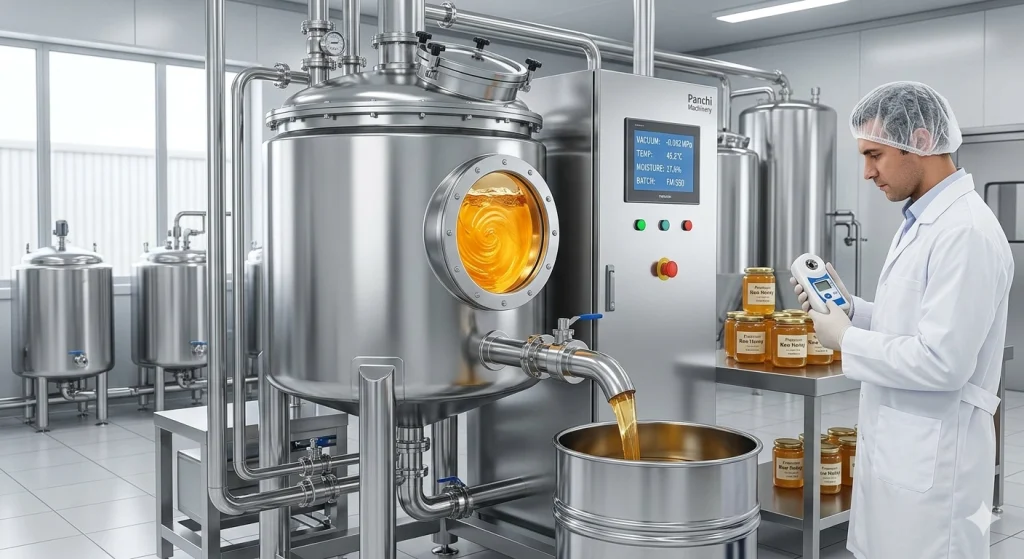
For commercial honey manufacturers, moisture reduction is not only a drying process. It requires precise control of temperature, processing conditions, and equipment performance to maintain honey quality while achieving stable production efficiency.
Modern honey processing solutions combine low-temperature technology, vacuum control, and sanitary Honey Processing Machine design to help manufacturers achieve reliable moisture reduction without damaging valuable honey characteristics.
Honey moisture content is one of the most important indicators affecting product quality and shelf life.
Although natural honey has strong preservation characteristics, excessive water content creates conditions where microorganisms, especially osmophilic yeast, can become active. This may lead to fermentation, gas formation, unpleasant flavors, and reduced market value.
For commercial honey processors, controlling moisture levels directly influences:
Different honey sources naturally contain different moisture levels. Factors such as flower species, harvesting season, climate conditions, and storage environment can affect the initial moisture content.
For example, honey collected during humid seasons may contain higher water content compared with honey harvested in dry environments. Without proper processing control, this variation can create difficulties for large-scale production.
High moisture content creates several challenges during honey processing.
The main concerns include:
Fermentation Risk
When moisture levels become too high, yeast activity increases. This can cause fermentation during storage and reduce product shelf life.
Quality Variation
Commercial buyers often require consistent honey characteristics. Unstable moisture levels may affect viscosity, flavor retention, and overall product appearance.
Export Requirements
Many international honey markets have strict quality expectations regarding moisture content. Processors need reliable methods to achieve stable results before packaging and shipment.
Traditional moisture reduction methods have been used in honey processing for many years. However, they often cannot meet the requirements of modern commercial production.
Natural evaporation is one of the simplest approaches to reduce honey moisture.
The method relies on exposing honey to environmental conditions to allow water to gradually evaporate.
Advantages include:
However, natural evaporation has significant limitations:
For industrial honey processors, these limitations make natural evaporation unsuitable for continuous and large-volume production.
Heating can accelerate moisture removal, but excessive temperature may negatively affect honey quality.
Potential problems include:
Therefore, commercial producers need a more controlled honey dehydration process that can remove moisture efficiently while protecting the natural properties of honey.
Vacuum-based processing provides an alternative solution by allowing moisture removal at lower temperatures.
Choosing the right method to lower honey moisture depends on production scale, quality requirements, and processing objectives.
Small beekeepers may use simple moisture reduction methods, while commercial honey processors require more stable and controllable solutions. The main difference between traditional and modern approaches is not only the speed of water removal but also the ability to protect honey quality during processing.
For industrial production, manufacturers should evaluate each method based on:
Production consistency
Natural evaporation is the most basic method used to reduce honey moisture.
The principle is simple: honey is exposed to air, allowing water to gradually evaporate under natural conditions.
This method may be suitable for:
However, natural evaporation has several disadvantages for commercial production.
The evaporation rate is affected by:
In humid environments, water removal becomes extremely slow. In addition, processors cannot accurately control the final moisture level, which may create quality variations between different batches.
For commercial manufacturers requiring stable honey moisture reduction, natural evaporation is usually not an efficient long-term solution.
Heating is another common method used in the honey industry.
By increasing temperature, manufacturers can accelerate water evaporation and shorten processing time.
Compared with natural evaporation, heating provides:
However, excessive heating may negatively affect honey quality.
High temperatures can contribute to:
Honey contains natural components that are sensitive to temperature. Therefore, commercial processors must carefully control heating conditions during the honey dehydration process.
The challenge is achieving sufficient moisture reduction without reducing the nutritional and sensory characteristics that customers expect.
For modern honey manufacturers, vacuum honey dehydration provides a more advanced approach to moisture control.
Unlike traditional heating methods, vacuum technology reduces the boiling point of water by lowering pressure inside the processing chamber.
This allows manufacturers to remove moisture at lower temperatures while maintaining better honey quality.
Key advantages include:
Vacuum technology is especially suitable for premium honey products where quality preservation is a priority.
For example, monofloral honey, raw honey, and specialty honey products often require careful processing conditions because excessive heat may affect their unique aroma and active components.
Different production requirements require different solutions.
| Processing Method | Advantages | Limitations |
|---|---|---|
| Natural Evaporation | Simple and low investment | Slow and difficult to control |
| Heating Dehydration | Faster processing | Higher temperature impact |
| Vacuum Honey Dehydration | Low-temperature and stable processing | Requires professional equipment |
For small operations, traditional methods may be acceptable. However, commercial honey processors need reliable honey processing equipment to achieve consistent moisture levels and maintain product quality.
A suitable moisture reduction system should not only remove water efficiently but also support long-term production goals, including stable output, reduced energy consumption, and better product value.
For commercial honey manufacturers, achieving stable moisture reduction while maintaining honey quality is a major production challenge.
Traditional heating methods can remove water quickly, but excessive temperatures may negatively affect natural honey characteristics. Therefore, many processors are moving toward vacuum honey dehydration technology to achieve more controlled and efficient moisture reduction.
Vacuum processing provides a different approach by reducing the pressure inside the processing chamber. Under vacuum conditions, water can evaporate at a lower temperature, allowing manufacturers to remove moisture while reducing thermal impact on honey.
This makes vacuum technology especially suitable for:
The main advantage of vacuum dehydration is the ability to control evaporation conditions more precisely.
Under normal atmospheric pressure, water requires a relatively high temperature to evaporate efficiently. However, when pressure is reduced, the boiling point of water decreases.
This allows processors to operate at lower temperatures while maintaining effective moisture removal.
Typical industrial vacuum honey dehydration parameters include:
Compared with high-temperature dehydration, this low-temperature approach helps reduce unnecessary heat exposure and improves final product consistency.
For manufacturers aiming to lower honey moisture without damaging quality, vacuum technology provides a more reliable production solution.
Honey contains natural enzymes, aroma compounds, and flavor components that contribute to its market value.
During processing, excessive heat may affect:
A controlled honey dehydration process should therefore focus on both moisture removal and quality preservation.
Vacuum dehydration helps manufacturers maintain better product characteristics by reducing thermal stress during processing.
This is particularly important for:
Premium monofloral honey often has unique aroma and flavor profiles. Lower-temperature processing helps preserve these characteristics.
Specialty honey products usually have higher quality expectations and require gentler processing conditions.
International buyers often require consistent moisture levels while maintaining product quality. Stable dehydration technology helps processors meet these requirements.
Besides quality protection, vacuum dehydration can also improve commercial production efficiency.
A well-designed vacuum system helps manufacturers achieve:
Unlike natural evaporation, vacuum systems are not significantly affected by external humidity or weather conditions.
This allows honey processors to maintain stable production throughout the year.
For large-scale operations, improved consistency can reduce product losses and increase overall processing efficiency.
Selecting suitable equipment is essential for achieving reliable moisture reduction results.
Professional honey processing equipment should include:
For commercial honey processors requiring low-temperature moisture reduction, PCM provides customized solutions such as the Automatic Vacuum Honey Processing Filtering Machine.
This system integrates vacuum processing and filtration functions to support applications requiring:
As honey markets become more quality-focused, manufacturers need processing methods that balance efficiency and product protection.
Vacuum honey dehydration provides advantages over traditional approaches by offering:
For companies planning to expand commercial honey production, investing in suitable vacuum technology can help create a more reliable and competitive processing system.
Selecting the correct honey processing equipment is an important step for manufacturers who want to achieve stable moisture control and consistent product quality.
Many honey processors focus mainly on equipment capacity or purchase price. However, a suitable system should also match the characteristics of the honey, production targets, and future business requirements.
The right equipment configuration can influence:
For commercial honey production, equipment selection should be based on a complete evaluation of processing requirements rather than a single technical specification.
Capacity is one of the first factors manufacturers should consider when choosing honey processing equipment.
An undersized system may create:
However, selecting excessive capacity may increase investment costs and reduce equipment utilization.
Common honey processing equipment capacities include:
Before purchasing, manufacturers should evaluate:
A professional supplier should recommend equipment based on actual production requirements instead of simply providing standard models.
Material selection directly affects equipment durability, hygiene performance, and service life.
For commercial honey processing, stainless steel is widely used because it provides:
SS304 is commonly selected for standard honey processing applications.
Advantages include:
SS316L is preferred for applications requiring higher corrosion resistance and stricter sanitary standards.
Advantages include:
The correct material depends on:
A reliable honey moisture reduction system should include features that improve process control and product consistency.
Key functions include:
Precise vacuum control helps maintain stable evaporation conditions and supports low-temperature processing.
Accurate temperature management prevents excessive heating and helps protect honey quality.
An efficient heating structure improves energy utilization while maintaining uniform processing conditions.
Smooth internal surfaces and easy cleaning structures reduce contamination risks and simplify maintenance.
For manufacturers requiring more advanced low-temperature processing, PCM provides solutions such as the SS304/316L Low Temperature Vacuum Scraper Concentrator.
This type of vacuum concentration equipment is designed for applications requiring:
Modern honey processors increasingly require automated systems to improve consistency and reduce manual operation.
Useful automation functions include:
Automation can help manufacturers:
When selecting equipment, companies should consider not only current production needs but also future market growth.
A flexible system allows manufacturers to expand capacity, process different honey varieties, and adapt to changing customer requirements.
A successful honey dehydration process depends on the combination of suitable technology, correct equipment configuration, and reliable process control.
The ideal system should help manufacturers:
By selecting the right honey processing equipment, companies can create a more reliable production workflow and improve their competitiveness in the global honey market.
Achieving consistent moisture levels requires more than selecting the right equipment. Commercial honey processors need to optimize the complete production process, from raw honey inspection to final storage.
A reliable moisture control strategy helps manufacturers improve product stability, reduce processing risks, and maintain consistent quality across different batches.
Before starting the honey dehydration process, manufacturers should measure the initial moisture content of each batch.
Different honey sources may have different moisture levels due to:
Regular moisture testing allows processors to determine suitable processing parameters and avoid unnecessary energy consumption.
A controlled approach to lower honey moisture helps maintain predictable production results.
Temperature control is essential when reducing honey moisture.
Excessive heating may affect:
Commercial processors should maintain suitable operating conditions based on honey characteristics.
Using low-temperature vacuum technology allows manufacturers to remove moisture efficiently while protecting important honey properties.
A European honey processor experienced challenges with inconsistent moisture levels during seasonal production.
The company faced:
After implementing a customized vacuum dehydration solution, the processor improved production stability through:
The upgraded system helped the company achieve more reliable honey quality while reducing risks associated with high moisture content.
This case demonstrates how suitable honey processing equipment can improve both production efficiency and final product quality.
In the 2026 honey market, “sweetness” is a commodity, but “density” and “purity” are luxuries. By investing in the technology required to precisely lower honey moisture, you are shifting your business from a reactive harvest model to a proactive quality-engineering model.
You are no longer at the mercy of a rainy harvest season or a humid warehouse. You have the tools to guarantee a consistent, 42° Baume product that will never ferment on the shelf, whether it is sold in a local boutique or shipped across the globe.pment features a Mirror-Polished Finish. This ensures there are no microscopic “dead corners” where honey can stick and ferment, ensuring 100% hygiene and easy Cleaning-in-Place (CIP).
Q: Will the vacuum process affect the honey’s color?
A: Quite the opposite. By operating in an oxygen-free environment at low temperatures, the vacuum process prevents the oxidation and caramelization that typically darken honey during conventional heating.
Q: What is the benefit of the PTFE scraper?
A: Standard stirrers can leave a thin film of honey on the heated walls of the tank, which can burn. The PTFE scrapers constantly wipe the walls, ensuring the entire batch is heated and dehydrated uniformly.
Q: Is the machine compliant with international food safety?
A: Yes, the FM-Series is constructed from food-grade 304 Stainless Steel and meets the certification standards for CE, FDA, and QS, making it suitable for global export operations.
Choosing the right technology to lower honey moisture is essential for improving honey quality, production efficiency, and long-term business value.
PCM provides customized honey processing equipment solutions designed for commercial honey dehydration, filtration, and low-temperature processing.
Contact PCM to discuss your honey processing requirements and develop a suitable production solution.


Whatsapp: +8615736768129
Email: [email protected]
Address: Zhengzhou, Henan Province, China
Automatic Vacuum Honey Processing & Filtering Machine
Vacuum Low-Temperature Liquid Extraction & Concentration Unit
Custom Steam Distillation & Heat Reflux Essential Oil Equipment
SS304/316L Low-Temperature Vacuum Scraper Concentrator
QN Spherical Vacuum Concentrator & Alcohol Recovery Unit
Multi-function Stainless Steel Vacuum Distillation & Extraction Unit
Hot Reflux Vacuum Liquid Extraction & Concentration Unit
Single-Effect External Circulation Vacuum Concentrator
SJN Series Double-Effect External Circulation Vacuum Evaporator
We will contact you within one working day. Please pay attention to your email.
Automatic Vacuum Honey Processing & Filtering Machine
Vacuum Low-Temperature Liquid Extraction & Concentration Unit
Custom Steam Distillation & Heat Reflux Essential Oil Equipment
WhatsApp: +8615736768129
Email: [email protected]
Address: Zhengzhou, Henan Province, China


COPYRIGHT© 2026 Zhengzhou Panchi Machinery Equipment Co., Ltd. | Privacy Policy

Our team will respond within 24 hours.
Thanks! We'll get back to you within 24 hours.
Check your inbox (and spam folder) for our reply.