
The demand for natural botanical ingredients is increasing across industries such as herbal medicine, nutraceuticals, cosmetics, food ingredients, and essential oils. As manufacturers expand production capacity, choosing suitable industrial botanical extraction equipment becomes a critical decision affecting product quality, operating efficiency, and long-term investment value.
Many producers face challenges when moving from laboratory or small-scale processing to commercial manufacturing. Common problems include inconsistent extraction yield, unstable product quality, high energy consumption, and difficulties in protecting heat-sensitive compounds.
Traditional extraction methods may achieve basic processing requirements, but they often lack precise control over temperature, mixing, filtration, and concentration. Modern production requires a complete processing solution that can maintain stable conditions throughout the entire extraction workflow.
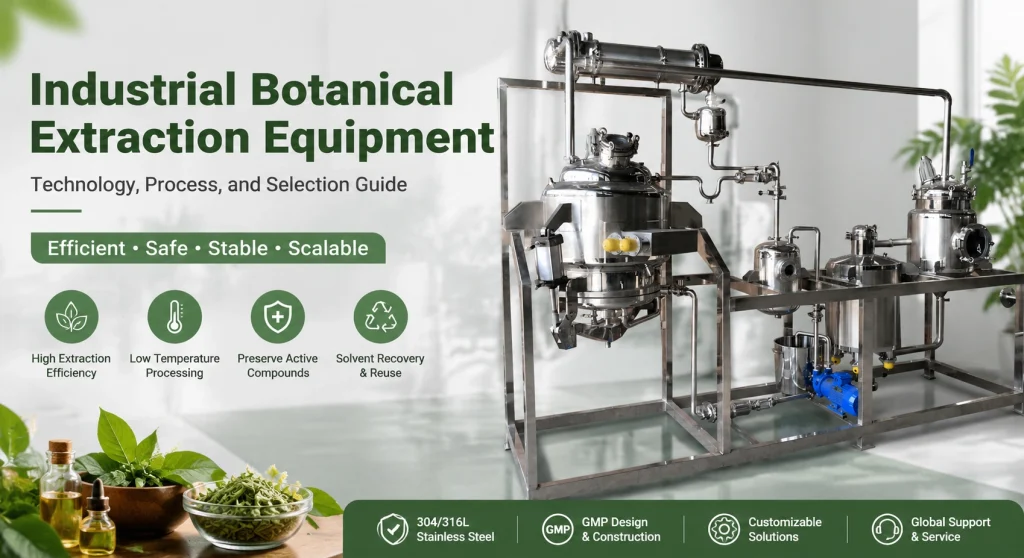
A professional industrial extraction system integrates multiple stages, including raw material preparation, extraction, filtration, concentration, and storage. This integrated approach helps manufacturers improve process consistency while reducing production risks.
Different botanical materials require different extraction strategies. Water extraction, ethanol extraction, vacuum-assisted extraction, and distillation technologies each provide specific advantages depending on raw material properties and final product requirements.
This guide explains the key technologies, equipment types, and selection factors manufacturers should consider when investing in industrial botanical extraction equipment.
The global botanical ingredient market continues to grow as industries increase their use of natural and plant-based products.
Common applications include:
This growth has increased the requirements for production equipment.
Manufacturers need systems that provide:
Compared with traditional methods, advanced botanical extraction equipment provides better control over key parameters such as temperature, extraction time, pressure, and mixing efficiency.
For high-value botanical materials, precise process control directly affects extract quality and commercial value.
Many manufacturers experience production limitations when using conventional extraction methods.
Key challenges include:
Inconsistent Extraction Results
Without accurate control of processing conditions, extraction performance may vary between batches.
This can influence:
High Energy Consumption
Long heating cycles and inefficient evaporation processes can increase operating costs, especially for industrial-scale production.
Protection of Heat-Sensitive Compounds
Many botanical materials contain valuable compounds that are sensitive to high temperatures.
Excessive heat may result in:
Modern extraction technologies help manufacturers overcome these challenges through improved temperature management and controlled processing conditions.
A complete botanical production line includes more than an extraction vessel.
A professional industrial extraction system may combine:
Each stage affects the final product performance.
For example:
For manufacturers planning production expansion, selecting suitable industrial botanical extraction equipment provides a foundation for improving efficiency, quality control, and future scalability.
Industrial botanical extraction equipment is a production system designed to separate valuable compounds from plant materials through controlled mechanical, thermal, and solvent-based processes.
Unlike laboratory equipment, industrial systems are designed for commercial manufacturing. They must handle larger production volumes while maintaining stable extraction performance and consistent product quality.
A complete extraction solution usually combines:
The purpose of an industrial extraction system is not only to transfer active compounds from plant materials but also to create a repeatable and efficient production process.
For commercial manufacturers, equipment design directly affects:
Industrial botanical extraction equipment is a production system designed to separate valuable compounds from plant materials through controlled mechanical, thermal, and solvent-based processes.
Unlike laboratory extraction devices, industrial systems are designed for continuous commercial production. They must handle larger raw material volumes while maintaining stable extraction efficiency and consistent product quality.
A complete extraction solution usually combines:
The purpose of an industrial extraction system is not only to transfer active compounds from plant materials but also to create a repeatable and efficient production process.
For commercial manufacturers, equipment design directly affects:
The working principle of botanical extraction equipment is based on improving the contact between plant materials and extraction media.
During processing, active compounds are transferred from plant structures into a liquid phase under controlled conditions.
The main factors affecting extraction performance include:
A typical industrial extraction process includes four major stages.
Before extraction, botanical materials are usually cleaned, dried, and reduced to suitable particle sizes.
Proper preparation improves:
For many botanical materials, particle size directly influences how effectively target compounds can be released during extraction.
During the extraction stage, plant materials are combined with water, ethanol, or other suitable extraction media.
The system controls important parameters such as:
Different materials require different processing conditions.
For example:
After extraction, solid residues must be separated from the liquid extract.
An efficient filtration process helps:
After filtration, the extract is often concentrated to increase active ingredient content.
Vacuum concentration technology allows manufacturers to remove excess liquid under lower temperature conditions, helping protect heat-sensitive compounds.
The final extract is then transferred to suitable storage equipment to maintain product stability.
A complete industrial extraction system consists of several connected components that work together to achieve stable production.
The extraction vessel is the core processing unit where plant materials interact with extraction media.
Important design factors include:
For food, herbal, and nutraceutical applications, stainless steel construction is commonly selected because of its corrosion resistance and sanitary performance.
Temperature control and mixing performance directly influence extraction efficiency.
A properly designed system provides:
Vacuum technology improves extraction and concentration performance by reducing operating temperature.
Benefits include:
For manufacturers requiring flexible extraction, distillation, and concentration functions, PCM provides solutions such as the Multi-function Stainless Steel Vacuum Distillation Extraction Unit.
This equipment integrates multiple functions for applications including botanical extraction, essential oil processing, and vacuum distillation.
Different botanical materials require different extraction methods. Selecting suitable industrial botanical extraction equipment depends on raw material characteristics, target compounds, production capacity, and final product requirements.
In commercial production, the most common extraction technologies include water extraction, ethanol extraction, and vacuum-assisted extraction.
Each method provides different advantages. Manufacturers should evaluate the complete process workflow instead of selecting equipment only based on extraction capacity.
Water extraction is one of the most widely used methods in botanical processing because water is safe, economical, and suitable for many plant-based applications.
Common applications include:
A typical water extraction process includes:
Botanical Materials
↓
Grinding
↓
Water Addition
↓
Heating & Agitation
↓
Filtration
↓
Concentration
↓
Final Extract
The performance of water extraction depends on several parameters:
For industrial production, botanical extraction equipment must provide accurate temperature control and stable operation to maintain consistent results.
Compared with traditional open heating methods, modern systems offer better process control and improved production repeatability.
Ethanol extraction is widely used when manufacturers need to obtain specific active compounds from plant materials.
Typical applications include:
The basic ethanol extraction workflow includes:
Plant Materials
↓
Ethanol Extraction
↓
Solid-Liquid Separation
↓
Vacuum Concentration
↓
Solvent Recovery
↓
Final Product
Compared with water extraction, ethanol can dissolve different groups of compounds and provide advantages for specific botanical applications.
However, industrial ethanol processing requires careful equipment design, including:
A complete industrial extraction system should integrate extraction, concentration, and solvent recovery processes to reduce solvent loss and improve operating efficiency.
Many botanical compounds are sensitive to high temperatures during processing.
For these applications, vacuum extraction equipment provides an effective solution by reducing operating pressure and allowing processing at lower temperatures.
Typical applications include:
The main advantages include:
Vacuum-assisted processing is especially valuable when manufacturers need to maintain natural aroma, color, and biological activity.
By combining vacuum control, temperature management, and efficient agitation, manufacturers can achieve more stable extraction performance.
For production lines requiring both extraction and concentration functions, PCM provides integrated solutions such as the Vacuum Low Temperature Liquid Extraction Concentration Unit.
This system is designed for applications requiring:
The correct extraction technology depends on the relationship between raw materials and production goals.
Manufacturers should evaluate:
Different compounds have different solubility characteristics, requiring suitable extraction media and process conditions.
Heat-sensitive materials often benefit from vacuum-based processing to reduce degradation risks.
Commercial systems must maintain stable performance across repeated production cycles.
A properly designed industrial botanical extraction equipment solution connects extraction, filtration, concentration, and storage into one efficient workflow.
Vacuum technology plays an important role in modern industrial botanical extraction equipment because many botanical compounds require gentle processing conditions to maintain quality.
Traditional extraction and concentration methods often rely on higher temperatures to improve processing speed. However, excessive heat exposure may affect sensitive components, natural aromas, and product stability.
By reducing operating pressure, vacuum technology lowers the boiling point of liquids and enables manufacturers to process materials under controlled lower temperatures.
This approach helps improve:
Active compound protection
Many botanical ingredients contain valuable compounds that are sensitive to thermal conditions.
Examples include:
During high-temperature processing, manufacturers may experience:
Vacuum-based processing allows extraction and concentration operations to occur at lower temperatures, reducing thermal stress on the product.
Typical operating conditions may include:
For manufacturers producing premium botanical extracts, maintaining gentle processing conditions can directly improve final product value.
The commercial value of botanical extracts depends on maintaining the concentration and stability of target compounds.
A well-designed vacuum extraction equipment solution provides better control over:
By combining vacuum control with efficient heating and agitation systems, manufacturers can achieve more consistent extraction performance.
For example:
Vacuum technology provides flexibility for different applications while maintaining production efficiency.
For ethanol-based extraction processes, solvent recovery is an important factor affecting operating costs.
Without effective recovery systems, manufacturers may face:
A complete industrial extraction system integrates extraction, concentration, and solvent recovery into a connected workflow.
Typical process flow:
Ethanol Extraction
↓
Filtration
↓
Vacuum Concentration
↓
Solvent Recovery
↓
Solvent Reuse
Vacuum-assisted recovery provides advantages including:
For large-scale botanical production, efficient solvent recovery can significantly improve long-term operational economics.
Extraction is only one stage of botanical processing.
After valuable compounds are transferred into liquid form, manufacturers often need concentration equipment to increase extract strength and improve storage stability.
Vacuum concentration helps remove excess liquid while maintaining lower processing temperatures.
Key benefits include:
For manufacturers requiring combined extraction and concentration capabilities, PCM provides customized solutions.
The Vacuum Low Temperature Liquid Extraction Concentration Unit is designed for applications requiring:
Selecting suitable industrial botanical extraction equipment from an experienced extraction equipment manufacturer helps companies build a reliable production process with better quality control and future scalability.
Selecting suitable industrial botanical extraction equipment requires evaluating the complete production process rather than focusing only on machine capacity.
Manufacturers should consider:
Equipment capacity should match the expected production demand.
Important factors include:
A balanced production line should ensure that extraction, filtration, concentration, and storage capacities work together efficiently.
An experienced extraction equipment manufacturer can help customers design suitable configurations and avoid production limitations caused by undersized or oversized equipment.
Material selection directly affects equipment durability and product safety.
For botanical processing, common options include:
Suitable for general food and herbal applications with good corrosion resistance and cost efficiency.
Recommended for higher-demand applications requiring improved corrosion resistance and stronger sanitary performance.
The correct material choice helps reduce maintenance requirements and improves long-term equipment reliability.
The investment cost of an extraction system depends on several factors, including:
For example, systems with vacuum concentration, solvent recovery, or customized control systems usually require higher investment but may provide better operating efficiency and product consistency.
Choosing the right supplier is equally important.
A reliable extraction equipment manufacturer should provide:
Manufacturers should evaluate not only the initial equipment price but also long-term factors such as energy consumption, maintenance cost, and production stability.
A botanical ingredient producer in India required a more stable extraction solution for herbal processing.
The previous production method had problems with inconsistent extract quality and high energy consumption.
After upgrading to a customized industrial extraction system, the company improved process control through:
The optimized workflow helped reduce processing variation and improve overall production efficiency.
Q: What is industrial botanical extraction equipment used for?
A: It is used to extract valuable compounds from botanical materials for industries such as herbal medicine, food ingredients, nutraceuticals, and essential oils.
Q: What extraction method is best for botanical materials?
A: The suitable method depends on the material and target compounds. Water extraction, ethanol extraction, and vacuum-assisted extraction are commonly used in industrial production.
Q: Why is vacuum technology important in botanical extraction?
A: Vacuum technology enables lower-temperature processing, helping protect heat-sensitive compounds and improve extract quality.
Q: How do I choose an extraction equipment manufacturer?
A: Consider engineering capability, customization experience, material quality, production support, and after-sales service.
Choosing the right industrial botanical extraction equipment helps manufacturers improve production efficiency, maintain product quality, and build scalable processing systems.
PCM provides customized extraction, concentration, and processing solutions based on different botanical materials and production requirements.
Contact PCM for professional equipment consultation and customized processing solutions.


Whatsapp: +8615736768129
Email: [email protected]
Address: Zhengzhou, Henan Province, China
Automatic Vacuum Honey Processing & Filtering Machine
Vacuum Low-Temperature Liquid Extraction & Concentration Unit
Custom Steam Distillation & Heat Reflux Essential Oil Equipment
SS304/316L Low-Temperature Vacuum Scraper Concentrator
QN Spherical Vacuum Concentrator & Alcohol Recovery Unit
Multi-function Stainless Steel Vacuum Distillation & Extraction Unit
Hot Reflux Vacuum Liquid Extraction & Concentration Unit
Single-Effect External Circulation Vacuum Concentrator
SJN Series Double-Effect External Circulation Vacuum Evaporator
We will contact you within one working day. Please pay attention to your email.
Automatic Vacuum Honey Processing & Filtering Machine
Vacuum Low-Temperature Liquid Extraction & Concentration Unit
Custom Steam Distillation & Heat Reflux Essential Oil Equipment
WhatsApp: +8615736768129
Email: [email protected]
Address: Zhengzhou, Henan Province, China


COPYRIGHT© 2026 Zhengzhou Panchi Machinery Equipment Co., Ltd. | Privacy Policy

Our team will respond within 24 hours.
Thanks! We'll get back to you within 24 hours.
Check your inbox (and spam folder) for our reply.