
Selecting the right extraction method is one of the most important decisions for manufacturers producing herbal extracts, natural ingredients, pharmaceuticals, and functional products. The choice between percolation vs maceration herbal extraction directly affects extraction efficiency, processing time, solvent consumption, and the final quality of active compounds.
Although both methods use solvents to extract valuable components from plant materials, they work in completely different ways. Maceration relies on soaking herbs in a solvent for a specific period, while percolation uses continuous solvent flow through plant materials to achieve more efficient extraction.
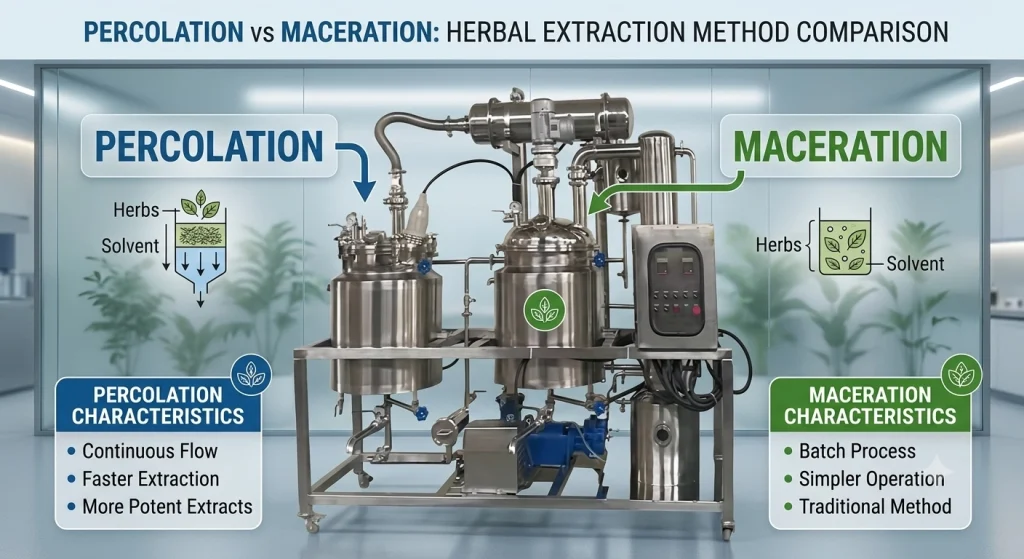
For small-scale production, maceration may provide a simple and economical solution. However, commercial manufacturers often require higher extraction yield, consistent quality, and better process control. In these cases, selecting suitable herbal extraction equipment becomes essential for improving production efficiency and maintaining product standards.
Understanding the advantages and limitations of each method helps manufacturers choose the most suitable extraction technology for their production goals.
Percolation extraction is a dynamic extraction method where solvent continuously passes through prepared plant materials inside an extraction vessel. Fresh solvent enters from the top of the system, moves through the herbal materials, dissolves active compounds, and exits as an enriched extract solution.
Unlike static soaking methods, percolation extraction maintains continuous contact between fresh solvent and plant materials. This improves the concentration gradient between the solvent and plant matrix, allowing more efficient transfer of soluble compounds.
The process usually includes:
Because the solvent is continuously renewed, percolation can achieve higher extraction efficiency with shorter processing times compared with traditional soaking methods.
For industries requiring standardized herbal ingredients, pharmaceutical extracts, or large-volume botanical production, percolation provides better process repeatability and scalability.
Maceration extraction is one of the oldest and simplest herbal extraction methods. It involves soaking plant materials in a solvent for a specific period until the desired compounds are dissolved.
During the process, the solvent gradually penetrates the plant cells and extracts soluble components. After sufficient extraction time, the liquid extract is separated from the remaining plant material through filtration or pressing.
A typical maceration extraction process includes:
The main advantage of maceration is its simplicity. It requires less complex equipment and is suitable for small batches, laboratory research, and products where extraction speed is not the primary concern.
However, traditional maceration usually requires longer processing time and may consume more solvent compared with modern continuous extraction methods.
| Feature | Percolation Extraction | Maceration Extraction |
|---|---|---|
| Extraction Method | Continuous solvent flow | Static soaking process |
| Extraction Speed | Faster | Slower |
| Solvent Contact | Continuous renewal | Limited by soaking time |
| Extraction Efficiency | Higher | Moderate |
| Process Control | More precise | Relatively simple |
| Equipment Requirement | Advanced system required | Basic vessels available |
| Production Scale | Commercial production | Small batch production |
The decision between percolation vs maceration herbal extraction depends mainly on production requirements, raw material characteristics, and expected output.
Manufacturers producing small quantities or developing new herbal formulas may prefer maceration because of its simplicity and lower investment.
However, companies focused on commercial production usually require better consistency, higher capacity, and improved extraction efficiency. A modern botanical extraction process often integrates controlled temperature, agitation, filtration, and automated operation to achieve stable results. (Internal Link → Botanical Extraction Process)
When selecting extraction technology, manufacturers should evaluate:
The right extraction method should not only improve current production performance but also support long-term manufacturing growth.
When comparing percolation vs maceration herbal extraction, manufacturers should look beyond the basic extraction principle and evaluate factors that directly affect production efficiency, product quality, and operating costs.
Both methods can extract valuable compounds from botanical materials, but their performance differs significantly when applied to commercial manufacturing. Percolation generally provides better process control and higher efficiency, while maceration remains attractive for simple, small-scale operations.
For companies planning to expand production or improve extract consistency, understanding these seven differences helps identify the most suitable extraction solution.
Extraction efficiency is one of the most important factors when selecting an extraction method.
In percolation extraction, fresh solvent continuously passes through the plant material, maintaining a stronger concentration difference between the solvent and botanical compounds. This continuous contact improves the transfer of active ingredients and often results in higher extraction yield.
By comparison, maceration extraction depends on static soaking. As the solvent becomes saturated with extracted compounds, the extraction driving force gradually decreases. Longer soaking periods may be required to achieve the desired extraction level.
For commercial manufacturers producing valuable herbal ingredients, higher extraction efficiency can significantly improve raw material utilization and reduce production waste.
Production speed is another major difference between these two methods.
Traditional maceration extraction requires extended soaking periods, which may range from several hours to multiple days depending on the plant material and solvent characteristics. This longer processing cycle can limit production capacity.
A modern percolation extraction process provides continuous solvent movement, allowing manufacturers to complete extraction cycles faster while maintaining consistent results.
For large-scale production, shorter processing time means:
This makes percolation more suitable for manufacturers supplying commercial herbal extracts.
Solvent usage directly influences production costs, especially for large-scale extraction facilities.
Maceration typically requires a larger solvent volume because plant materials remain immersed throughout the extraction period. Additional solvent recovery steps may also be required to reduce operating expenses.
Percolation uses solvent more efficiently because the flow direction and extraction parameters can be controlled. The system can optimize solvent-material contact while reducing unnecessary solvent usage.
When combined with professional herbal extraction equipment, manufacturers can further improve solvent recovery and overall process efficiency. (Internal Link → Herbal Extraction Equipment)
Maintaining active compounds is essential for pharmaceutical, nutraceutical, and high-value botanical products.
Maceration provides a gentle extraction environment, which can be beneficial for certain materials that require longer extraction at mild conditions.
However, uncontrolled soaking time may increase the risk of:
A controlled botanical extraction process allows manufacturers to manage important parameters such as temperature, solvent ratio, extraction time, and filtration conditions.
Modern extraction systems can provide more stable processing conditions, helping manufacturers achieve consistent extract quality between production batches. (Internal Link → Botanical Extraction Process)
Equipment selection depends on production scale and business objectives.
Maceration systems usually require simpler vessels and basic operation procedures. This makes them suitable for:
For commercial manufacturing, more advanced solutions are often required. A complete extraction setup may include:
A customized stainless steel extraction tank provides better hygiene, durability, and process control for industrial applications. (Internal Link → Stainless Steel Extraction Tank)
Although advanced equipment requires higher initial investment, it can provide better efficiency and long-term production benefits.
Automation has become increasingly important in modern herbal production.
Maceration processes often depend more on manual operation, including solvent addition, mixing, monitoring, and material discharge.
Commercial percolation systems can integrate:
These features improve production repeatability and reduce human errors.
For manufacturers seeking GMP-compliant production, automated extraction technology provides better control over quality standards.
Future expansion should always be considered when selecting extraction technology.
Maceration may work well for small production volumes but can become inefficient when demand increases.
Percolation systems are easier to integrate into larger extraction systems with additional automation, filtration, and concentration stages.
For companies planning long-term growth, investing in scalable extraction technology can reduce future upgrade costs and production interruptions.
| Production Requirement | Recommended Method |
|---|---|
| Small batch production | Maceration Extraction |
| Low initial investment | Maceration Extraction |
| Laboratory development | Maceration Extraction |
| Higher extraction yield | Percolation Extraction |
| Large-scale production | Percolation Extraction |
| Consistent commercial quality | Percolation Extraction |
| Automated production line | Percolation Extraction |
Choosing the right extraction technology requires more than comparing extraction principles. For commercial manufacturers, the best solution depends on raw material characteristics, production capacity, target compounds, and long-term business goals.
The comparison of percolation vs maceration herbal extraction shows that each method has specific advantages. Maceration provides simplicity and flexibility for small-scale production, while percolation offers higher efficiency and better process control for industrial manufacturing.
Before investing in an extraction line, manufacturers should evaluate their actual production requirements and select equipment that can deliver stable performance, consistent quality, and future scalability.
Different botanical materials respond differently during extraction. The structure of the plant material, active compound properties, and solvent compatibility all influence extraction performance.
For example:
A professional botanical extraction process considers these factors before selecting the extraction method, solvent system, and operating parameters.
Manufacturers should analyze:
This approach helps avoid inefficient extraction cycles and improves final product consistency.
The ideal extraction method depends largely on production objectives.
Maceration may be suitable when manufacturers prioritize simplicity and flexibility.
Typical applications include:
Its relatively simple operation allows manufacturers to process different materials without complex equipment requirements.
However, as production volume increases, limitations such as longer processing time, higher labor requirements, and lower automation capability may become significant challenges.
Percolation extraction is generally preferred for commercial production requiring higher efficiency and consistent output.
Advantages include:
For manufacturers producing standardized herbal extracts, nutraceutical ingredients, or pharmaceutical materials, percolation extraction can provide better scalability and process control.
Modern herbal production requires more than an extraction vessel. A complete extraction solution should integrate process control, material handling, filtration, heating, and concentration functions.
Professional herbal extraction equipment can help manufacturers achieve:
Industrial extraction systems may include:
For industries requiring pharmaceutical or food-grade production, equipment design and material selection are especially important. Stainless steel construction, sanitary piping, and easy-cleaning structures help maintain product safety and production reliability.
Before selecting an extraction system, manufacturers should evaluate several important factors:
Determine whether the equipment can meet current demand and support future expansion.
Ensure the system is suitable for different herbal materials and solvents.
Consider whether automatic control, monitoring, and data recording are required.
Choose equipment that supports efficient cleaning procedures and reduces downtime.
A complete production line may require connection with grinding, filtration, concentration, and storage equipment.
A well-designed extraction system should not only solve current production requirements but also provide flexibility for future product development.
The best choice in the percolation vs maceration herbal extraction comparison depends on your production strategy.
Companies producing small volumes or developing new products may benefit from the simplicity of maceration. However, manufacturers focused on commercial-scale production, consistent quality, and improved efficiency often require more advanced extraction solutions based on percolation technology.
Panchi provides customized herbal extraction equipment solutions for botanical, pharmaceutical, food, and natural ingredient industries. Our engineering team evaluates each project according to raw materials, production targets, and processing requirements to recommend suitable extraction configurations.
From extraction vessels and solvent circulation systems to integrated concentration solutions, Panchi helps manufacturers build efficient and reliable production lines that improve extract quality and operational performance.
A: The main difference between percolation vs maceration herbal extraction is how the solvent interacts with plant materials. Maceration uses a soaking method where herbs remain immersed in solvent for a specific period, while percolation continuously passes fresh solvent through the material to improve extraction efficiency. Maceration is suitable for small batches and flexible production, while percolation is generally preferred for commercial manufacturing that requires higher yield, shorter processing time, and consistent extract quality.
A: Yes, percolation extraction is usually more efficient than traditional maceration because fresh solvent continuously contacts the herbal material during the process. This maintains a stronger concentration gradient and improves the transfer of active compounds. Compared with maceration extraction, percolation can reduce processing time, improve solvent utilization, and provide more consistent extraction results. However, the best method depends on the raw materials, target compounds, production scale, and required product quality.
A: Manufacturers may choose maceration extraction when they need a simple, flexible, and cost-effective extraction method. It is commonly used for small-batch production, laboratory testing, product development, and specialty herbal products. Maceration requires less complex equipment and allows manufacturers to process different materials with minimal investment. However, for large-scale production, longer extraction cycles and lower automation levels may limit efficiency compared with more advanced extraction technologies.
A: Manufacturers may choose maceration extraction when they need a simple, flexible, and cost-effective extraction method. It is commonly used for small-batch production, laboratory testing, product development, and specialty herbal products. Maceration requires less complex equipment and allows manufacturers to process different materials with minimal investment. However, for large-scale production, longer extraction cycles and lower automation levels may limit efficiency compared with more advanced extraction technologies.


Whatsapp: +8615736768129
Email: [email protected]
Address: Zhengzhou, Henan Province, China
Automatic Vacuum Honey Processing & Filtering Machine
Vacuum Low-Temperature Liquid Extraction & Concentration Unit
Custom Steam Distillation & Heat Reflux Essential Oil Equipment
SS304/316L Low-Temperature Vacuum Scraper Concentrator
QN Spherical Vacuum Concentrator & Alcohol Recovery Unit
Multi-function Stainless Steel Vacuum Distillation & Extraction Unit
Hot Reflux Vacuum Liquid Extraction & Concentration Unit
Single-Effect External Circulation Vacuum Concentrator
SJN Series Double-Effect External Circulation Vacuum Evaporator
We will contact you within one working day. Please pay attention to your email.
Automatic Vacuum Honey Processing & Filtering Machine
Vacuum Low-Temperature Liquid Extraction & Concentration Unit
Custom Steam Distillation & Heat Reflux Essential Oil Equipment
WhatsApp: +8615736768129
Email: [email protected]
Address: Zhengzhou, Henan Province, China


COPYRIGHT© 2026 Zhengzhou Panchi Machinery Equipment Co., Ltd. | Privacy Policy

Our team will respond within 24 hours.
Thanks! We'll get back to you within 24 hours.
Check your inbox (and spam folder) for our reply.