
For commercial beekeepers and honey exporters, the challenge to lower honey moisture is a race against fermentation. When honey moisture exceeds 18.6%, osmophilic yeasts become active, leading to spoilage and a sour profile—a phenomenon known in the trade as the “moisture time bomb.” To successfully lower honey moisture while preserving heat-sensitive enzymes like diastase and invertase, producers must move beyond traditional open-air heating toward precision-engineered vacuum technology.
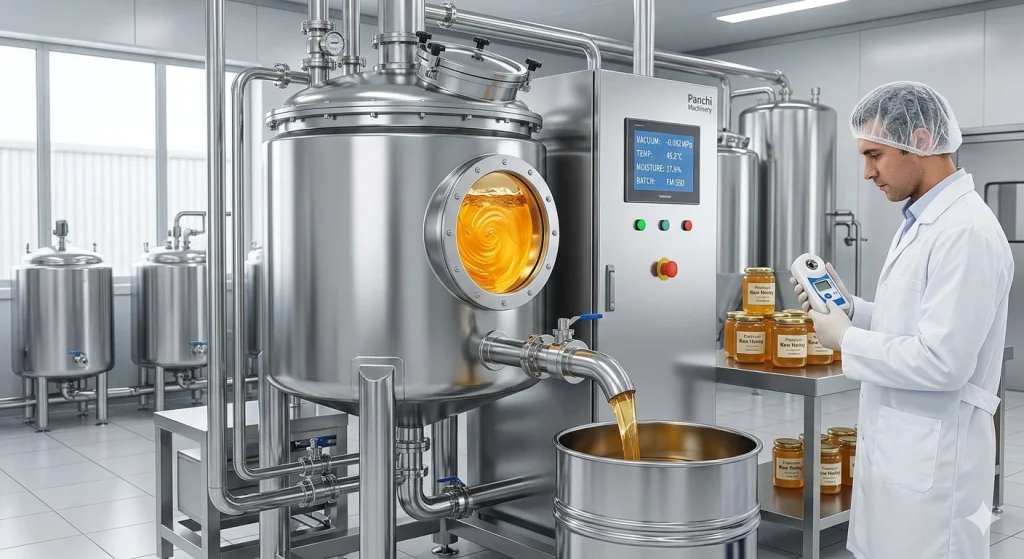
On platforms like Reddit’s r/beekeeping and Quora, a common distress call from tropical regions is: “How do I lower honey moisture when the ambient humidity is 80% and my honey is darkening under heat?” The answer lies in the laws of physics. By manipulating atmospheric pressure, it is possible to evaporate excess water at temperatures that respect the biological integrity of the hive. This guide analyzes the sophisticated approach utilized by the Panchi Automatic Vacuum Honey Processing Machine to achieve shelf-stable, Grade-A honey.
Based on the technical documentation of the Panchi Vacuum Honey Machine, the equipment is engineered to solve the “Paradox of Heat.” Usually, heat is required to evaporate water, but heat is the enemy of honey quality.
The link highlights a critical specification: a vacuum degree of ≥ 0.092 MPa. In this low-pressure environment, the boiling point of water drops from 100°C to approximately 40°C–50°C. This “Goldilocks Zone” allows the machine to lower honey moisture rapidly while preventing the Maillard reaction (browning) and keeping Hydroxymethylfurfural (HMF) levels within strict international export limits.
When users search for ways to lower honey moisture, Google’s “People Also Ask” (PAA) data reveals deep concerns regarding quality and compliance:
The Panchi machine addresses these via a closed-loop system. By excluding oxygen during the dehydration phase, the honey retains its original translucent color and floral volatile compounds that would otherwise escape into the atmosphere.
A major inefficiency cited in professional processing forums is the “multi-tank struggle”—moving honey from a liquefier to a filter, and then to a dryer. The Panchi FM-Series integrates these into a singular 304-stainless steel footprint:
| Model | Capacity (8H) | Target Market |
| FM-400 | 0.5 Tons | Small-scale boutique apiaries focusing on high-margin “Raw” retail. |
| FM-550 | 1.0 Ton | Mid-sized cooperatives in high-humidity tropical zones. |
| FM-600 | 2.0 Tons | Large-scale exporters requiring standardized B2B bulk processing. |
This is a recurring debate on Quora’s Food Science boards. The purist definition of raw honey is honey that hasn’t been heated beyond 45°C.
Because vacuum technology allows a producer to lower honey moisture at exactly these temperatures, the product remains biologically “alive.” In fact, vacuum processing is often more “raw” than air-drying in a hot room, as the latter exposes the honey to hours of oxidation. The vacuum method provides a scientific bridge between artisanal quality and commercial shelf-stability.
To maximize the efficiency of your equipment and the quality of your harvest, consider these professional field tips:
Honey has high thermal mass; it holds onto heat long after the power is cut. To perfectly lower honey moisture, experienced operators recommend shutting off the heating elements when the moisture is 0.5% away from the target, allowing the vacuum pump to finish the dehydration using the residual heat in the tank.
The link specifies a mirror-polished interior (Ra < 0.4μm). This is not for aesthetics—it is for Clean-In-Place (CIP) efficiency. A smoother surface means less honey “hangs” on the walls, reducing waste between batches and ensuring you meet the most stringent FDA and CE hygiene standards.
One of the “incremental values” of a vacuum system is the preservation of aroma. In an open-air evaporator, your facility smells like honey because the flavor is leaving the product. In a vacuum cycle, those floral esters are trapped within the liquid, resulting in a more robust, “terroir-driven” flavor profile that commands higher prices.
In the 2026 honey market, “sweetness” is a commodity, but “density” and “purity” are luxuries. By investing in the technology required to precisely lower honey moisture, you are shifting your business from a reactive harvest model to a proactive quality-engineering model.
You are no longer at the mercy of a rainy harvest season or a humid warehouse. You have the tools to guarantee a consistent, 42° Baume product that will never ferment on the shelf, whether it is sold in a local boutique or shipped across the globe.pment features a Mirror-Polished Finish. This ensures there are no microscopic “dead corners” where honey can stick and ferment, ensuring 100% hygiene and easy Cleaning-in-Place (CIP).
Q: Will the vacuum process affect the honey’s color?
A: Quite the opposite. By operating in an oxygen-free environment at low temperatures, the vacuum process prevents the oxidation and caramelization that typically darken honey during conventional heating.
Q: What is the benefit of the PTFE scraper?
A: Standard stirrers can leave a thin film of honey on the heated walls of the tank, which can burn. The PTFE scrapers constantly wipe the walls, ensuring the entire batch is heated and dehydrated uniformly.
Q: Is the machine compliant with international food safety?
A: Yes, the FM-Series is constructed from food-grade 304 Stainless Steel and meets the certification standards for CE, FDA, and QS, making it suitable for global export operations.


Whatsapp: +8615736768129
Email: inquiry@panchimachinery.com
Address: Zhengzhou, Henan Province, China
Automatic Vacuum Honey Processing & Filtering Machine
Vacuum Low-Temperature Liquid Extraction & Concentration Unit
Custom Steam Distillation & Heat Reflux Essential Oil Equipment
SS304/316L Low-Temperature Vacuum Scraper Concentrator
QN Spherical Vacuum Concentrator & Alcohol Recovery Unit
Multi-function Stainless Steel Vacuum Distillation & Extraction Unit
Hot Reflux Vacuum Liquid Extraction & Concentration Unit
Single-Effect External Circulation Vacuum Concentrator
SJN Series Double-Effect External Circulation Vacuum Evaporator
We will contact you within one working day. Please pay attention to your email.
Automatic Vacuum Honey Processing & Filtering Machine
Vacuum Low-Temperature Liquid Extraction & Concentration Unit
Custom Steam Distillation & Heat Reflux Essential Oil Equipment
WhatsApp: +8615736768129
Email: inquiry@panchimachinery.com
Address: Zhengzhou, Henan Province, China


COPYRIGHT© 2026 Zhengzhou Panchi Machinery Equipment Co., Ltd. | Privacy Policy