
For centuries, the dense tropical rainforests of Southeast Asia—spanning Indonesia, Malaysia, Vietnam, Thailand, and Cambodia—have produced some of the most ecologically diverse and medicinally potent honey in the world. Whether it is the deep, dark wild forest honey harvested from giant Apis dorsata hives high in the canopy, traditional village indigenous wild honey (locally known as pressed honey), or the highly prized, tangy stingless bee honey locally known as KelulutouMadu Kelulut, these products are nature’s premium treasures.
They are packed with unique floral aromas, rich polyphenols, and a dense complex of live bioactive enzymes. However, because of the extreme equatorial humidity, regional aggregators and exporters face a non-stop battle to stop wild honey fermentation before these pristine active elements degrade into sour, low-value byproducts.
Yet, for traditional beekeepers, honey hunters, and local B2B wholesalers who harvest this liquid gold, the tropical climate turns this blessing into a logistical nightmare.
Consider this real, painful scenario frequently shared across honey processing forums on Reddit (such as /r/beekeeping) and Quora:
“I just purchased two tons of pure, raw pressed wild honey from a local harvesting community in Sumatra. It tasted amazing on day one—rich, complex, and dark. But after just five days of storage in our warehouse, a thick layer of white foam started creeping over the top of the plastic drums. Now, the drums are bulging under immense pressure, the honey is bubbling violently, and it has developed a sharp, sour, beer-like alcoholic smell. Is my entire investment ruined? Can I save this batch? Please tell me how to prevent raw honey from fermenting before I lose everything!”
This is the catastrophic phenomenon of tropical honey spoilage. Local aggregators who fail to stop wild honey fermentation early always find their premium stocks turning into unsellable vinegar within weeks.
[Tropical Rain / High Humidity] ──► [Honey Moisture Exceeds 23%] ──► [Osmophilic Yeast Activates] ──► [Sugars Convert to Alcohol & CO2] ──► [Sour Taste, White Foam & Bulging Drums]
In the humid ecosystems of Southeast Asia, raw wild honey naturally sits at a critically high moisture level, often fluctuating between 24% and 28%, while Stingless Bee (Kelulut) honey routinely arrives at a staggering 28%–32% moisture level. Because the air humidity routinely exceeds 80%, honey bees struggle to cap the cells, and the traditional “pressing” or crushing method of harvesting exposes the honey to even more atmospheric moisture. At this level of water content, wild, sugar-tolerant (osmophilic) yeasts dormant within the honey wake up. They consume the natural glucose and fructose, converting them into alcohol and carbon dioxide(CO2).
The result? Bulging plastic buckets, a terrible sour taste, a ruined reputation, and thousands of dollars in lost inventory. If you are a Southeast Asian honey supplier, you are likely trapped in a vicious cycle: you must sell your honey as fast as possible in cheap, raw industrial bulk plastic containers before it goes sour, forcing you to accept rock-bottom commodity prices because you lack the technical knowledge of how to prevent raw honey from fermenting at scale.
This comprehensive guide will show you exactly how to prevent raw honey from fermenting permanently, teach your team how to stop wild honey fermentation without destroying medical enzymes, transform your raw harvest into export-ready retail stock, and unlock the true wealth hidden inside your barrels.
To understand why upgrading your honey processing is a financial necessity, we must look at the data driving the global and regional honey markets. Many local suppliers believe that keeping honey in its raw, unfiltered, high-moisture state is the only way to prove its authenticity to local consumers. However, this belief comes with a massive financial penalty, especially when you fail to implement modern methods to stop wild honey fermentation.
When you sell your wild honey in raw, unpasteurized, high-moisture bulk drums because you cannot stop wild honey fermentation, you are operating at the very bottom of the global B2B value chain. Let’s look at the stark contrast in market realities:
The Commodity Bulk Trap: Right now, regional aggregators and middlemen buy raw, high-moisture tropical wild honey in 50kg or 200kg plastic drums for a mere $3.00 to $5.00 per kilogram. They buy it cheap because they know they are taking on the massive risk of spoilage, and they know that understanding how to prevent raw honey from fermenting is the only way to save it later.
The Premium Retail Boom: Meanwhile, in the upscale supermarkets of Jakarta, Kuala Lumpur, Bangkok, and Singapore, as well as high-value import markets like the Middle East (GCC countries), North America, and Europe, demand for pure, raw, organic wild honey is exploding. Urban middle-class consumers and health-conscious buyers are willingly paying $25.00 to $40.00 per kilogram—sometimes even more for stingless bee Kelulut honey—provided it meets strict food safety standards, features a beautiful, crystal-clear amber clarity, and guarantees a stable shelf life.
Why can’t traditional bulk suppliers access this high-margin market? Because they run into a wall of international and local regulatory standards regarding moisture and quality.
If your honey turns sour on the shelf or shows unsightly black specs and a thick ring of white foam at the neck of the glass bottle, retail buyers will immediately pull your product. They know you don’t understand how to prevent raw honey from fermenting properly. Moving from a low-margin farm-gate supplier to a premium, high-margin brand requires a shift from primitive, open-air handling to gentle, scientific processing.
When local honey processors notice their honey starting to foam and ferment, their instinctual reaction is often the most destructive one: they pour the honey into massive open-air direct-heat jacketed pans or boilers and crank up the heat.
The logic seems sound on the surface: “If heat evaporates water and kills yeast in milk, it should do the same for honey.”
However, honey is an extremely complex, heat-sensitive biological matrix that reacts terribly to crude thermal processing. Subjecting raw honey to high-temperature direct boiling (anything above 55°C to 60°C in an open atmosphere) is a form of commercial suicide for your product. Furthermore, random heating without adjusting for the specific wild honey fermentation temperature curves will completely ruin the flavor profile. Here is the scientific breakdown of why traditional open boiling destroys your value:
The prime reason consumers buy high-priced wild tropical honey is for its medicinal benefits, driven by live enzymes like diastase (alpha-amylase) and invertase, which are deposited by the bees. These enzymes are highly thermolabile. Subjecting honey to open-air heating at 65°C for even a short period causes the diastase activity to plummet to near-zero levels. When food laboratories test your honey for export or supermarket placement, a low diastase value proves that the honey has been thermally abused, rendering it “dead sugar water” in the eyes of regulators and buyers.
When honey is heated, the natural acid catalyzes the dehydration of fructose into a chemical compound called Hydroxymethylfurfural (HMF). HMF is a universal indicator of heat damage and aging in honey. International standards strictly dictate that honey intended for tropical regions must not exceed an HMF level of 80 mg/kg (and 40 mg/kg for temperate zones). Open-pot boiling causes HMF levels to skyrocket within hours, instantly disqualifying your honey from legal export and high-end distribution.
What makes Malaysian Kelulut honey or Indonesian rainforest honey special? It is the complex, exotic, woody, citrusy, and floral tasting notes derived from rare tropical blossoms. These flavors are governed by volatile organic compounds (VOCs). When you boil honey in an open pot, these fragile aroma compounds vaporize into the air. Your factory might smell wonderful for an hour, but your finished honey will taste flat, burnt, caramelized, and indistinguishable from cheap, industrial sugar syrup. To preserve these notes, the operator must control the wild honey fermentation temperature limits precisely under vacuum conditions.
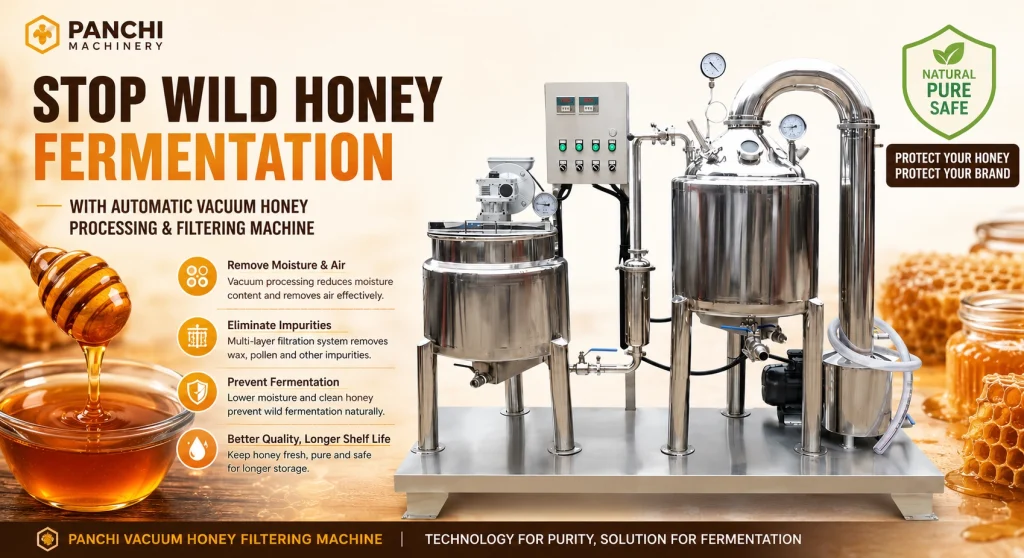
To solve the double dilemma of stopping fermentation while preserving 100% of the raw honey’s medical, sensory, and organic integrity, Panchi Machinery engineered a specialized Low-Temperature Vacuum Processing and Dual-Stage Filtration System.
Instead of fighting the laws of physics, this system leverages them to stop wild honey fermentation completely. By manipulating atmospheric pressure, we alter the boiling point of water, allowing you to achieve international-standard moisture reduction at a temperature that feels no hotter than a warm tropical afternoon.
(Please check out our full processing video below to watch this continuous 38-second live raw-to-premium transformation in real-time. If the media player fails to render on your browser, click here to watch the full processing video directly.)
Here is exactly how this core process works step-by-step to handle the unique challenges of Southeast Asian wild honey:
[Raw High-Moisture Harvest]
│
▼
Traditional wild honey obtained through pressing contains heavy suspended solids—macro-particles of honeycomb, bee wings, and sticky beeswax. If you run this through standard industrial micro-filters, the beeswax will instantly clog the filter mesh, halting production.
Panchi utilizes a Sanitary SUS316L Duplex Filter System operating in parallel. It features a progressive coarse-to-medium mesh sizing.
This is where we address the ultimate question of how to prevent raw honey from fermenting without destroying its value. Under normal sea-level atmospheric pressure, water evaporates at 100°C. Heating honey to this level would ruin it completely.
When honey is pressed by hand or mixed roughly, it traps millions of micro-bubbles of ambient air. When bottled, these tiny bubbles slowly migrate to the top, forming an unsightly, thick white ring of foam that consumers frequently mistake for spoilage or fermentation.
In the world of B2B industrial manufacturing, emotional arguments mean nothing without hard, verifiable data. Let’s look at the quantifiable parameters obtained from an operational case study of a mid-sized honey processing cooperative in Medan, Indonesia, which transitioned from traditional manual handling to the Panchi Low-Temperature Vacuum Processing Line.
The following table contrasts the key laboratory and economic metrics before and after implementing the Panchi processing technology:
| Quantitative Parameter / Metric | Traditional Manual & Open Heating | Panchi 44°C Vacuum Integrated Line | Commercial Value and Impact |
| Average Honey Moisture Content | 25.5% – 28.2% (Up to 32% for Kelulut) | 17.2% – 18.0% | Completely halts yeast metabolism; guarantees shelf stability for up to 3 years without refrigeration. |
| Diastase Enzyme Activity Index | Decreased by 60% – 85% | Preserved at >95% of raw levels | Fully complies with EU, GCC, and local national standards for premium “Active Raw Honey.” |
| HMF (Hydroxyméthylfurfural) | 95 mg/kg – 140 mg/kg (Disqualified) | <15 mg/kg (Pristine Quality) | Effortlessly passes strict FDA, BPOM, and international export customs laboratory tests. |
| Visible Particulate Matter / Contamination | Heavy wax flakes, bee parts, sediment | Zero visible debris; clear micro-pollen retention | Meets the stringent cosmetic and hygiene standards required for premium glass jar retail display. |
| Labor Requirement & Processing Speed | 5 workers processing 100kg over 8 hours | 1 operator processing 500kg in 4 hours | Cuts operational labor overhead by 80% while eradicating product spillage and ambient dust exposure. |
| B2B Market Value / Selling Price | $3.50 / kg (Bulk drums) | $15.00 – $18.00 / kg (Wholesale premium bottled) | Increases gross profit margins per batch by 400% to 500%. |
Let’s calculate a conservative Return on Investment (ROI) based on a modest production throughput of 1,000 kilograms of raw wild honey per month:
For most small-to-medium honey enterprises in Southeast Asia, the capital expenditure of purchasing a Panchi processing unit is entirely recovered within the first 3 to 6 months of seasonal harvesting operation. Every month after that represents pure, amplified profitability flowing straight back into your business, proving that learning how to prevent raw honey from fermenting via automated processing is the most profitable business decision you can make.
If you continue to operate your honey business out of plastic buckets and raw bulk drums, you will always be at the mercy of middlemen who beat down your prices. The market trend across Southeast Asia is clear: urbanization, rising incomes, and an intense focus on health and hygiene mean that consumers are actively searching for clean, trustworthy, premium honey brands—and they are willing to pay a massive premium for them.
By integrating the Panchi processing line into your operations, you are not just buying a machine; you are buying a gateway to an entirely different class of business that allows you to stop wild honey fermentation permanently.
[Primitive Backyard Workshop] ──► [Panchi Advanced Processing] ──► [Modern Glass Bottling] ──► [Premium Supermarket & Export Brand]
Once the heavy honeycomb wax and sticky particulate matter are removed by our duplex filters, your honey becomes a smooth, highly uniform fluid. You can immediately feed this directly into automated rotary or linear bottle-filling machines without worrying about clogged nozzles, dripping valves, or inconsistent fill volumes.
Panchi machines are engineered with zero-dead-angle sanitary fluid piping and polished SUS316L food-grade stainless steel internal surfaces. The entire system supports fully integrated CIP (Nettoyage en Place) processing via dual internal CIP rotary spray balls built directly into the tank ceilings. This means you can flush, sanitize, and cycle-clean the internal systems thoroughly between batches without tearing down a single pipe. Factory auditors will see that your automated wild honey fermentation temperature control prevents bacteria growth, making your factory fully compliant with international HACCP,BPF, etISO 22000 requirements.
With a guaranteed moisture level below 18%, zero white surface foam, and low HMF metrics, your honey can confidently be submitted to national laboratories. Your team will have a standardized blueprint on how to prevent raw honey from fermenting at a corporate grade. This allows you to effortlessly clear the certification processes for BPOM (Indonesia), JAKIM Halal (Malaysia), MUI Halal (Indonesia), Thai FDA, and international customs standard checks for lucrative export markets like Saudi Arabia, the UAE, Japan, and the European Union.
Imagine moving your product out of dusty warehouses and placing beautifully designed hex-glass jars with custom labels onto the shelves of high-end grocery stores in Jakarta, Kuala Lumpur, or Singapore. You can market your honey as “Pure Wild Rainforest Active Honey—Zero Additives, Preserved Enzyme Activity, Stable Shelf Life.” Your business shifts from a volatile, stressful commodity race-to-the-bottom into a highly stable, equity-building premium food brand.
Are you ready to stop letting the tropical humidity and rapid fermentation eat away at your hard-earned profits? Don’t let another harvest season pass by while your raw honey turns sour in storage drums.
Panchi Machinery has spent over two decades engineering turnkey processing solutions for the food, pharmaceutical, and apiculture industries. We provide end-to-end support specifically tailored to the unique economic and environmental realities of operators throughout Southeast Asia. We provide three seamless, low-pressure paths for you to explore how this technology can revolutionize your business:
A: No. Open-pot boiling over 50°C kills the honey’s medicinal diastase enzymes and causes HMF levels to spike, violating export laws. The ideal wild honey fermentation temperature is precisely 44°C, but only under a deep vacuum (-0.092 MPa). This drops the water boiling point, pulling out moisture without thermal damage.
A: Kelulut honey has a staggering moisture level of 28%–32%. Standard heat will caramelize it and turn it bitter. By using a vacuum thin-film evaporator locked at 44°C, the excess water is stripped down to 18% in seconds. This is the ultimate way how to prevent raw honey from fermenting because it deactivates yeast while locking in the signature sour-sweet flavor profile.
A: No, it retains 100% of the pollen. We use a SUS316L Duplex Filter with calibrated mechanical mesh—not ultra-filtration. It blocks large wax flakes and bee wings to protect your bottling valves and stop wild honey fermentation, but lets microscopic pollen pass to satisfy laboratory authenticity tests. The dual-chamber design lets you clean one filter while the other runs, ensuring zero production downtime.


WhatsApp:+8615736768129
Email :inquiry@panchimachinery.com
Adresse : Zhengzhou, Province du Henan, Chine
Machine automatique de traitement et de filtration du miel par vide
Unité d'extraction et de concentration de liquides à basse température sous vide
Équipement personnalisé de distillation à la vapeur et de reflux thermique pour huiles essentielles
Concentrateur à grattoir sous vide à basse température SS304/316L
Concentrateur sphérique sous vide QN et unité de récupération d'alcool
Unité de distillation sous vide multifonction en acier inoxydable et d'extraction
Unité d'extraction liquide sous vide à reflux chaud et de concentration
Concentrateur à circulation externe à effet unique sous vide
Evaporateur à vide à circulation externe à double effet de la série SJN
Réacteur chimique en acier inoxydable sous vide à haute température
Citerne de précipitation d'alcool à vide en acier inoxydable 304SS
Pot de cuisson à double couche en acier inoxydable 304SS à chauffage par vapeur
Marmite de cuisson électrique avec veste chauffante
Marmite de cuisson à haute efficacité avec chauffage au gaz et cuve isolée
Nous vous contacterons dans un délai d'un jour ouvrable. Veuillez surveiller votre courriel.
Machine automatique de traitement et de filtration du miel par vide
Unité d'extraction et de concentration de liquides à basse température sous vide
Équipement personnalisé de distillation à la vapeur et de reflux thermique pour huiles essentielles
WhatsApp : +8615736768129
Email : inquiry@panchimachinery.com
Adresse :Zhengzhou, province du Henan, Chine


DROITS D'AUTEUR© 2026Zhengzhou Panchi Machinery Equipment Co., Ltd.|Politique de confidentialité