
Coconut syrup contains sugars, dissolved solids, water, and volatile aroma compounds that can be affected by excessive thermal exposure. For manufacturers, the objective is not simply to remove water faster. The coconut syrup vacuum concentration process must balance evaporation rate, product temperature, residence time, viscosity, and final solids content.
A properly designed coconut syrup vacuum concentration solution can lower the boiling temperature of water, allowing manufacturers to concentrate the syrup with less thermal stress. However, operating below 50°C is a process target rather than a universal guarantee of product quality. Actual performance depends on vacuum level, feed composition, equipment design, and heat-transfer conditions.
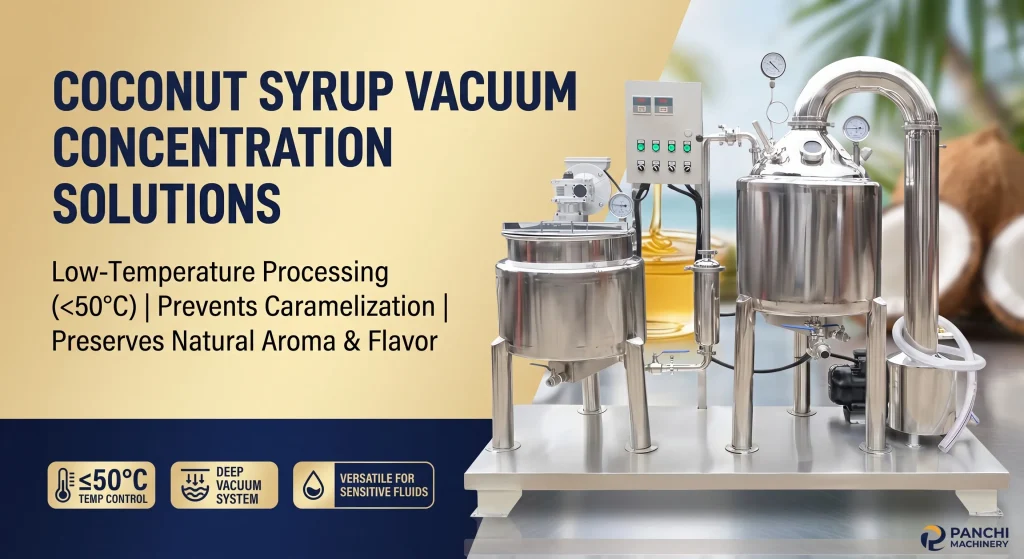
When coconut syrup is exposed to excessive temperature, several quality problems can develop. High thermal exposure can accelerate color changes, promote unwanted flavor development, and increase the risk of caramelization or other heat-related reactions.
The risk becomes more important as the syrup becomes more concentrated. As water is removed, the dissolved solids increase and the product becomes more viscous. Heat transfer can then become less uniform, particularly if the syrup begins to form a layer on heated surfaces.
For this reason, coconut syrup concentration should be controlled as a combination of temperature, vacuum, evaporation rate, and residence time rather than temperature alone.
A lower product temperature can help reduce thermal stress, but manufacturers still need to monitor the actual product temperature throughout the concentration cycle.
Natural coconut aroma can be influenced by heat and evaporation conditions. Some aroma compounds are relatively volatile, meaning they may leave the product together with vapor during processing.
This creates a challenge for coconut syrup processing. Increasing the heating intensity may accelerate water removal, but excessive thermal exposure can change the sensory profile of the finished syrup.
Vacuum processing provides a useful alternative because reducing absolute pressure lowers the boiling temperature of water. This allows evaporation to occur at a lower product temperature than would normally be required under atmospheric conditions.
However, vacuum does not automatically preserve every aroma compound. Vapor flow, condenser performance, residence time, and the properties of the raw syrup also influence aroma retention.
In atmospheric concentration, water generally requires relatively high temperatures to evaporate efficiently. A vacuum system reduces the operating pressure inside the vessel, lowering the boiling point of water.
For coconut syrup, this creates an opportunity to remove water while keeping the product temperature comparatively low. A low temperature vacuum concentration process can therefore be useful when the main objective is to limit thermal exposure while reaching a defined Brix level.
The actual vacuum level must be selected according to the product and equipment. If the vacuum is too weak, the required evaporation temperature may remain high. If the system is poorly matched to the evaporation load, unstable boiling or inadequate vapor handling can also reduce process consistency.
Keeping the product temperature below 50°C can be a practical target when the syrup is sensitive to heat-related quality changes. Lower-temperature processing may help reduce thermal exposure, particularly during longer production cycles.
The key point is that coconut syrup vacuum concentration below 50°C should be evaluated as a complete process condition rather than a single equipment specification.
For example, a system may have a heating medium above 50°C while maintaining the actual syrup temperature below 50°C under vacuum. Therefore, buyers should distinguish between:
This distinction is important when comparing vacuum concentration equipment from different suppliers.
A reliable coconut syrup vacuum concentration solution should provide control over the main variables affecting product quality and evaporation performance.
The starting Brix determines how much water must be removed. Product temperature affects thermal exposure. Vacuum pressure influences the evaporation temperature. Residence time determines how long the syrup remains under processing conditions, while viscosity affects circulation and heat transfer.
As concentration increases, the syrup may also become more difficult to circulate and transfer heat through conventional surfaces. Equipment with appropriate agitation or scraping can help maintain more consistent contact between the product and heated surface.
Ultimately, the goal of coconut syrup concentration is not simply maximum evaporation speed. It is to reach the required final solids content while controlling temperature, residence time, fouling, viscosity, and aroma loss. These process factors provide the foundation for selecting the appropriate equipment in the next stage of the production design.
A consistent coconut syrup vacuum concentration process depends on more than simply applying vacuum and heating. Feed composition, product temperature, pressure, heat transfer, residence time, evaporation rate, and final Brix all influence the performance of the concentration process.
For manufacturers developing a coconut syrup concentration line, these parameters should be considered together rather than optimized independently.
The starting Brix determines the amount of water that must be removed before reaching the target concentration.
A dilute feed requires greater evaporation capacity and generally a longer processing cycle. A higher-solids feed reduces the water-removal load but may enter the equipment at a higher viscosity.
Before selecting vacuum concentration equipment, manufacturers should define the normal feed Brix range rather than using only one laboratory test value.
Product temperature is one of the most important controls in a low temperature vacuum concentration process.
For heat-sensitive coconut syrup, maintaining the product below 50°C may help reduce thermal exposure and control unwanted color or flavor changes. However, the actual temperature depends on the operating vacuum, syrup composition, heat-transfer conditions, and required evaporation rate.
Temperature sensors should therefore monitor the syrup itself rather than relying only on the heating-medium temperature.
Vacuum pressure directly influences the temperature at which water can evaporate. A deeper vacuum generally allows evaporation at a lower temperature, although the relationship between pressure and boiling temperature depends on the product system.
For coconut syrup processing, the vacuum system should be capable of maintaining stable pressure throughout the batch. Fluctuating vacuum can cause unstable boiling, inconsistent evaporation, or changes in product temperature.
The vacuum pump, condenser, piping, and vessel should therefore be designed as one integrated system.
The heating medium transfers energy to the syrup through the vessel’s heat-transfer surface. Its temperature should not be confused with the actual syrup temperature.
A higher heating-medium temperature can increase the driving force for evaporation, but excessive temperature difference may increase local thermal stress or surface fouling.
A well-designed coconut syrup vacuum concentration solution should provide sufficient heat-transfer capacity while maintaining controlled product temperature.
Residence time describes how long the syrup remains inside the concentration system under processing conditions.
Two systems may reach the same final Brix but expose the product to different thermal histories. A longer residence time can increase cumulative thermal exposure, while insufficient processing time may prevent stable concentration.
This makes residence time particularly important when the objective is to preserve the natural characteristics of coconut syrup.
Evaporation rate determines how quickly water is removed from the syrup.
A higher evaporation rate is not automatically better. If evaporation is too aggressive, the system may experience excessive foaming, unstable boiling, poor vapor separation, or insufficient control of product temperature.
As the syrup becomes more concentrated, viscosity can increase and heat transfer can become more difficult. Scraping or controlled agitation may therefore become increasingly important for maintaining consistent evaporation performance.
The final Brix defines when the coconut syrup concentration process should stop.
Using processing time alone as the endpoint can produce batch-to-batch variation because feed concentration, temperature, vacuum conditions, and evaporation performance can change.
A better approach is to establish a target final Brix range and verify it using appropriate measurement methods. The target should be based on the intended application, such as beverage ingredients, food formulations, or concentrated coconut products.
For equipment selection, buyers should provide the supplier with:
These parameters provide the engineering basis for sizing the vessel, heating area, condenser, vacuum system, agitator, and other components of the coconut syrup vacuum concentration solution.
Selecting vacuum concentration equipment for coconut syrup requires more than matching a vessel volume to the desired production capacity. The equipment must provide controlled evaporation, stable vacuum conditions, adequate heat transfer, and sufficient product handling as the syrup becomes more concentrated.
For manufacturers developing a coconut syrup vacuum concentration solution, the following seven factors are particularly important.
Start with the required batch size or continuous production rate. The working volume should account for headspace, foaming, vapor generation, and the actual volume occupied by the syrup during processing.
An oversized vessel can increase equipment cost and may reduce process efficiency at low fill levels. An undersized vessel can limit production capacity and create operational problems when the syrup expands or foams.
For coconut syrup processing, suppliers should evaluate the complete evaporation load rather than sizing the system only from nominal vessel volume.
Stable vacuum is fundamental to coconut syrup vacuum concentration because it determines the evaporation conditions.
The system should include a properly sized vacuum pump, condenser, vacuum piping, valves, and instrumentation. The condenser must be capable of handling the expected vapor load so that condensable vapor does not overload the vacuum pump.
Buyers should also confirm the expected operating pressure and product temperature under actual production conditions instead of evaluating the vacuum pump specification alone.
Heat-transfer performance directly affects evaporation capacity. The heating surface must provide enough energy to remove water while maintaining controlled product temperature.
For a low-temperature process, the objective is not simply to maximize heating power. The system should provide a manageable temperature difference between the heating medium and syrup.
This is particularly relevant when targeting low temperature vacuum concentration below 50°C. The actual syrup temperature should be monitored independently from the heating-medium temperature.
As coconut syrup becomes more concentrated, viscosity generally increases. Higher viscosity can reduce circulation and make heat transfer less uniform.
A suitable scraper or agitation system can help move the product across heated surfaces and reduce the formation of stagnant or overheated layers. This can be especially useful when processing concentrated syrup with a tendency to foul heated surfaces.
For this reason, equipment selection should consider the syrup’s viscosity range, not only its initial Brix.
Evaporated water and other vapors must be efficiently condensed before they reach the vacuum pump.
An undersized condenser can reduce vacuum stability and restrict the effective evaporation capacity of the system. Condenser selection should therefore consider vapor load, cooling-water temperature, operating pressure, and expected production rate.
A complete coconut syrup concentration system should treat the evaporator and condenser as interconnected process equipment rather than independent components.
For food applications, product-contact surfaces should be selected according to the required hygiene and corrosion-resistance standards.
Common considerations include stainless-steel grade, internal surface finish, weld quality, drainability, inspection access, and cleaning requirements.
The design should minimize dead zones where concentrated syrup can accumulate. Smooth internal surfaces and appropriate vessel geometry can also support easier cleaning and reduce residual product after discharge.
A reliable coconut syrup vacuum concentration solution should provide sufficient process monitoring to keep the operating conditions within the defined range.
Important measurements may include:
For production equipment, automated control can help maintain repeatable vacuum and temperature conditions from batch to batch. However, the control system should be designed around the actual process requirements rather than adding unnecessary automation.
Before purchasing vacuum concentration equipment, manufacturers should provide the equipment supplier with the feed Brix, target Brix, batch capacity, expected viscosity, maximum product temperature, required evaporation capacity, and available utilities.
These specifications allow the heating area, vessel size, vacuum system, condenser, scraper or agitator, and control system to be matched to the actual coconut syrup processing conditions rather than relying on a generic concentrator configuration.
For coconut syrup manufacturers, the objective of concentration is to reach the required solids content while controlling product temperature, residence time, vacuum stability, and aroma loss. PCM can configure a coconut syrup vacuum concentration solution around the actual feed characteristics and production requirements.
Vacuum concentration allows water to evaporate at a lower temperature than atmospheric processing. When the process is properly designed, operating below 50°C can help reduce thermal exposure and control the risk of excessive caramelization or aroma degradation.
PCM’s Low-Temperature Vacuum Honey Concentrator can be considered for syrup products where viscosity and heat-transfer consistency become increasingly important during concentration.
The system can be configured according to batch capacity, target Brix, evaporation requirement, vacuum conditions, heating method, and product viscosity.
Different coconut syrup formulations can have substantially different solids content and viscosity. Equipment selection should therefore be based on process data rather than vessel volume alone.
A customized coconut syrup concentration system can consider:
This approach helps match the vacuum concentration equipment to the actual production process.
PCM can integrate the main components required for coconut syrup processing, including the concentration vessel, heating system, condenser, vacuum system, scraper or agitator, and process controls.
The engineering focus is to provide stable evaporation conditions rather than simply maximizing heating intensity. For heat-sensitive syrup, controlling product temperature and residence time is particularly important.
Manufacturers can provide their feed Brix, target Brix, processing capacity, viscosity range, and maximum allowable product temperature to determine a suitable coconut syrup vacuum concentration configuration.
A: Yes. Under suitable vacuum conditions, water can evaporate at a lower temperature. The achievable product temperature depends on vacuum pressure, syrup composition, heat transfer, and evaporation requirements.
A: Vacuum concentration can reduce thermal exposure and help control caramelization risk, but it does not guarantee prevention. Product temperature, residence time, solids content, and equipment design also affect the result.
A: A vacuum concentrator with suitable agitation or scraping can help maintain product movement and heat-transfer consistency as viscosity increases during concentration.
A: Define feed and final Brix, capacity, viscosity, maximum product temperature, vacuum conditions, evaporation load, heating method, condenser capacity, and required hygiene specifications before equipment sizing.


Whatsapp: +8615736768129
Email: [email protected]
Address: Zhengzhou, Henan Province, China
Automatic Vacuum Honey Processing & Filtering Machine
Vacuum Low-Temperature Liquid Extraction & Concentration Unit
Custom Steam Distillation & Heat Reflux Essential Oil Equipment
SS304/316L Low-Temperature Vacuum Scraper Concentrator
QN Spherical Vacuum Concentrator & Alcohol Recovery Unit
Multi-function Stainless Steel Vacuum Distillation & Extraction Unit
Hot Reflux Vacuum Liquid Extraction & Concentration Unit
Single-Effect External Circulation Vacuum Concentrator
SJN Series Double-Effect External Circulation Vacuum Evaporator
We will contact you within one working day. Please pay attention to your email.
Automatic Vacuum Honey Processing & Filtering Machine
Vacuum Low-Temperature Liquid Extraction & Concentration Unit
Custom Steam Distillation & Heat Reflux Essential Oil Equipment
WhatsApp: +8615736768129
Email: [email protected]
Address: Zhengzhou, Henan Province, China


COPYRIGHT© 2026 Zhengzhou Panchi Machinery Equipment Co., Ltd. | Privacy Policy

Our team will respond within 24 hours.
Thanks! We'll get back to you within 24 hours.
Check your inbox (and spam folder) for our reply.