
Developing a new essential oil product often starts with limited quantities of botanical material. Before investing in a commercial production line, manufacturers need to know how a plant material behaves during distillation, how much oil it can produce, and which operating conditions provide the best product quality.
This is where small scale essential oil distillation equipment becomes valuable. Instead of committing large quantities of raw material to industrial trials, R&D teams can use controlled small-batch testing to evaluate different botanical materials and processing conditions.
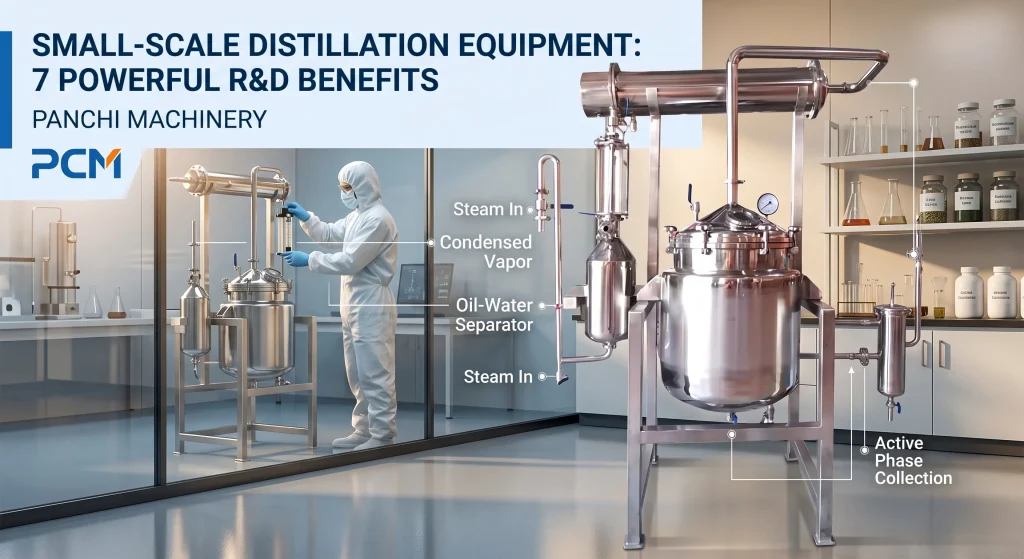
For product developers, the purpose is not simply to produce a small amount of essential oil. The equipment should generate reliable process information that can guide future pilot and commercial production.
Botanical materials rarely behave exactly the same way during distillation. Leaves, flowers, roots, seeds, peels, and aromatic woods can differ substantially in moisture, density, structure, volatile-oil content, and resistance to steam penetration.
These differences can affect:
Testing these variables directly on an industrial line can be expensive. A single unsuccessful trial may consume a large quantity of raw material and occupy production equipment that could otherwise be used for commercial orders.
Small scale essential oil distillation provides a lower-risk environment for this initial process development.
Researchers can test several materials or operating conditions using relatively small batches before deciding whether a process deserves further investment.
The main advantage of small scale essential oil distillation testing is flexibility.
An R&D team may need to compare several varieties of the same plant, different drying conditions, or different distillation times. With appropriately sized essential oil distillation equipment, these tests can be completed without committing the capacity of a full production system.
Small-batch trials can help manufacturers determine:
This information can prevent poorly defined processes from moving directly into expensive pilot or industrial trials.
It also makes experimentation easier. If the first operating condition produces unsatisfactory results, the R&D team can adjust one parameter and repeat the test rather than redesigning a commercial production schedule.
A useful laboratory essential oil distillation system should allow researchers to observe the complete process rather than focusing only on final oil yield.
Important parameters include:
Raw Material
Moisture, particle size, bulk density, and material loading can influence steam contact and extraction behavior.
Heating and Steam
Controlled heating and steam flow help researchers determine how quickly volatile compounds are released without unnecessarily extending thermal exposure.
Distillation Time
The initial condensate rate may be relatively high and then decline as extraction progresses. Monitoring this change can help identify a practical process endpoint.
Condensation
The condenser must efficiently convert vapor into liquid. Condensation performance can influence both recovery and operating stability.
Oil-Water Separation
The collected distillate normally contains water and essential oil. Separation behavior provides useful information for designing downstream collection and purification stages.
Product Quality
Yield alone does not determine whether a distillation process is successful. Color, aroma, clarity, moisture, and other application-specific quality characteristics may also need evaluation.
For R&D teams, these measurements provide a much more useful picture of process performance than simply recording how many milliliters of oil were collected.
| Factor | Small Scale | Industrial |
|---|---|---|
| Raw-material requirement | Low | High |
| Testing cost | Lower | Higher |
| Process flexibility | High | Moderate |
| Parameter adjustment | Easy | More complex |
| R&D suitability | Excellent | Limited |
| Production objective | Development | Commercial output |
The two scales serve different purposes. Industrial equipment is optimized for throughput, operating efficiency, and repeatable commercial production. Small scale essential oil distillation equipment is optimized for testing, comparison, optimization, and process learning.
The most effective development strategy is therefore not to choose between them. It is to use small scale essential oil distillation testing to reduce uncertainty before moving toward commercial production.
A structured development pathway can be:
Raw Material Testing → Small-Batch Distillation → Parameter Optimization → Product Evaluation → Pilot Validation → Industrial Production
Data generated during early trials can help determine future equipment requirements, including vessel capacity, heating demand, steam consumption, condenser capacity, and oil collection.
This makes small scale essential oil distillation equipment more than an R&D convenience. When properly selected, it becomes a process-development tool that helps manufacturers make better technical and investment decisions before scaling up.
Selecting small scale essential oil distillation equipment is only the first step. For R&D work, researchers also need to understand how operating parameters affect oil recovery, distillation efficiency, and product quality. A well-controlled test should change one or two variables at a time so that the resulting data can be compared reliably.
Moisture content can significantly affect small scale essential oil distillation.
Fresh plant material contains substantial internal water, while dried material has a different structure and bulk density. These differences influence heating requirements, steam penetration, and the time required to release volatile compounds.
Researchers should record the condition of each raw-material batch, including:
Using consistent raw-material preparation makes experimental results easier to compare.
If two batches contain significantly different moisture levels, a difference in oil yield may come from the raw material rather than the distillation conditions.
Particle size affects the exposed surface area and how steam moves through the plant material.
Moderate size reduction can improve contact between steam and plant tissues. However, excessive grinding may create fine particles that compact inside the vessel and restrict steam movement.
This can produce an undesirable balance:
Smaller particles → Greater surface area → Potentially better release
but also:
Excessive fines → Higher compaction → Poorer steam flow
For this reason, essential oil distillation equipment should be operated with a material preparation method appropriate to the botanical structure.
Leaves and flowers may require relatively gentle preparation, while roots, seeds, peels, or woody materials may require cutting or controlled size reduction before distillation.
Steam or heating intensity directly affects how quickly volatile compounds are released.
If heating is too slow, the batch may require excessive time. If heating is too aggressive, the system may generate vapor faster than the condenser can efficiently handle.
Researchers should therefore evaluate:
The objective is to establish a stable operating range rather than simply maximizing steam input.
For small scale essential oil distillation, controlled heating is particularly useful because R&D teams often need to compare several operating conditions using limited quantities of raw material.
Temperature should be considered together with steam conditions and the characteristics of the target oil.
Higher temperature may accelerate the release of volatile compounds, but it can also increase thermal exposure and energy consumption.
For sensitive botanical materials, researchers may therefore prefer a controlled temperature profile rather than operating at the highest available temperature.
A useful R&D trial can compare different temperature conditions while keeping raw-material preparation and batch size consistent.
This helps determine whether increased thermal intensity actually improves oil recovery or simply increases energy consumption and product exposure.
After volatile compounds leave the extraction vessel, the vapor must be condensed efficiently.
The condenser should be capable of handling the expected vapor load while maintaining stable cooling conditions.
Important variables include:
Poor condensation can reduce process stability and may allow vapor to reach the vacuum or downstream system where applicable.
For laboratory essential oil distillation, a properly matched condenser is therefore just as important as the distillation vessel itself.
The condensed distillate normally contains essential oil and water. Their separation depends on the physical properties of the particular botanical oil.
Researchers should observe:
These observations help determine the appropriate collection and separation configuration for later pilot-scale development.
Oil recovery should be measured after sufficient separation rather than immediately after condensation. Otherwise, differences in water content can make yield comparisons misleading.
A fixed processing time does not always represent the best endpoint.
During distillation, the oil release rate may change as the readily available volatile compounds are removed. Continuing the process indefinitely may consume additional steam and energy while producing relatively little additional oil.
R&D teams can monitor:
Distillate Rate → Oil Recovery → Product Characteristics → Energy/Steam Consumption
The practical endpoint should balance additional recovery against processing cost and product quality.
This is one of the most useful advantages of small scale essential oil distillation equipment: researchers can test different endpoints without disrupting commercial production.
Together, these seven parameters provide a framework for evaluating distillation performance. Raw-material condition, particle size, heating, temperature, condensation, separation, and endpoint should be considered as connected variables rather than isolated settings.
The resulting data can then guide the equipment-selection decisions required for pilot and commercial applications.
Choosing small scale essential oil distillation equipment for R&D requires more than selecting the smallest available vessel. The equipment should reproduce the intended distillation conditions while providing enough control to compare raw materials, operating parameters, and product performance.
For product-development teams, the best system is one that generates reliable data without creating unnecessary operating complexity.
Start with the actual amount of botanical material available for each test.
Consider:
The stated vessel volume should not be treated as the actual processing capacity. Sufficient headspace is required for proper vapor movement and safe operation.
For R&D, a flexible working range can be more valuable than a vessel designed around one fixed batch size. This allows researchers to test different loading conditions while maintaining comparable process parameters.
Different botanical materials may require different equipment arrangements.
Leaves and flowers may behave differently from roots, seeds, peels, or aromatic woods. The equipment should therefore provide suitable contact between the plant material and steam or hot water.
Common configurations include:
The selection depends on the material structure, volatile-compound characteristics, desired oil quality, and development objectives.
For small scale essential oil distillation, configuration flexibility is particularly useful because R&D teams may need to evaluate several botanical materials before establishing a standard production process.
Heating should be stable and controllable rather than simply powerful.
A suitable system should allow researchers to adjust and monitor:
Stable steam distribution is important because uneven flow can produce inconsistent extraction conditions inside the vessel.
When comparing essential oil distillation equipment, buyers should also consider how quickly the system responds to changes in heating or steam input. This can make a significant difference when researchers are comparing different operating conditions.
The condenser must match the vapor-generation capacity of the distillation system.
An undersized condenser can create several problems:
The correct condenser should therefore be selected according to expected vapor flow rather than simply matching the nominal vessel volume.
For laboratory and R&D applications, the condenser should also allow researchers to observe and collect the condensate efficiently so that oil yield can be measured accurately.
After condensation, the distillate normally contains both water and essential oil.
The collection system should provide sufficient space and suitable configuration for phase separation.
Important factors include:
A poorly designed collection system can make accurate yield measurement difficult.
For R&D, this is especially important because even small measurement errors can affect comparisons between different botanical materials or process conditions.
Product-contact materials should be selected according to the botanical application and expected operating conditions.
Common choices include SUS304 and SUS316L stainless steel.
Other components should also be considered:
Smooth, cleanable surfaces can simplify cleaning between different test batches and reduce the possibility of cross-contamination.
For laboratories working with high-value botanical products, sanitary design also makes repeated experimentation more practical.
A major purpose of R&D equipment is to reduce uncertainty before commercial investment.
The system should help researchers establish:
These results can provide a technical basis for future essential oil pilot plant development.
However, scale-up should not rely on vessel volume alone. Production engineers also need to consider heat-transfer requirements, steam distribution, material loading, condenser capacity, cycle time, and downstream separation.
The best small scale essential oil distillation equipment therefore acts as a process-development platform. It allows manufacturers to test botanical materials under controlled conditions, identify practical operating ranges, and collect data before moving toward pilot or commercial production.
Panchi Machinery (PCM) designs and configures sanitary, laboratory- and pilot-ready distillation systems tailored for essential-oil research, small-batch formulation, and process scale-up validation. Rather than supplying generic benchtop vessels, PCM engineers pilot distillation skids that replicate industrial thermodynamic and hydraulic principles, allowing R&D teams to optimize extraction kinetics, protect volatile aromatic fractions, and establish empirical benchmarks before full-scale commercial commitment.
PCM configures comprehensive benchtop and pilot distillation platforms that combine precise steam generation, controlled extraction chambers, multi-stage vapor condensation, and fine oil-water separation within a compact footprint:
Every botanical matrix presents unique cellular diffusion resistances and vapor-liquid phase behaviors. PCM tailors each small-scale skid according to your specific product development roadmap:
The core objective of deploying small scale essential oil distillation equipment is to de-risk capital investment. Empirical data collected during small-scale trials—including dry-basis yield curves, steam consumption ratios, optimal distillation durations, and thermal sensitivity limits—serves as the mathematical baseline for engineering larger industrial essential oil production facilities[cite: 3].
When formulating concentrated botanical syrups or preparing enriched aromatic fractions requiring subsequent solvent flash-off, our engineering department also supports process integration with dedicated low-temperature vacuum concentration systems[cite: 3, 4].
Contact the PCM engineering team today to review your botanical R&D objectives, evaluate feedstock testing parameters, and receive a customized equipment proposal for your laboratory or pilot plant.
A: Small scale essential oil distillation equipment comprises compact, sanitary laboratory or pilot-scale systems engineered to extract volatile oils from botanical biomass via steam distillation or hydro-distillation. Designed for R&D laboratories, cosmetic formulators, and natural ingredient developers, these systems allow precise regulation of steam rates, temperatures, and condensation to test new feedstocks and optimize extraction kinetics.
A: Small scale essential oil distillation allows researchers to evaluate raw material moisture levels, optimal particle milling sizes, active oil yield percentages, distillation time curves, and aromatic volatile profiles. Additionally, testing determines the exact steam-to-biomass ratio, condensation cooling duties, and phase separation behavior needed to prevent emulsion formation.
A: Selecting essential oil distillation equipment for R&D requires evaluating the true biomass working volume, heating flexibility (direct steam vs. jacketed hydro-distillation), condenser heat-transfer area, and separator compatibility for both light and heavy oils. Look for sanitary SUS304/SUS316L construction, accurate temperature sensing, and modular fittings that facilitate easy cleaning and zero batch cross-contamination.


Whatsapp: +8615736768129
Email: [email protected]
Address: Zhengzhou, Henan Province, China
Automatic Vacuum Honey Processing & Filtering Machine
Vacuum Low-Temperature Liquid Extraction & Concentration Unit
Custom Steam Distillation & Heat Reflux Essential Oil Equipment
SS304/316L Low-Temperature Vacuum Scraper Concentrator
QN Spherical Vacuum Concentrator & Alcohol Recovery Unit
Multi-function Stainless Steel Vacuum Distillation & Extraction Unit
Hot Reflux Vacuum Liquid Extraction & Concentration Unit
Single-Effect External Circulation Vacuum Concentrator
SJN Series Double-Effect External Circulation Vacuum Evaporator
We will contact you within one working day. Please pay attention to your email.
Automatic Vacuum Honey Processing & Filtering Machine
Vacuum Low-Temperature Liquid Extraction & Concentration Unit
Custom Steam Distillation & Heat Reflux Essential Oil Equipment
WhatsApp: +8615736768129
Email: [email protected]
Address: Zhengzhou, Henan Province, China


COPYRIGHT© 2026 Zhengzhou Panchi Machinery Equipment Co., Ltd. | Privacy Policy

Our team will respond within 24 hours.
Thanks! We'll get back to you within 24 hours.
Check your inbox (and spam folder) for our reply.