
In the high-stakes global botanical ingredients market, ginger essential oil (Zingiber officinale) has solidified its position as a high-volume, premium commodity. Spanning the pharmaceutical, functional food, and fine fragrance sectors, the international demand for top-tier ginger distillates is reaching unprecedented heights.
However, from a strict chemical engineering perspective, ginger rhizomes present an exceptionally difficult processing matrix. The plant’s most prized volatile organic compounds (VOCs) are trapped alongside high-viscosity oleoresins, plant waxes, and sharp pungent principles within a dense, fibrous lignocellulose root structure.
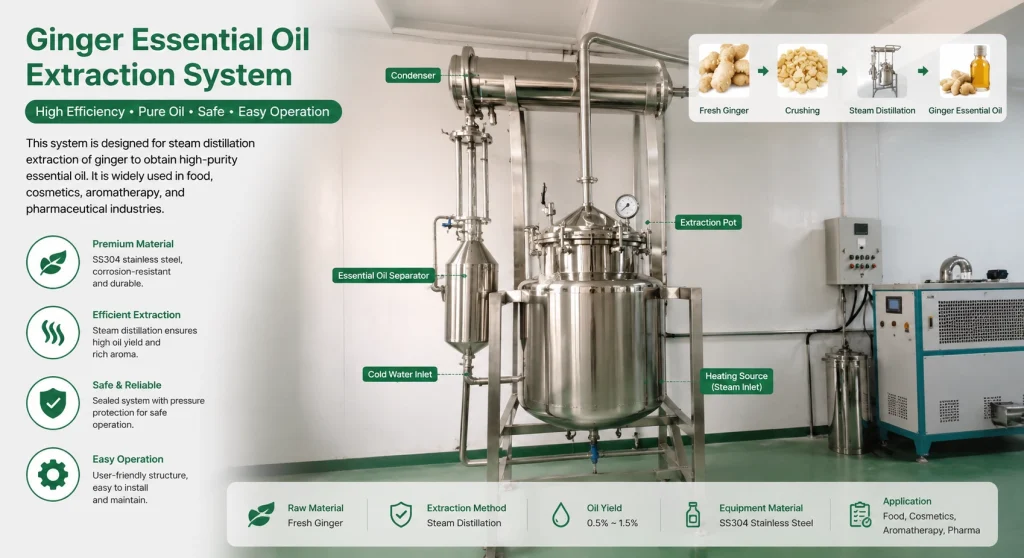
For decades, traditional processing facilities have relied on legacy 100°C atmospheric steam distillation. But on the modern industrial stage, this brute-force method acts as a massive profit leak—destroying the delicate molecular profile of the oil, generating cooked off-notes, and driving utility costs through the roof.
By restructuring processing thermodynamics through the application of sub-atmospheric vacuum mechanics, next-generation technologies have rewritten the rules of root extraction. For agricultural enterprises, contract manufacturers, and international ingredient brokers, deploying a specialized, low-temperature Ginger Essential Oil extraction system is no longer just an innovative upgrade; it is an absolute technical requirement to secure premium market valuations. Implementing a modern Ginger Essential Oil extraction system ensures that the delicate aromatic fractions remain perfectly intact. Furthermore, utilizing this advanced Ginger Essential Oil extraction system allows processing plants to scale up their production capacity without sacrificing purity.
To understand why high-purity ginger oil commands such a massive premium, one must look at the strict quality requirements of its multi-billion-dollar downstream applications. The adoption of a controlled Ginger Oil extraction Process is essential to satisfy these industrial standards. When looking at long-term profitability, a well-engineered Ginger Oil extraction Process guarantees the retention of delicate bio-active compounds. Ultimately, upgrading to an optimized Ginger Oil extraction Process allows factories to deliver the clean, un-scorched flavor profiles required by tier-one global distributors:
Because the downstream market is so diverse, this advanced extraction technology addresses the core pain points of three distinct, high-value customer groups across the global agricultural and industrial supply chain:
To successfully isolate premium ginger volatiles from a dense root matrix without triggering irreversible heat damage, the advanced Zingiber Officinale Oil extraction Process utilizes a synchronized, four-stage closed-loop design engineered for continuous stability. This comprehensive Zingiber Officinale Oil extraction Process is structured as follows:
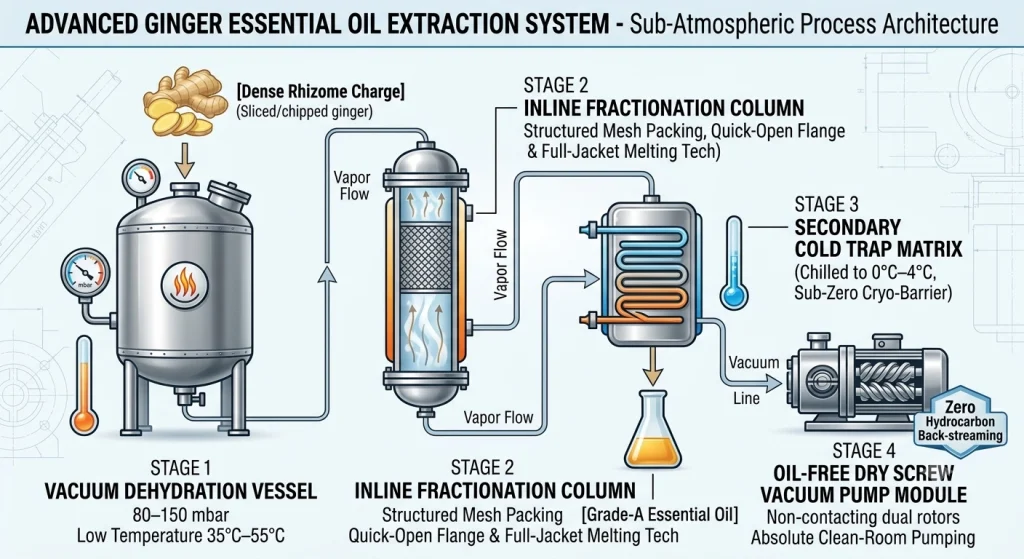
The extraction process takes place inside a heavy-duty chamber crafted entirely from premium, non-reactive 316L stainless steel, fulfilling global pharma-grade sanitation codes. Raw ginger rhizomes—sliced or chipped to optimum geometric thicknesses to expose maximum surface area—are loaded into the vessel. Once sealed, a high-capacity vacuum network integrated within the Ginger Essential Oil extraction system rapidly evacuates the chamber air, bringing the absolute system pressure down to a tight, negative operating window between 80 mbar and 150 mbar.
According to basic thermodynamic laws, boiling thresholds drop dramatically as surrounding pressure decreases. By pulling a deep sub-atmospheric vacuum, the vaporization point of the internal botanical moisture and volatile oils is suppressed from 100°C down to a highly gentle 35°C to 55°C. This process, known as Vacuum Dehydration, vaporizes target compounds within a low-temperature zone, preventing the cellular blistering typical of traditional setups.
Recognizing that actual factory floor conditions require rugged reliability over overly complex electronics, our Ginger Essential Oil extraction system rejects fragile, over-engineered software systems. Instead, this Ginger Essential Oil extraction system utilizes a highly dependable, practical Dual-Gauge Parametric Monitoring System. Operators are equipped with high-precision industrial mechanical temperature gauges and digital deep-vacuum readouts. This allows factory technicians to visually monitor conditions and make manual adjustments to steam inputs and pump speeds based on the raw material’s condition (e.g., high-moisture fresh ginger vs. dry ginger slices), ensuring flawless adaptation to any ginger variety with near-zero machine downtime.
As the enriched vapors vaporize from the root tissue during the Ginger Oil extraction Process, they rise directly into an integrated vertical fractionation column lined with high-surface-area structured wire mesh. By maintaining an accurate, localized temperature-vacuum gradient up the column, different vapor components sort themselves in real time based on their distinct saturated vapor pressures and condensation enthalpies. Heavy, non-volatile compounds condense early and drop back, while pure, high-value volatile fractions continue onward toward the collection zone.
Experienced plant managers know that raw ginger contains incredibly sticky oleoresins and heavy botanical waxes that quickly coat vessel walls. While many machinery manufacturers promise automated Clean-in-Place (CIP) spray systems, the harsh reality is that raw ginger resins behave like heavy tar—rendering standard spray balls completely useless and leading to clogged lines.
To solve this real-world maintenance headache, our column features a highly pragmatic engineering layout:
While mid-weight aromatic fractions smoothly condense in standard primary cooling heat exchangers during the execution of the Ginger Oil extraction Process, ultra-light, fugitive top notes—the exact molecules that give ginger its irreplaceable, fresh-cut, spicy character—frequently remain in a gaseous state under deep vacuum. If left unmanaged, these vapors pass right through the primary condenser and escape through the vacuum pump exhaust, leaving behind a flat, incomplete final oil.
To capture these volatile elements, the system integrates a secondary cold trap matrix chilled to a precise sub-zero window of 0°C to 4°C. This matrix serves as a highly efficient cryo-barrier, instantly condensing and trapping the most volatile top-note aromatics in-situ. These fractions are later recombined with the primary yield, delivering a full-spectrum, multi-dimensional essential oil profile.
The constant negative pressure environment required for a continuous, high-yield Ginger Oil extraction Process is maintained exclusively by an industrial dry screw vacuum pump. Operating via synchronized, non-contacting internal dual-rotors, this pump requires absolutely no sealing oils, water, or hydrocarbons inside its swept chamber. This architecture forms a definitive physical defense, completely eliminating the risk of pump oil vapors migrating backward through the vacuum lines (back-streaming) and contaminating the clean extraction stream.
Processing dense, high-resin root matrices under deep vacuum conditions introduces specific chemical and mechanical bottlenecks that traditional distillation equipment cannot resolve. Below is how our system overcomes the three most expensive processing failures in the ginger industry:
To provide processing engineers and C-level procurement officers with clear data for return-on-investment (ROI) assessments, consider the audited performance matrix below comparing traditional methods against our modern vacuum system:
| Operational & Quality Performance Matrix | Traditional Atmospheric Steam Distillation | Advanced Sub-Atmospheric Vacuum Extraction System |
| Absolute System Pressure | 1,013 mbar (Standard Atmospheric) | 80 mbar – 150 mbar (Deep Vacuum) |
| Internal Processing Temperature | 100°C to 105°C | 35°C to 55°C (True Low-Temperature) |
| Average Batch Cycle Time | 10 to 16 Hours (High Thermal Load) | 4 to 6 Hours (High-Efficiency Phase Transition) |
| $\alpha$-Zingiberene Content Retention | 22% – 28% (Heavy losses due to heat rearrangement) | 38% – 46% (Maximum preservation of primary volatile) |
| “Cooked / Baked” Off-Note Presence | High (Formed via heat-induced gingerol degradation) | Undetectable via GC-MS (Pure, true-to-nature aroma) |
| Total Utility Consumption (Per KG Output) | ~18.5 kWh / kg | ~8.2 kWh / kg (Over 50% Reduction in Energy Cost) |
| Hydrocarbon Cross-Contamination Risk | High (When paired with legacy oil-sealed pumps) | Absolute Zero (Guaranteed by oil-free dry screw matrix) |
| Spent Ginger Waste Residue Quality | Charred, black industrial waste (Disposal cost liability) | Un-charred, active botanical fiber (Sellable asset) |
| Final Product Visual & Market Grade | Dark brown/amber; lower-tier industrial fragrance | Pale, brilliant straw yellow; premium pharmaceutical grade |
Procuring industrial-scale stainless steel machinery represents a significant capital investment. We understand that international buyers face unique logistical and operational anxieties. To eliminate cross-border risk, our global delivery network provides three robust guarantees:
Q: How does the sub-atmospheric system eliminate the “cooked” off-notes common to old distillation lines?
A: Traditional systems rely on 100°C steam at standard atmospheric pressure, which essentially boils the botanical matrix for half a day, forcing delicate linear monoterpenes to cyclize and scorching plant sugars. Our advanced technology lowers thermal thresholds, allowing operators to execute a highly efficient Ginger Oil extraction Process that drops internal operating pressures below 150 mbar, lowering the vaporization threshold to 35°C–55°C. This low-temperature window does not provide the activation energy required for thermal pyrolysis or molecular rearrangement, ensuring the final oil retains the vibrant, crisp, fresh-cut profile of raw ginger.
Q: Why is an oil-free dry screw vacuum pump configuration mandatory for this setup?
A: When executing a high-purity Zingiber Officinale Oil extraction Process, absolute cleanliness is the single defining factor for market access. Standard liquid-ring pumps experience severe vacuum drops when handling high-volume ginger vapors, while oil-sealed pumps naturally suffer from hydrocarbon back-streaming—where tiny amounts of mineral pump oil migrate backward through the lines and contaminate the product. A dry screw pump completely eliminates this risk, maintaining a rock-solid vacuum matrix while ensuring zero cross-contamination, allowing your facility to effortlessly clear strict international organic and pharmaceutical GMP inspections.
Q: Can this automated equipment handle volatile extraction and dewaxing in a single continuous pass?
A: Yes. Our high-efficiency Ginger Oil extraction Process mounts a vertical fractionation column lined with high-density structured mesh directly above the extraction vessel. By maintaining a clear, mechanical temperature-vacuum gradient up the tower, heavy plant oleoresins, high-molecular-weight lipids, and sticky root waxes are automatically condensed and filtered out in-situ, dropping back to the vessel base. Only the pure, light volatile vapors pass through the column top into the sub-zero cold traps, delivering a clear, retail-ready, dewaxed essential oil without requiring secondary solvent-based winterization.


Whatsapp: +8615736768129
Email: [email protected]
Address: Zhengzhou, Henan Province, China
Automatic Vacuum Honey Processing & Filtering Machine
Vacuum Low-Temperature Liquid Extraction & Concentration Unit
Custom Steam Distillation & Heat Reflux Essential Oil Equipment
SS304/316L Low-Temperature Vacuum Scraper Concentrator
QN Spherical Vacuum Concentrator & Alcohol Recovery Unit
Multi-function Stainless Steel Vacuum Distillation & Extraction Unit
Hot Reflux Vacuum Liquid Extraction & Concentration Unit
Single-Effect External Circulation Vacuum Concentrator
SJN Series Double-Effect External Circulation Vacuum Evaporator
We will contact you within one working day. Please pay attention to your email.
Automatic Vacuum Honey Processing & Filtering Machine
Vacuum Low-Temperature Liquid Extraction & Concentration Unit
Custom Steam Distillation & Heat Reflux Essential Oil Equipment
WhatsApp: +8615736768129
Email: [email protected]
Address: Zhengzhou, Henan Province, China


COPYRIGHT© 2026 Zhengzhou Panchi Machinery Equipment Co., Ltd. | Privacy Policy

Our team will respond within 24 hours.
Thanks! We'll get back to you within 24 hours.
Check your inbox (and spam folder) for our reply.