
Harvesting watery or uncapped honey during late monsoon or high-humidity seasons is a constant headache for apiaries. When raw honey sits at an unstable 38 to 39 Baume, its moisture content exceeds 21%. At this level, osmo-tolerant yeasts run rampant. Within weeks, your investment begins to bubble, turn sour, and generate gases that warp retail packaging.
To halt yeast activity and achieve an export-grade, shelf-stable product, learning how to reach 42 Baume honey density fast is the ultimate goal. However, many traditional operations resort to open-air boiling, which is a critical mistake. Extended thermal exposure spikes Hydroxymethylfurfural (HMF) levels, alters the organic acid profile, and permanently destroys heat-sensitive diastase activity in honey processing.
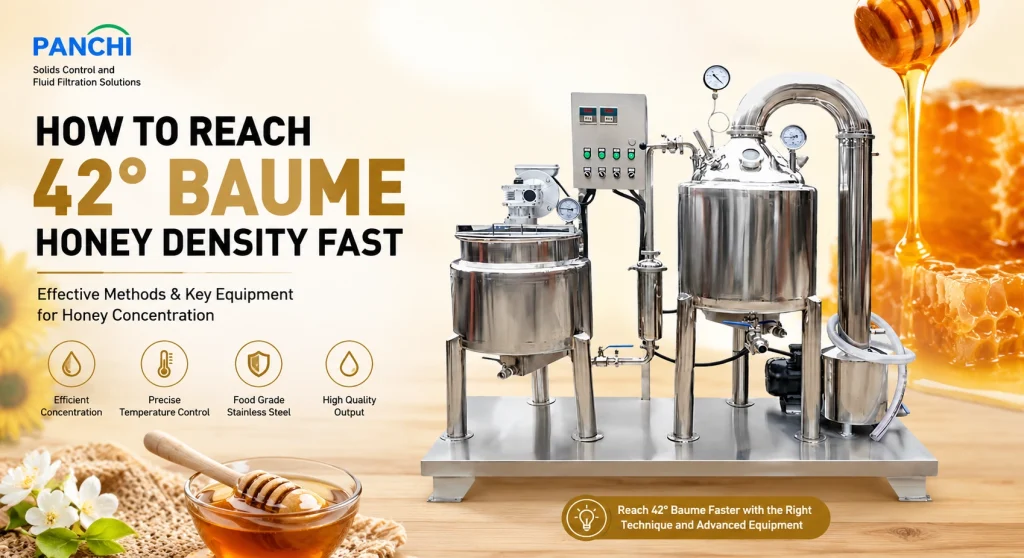
To protect your wholesale margins and pass laboratory inspections, you need a professional honey concentration machine that extracts water efficiently. By deploying a low temperature honey dehydration system, you can reduce honey moisture content fast while keeping vital biological properties perfectly alive.
Traditional thermal evaporation fails because honey holds onto moisture tightly within its sticky sugar matrix. In an open-air environment, you would have to heat the fluid above 60 degrees Celsius to force water out, which instantly ruins the honey quality.
The modern industrial standard relies on a specialized vacuum honey thickener. According to fluid dynamics, lowering the ambient barometric pressure drastically drops the boiling point of liquids. By establishing a deep vacuum environment of 0.08 MPa to 0.09 MPa inside a sealed honey concentration machine, excess moisture flash-evaporates at a safe biological temperature below 40 degrees Celsius.
This advanced vacuum honey thickener technology explains how to reach 42 Baume honey density fast without thermal damage. Embracing a low temperature honey dehydration protocol allows commercial packers to reduce honey moisture content fast while preserving natural floral aromas, clarity, and essential diastase activity in honey processing.
To give you a clear view of your operational options, here is a quick look at how traditional passive thermal systems compare to a modern honey concentration machine:
| Operational Metric | Passive Heat Rooms / Sun-Drying | Modern Honey Concentration Machine |
|---|---|---|
| Processing Time | 48 to 72 Hours | 15 to 20 Minutes per batch |
| Core Honey Temp | 55 to 65 degrees Celsius | Under 40 degrees Celsius |
| Risk of Color Darkening | Extremely High | Zero (Retains exact natural color) |
| Diastase Activity in Honey Processing | Severe degradation (Fails lab compliance tests) | 100% Preserved (Matches fresh raw honey) |
| Efficiency Profile | Unable to reduce honey moisture content fast | Engineered to reduce honey moisture content fast |
Raw honey with high glucose ratios often crystallizes during storage, which can clog your honey concentration machine lines. Pour the crude honey into the double-jacketed pre-heating tank of your low temperature honey dehydration unit. Set the water jacket temperature between 60 to 70 degrees Celsius to transfer gentle, indirect heat. Engage the low-speed paddle agitator at a constant 36 R/min.
Pro-Tip from the Field: Keep the agitation speed exactly at 36 R/min. Pushing the paddle faster injects micro-bubbles into the fluid, creating a cloudy appearance. Never rush this step by raising the water jacket above 80 degrees Celsius; overheating the tank walls causes local caramelization and harms the diastase activity in honey processing. This is why a vacuum honey thickener is the primary tool used by those who know how to reach 42 Baume honey density fast.
Skip mechanical gear pumps that smash wax particles into the fluid. Instead, utilize the differential negative pressure built up inside your primary vacuum honey thickener to draw the warm honey through the transfer plumbing automatically. As the fluid moves inside the honey concentration machine, it passes through an inline dual-stage stainless steel filter ranging from 120-mesh down to 200-mesh. This isolates bee wings and wax fragments in an enclosed loop, helping you reduce honey moisture content fast and cleanly. This is why learning how to reach 42 Baume honey density fast requires gentle handling of fluids.
Pro-Tip from the Field: If you notice your suction speed slowing down, the 120-mesh filter is likely choked with wax. Always choose a honey concentration machine equipped with a dual-route bypass valve. This allows you to redirect the honey flow to a secondary backup filter line instantly, allowing you to clean the primary mesh without shutting down your low temperature honey dehydration process.
Engage your water-recycle vacuum pump on the vacuum honey thickener and verify that your pressure gauge reaches a steady 0.08 to 0.09 MPa. This deep negative pressure is the secret of how to reach 42 Baume honey density fast. As the filtered honey enters the evaporation chamber, excess water transitions into vapor almost instantly. Connect the vapor line to a cooling condensing tower to rapidly capture and discharge the waste moisture, allowing you to reduce honey moisture content fast.
This ensures you do not overheat the core fluids and permanently degrade any diastase activity in honey processing. Run a batch test after 15 to 20 minutes, crack open the atmospheric relief valve, and pull a sample. You will find clean, clear honey sitting at a stable 42.5 Baume.
Let us look at a real-world case study from an artisanal cooperative that faced severe losses when unseasonable rains left their wildflower harvest sitting at a watery 39 Baume. Wholesale buyers rejected the crop due to fermentation risks, forcing prices down.
To save the season, the cooperative integrated a 0.5-ton integrated honey concentration machine into their cleanroom. This compact vacuum honey thickener allowed them to execute low temperature honey dehydration anywhere. Because the unit was optimized to run entirely on a standard 220V single-phase power line, it saved them thousands of dollars in utility upgrade costs.
Instead of waiting days in a heat room, they processed raw honey in 20-minute batch cycles. The honey concentration machine dropped moisture levels from 23% down to 17.5% (42.5 Baume) in a single pass. The actual volumetric loss from removing water weight was only about 5.5%. However, because the finished product was now shelf-stable and preserved its natural diastase activity in honey processing, its market value instantly doubled.
By learning how to reach 42 Baume honey density fast, the cooperative bypassed low-tier packers, secured direct premium supermarket contracts, and proved that investing in a vacuum honey thickener can reduce honey moisture content fast while preserving diastase activity in honey processing, which is the key to passing customs audits.
To safely execute low temperature honey dehydration and reduce honey moisture content fast, your chosen honey concentration machine must meet these three non-negotiable criteria:
Q: Can I reach 42 Baume honey by using sun-drying or household dehumidifiers?
A: While passive dehumidification works for home-use setups, it cannot reduce honey moisture content fast for commercial volumes. Sun-drying exposes open honey to dust and wild yeasts, while hot-rooms take days to drop a single Baume point, risking active fermentation before dehydration is complete. A dedicated honey concentration machine is required for professional operations.
Q: What is the exact correlation between Baume and honey moisture percentage?
A: A standard reading of 42 degrees Be (Baume), calibrated to 20 degrees Celsius, corresponds to exactly 17.8% moisture content. A reading of 43 Baume indicates roughly 15.9% moisture. Any honey density measuring above 42 Baume via a vacuum honey thickener is universally recognized as safe from yeast fermentation.
Q: Does a vacuum honey concentration machine harm diastase activity in honey processing?
A: No. Modern low temperature honey dehydration relies on atmospheric pressure reduction rather than high heat to boil off water. As long as your core product temperature inside the vacuum honey thickener stays under 45 degrees Celsius, your HMF profiles and diastase activity in honey processing remain completely unaltered, matching raw honey fresh from the hive.
Q: How does a professional vacuum honey thickener help me reduce honey moisture content fast?
A: By establishing a deep negative pressure environment of 0.08 to 0.09 MPa, a high-quality honey concentration machine lowers the boiling point of water trapped inside the nectar. This allows you to pull out excess water vapor in less than 20 minutes per batch, providing the fastest and safest solution on how to reach 42 Baume honey density fast.


Whatsapp: +8615736768129
Email: [email protected]
Address: Zhengzhou, Henan Province, China
Automatic Vacuum Honey Processing & Filtering Machine
Vacuum Low-Temperature Liquid Extraction & Concentration Unit
Custom Steam Distillation & Heat Reflux Essential Oil Equipment
SS304/316L Low-Temperature Vacuum Scraper Concentrator
QN Spherical Vacuum Concentrator & Alcohol Recovery Unit
Multi-function Stainless Steel Vacuum Distillation & Extraction Unit
Hot Reflux Vacuum Liquid Extraction & Concentration Unit
Single-Effect External Circulation Vacuum Concentrator
SJN Series Double-Effect External Circulation Vacuum Evaporator
We will contact you within one working day. Please pay attention to your email.
Automatic Vacuum Honey Processing & Filtering Machine
Vacuum Low-Temperature Liquid Extraction & Concentration Unit
Custom Steam Distillation & Heat Reflux Essential Oil Equipment
WhatsApp: +8615736768129
Email: [email protected]
Address: Zhengzhou, Henan Province, China


COPYRIGHT© 2026 Zhengzhou Panchi Machinery Equipment Co., Ltd. | Privacy Policy

Our team will respond within 24 hours.
Thanks! We'll get back to you within 24 hours.
Check your inbox (and spam folder) for our reply.