
After the extraction stage, herbal manufacturers still face a critical challenge: removing unwanted impurities while preserving valuable active compounds. Components such as proteins, polysaccharides, pigments, resins, and fine particles can affect extract clarity, stability, and final product quality.
A properly designed purification process is therefore essential for producing high-quality herbal ingredients.
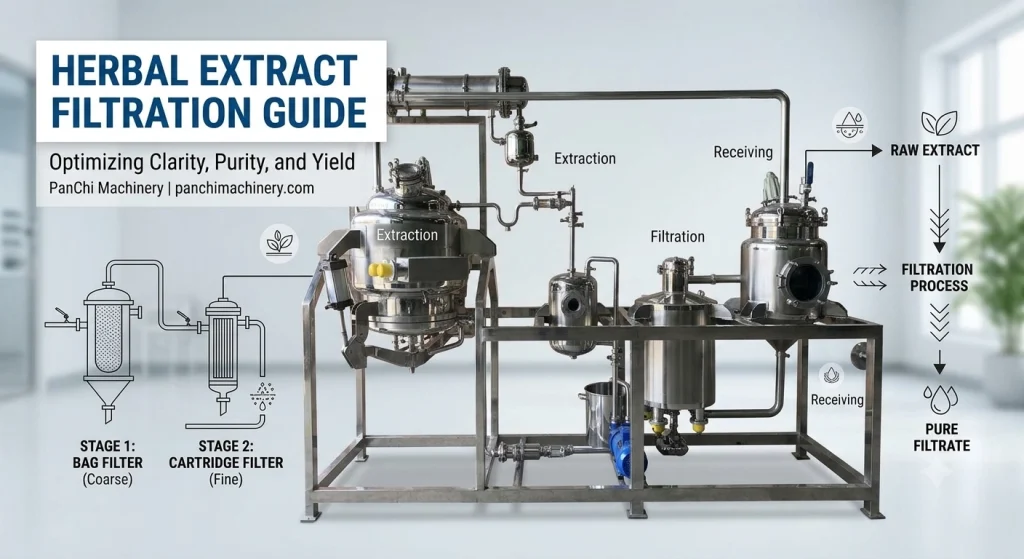
This herbal extract filtration guide explains how the alcohol precipitation process works, why it is widely used in herbal extract purification, and how manufacturers can improve separation efficiency through suitable equipment and process control.
For commercial herbal production, extraction is only the first step. The following purification stages determine whether the final extract meets pharmaceutical, nutraceutical, or food-grade quality requirements.
The alcohol precipitation process is a widely used purification method that separates unwanted substances from herbal extracts by adjusting solvent concentration and utilizing differences in compound solubility.
During this process, ethanol is gradually added to the concentrated herbal extract. Certain components, such as polysaccharides, proteins, and high-molecular-weight impurities, become less soluble in the alcohol-water mixture and form precipitates.
After precipitation occurs, the solid impurities are separated from the liquid extract through filtration or other solid-liquid separation methods.
A typical alcohol precipitation process includes:
The original herbal extract is first concentrated to achieve a suitable solid content. Proper concentration improves the efficiency of the following precipitation step.
Ethanol is added according to the required concentration ratio. Uniform mixing ensures that the solvent contacts the entire extract solution.
The mixture is usually cooled and maintained for a specific period to allow impurities to fully precipitate.
The precipitated solids are removed through filtration equipment, producing a clearer purified extract.
The purified liquid can then enter subsequent concentration or solvent recovery processes.
This controlled separation method improves extract purity while maintaining important active ingredients.
The goal of herbal extract purification is not simply removing visible particles. It directly influences product performance, stability, and manufacturing consistency.
Raw herbal extracts often contain:
Without effective purification, these substances may cause:
A complete herbal extract purification process helps manufacturers achieve:
For pharmaceutical and high-value botanical products, purification quality directly affects the commercial value of the final extract.
After precipitation, efficient solid-liquid separation becomes essential.
A suitable filtration system removes precipitated impurities while minimizing product loss. The selection of filtration technology depends on factors such as:
Common filtration solutions include:
For large-scale production, an integrated filtration system provides better process control and reduces manual operation requirements.
Combining precipitation with an optimized filtration stage allows manufacturers to improve purification efficiency and maintain stable product quality.
Equipment design plays an important role in achieving reliable purification results.
Professional herbal extraction equipment should support not only extraction but also downstream purification requirements. Stainless steel construction, sanitary design, and easy cleaning capability are important considerations for pharmaceutical and food-grade production.
A complete production setup may include:
Choosing suitable herbal extraction equipment helps manufacturers create a smoother production workflow from extraction to purified final product.
A modern herbal production line usually follows a complete process:
Raw Botanical Materials
↓
Extraction
↓
Extract Concentration
↓
Alcohol Precipitation
↓
Filtration
↓
Purified Extract
↓
Final Concentration
This workflow ensures that each stage contributes to improving final product quality.
A reliable herbal extract filtration guide should not only explain filtration methods but also consider the relationship between extraction, precipitation, separation, and concentration.
By optimizing every step, manufacturers can achieve higher efficiency, lower material loss, and more consistent herbal extract quality.
A successful alcohol precipitation process requires more than simply adding ethanol into herbal extract. In commercial production, each stage must be carefully controlled to achieve effective impurity removal, stable extract quality, and efficient downstream processing.
This herbal extract filtration guide focuses on the key engineering steps that influence purification performance, from solvent adjustment and precipitation formation to filtration and solvent recovery.
For manufacturers producing botanical extracts, pharmaceuticals, and natural ingredients, optimizing these steps can improve production efficiency while reducing material loss during purification.
The first step of the alcohol precipitation process is preparing the herbal extract with a suitable concentration level.
The original extraction liquid usually contains a high amount of water and dissolved components. Before ethanol addition, manufacturers often concentrate the extract to improve precipitation efficiency.
Important parameters include:
If the extract concentration is too low, excessive ethanol may be required, increasing operating costs. If the concentration is too high, the solution viscosity may increase and affect mixing and filtration performance.
A properly controlled concentration stage creates better conditions for the following purification process.
Ethanol concentration is one of the most important factors affecting precipitation quality.
During the alcohol precipitation process, ethanol changes the solvent environment and reduces the solubility of certain impurities, including:
The ethanol addition speed and mixing performance directly influence precipitation uniformity.
Poor mixing may cause:
Industrial production usually requires a controlled mixing system to ensure ethanol is evenly distributed throughout the herbal extract.
For this reason, professional herbal extraction equipment often integrates agitation systems and temperature monitoring functions to improve process consistency.
Temperature control plays a critical role in the precipitation stage.
After ethanol mixing, the solution is commonly cooled and maintained for a specific period to allow impurities to form stable precipitates.
Cooling conditions influence:
A controlled low-temperature environment can improve impurity precipitation while reducing unwanted reactions.
In pharmaceutical and high-value botanical production, temperature management is especially important because excessive heat may affect sensitive natural compounds.
After precipitation formation, the next step is removing solid impurities from the liquid extract.
A suitable filtration system determines the efficiency of this separation stage.
Common industrial filtration solutions include:
Suitable for applications requiring gentle separation and reduced oxidation risk.
Used for larger production volumes where efficient solid removal is required.
Suitable for applications requiring higher filtration accuracy.
The selection depends on:
A properly designed filtration stage improves extract clarity and prepares the product for further concentration.
After primary filtration, some fine particles may remain in the liquid extract.
Additional clarification can improve:
For premium herbal products, multiple filtration stages may be applied to achieve higher purity requirements.
A complete herbal extract purification workflow often combines precipitation, filtration, clarification, and concentration technologies to produce a stable final extract.
This integrated approach is widely used in pharmaceutical, nutraceutical, and botanical ingredient manufacturing.
Ethanol consumption is an important economic factor in large-scale herbal production.
After purification, recovering ethanol can significantly reduce operating costs and improve sustainability.
A complete production line may include:
Efficient solvent recovery helps manufacturers reduce raw material expenses while improving overall production efficiency.
When designing a complete herbal extract purification system, solvent management should be considered together with filtration and concentration requirements.
After filtration and purification, the clarified extract usually requires further concentration before final processing.
The concentration stage removes excess solvent or water while maintaining valuable active ingredients.
Common technologies include:
Integrating concentration equipment with the filtration process creates a more efficient production workflow.
Modern filtration systems are often designed as part of a complete processing line rather than operating as independent units.
| Process Stage | Key Control Factor | Equipment Consideration |
|---|---|---|
| Extract Preparation | Solid content | Concentration system |
| Ethanol Mixing | Uniform distribution | Mixing vessel |
| Precipitation | Temperature control | Cooling system |
| Separation | Particle removal efficiency | Filtration system |
| Clarification | Purity requirement | Fine filtration |
| Solvent Recovery | Ethanol recycling | Recovery equipment |
| Final Processing | Concentration stability | Vacuum evaporator |
The performance of an alcohol precipitation process depends on the interaction between process parameters and equipment design.
A professional herbal extract filtration guide should consider not only filtration technology but also the complete relationship between extraction, precipitation, separation, and concentration.
For commercial manufacturers, selecting suitable herbal extraction equipment and designing an integrated purification workflow can improve:
After completing the alcohol precipitation process, the filtration stage becomes one of the most important steps affecting final extract quality. A properly selected filtration system can remove unwanted precipitates, improve extract clarity, reduce product loss, and create more stable conditions for downstream concentration.
For commercial manufacturers, choosing filtration equipment should not only focus on filtration speed. Factors such as extract characteristics, production capacity, cleaning requirements, and future expansion should also be considered.
This herbal extract filtration guide explains the key factors manufacturers should evaluate when selecting purification equipment for herbal extract production.
Different herbal extracts have different physical properties. The filtration solution that works for one product may not be suitable for another.
Before selecting a filtration system, manufacturers should analyze:
High-viscosity extracts require stronger filtration capability and optimized flow design. Excessive viscosity may reduce filtration speed and increase processing time.
The size and amount of precipitated particles after the alcohol precipitation process determine the required filtration accuracy.
Large particles may be removed through conventional filtration, while finer particles may require additional clarification stages.
Some herbal extracts contain heat-sensitive or oxidation-sensitive compounds. Gentle filtration conditions help protect product quality.
Understanding these characteristics allows manufacturers to select the most suitable filtration technology instead of using a standard solution.
Different production scales and purity requirements require different filtration methods.
Vacuum filtration is commonly used when manufacturers require gentle solid-liquid separation.
Advantages include:
It is often applied after precipitation when the extract contains suspended impurities that require careful removal.
For large-scale production, filter presses provide efficient solid separation.
Advantages include:
This type of filtration system is suitable for manufacturers producing large quantities of herbal extracts where stable production efficiency is required.
Membrane filtration provides higher separation accuracy and is used when manufacturers require improved clarification.
Applications include:
The final selection depends on purity requirements, production volume, and operating costs.
For pharmaceutical, food, and nutraceutical production, equipment materials directly affect product safety and service life.
High-quality herbal extraction equipment and purification systems commonly use:
These designs provide:
For GMP-oriented production facilities, sanitary design is especially important because equipment must support frequent cleaning and stable operation.
A professional herbal extract purification system should be designed not only for performance but also for hygiene compliance.
Capacity planning is another critical factor when purchasing purification equipment.
Manufacturers should consider:
Small-scale producers may require flexible filtration units for multiple products.
Large industrial manufacturers usually need integrated systems that connect:
Extraction
↓
Alcohol Precipitation
↓
Filtration
↓
Concentration
↓
Storage
A complete production line reduces manual transfer and improves overall efficiency.
Modern herbal production rarely depends on a single machine. The filtration stage should work smoothly with upstream and downstream equipment.
A complete solution may include:
Integrating these systems improves:
For manufacturers upgrading their production capacity, choosing compatible herbal extraction equipment helps create a more reliable manufacturing workflow.
Every herbal product has unique processing requirements. Standard equipment may not always achieve the desired purification performance.
A customized filtration system can be designed according to:
Panchi provides customized solutions for herbal extraction and purification applications, including stainless steel extraction vessels, filtration systems, and integrated processing equipment.
By combining suitable equipment design with optimized process parameters, manufacturers can improve extract quality, reduce production losses, and achieve more stable commercial production.
A successful purification process depends on the coordination of every stage.
The complete workflow includes:
Raw Botanical Materials
↓
Extraction
↓
Extract Concentration
↓
Alcohol Precipitation
↓
Filtration
↓
Purification
↓
Final Concentration
↓
Finished Herbal Extract
The right filtration system ensures that impurities are effectively removed while valuable compounds remain protected.
Following this herbal extract filtration guide, manufacturers can make better equipment decisions and develop a purification process that supports long-term production efficiency.
A: The alcohol precipitation process uses ethanol concentration changes to separate impurities such as proteins and polysaccharides from herbal extracts. After precipitation, a suitable filtration system removes solid impurities to improve extract clarity, stability, and final product quality.
A: A complete herbal extract filtration guide usually includes precipitation preparation, solid-liquid separation, clarification, and final concentration. The process helps remove unwanted particles while protecting valuable active compounds and improving extract consistency for commercial production.
A: After the alcohol precipitation process, filtration is required to remove formed precipitates and suspended impurities. A suitable filtration system improves extract purity, reduces product loss, and prepares the extract for further concentration or processing.
A: Common equipment for herbal extract purification includes extraction vessels, precipitation tanks, filtration units, solvent recovery systems, and concentration equipment. Professional herbal extraction equipment helps manufacturers achieve better hygiene, process control, and production consistency.
A: Selecting the right filtration system depends on extract viscosity, particle size, production capacity, and purity requirements. Manufacturers should also consider equipment compatibility, automation level, and integration with existing herbal extraction equipment.


Whatsapp: +8615736768129
Email: [email protected]
Address: Zhengzhou, Henan Province, China
Automatic Vacuum Honey Processing & Filtering Machine
Vacuum Low-Temperature Liquid Extraction & Concentration Unit
Custom Steam Distillation & Heat Reflux Essential Oil Equipment
SS304/316L Low-Temperature Vacuum Scraper Concentrator
QN Spherical Vacuum Concentrator & Alcohol Recovery Unit
Multi-function Stainless Steel Vacuum Distillation & Extraction Unit
Hot Reflux Vacuum Liquid Extraction & Concentration Unit
Single-Effect External Circulation Vacuum Concentrator
SJN Series Double-Effect External Circulation Vacuum Evaporator
We will contact you within one working day. Please pay attention to your email.
Automatic Vacuum Honey Processing & Filtering Machine
Vacuum Low-Temperature Liquid Extraction & Concentration Unit
Custom Steam Distillation & Heat Reflux Essential Oil Equipment
WhatsApp: +8615736768129
Email: [email protected]
Address: Zhengzhou, Henan Province, China


COPYRIGHT© 2026 Zhengzhou Panchi Machinery Equipment Co., Ltd. | Privacy Policy

Our team will respond within 24 hours.
Thanks! We'll get back to you within 24 hours.
Check your inbox (and spam folder) for our reply.