
Herbal extraction production requires strict control over cleanliness, product safety, and process consistency. As extraction facilities move from small-batch production to industrial-scale manufacturing, traditional manual cleaning methods often become inefficient and difficult to maintain.
Extraction vessels, pipelines, filters, and auxiliary equipment may accumulate residues from botanical materials, including:
If these residues are not completely removed, they may create risks such as cross-contamination, microbial growth, reduced product quality, and GMP compliance issues.
For pharmaceutical and high-value herbal extract manufacturers, cleaning is not simply a maintenance task. It is a critical part of the production process.
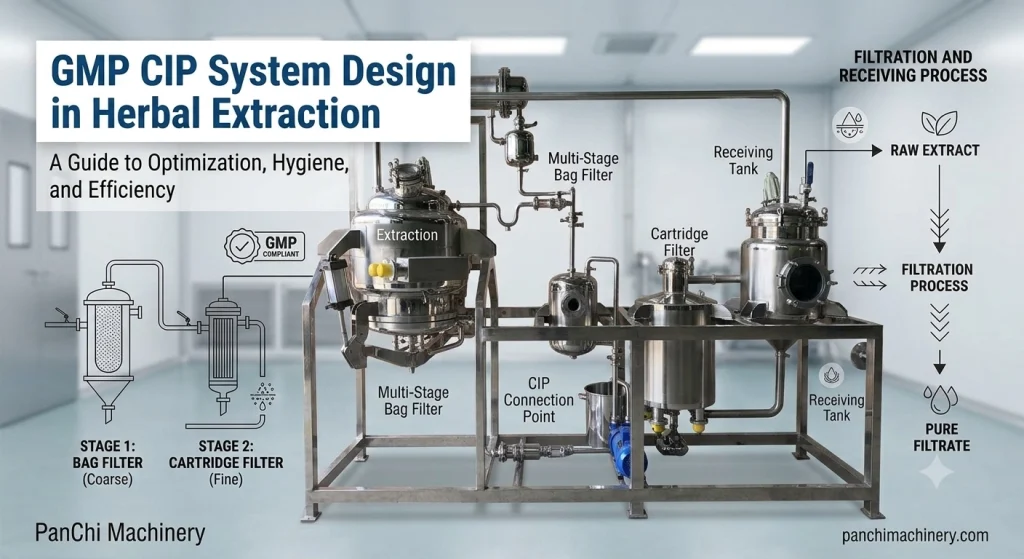
A properly engineered cip system design herbal extraction solution helps manufacturers achieve reliable cleaning performance by combining automated circulation, sanitary equipment design, and controlled cleaning parameters.
Compared with manual cleaning, a modern CIP (Clean-In-Place) system allows operators to clean processing equipment without dismantling tanks, pipes, or production units. This reduces downtime while improving cleaning repeatability.
An effective CIP system can provide:
For industrial herbal extraction lines, CIP design must consider not only cleaning efficiency but also equipment structure, piping layout, material selection, and integration with the entire production system.
CIP system design refers to the engineering planning of automated cleaning processes that allow production equipment to be cleaned internally without manual disassembly.
In herbal extraction facilities, a CIP cleaning system usually circulates cleaning fluids through:
The cleaning process typically includes several stages:
Each stage is controlled through specific parameters, including:
A well-designed system ensures that cleaning solutions reach all internal surfaces and remove product residues effectively.
For herbal extraction applications, this is especially important because botanical extracts often contain complex components that can strongly adhere to equipment surfaces.
Herbal extraction processes are different from many conventional liquid processing applications.
Plant-based materials often contain natural compounds that create additional cleaning challenges.
For example:
Some botanical extracts contain:
These compounds may attach to vessel walls and pipelines during processing.
Without effective cleaning, residues can affect the next production batch and increase contamination risks.
Modern extraction systems often include:
Areas with poor accessibility or improper design may become difficult to clean manually.
This is why GMP sanitary design principles are essential during CIP planning.
Equipment should minimize:
A sanitary layout improves cleaning efficiency and supports long-term production reliability.
GMP requirements focus on maintaining consistent product quality and preventing contamination throughout manufacturing.
For herbal extraction plants, a suitable CIP system design herbal extraction solution supports GMP objectives by providing:
Automated cleaning systems can record important data such as:
This information helps manufacturers demonstrate cleaning consistency during quality inspections.
For companies producing pharmaceutical-grade herbal extracts, CIP is not only a cleaning technology but also an important quality management tool.
A successful CIP design should be developed together with the extraction equipment layout.
The cleaning system must match:
For example, an extraction line using SUS316L stainless steel vessels with hygienic piping requires a different CIP configuration compared with a standard industrial system.
By integrating CIP planning during equipment design, manufacturers can achieve better cleaning coverage, lower maintenance costs, and improved production efficiency.
The following sections will explore the key components of a GMP CIP system, including cleaning tanks, circulation systems, sanitary piping design, automation controls, and equipment integration.
A successful cip system design herbal extraction solution depends on the correct combination of cleaning equipment, sanitary piping, automated control, and process monitoring.
Unlike simple cleaning methods, an industrial CIP system must ensure that cleaning solutions can reach all internal surfaces of the production line while maintaining stable temperature, chemical concentration, and flow conditions.
For herbal extraction facilities, the CIP system is usually integrated with:
A well-designed system improves cleaning consistency and helps manufacturers maintain GMP production standards.
The cleaning tank is one of the core components of a complete CIP cleaning system.
It stores and prepares cleaning solutions before they are circulated through the production equipment.
A typical CIP station may include multiple tanks for different cleaning stages, such as:
Each tank is designed to provide accurate control of:
For herbal extraction applications, the tank capacity should match the size and configuration of the processing line.
For example, larger extraction vessels require sufficient cleaning solution volume to ensure complete surface coverage and effective residue removal.
The construction material is also important.
Most pharmaceutical and high-value botanical applications use stainless steel materials such as SUS304 or SUS316L because they provide:
A properly designed CIP tank should also minimize contamination risks through smooth internal surfaces and hygienic connections.
The circulation system determines whether cleaning solutions can effectively remove residues from the entire production line.
A CIP pump must provide sufficient:
This creates the mechanical cleaning effect required to remove remaining materials from equipment surfaces.
For herbal extraction lines, circulation performance is especially important because residues from plant extracts can be sticky and difficult to remove.
An efficient circulation loop should include:
The system design should ensure that cleaning fluid reaches:
Poor circulation design may result in incomplete cleaning and create hidden contamination risks.
Therefore, sanitary processing equipment should always be considered together with CIP circulation requirements.
Piping design is one of the most important factors affecting CIP performance.
In herbal extraction production, pipelines transport:
Improper piping layouts may create areas where residues accumulate.
A GMP-oriented design focuses on:
A dead leg refers to an area where liquid cannot flow effectively, creating a potential location for residue buildup.
To support GMP sanitary design, industrial extraction lines often use:
These features help improve cleaning coverage and reduce maintenance requirements.
Inside extraction vessels and tanks, cleaning devices ensure that cleaning solutions contact all internal surfaces.
Common CIP cleaning devices include:
The selection depends on:
For smaller vessels, spray balls may provide sufficient cleaning coverage.
For larger extraction tanks with complex internal structures, stronger cleaning devices may be required.
A properly selected cleaning device helps remove residues from:
This improves cleaning efficiency and reduces manual intervention.
Automation is a key part of modern CIP design.
A PLC-based control system can manage the entire cleaning cycle automatically, including:
Automation provides several advantages:
For pharmaceutical and herbal extract manufacturers, cleaning records are important for quality management.
A digital CIP control system can store process information, helping manufacturers verify that each cleaning cycle meets predefined requirements.
The CIP system should be designed together with the main production equipment.
A complete herbal extraction equipment solution should consider cleaning requirements from the beginning of the engineering process.
Important integration points include:
For example, extraction tanks with smooth internal surfaces and hygienic structures are easier to clean and require less chemical consumption.
When CIP planning is integrated into equipment design, manufacturers can achieve:
A GMP-compliant CIP system is therefore not an independent unit but an essential part of the entire herbal extraction production line.
Designing an effective cip system design herbal extraction solution requires more than selecting cleaning tanks and pumps. The entire system must be engineered around the characteristics of herbal extracts, production conditions, and GMP sanitary requirements.
A poorly designed CIP system may leave residues behind, increase cleaning time, and create risks during quality inspections.
For industrial herbal extraction lines, the following factors determine whether a CIP system can achieve reliable cleaning performance.
Piping layout is one of the most important considerations in a GMP-compliant CIP system.
During herbal extraction production, pipelines may contain:
If the piping system contains areas where liquid cannot flow or drain properly, residues may accumulate and become difficult to remove.
A proper GMP sanitary design should minimize:
Key design features include:
For pharmaceutical and botanical applications, sanitary piping design directly affects cleaning reliability and long-term production safety.
CIP cleaning efficiency depends not only on chemical action but also on the mechanical force created by liquid circulation.
The cleaning solution must achieve sufficient velocity to remove residues from internal surfaces.
Important parameters include:
If the flow rate is too low:
If the flow rate is properly controlled, the system can achieve better cleaning performance while reducing operating costs.
Therefore, circulation calculations should be completed during the design stage of the CIP cleaning system.
Cleaning performance is strongly influenced by temperature and chemical concentration.
Different residues require different cleaning conditions.
For example:
A reliable CIP system should accurately control:
Automated sensors and dosing systems help maintain stable cleaning conditions.
For herbal extraction facilities, this is particularly important because plant-based residues often contain complex compounds that require specific cleaning parameters.
Modern herbal extraction plants increasingly rely on automated CIP systems to improve consistency.
A PLC-controlled CIP system can manage:
Automation reduces dependence on manual operation and helps prevent human errors.
Additional benefits include:
For regulated industries, automated cleaning records provide valuable evidence during audits.
The materials used in extraction and cleaning systems directly affect hygiene performance.
For high-standard herbal extraction production, stainless steel is commonly selected because it provides:
SUS316L stainless steel is often preferred for pharmaceutical applications because it performs well against aggressive cleaning chemicals.
Internal surface finishing is also important.
Features such as:
help prevent residue attachment and improve cleaning effectiveness.
When combined with suitable sanitary processing equipment, high-quality materials support more reliable GMP production.
A GMP-compliant CIP system requires verification that cleaning procedures achieve the required results.
Cleaning validation may include:
Manufacturers need to demonstrate that the system consistently removes previous batch residues.
Monitoring systems can collect important process data, including:
This information supports quality management and continuous process improvement.
For pharmaceutical herbal extraction facilities, validation is an essential part of the overall production strategy.
The CIP system should not be designed separately from the production equipment.
A complete cleaning strategy must consider the entire process line, including:
The structure of herbal extraction equipment directly affects CIP efficiency.
For example:
A vessel with smooth internal surfaces, optimized nozzle locations, and proper drainage will require less cleaning time compared with equipment containing difficult-to-access areas.
Therefore, CIP design should begin during the equipment engineering stage.
For herbal extraction manufacturers, GMP compliance requires a combination of hygienic equipment design and controlled cleaning procedures.
A reliable CIP system supports GMP goals by providing:
Important GMP considerations include:
Equipment should avoid contamination-prone areas through:
A properly designed CIP process helps prevent residues from previous batches affecting future production.
This is especially important when manufacturers process different herbal materials with different active compounds.
Automated CIP systems can provide detailed records that support:
By combining sanitary design, automation, and validated cleaning procedures, manufacturers can build a more reliable herbal extraction production environment.
For manufacturers producing herbal extracts under GMP requirements, a reliable cleaning system is essential for maintaining product quality, reducing downtime, and ensuring consistent production performance.
PCM provides customized cip system design herbal extraction solutions that integrate sanitary engineering, automated cleaning processes, and extraction equipment requirements.
Instead of designing CIP systems separately from production equipment, PCM considers the complete processing workflow, including:
This integrated approach helps manufacturers achieve more effective cleaning coverage and improve overall production efficiency.
A complete CIP cleaning system from PCM can be customized according to different herbal extraction applications.
Typical configurations include:
The system parameters can be adjusted based on:
For pharmaceutical and high-value botanical processing, PCM can provide stainless steel sanitary solutions designed for demanding production environments.
CIP performance depends heavily on the structure of the production equipment.
PCM designs herbal extraction equipment with cleaning requirements considered from the beginning of the engineering process.
Key design features include:
These features support better cleaning efficiency and help reduce residue accumulation.
By combining extraction equipment design with CIP planning, manufacturers can achieve:
Modern herbal extraction facilities require equipment that meets strict hygiene expectations.
PCM focuses on sanitary processing equipment design by applying:
These solutions help manufacturers maintain stable production conditions while improving operational safety.
A properly designed CIP system also supports better resource utilization by reducing water consumption, cleaning chemical waste, and unnecessary production interruptions.
A: CIP system design herbal extraction refers to the engineering design of automated cleaning systems for herbal extraction lines. It enables cleaning of tanks, pipelines, and processing equipment without disassembly while supporting GMP production requirements.
A: CIP helps prevent cross-contamination, maintain sanitary conditions, and ensure consistent cleaning performance. It reduces manual cleaning errors and provides documented cleaning processes required for GMP manufacturing.
A: A complete CIP cleaning system usually includes cleaning tanks, pumps, heating units, chemical dosing systems, sanitary pipelines, spray devices, and automated control systems.
A well-designed CIP system is a critical part of modern herbal extraction production. By combining sanitary equipment design, automated cleaning control, and GMP-focused engineering, manufacturers can improve product safety, production efficiency, and long-term operational reliability.
PCM provides customized solutions for herbal extraction lines, including extraction vessels, sanitary processing equipment, and integrated CIP cleaning systems.
Contact PCM to discuss your production requirements and develop a cleaning solution designed for your specific herbal extraction process.


Whatsapp: +8615736768129
Email: [email protected]
Address: Zhengzhou, Henan Province, China
Automatic Vacuum Honey Processing & Filtering Machine
Vacuum Low-Temperature Liquid Extraction & Concentration Unit
Custom Steam Distillation & Heat Reflux Essential Oil Equipment
SS304/316L Low-Temperature Vacuum Scraper Concentrator
QN Spherical Vacuum Concentrator & Alcohol Recovery Unit
Multi-function Stainless Steel Vacuum Distillation & Extraction Unit
Hot Reflux Vacuum Liquid Extraction & Concentration Unit
Single-Effect External Circulation Vacuum Concentrator
SJN Series Double-Effect External Circulation Vacuum Evaporator
We will contact you within one working day. Please pay attention to your email.
Automatic Vacuum Honey Processing & Filtering Machine
Vacuum Low-Temperature Liquid Extraction & Concentration Unit
Custom Steam Distillation & Heat Reflux Essential Oil Equipment
WhatsApp: +8615736768129
Email: [email protected]
Address: Zhengzhou, Henan Province, China


COPYRIGHT© 2026 Zhengzhou Panchi Machinery Equipment Co., Ltd. | Privacy Policy

Our team will respond within 24 hours.
Thanks! We'll get back to you within 24 hours.
Check your inbox (and spam folder) for our reply.