Selecting the right mixing equipment is one of the most important decisions in any liquid processing plant. Whether producing food, botanical extracts, pharmaceuticals, cosmetics, or chemicals, manufacturers rely on efficient mixing to achieve consistent product quality, stable production, and high operational efficiency.
However, many companies focus primarily on tank capacity or purchase price while overlooking critical engineering factors such as agitator design, material compatibility, heating methods, and sanitary construction. An incorrectly selected mixing tank may lead to incomplete blending, uneven heating, longer production cycles, higher energy consumption, and increased maintenance costs.
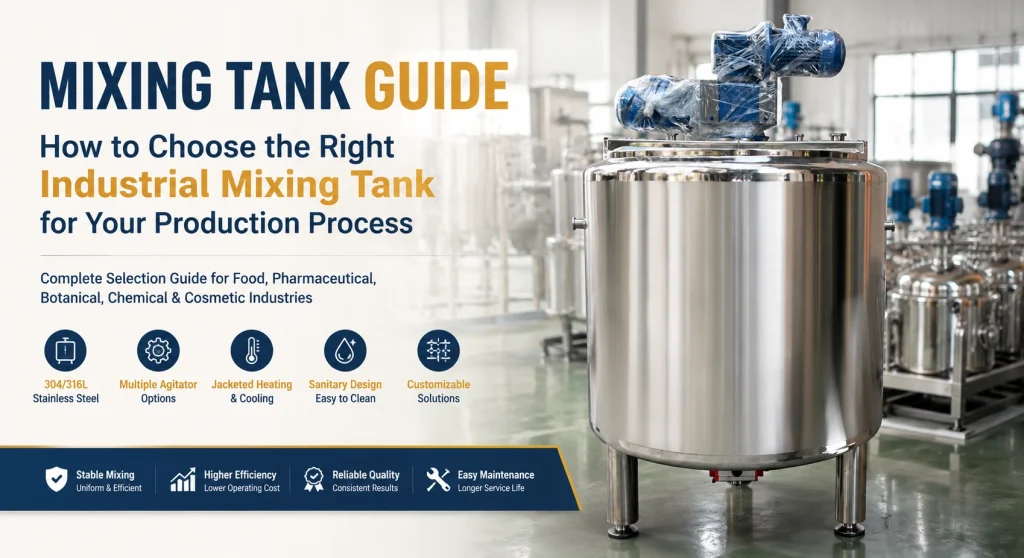
A well-designed Mixing Tank Guide helps manufacturers understand that mixing is more than simply combining ingredients. It is a controlled process that directly influences downstream operations such as extraction, concentration, filtration, storage, and packaging. Choosing the appropriate equipment at the beginning of a production line can significantly improve overall process performance and reduce long-term operating costs.
This Mixing Tank Guide explains how industrial mixing tanks work, what factors should be considered during equipment selection, and how different configurations meet various production requirements. Whether you are designing a new production line or upgrading an existing facility, understanding these fundamentals will help you make a more informed investment decision.
A mixing tank is far more than a vessel for combining liquids. In modern manufacturing, it serves as the core processing unit where raw materials are blended, dissolved, suspended, heated, cooled, or homogenized before moving to the next production stage.
For industries processing heat-sensitive or high-value materials, mixing quality has a direct impact on product consistency and manufacturing efficiency. An optimized industrial mixing tank creates a stable processing environment that improves material dispersion, shortens mixing time, and supports repeatable production results.
Common industrial applications include:
Each application has unique process requirements. Honey manufacturers may require gentle agitation to preserve product characteristics, while cosmetic producers often need high-shear mixing to create stable emulsions. Botanical extraction plants typically use jacketed mixing tanks to prepare raw materials before extraction, whereas chemical manufacturers may require corrosion-resistant materials and higher operating pressures.
Because processing objectives vary significantly, selecting the correct stainless steel mixing tank requires careful evaluation of product characteristics rather than choosing a standard design.
Efficient mixing provides benefits throughout the production process.
Uniform mixing improves heat transfer efficiency, allowing heating or cooling systems to maintain consistent temperatures across the entire batch. Proper agitation also prevents material sedimentation, reduces dead zones inside the tank, and ensures every ingredient is evenly distributed.
These improvements contribute to:
For manufacturers operating continuous or batch production lines, optimizing the mixing stage often improves the performance of every subsequent process.
A mixing tank should never be evaluated as an independent piece of equipment. Instead, it should be integrated into the overall production workflow.
In a typical botanical or food processing line, materials usually follow this sequence:
Raw Material Preparation
↓
Grinding
↓
Mixing
↓
Extraction
↓
Vacuum Concentration
↓
Storage
↓
Packaging
Within this workflow, the mixing stage prepares raw materials for efficient extraction and subsequent processing. Uniform particle suspension and controlled temperature help improve extraction performance while reducing unnecessary processing time.
For manufacturers planning complete processing systems, PCM’s industrial mixing tank solutions can be integrated with downstream extraction and concentration equipment to create an efficient, continuous production line that supports higher productivity and consistent product quality.
Selecting the right mixing system is one of the most important decisions in process engineering. A properly configured mixing tank improves production efficiency, reduces operating costs, and ensures consistent product quality throughout the manufacturing process.
Many buyers compare equipment based only on price or capacity. However, an industrial mixing tank should be selected according to the product characteristics, production objectives, and process requirements. Understanding these factors before purchasing helps manufacturers avoid expensive modifications and achieve better long-term performance.
The following considerations can help identify the most suitable mixing solution for different industries and applications.
The construction material directly influences equipment durability, hygiene, and long-term operating costs.
Most stainless steel mixing tank systems are manufactured using either SS304 or SS316L stainless steel.
SS304 Stainless Steel
SS304 is widely used in food processing, beverage production, honey processing, and general botanical extraction. It offers excellent corrosion resistance under normal operating conditions while providing a cost-effective solution for most industrial applications.
Typical applications include:
SS316L Stainless Steel
SS316L contains molybdenum, providing higher resistance to corrosion and chemical attack. It is commonly selected for pharmaceutical manufacturing, cosmetic production, and processes involving acidic or highly corrosive materials.
Typical applications include:
For a detailed material comparison, manufacturers can also review PCM’s guide on 316L vs 304 Stainless Steel before making a final equipment selection.
Capacity should be determined according to actual production requirements instead of simply choosing the largest available model.
A properly sized industrial mixing tank should balance production efficiency with investment cost.
Typical capacities include:
| Production Scale | Recommended Capacity |
|---|---|
| Laboratory | 50–100 L |
| Pilot Production | 100–300 L |
| Small Commercial | 500–1000 L |
| Industrial Production | 1000–5000 L |
| Large Customized Plants | 5000 L+ |
When calculating capacity, manufacturers should evaluate:
Selecting excessive capacity may increase equipment investment and energy consumption, while undersized equipment often becomes a production bottleneck.
Not every production process requires the same mixing performance.
Before selecting equipment, manufacturers should clearly identify the primary processing objective.
Common mixing applications include:
Liquid Blending
Suitable for combining liquids with similar viscosity while maintaining product uniformity.
Solid-Liquid Dispersion
Used for dispersing powders into liquids without excessive agglomeration.
Heating and Dissolving
Often applied when ingredients require controlled heating before complete dissolution.
Suspension Mixing
Maintains solid particles evenly distributed throughout the liquid during processing.
Emulsification Preparation
Provides uniform pre-mixing before high-shear emulsification or homogenization.
Different objectives require different impeller structures, rotational speeds, and tank configurations. Matching equipment to the production process improves both efficiency and product consistency.
The agitator is the core component that determines mixing performance.
Common designs include:
Anchor Agitator
Ideal for high-viscosity materials requiring gentle mixing and efficient wall scraping.
Paddle Agitator
Suitable for medium-viscosity liquids and general blending operations.
Propeller Agitator
Designed for low-viscosity liquids requiring rapid circulation and high flow rates.
High-Shear Mixer
Recommended for emulsification, dispersion, and products requiring extremely fine particle distribution.
A professional mixing tank manufacturer should recommend the appropriate agitator based on material viscosity, particle size, production capacity, and desired mixing performance rather than offering a standard configuration for every application.
Many production processes require heating during mixing to improve dissolution, viscosity control, or reaction efficiency.
Common heating options include:
Steam heating is generally preferred for large-scale industrial production because it provides rapid and uniform heat transfer. Electric heating is often suitable for laboratory or pilot-scale systems, while thermal oil heating is commonly selected for processes requiring higher operating temperatures.
The correct heating system should be selected according to energy availability, production scale, temperature requirements, and operating costs.
By carefully evaluating material selection, capacity, agitator design, and heating methods, manufacturers can choose an industrial mixing tank that delivers reliable performance while supporting future production growth.
Modern manufacturing requires far more than a basic vessel with an agitator. Today’s Mixing Tank Guide focuses on equipment that improves process efficiency, supports hygienic production, and adapts to different industrial applications.
A well-designed industrial mixing tank should not only blend materials effectively but also provide stable temperature control, simplify cleaning, and maintain consistent product quality across multiple production batches.
When evaluating equipment, manufacturers should compare the engineering features that directly influence production performance rather than focusing only on tank size or purchase price.
For food, pharmaceutical, cosmetic, and botanical processing, hygiene is one of the most important design considerations.
A high-quality sanitary mixing tank is designed to minimize contamination risks and simplify routine cleaning.
Typical sanitary features include:
These features help reduce product residue, improve cleaning efficiency, and support compliance with food and pharmaceutical manufacturing standards.
For manufacturers producing multiple products on the same production line, sanitary design also shortens cleaning time between batches and reduces the risk of cross-contamination.
The agitation system determines how efficiently materials are mixed inside the tank.
An appropriately designed impeller improves:
The optimum agitator depends on several process variables, including viscosity, density, particle size, and production volume.
Variable-speed drives further improve flexibility by allowing operators to adjust mixing speed for different products instead of using a fixed operating condition.
This flexibility improves product consistency while reducing unnecessary energy consumption.
Many industrial applications require accurate temperature control during mixing.
A jacketed stainless steel mixing tank allows heating or cooling media to circulate around the vessel, providing uniform temperature distribution without direct contact with the product.
Depending on production requirements, jacket systems may use:
Typical applications include:
Uniform temperature distribution helps improve process stability while reducing localized overheating.
Cleaning-In-Place (CIP) systems have become a standard feature in modern processing plants.
Instead of manually cleaning the inside of the tank, automated spray devices circulate cleaning solutions through the vessel.
Advantages include:
For companies operating multiple production shifts, CIP capability significantly increases equipment utilization by reducing cleaning time.
Automation has become increasingly important in industrial mixing systems.
Modern control systems can monitor and adjust key operating parameters such as:
Digital control improves production repeatability while reducing dependence on operator experience.
Manufacturers also benefit from production data recording, which supports quality management and process optimization. <hr>
Selecting a reliable mixing tank manufacturer is just as important as selecting the equipment itself.
PCM designs and manufactures customized industrial mixing tank systems for food, botanical extraction, pharmaceutical, cosmetic, and chemical processing applications.
Our Mixing Tank solutions can be customized with:
Each system is configured according to the customer’s material characteristics, production capacity, and processing objectives, helping manufacturers achieve reliable mixing performance while supporting future production expansion.
By combining sanitary construction, efficient agitation, intelligent controls, and customized engineering, a modern sanitary mixing tank becomes an essential component of a stable and efficient industrial processing line.
A mixing tank should not be viewed as a standalone piece of equipment. In modern manufacturing, it functions as an integrated component of the entire production system, connecting upstream material preparation with downstream extraction, concentration, storage, and packaging.
For many manufacturers, production efficiency is determined not by a single machine but by how well each process works together. Even a high-performance industrial mixing tank cannot deliver optimal results if the subsequent extraction or concentration equipment is not properly matched.
When planning a new production line or upgrading an existing facility, engineers should evaluate the complete processing workflow rather than selecting equipment individually.
Typical considerations include:
A complete system design reduces material transfer time, improves production consistency, and lowers long-term operating costs.
Most botanical extraction plants follow a standardized production sequence.
Raw Materials

        ↓

Grinding

        ↓

Mixing

        ↓

Extraction

        ↓

Vacuum Concentration

        ↓

Storage

        ↓

Packaging
Each stage influences the efficiency of the next.
If raw materials are not uniformly mixed before extraction, solvent contact becomes uneven, resulting in lower extraction efficiency and inconsistent product quality.
Likewise, stable mixing improves heat distribution and creates a more homogeneous feed solution, allowing downstream concentration equipment to operate more efficiently.
This is why engineers often consider mixing the foundation of a stable extraction process.
One of the primary functions of a mixing system is preparing raw materials before extraction.
A properly configured stainless steel mixing tank helps manufacturers:
For herbal extraction, food ingredients, and botanical concentrates, uniform mixing creates better contact between raw materials and extraction solvents.
As a result, manufacturers often achieve:
Rather than operating as an isolated process, mixing directly supports downstream extraction performance.
After materials are thoroughly mixed, they are transferred to the extraction stage.
For manufacturers processing herbs, essential oils, plant extracts, and other natural products, PCM’s Vacuum Low Temperature Liquid Extraction Concentration Unit integrates extraction and low-temperature concentration into a single processing system.
Combining an industrial mixing tank with an extraction and concentration unit provides several operational advantages:
This integrated approach is particularly suitable for industries requiring precise control of heat-sensitive materials, including botanical extracts, essential oils, functional foods, and pharmaceutical ingredients.
Production requirements often change as businesses expand.
A well-designed processing system should allow manufacturers to increase capacity, introduce new products, or improve automation without replacing the entire production line.
When selecting a sanitary mixing tank, manufacturers should consider future integration with equipment such as:
Designing equipment with future expansion in mind reduces long-term investment costs and allows production lines to adapt to changing market demands.
Instead of purchasing individual machines independently, many manufacturers now choose complete processing solutions that integrate mixing, extraction, concentration, and storage into a coordinated workflow.
This approach improves production efficiency, simplifies system management, and creates a more reliable manufacturing process from raw materials to finished products.
Selecting the right equipment is only the first step toward achieving consistent production. To maximize the performance of an industrial mixing system, manufacturers should combine proper equipment selection with standardized operating procedures, preventive maintenance, and process optimization.
Whether producing food ingredients, botanical extracts, cosmetics, or pharmaceuticals, following best practices helps improve product quality, reduce operating costs, and extend equipment service life.
Every product has different processing characteristics. Selecting the appropriate industrial mixing tank according to material properties is essential for efficient operation.
Before choosing equipment, evaluate factors such as:
For example, low-viscosity liquids generally require high-flow propeller agitators, while high-viscosity products benefit from anchor agitators with scraper systems to improve wall heat transfer.
Routine maintenance helps maintain stable mixing performance and minimizes unexpected downtime.
A preventive maintenance schedule should include:
Regular inspection not only improves equipment reliability but also reduces long-term maintenance costs.
For food, pharmaceutical, and botanical applications, hygiene directly affects product safety.
A sanitary mixing tank should be cleaned after each production batch using validated cleaning procedures.
Recommended practices include:
Maintaining a hygienic production environment reduces contamination risks and supports consistent product quality.
A botanical extract manufacturer in India experienced inconsistent mixing performance when processing herbal raw materials with different particle sizes.
The company faced several production challenges:
After upgrading to a customized PCM industrial mixing tank with a jacketed heating system and variable-speed agitator, the production process became significantly more stable.
The improvements included:
By integrating the mixing system with downstream extraction equipment, the manufacturer optimized the entire production workflow instead of improving only a single processing step.
Q: What size mixing tank should I choose?
A: The correct tank capacity depends on daily production volume, batch size, material characteristics, and future expansion plans. Selecting equipment based on actual processing requirements improves efficiency and avoids unnecessary investment.
Q: Which agitator is best for industrial mixing?
A: The ideal agitator depends on viscosity and mixing objectives. Propeller agitators suit low-viscosity liquids, paddle agitators are suitable for general blending, while anchor and scraper designs perform better with high-viscosity materials.
Q: Should I choose SS304 or SS316L for a mixing tank?
A: SS304 is suitable for most food and general industrial applications, while SS316L provides improved corrosion resistance for pharmaceutical, cosmetic, and highly corrosive processing environments.
Q: Can one mixing tank process different products?
A: Yes. A properly designed stainless steel mixing tank with adjustable speed control and sanitary construction can process multiple products, provided appropriate cleaning procedures are followed between production batches.
Q: How much does an industrial mixing tank cost?
A: The price depends on capacity, construction material, heating configuration, agitator type, automation level, and customization requirements. Providing your production specifications allows manufacturers to recommend the most suitable solution.
Every production process has unique mixing requirements. Selecting the right mixing tank manufacturer is essential for building an efficient and reliable processing system.
PCM designs and manufactures customized industrial mixing tank solutions for food, botanical extraction, pharmaceutical, cosmetic, and chemical industries. From laboratory-scale units to fully integrated industrial production systems, our engineering team can help configure equipment that matches your material characteristics, production capacity, and process objectives.
If you are planning a new production line or upgrading an existing facility, contact PCM to discuss a customized mixing solution that improves efficiency, product consistency, and long-term production performance.


Whatsapp: +8615736768129
Email: [email protected]
Address: Zhengzhou, Henan Province, China
Automatic Vacuum Honey Processing & Filtering Machine
Vacuum Low-Temperature Liquid Extraction & Concentration Unit
Custom Steam Distillation & Heat Reflux Essential Oil Equipment
SS304/316L Low-Temperature Vacuum Scraper Concentrator
QN Spherical Vacuum Concentrator & Alcohol Recovery Unit
Multi-function Stainless Steel Vacuum Distillation & Extraction Unit
Hot Reflux Vacuum Liquid Extraction & Concentration Unit
Single-Effect External Circulation Vacuum Concentrator
SJN Series Double-Effect External Circulation Vacuum Evaporator
We will contact you within one working day. Please pay attention to your email.
Automatic Vacuum Honey Processing & Filtering Machine
Vacuum Low-Temperature Liquid Extraction & Concentration Unit
Custom Steam Distillation & Heat Reflux Essential Oil Equipment
WhatsApp: +8615736768129
Email: [email protected]
Address: Zhengzhou, Henan Province, China


COPYRIGHT© 2026 Zhengzhou Panchi Machinery Equipment Co., Ltd. | Privacy Policy

Our team will respond within 24 hours.
Thanks! We'll get back to you within 24 hours.
Check your inbox (and spam folder) for our reply.