
Essential oils have become increasingly important in the cosmetics, aromatherapy, pharmaceutical, and natural wellness industries, with lavender oil remaining one of the world’s most popular botanical extracts. Its pleasant fragrance, versatile applications, and strong market demand have encouraged many manufacturers to invest in commercial lavender processing facilities. However, producing premium lavender essential oil requires much more than harvesting flowers and applying steam. The design of the distillation system, operating parameters, and equipment configuration all directly influence oil yield, aroma profile, and production efficiency.
For manufacturers entering or expanding the essential oil market, understanding the complete Lavender Oil Distillation process is essential. Many first-time producers assume that any steam distillation system can produce high-quality lavender oil. In reality, improper equipment selection, excessive steam pressure, overloading the distillation vessel, or inaccurate temperature control can significantly reduce oil quality while increasing production costs.
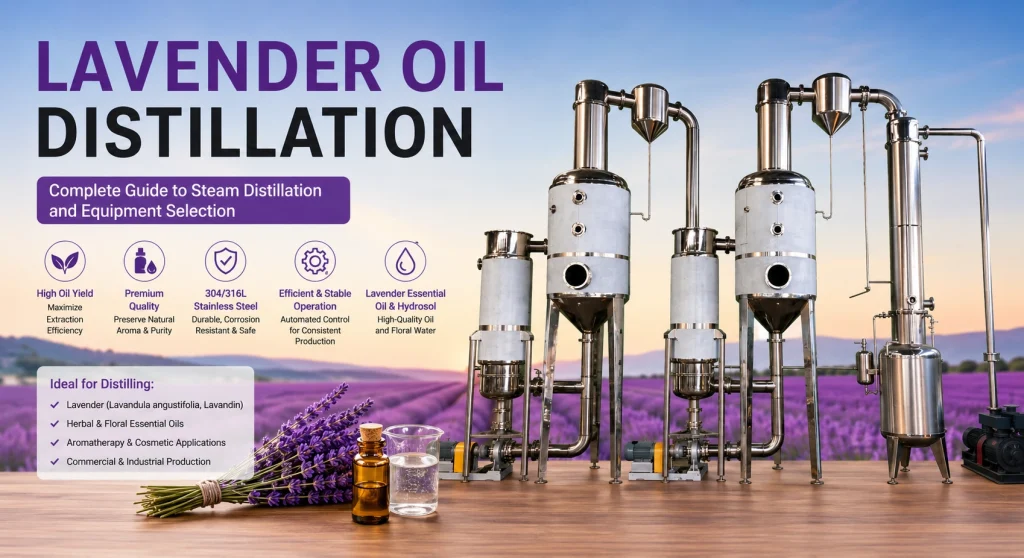
A successful Lavender Oil Distillation process begins long before steam enters the distillation tank. Flower harvesting time, raw material freshness, moisture content, loading density, steam distribution, condensation efficiency, and oil separation all work together to determine the final product. Even small improvements in these stages can increase oil recovery, reduce processing time, and improve batch consistency.
This Lavender Oil Distillation guide explains how commercial producers can select suitable equipment, optimize steam distillation parameters, and build an efficient production line for consistent essential oil manufacturing. Whether you are processing lavender for cosmetics, aromatherapy products, pharmaceuticals, or natural fragrances, understanding these engineering principles will help maximize both product quality and return on investment.
Among all extraction technologies, steam distillation for lavender oil remains the preferred method for commercial production because it efficiently separates volatile aromatic compounds while preserving the plant’s natural fragrance. Unlike solvent extraction, steam distillation leaves no solvent residues and produces an essential oil suitable for a wide range of food, cosmetic, and wellness applications.
The quality of lavender oil depends on far more than the lavender variety itself. Factors such as harvesting maturity, flower moisture, steam pressure, distillation time, and cooling efficiency all influence the concentration of valuable compounds like linalool and linalyl acetate. Poorly controlled operating conditions may result in reduced aroma intensity, lower extraction efficiency, or degradation of heat-sensitive components.
Commercial producers generally process either Lavandula angustifolia, valued for its premium fragrance, or Lavandin, a hybrid variety known for its higher oil yield and industrial-scale production. Because these varieties differ in oil composition and biomass characteristics, the distillation process should be adjusted to achieve the best balance between yield and quality.
Modern lavender essential oil extraction facilities also focus on improving production efficiency without sacrificing product quality. Automated steam control, efficient condensers, sanitary piping systems, and optimized oil separators help maintain stable operating conditions while reducing energy consumption and labor requirements.
For manufacturers planning new production lines, selecting appropriate equipment is just as important as optimizing the distillation process itself. A properly engineered system not only improves essential oil recovery but also supports continuous production, easier cleaning, and long-term operational reliability.
This guide will walk through every stage of commercial Lavender Oil Distillation, from steam distillation principles and equipment selection to production optimization and practical engineering recommendations for industrial essential oil processing.
When users search for ways to lower honey moisture, Google’s “People Also Ask” (PAA) data reveals deep concerns regarding quality and compliance:
The Panchi machine addresses these via a closed-loop system. By excluding oxygen during the dehydration phase, the honey retains its original translucent color and floral volatile compounds that would otherwise escape into the atmosphere.
Commercial Lavender Oil Distillation relies on a carefully controlled steam distillation process that separates volatile aromatic compounds from fresh or partially dried lavender flowers. Unlike solvent extraction, steam distillation preserves the natural fragrance while producing a clean essential oil suitable for cosmetics, aromatherapy, pharmaceuticals, and personal care products.
Although the process appears straightforward, achieving high oil yield and consistent quality requires careful control of every production stage. Factors such as flower preparation, steam pressure, condensation efficiency, and oil separation all influence the final result.
The following workflow represents a typical industrial steam distillation for lavender oil process.
Fresh Lavender Flowers
│
▼
Raw Material Inspection & Cleaning
│
▼
Loading the Distillation Tank
│
▼
Steam Generation
│
▼
Steam Distillation
│
▼
Condensation
│
▼
Oil-Water Separation
│
▼
Lavender Essential Oil Collection
│
▼
Filtration & Quality Inspection
│
▼
Storage & Packaging
High-quality essential oil begins with proper harvesting.
Lavender flowers are generally harvested during peak flowering when the concentration of volatile compounds reaches its optimum level. Harvesting too early may reduce oil yield, while harvesting too late can weaken aroma intensity as valuable components begin to evaporate naturally.
After harvesting, producers should remove foreign materials such as leaves, stems, soil, and damaged flowers before loading the distillation vessel.
Unlike many herbal extraction processes, lavender flowers usually do not require fine grinding. Excessive crushing may rupture oil glands before distillation, causing aroma loss and reducing extraction efficiency.
Instead, flowers are typically loaded whole or with only light size reduction to maintain natural oil retention.
Steam generation is the core of steam distillation for lavender oil.
Clean saturated steam enters the bottom of the distillation vessel and passes evenly through the packed lavender flowers. As the steam moves upward, volatile essential oil compounds vaporize together with water vapor.
Inside the distillation tank, several operating parameters must remain stable:
Balanced steam distribution is particularly important. Excessive steam pressure may damage delicate aromatic compounds, while insufficient steam flow reduces extraction efficiency and prolongs production time.
For most commercial production systems, operators focus on maintaining stable operating conditions rather than maximizing steam pressure.
The vapor mixture leaving the distillation vessel contains both water vapor and lavender essential oil.
The condenser rapidly cools this vapor into liquid form before it enters the oil separator.
Because lavender oil has a different density from water, gravity naturally separates the two phases.
The separator continuously collects:
Efficient condensation and separation improve oil recovery while minimizing product loss.
Modern systems often incorporate precision condensers and optimized separator designs to increase production efficiency and reduce manual operation.
Several production variables influence the performance of lavender essential oil extraction.
Important considerations include:
Optimizing these parameters can improve both essential oil yield and product consistency.
Many manufacturers also monitor processing data for every production batch to identify opportunities for improving energy efficiency and reducing operating costs.
Commercial Lavender Oil Distillation does not end when the oil leaves the separator.
Each production batch should undergo routine quality inspection before storage or packaging.
Typical quality checks include:
Maintaining consistent quality standards ensures that the finished lavender oil meets customer specifications and international market requirements.
By understanding each stage of steam distillation for lavender oil, manufacturers can improve process stability and prepare for selecting the most appropriate equipment, which will be discussed in the next section.
Selecting the right equipment is one of the most important decisions in commercial Lavender Oil Distillation. While factors such as harvesting time and operating parameters influence oil quality, the performance of the distillation system ultimately determines production efficiency, oil yield, energy consumption, and long-term operating costs.
Many manufacturers focus primarily on equipment price or processing capacity. However, a complete lavender oil distillation equipment solution should be evaluated based on process design, steam distribution, condensation efficiency, automation level, and future production requirements.
The following components form the foundation of an efficient industrial distillation system.
The distillation vessel is the core component of the production line.
Its primary function is to hold the lavender flowers while allowing steam to pass evenly through the plant material.
A professionally designed vessel should provide:
Improper vessel design may create steam channeling, where steam bypasses portions of the material bed. This reduces contact between steam and flowers, resulting in lower extraction efficiency and inconsistent oil quality.
Most commercial systems are manufactured from SS304 or SS316L stainless steel to provide corrosion resistance, hygienic operation, and long service life.
Steam quality directly influences the success of steam distillation for lavender oil.
The steam generator should produce clean, stable, saturated steam with consistent pressure throughout the entire production cycle.
An efficient steam system offers several advantages:
Rather than operating at excessively high pressure, commercial producers generally prioritize stable steam flow and even heat transfer to protect delicate aromatic compounds.
After steam carries volatile oils out of the distillation vessel, rapid cooling becomes essential.
A high-efficiency condenser quickly converts vapor into liquid while minimizing the loss of volatile compounds.
The condensed liquid then enters the oil separator, where lavender essential oil naturally separates from floral water due to density differences.
An optimized separation system helps manufacturers achieve:
The efficiency of the condenser and separator often determines whether valuable aromatic compounds are successfully recovered or lost during processing.
Modern lavender oil distillation equipment increasingly incorporates automated control systems to improve production consistency.
Typical monitoring functions include:
Automation reduces dependence on manual operation while improving batch repeatability and production efficiency.
For manufacturers operating multiple production shifts, digital monitoring also simplifies production management and quality documentation.
For commercial essential oil manufacturers, selecting a reliable equipment supplier is just as important as selecting the equipment itself.
PCM’s lavender oil distillation equipment is designed for processing lavender, rose, chamomile, rosemary, peppermint, eucalyptus, citrus peels, and many other aromatic plants.
Our lavender oil distillation equipment integrates steam distillation, condensation, oil separation, and process control into a compact production system that improves operational efficiency while maintaining excellent essential oil quality.
One recommended solution is the Custom Steam Distillation & Heat Reflux Essential Oil Equipment, which is specifically designed for industrial essential oil production.
Suitable applications include:
Key advantages include:
By selecting professionally engineered lavender oil distillation equipment, manufacturers can improve extraction efficiency, reduce energy consumption, and achieve more consistent product quality throughout long-term commercial production.
Producing premium lavender essential oil requires more than selecting high-quality flowers and reliable equipment. Commercial Lavender Oil Distillation depends on optimizing the entire production process, from raw material handling to final oil storage. Small improvements at each stage can significantly increase oil yield, improve aroma consistency, and reduce overall operating costs.
Modern essential oil manufacturers focus on process optimization rather than simply extending distillation time or increasing steam pressure. A balanced production system delivers higher efficiency while preserving the delicate aromatic compounds that determine the value of lavender oil.
The quality of raw lavender has a direct influence on the efficiency of lavender essential oil extraction.
For commercial production, flowers should be harvested during peak bloom when essential oil content is highest. Harvesting too early reduces oil yield, while delayed harvesting may decrease the concentration of desirable aromatic compounds.
Manufacturers should also minimize the time between harvesting and distillation. Fresh lavender retains more volatile oil than flowers stored for extended periods under unsuitable conditions.
Before loading the distillation vessel, operators should:
These simple practices improve extraction consistency and reduce unnecessary processing time.
Successful steam distillation for lavender oil depends on maintaining stable operating conditions rather than maximizing temperature or pressure.
Important process variables include:
Maintaining balanced operating conditions helps protect heat-sensitive aromatic compounds such as linalool and linalyl acetate while improving extraction efficiency.
Modern automated control systems allow operators to monitor these parameters continuously, reducing production variability between batches.
Oil recovery does not end when vapor leaves the distillation vessel.
Efficient condensation and oil-water separation are equally important for maximizing production efficiency.
Manufacturers can improve recovery by:
These improvements increase both oil recovery and overall production consistency while lowering operating costs.
Commercial essential oil production is most efficient when every process is connected into a complete manufacturing system instead of operating as independent equipment.
A typical PCM lavender processing workflow includes:
Lavender Harvesting
↓Raw Material Inspection
↓Steam Distillation
↓Condensation
↓Oil-Water Separation
↓Essential Oil Filtration
↓Storage Tank
↓Packaging
For manufacturers processing multiple botanical materials, integrating essential oil distillation machine systems with downstream purification and storage equipment creates a more stable and efficient production line.
PCM’s Vacuum Herbal Extraction Essential Oil Distillation Unit combines extraction and distillation technologies into a compact processing solution suitable for a wide range of aromatic plants and botanical materials.
Compared with standalone equipment, an integrated system offers several advantages:
As production capacity grows, integrated processing systems also make future expansion easier without redesigning the entire factory layout.
When investing in essential oil distillation machine solutions, manufacturers should evaluate not only today’s production requirements but also future business growth.
Important planning considerations include:
A scalable production line allows manufacturers to increase capacity, introduce new essential oils, and improve operational efficiency with minimal disruption.
Rather than selecting equipment individually, many commercial producers now invest in complete processing solutions that integrate distillation, filtration, storage, and packaging into one coordinated production system.
This engineering approach improves operational reliability while supporting consistent, high-quality Lavender Oil Distillation for long-term commercial success.
Producing premium lavender essential oil consistently requires more than high-quality equipment. Successful commercial manufacturers combine proper raw material management, optimized operating parameters, preventive maintenance, and standardized quality control to maximize production efficiency and maintain stable product quality.
Whether operating a pilot-scale distillery or a large industrial production line, following proven best practices helps improve oil yield, reduce operating costs, and extend equipment service life.
The quality of Lavender Oil Distillation begins in the field.
Lavender should be harvested during peak flowering, when the concentration of volatile aromatic compounds is at its highest. Delayed harvesting or improper storage can reduce both oil yield and fragrance quality.
To maintain the best processing conditions, manufacturers should:
Proper raw material preparation allows steam to circulate evenly, resulting in more efficient extraction and consistent essential oil quality.
Reliable lavender oil distillation equipment requires regular inspection and preventive maintenance.
A routine maintenance program should include:
Regular maintenance reduces unexpected downtime while ensuring stable production performance throughout the harvesting season.
Commercial producers should establish consistent quality control procedures for every production batch.
Routine testing typically includes:
Standardized inspection procedures improve product consistency and help manufacturers meet international customer specifications.
A commercial essential oil producer in Bulgaria wanted to expand lavender oil production while improving batch consistency and reducing energy consumption.
The existing system suffered from uneven steam distribution, inconsistent oil recovery, and labor-intensive manual operation.
After upgrading to PCM’s customized lavender oil distillation equipment, the manufacturer implemented:
The upgraded production line achieved several operational improvements:
By optimizing both equipment configuration and process control, the company improved production efficiency while maintaining the premium quality required for export markets.
Q: What is the best method for Lavender Oil Distillation?
A: Steam distillation for lavender oil is the most widely used commercial method because it efficiently extracts volatile aromatic compounds without introducing solvent residues. Proper steam control also helps preserve fragrance quality and supports consistent industrial production.
Q: How long does steam distillation for lavender oil take?
A: The processing time depends on the lavender variety, equipment design, batch size, and steam conditions. Commercial producers generally optimize the distillation cycle to achieve maximum oil recovery while avoiding unnecessary energy consumption or thermal degradation.
Q: What equipment is required for commercial lavender oil production?
A: A complete production line typically includes a steam generator, distillation vessel, condenser, oil-water separator, filtration system, storage tank, and supporting process controls. Choosing professional lavender oil distillation equipment improves efficiency, product quality, and long-term operational reliability.
Q: How much essential oil can be produced from lavender?
A: Oil yield varies according to lavender variety, harvesting conditions, flower freshness, and operating parameters. Commercial manufacturers focus on optimizing raw material quality and distillation efficiency to maximize oil recovery rather than relying on fixed production figures.
Q: How do I choose the right essential oil distillation machine?
A: When selecting an essential oil distillation machine, manufacturers should evaluate processing capacity, steam distribution, condenser efficiency, automation level, construction materials, and future expansion requirements. Equipment should match both current production needs and long-term business growth.
Choosing the right equipment is the foundation of efficient Lavender Oil Distillation. From pilot-scale research to large commercial production, PCM provides customized solutions designed to improve essential oil yield, production efficiency, and product consistency.
Our engineering team can configure complete processing systems tailored to your production capacity, plant layout, and botanical materials. Whether you process lavender, rose, chamomile, peppermint, rosemary, or other aromatic plants, PCM offers integrated distillation solutions that support reliable, long-term industrial operation.
Contact PCM today to discuss your project and discover how a customized lavender oil distillation system can help maximize both production efficiency and business value.


Whatsapp: +8615736768129
Email: [email protected]
Address: Zhengzhou, Henan Province, China
Automatic Vacuum Honey Processing & Filtering Machine
Vacuum Low-Temperature Liquid Extraction & Concentration Unit
Custom Steam Distillation & Heat Reflux Essential Oil Equipment
SS304/316L Low-Temperature Vacuum Scraper Concentrator
QN Spherical Vacuum Concentrator & Alcohol Recovery Unit
Multi-function Stainless Steel Vacuum Distillation & Extraction Unit
Hot Reflux Vacuum Liquid Extraction & Concentration Unit
Single-Effect External Circulation Vacuum Concentrator
SJN Series Double-Effect External Circulation Vacuum Evaporator
We will contact you within one working day. Please pay attention to your email.
Automatic Vacuum Honey Processing & Filtering Machine
Vacuum Low-Temperature Liquid Extraction & Concentration Unit
Custom Steam Distillation & Heat Reflux Essential Oil Equipment
WhatsApp: +8615736768129
Email: [email protected]
Address: Zhengzhou, Henan Province, China


COPYRIGHT© 2026 Zhengzhou Panchi Machinery Equipment Co., Ltd. | Privacy Policy

Our team will respond within 24 hours.
Thanks! We'll get back to you within 24 hours.
Check your inbox (and spam folder) for our reply.