
In the hierarchy of industrial process equipment, the fundamental distinction between a Mixing Tank and a Storage Tank is often misunderstood during the initial project scoping phase. While both may appear as similar stainless steel vessels, their internal engineering, agitation architecture, and fluid dynamics serve fundamentally different operational objectives. Misaligning these two units in your process flow—specifically failing to understand the operational nuances of a Mixing Tank vs Storage Tank—can result in inefficient batch cycles, uneven product homogeneity, or excessive capital expenditure (CapEx).
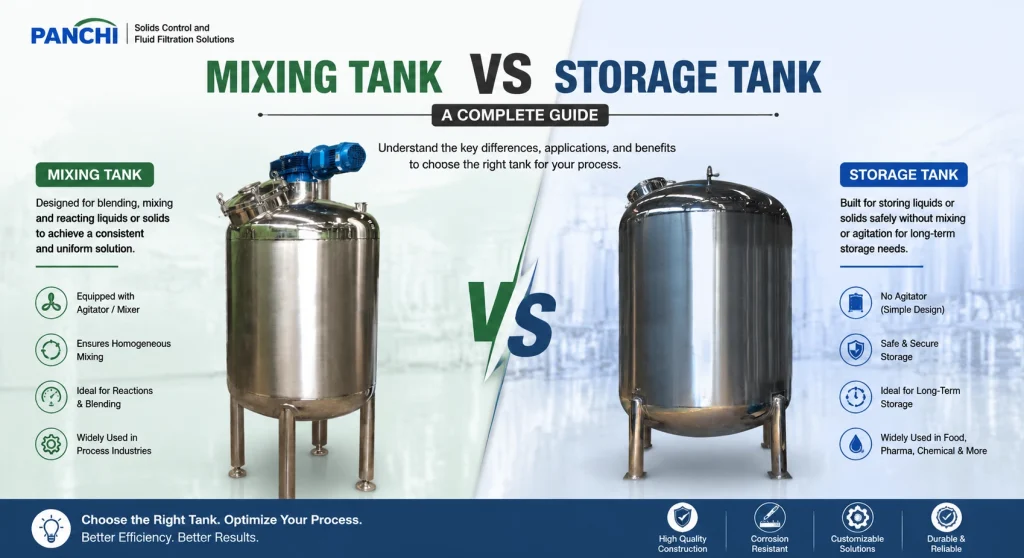
This guide provides an engineering-grade breakdown of why these two vessels must be specified differently to achieve true Process Flow Optimization.
The core conflict in the Mixing Tank vs Storage Tank debate lies in the specific demand for energy input. A process plant is essentially a series of energy transfer points, and understanding where to apply kinetic energy is the hallmark of a master process engineer.
A Mixing Tank is an active kinetic vessel designed to achieve physical or chemical uniformity. The primary engineering goal here is mass transfer. Whether your objective is the creation of complex colloidal emulsions, the suspension of heavy solid particulates, or the acceleration of reaction kinetics, the Mixing Tank relies on specialized Industrial Agitation System configurations. Engineers must specify the correct impeller-to-tank diameter ratio to generate the necessary Reynolds number for a fully turbulent mixing regime.
Conversely, a Storage Tank (or Stainless Steel Buffer Tank) is a passive vessel. Its objective is the maintenance of product stability during the transition between production stages. The engineering focus shifts entirely toward Thermal Degradation Prevention and the mitigation of environmental contamination. While a Storage Tank may incorporate a low-RPM “gentle sweep” agitator, its goal is never active homogenization. Instead, it serves as a “hold” station to ensure consistent throughput for filling or downstream processing, acting as the critical link in Process Flow Optimization. Comparing a Mixing Tank vs Storage Tank reveals that the latter is purely for buffering, not kinetic reaction.
To optimize your production line, you must quantify the energy density required for your process. The decision matrix between a Mixing Tank vs Storage Tank relies on three critical fluid behaviors that define Shear Force Dynamics.
Mixing requires a controlled, measurable shear environment. High-viscosity formulations—such as pharmaceutical ointments or cosmetic gels—demand high-shear rates to break down agglomerates. A Mixing Tank is engineered with precisely positioned baffles to prevent vortexing and direct flow energy into shear zones. In contrast, a Storage Tank, lacking these internal geometries, would allow material to stagnate, leading to concentration gradients. When evaluating the Mixing Tank vs Storage Tank requirement, it becomes clear that only the former provides the shear needed for true dispersion.
Large vessels without thermal management will develop “pockets,” where the center of the tank retains heat differently than the wall boundary. By utilizing a Stainless Steel Buffer Tank with an integrated dimple jacket, engineers can maintain precise temperature profiles. This requires specific attention to the heat transfer coefficient (U-value) calculated for the fluid viscosity, a metric that is far more critical in a Mixing Tank vs Storage Tank evaluation due to the heat generated by friction in the mixing vessel.
In multiphasic systems, time is the enemy of stability. A Storage Tank must be designed to accommodate the specific sedimentation velocity of your product. If your formulation is prone to separation, the Storage Tank must incorporate a low-energy agitator, whereas the Mixing Tank—having already completed the dispersion phase—is where the active, high-energy work is performed to reach the target Brix or viscosity.
Understanding the operational boundary of these two units is essential for Process Flow Optimization and lean manufacturing.
| Engineering Metric | Mixing Tank (Active) | Storage Tank (Static Buffer) |
| Primary Goal | Homogenization, Reaction, Dispersion | Product Stability, Inventory Buffering |
| Energy Input | High (High-Torque Agitation) | Low (Gentle Sweep or None) |
| Internal Geometry | Baffles, Impellers | Smooth walls, High-Polished Finishes |
| Flow State | Turbulent, Controlled Shear | Laminar or Stagnant |
| Selection Logic | Mixing Tank vs Storage Tank | Choose Storage for stability |
When selecting between a Mixing Tank vs Storage Tank, process engineers must account for the rheology of the material. In cosmetic manufacturing, an Industrial Agitation System in a Mixing Tank is a reactor; once the emulsion is formed, it is transferred to a Storage Tank to maintain temperature. For low-viscosity solutions, a Mixing Tank vs Storage Tank comparison shows that storage requirements are minimal—often just a simple atmospheric vessel.
In cosmetic manufacturing, formulating creams requires an Industrial Agitation System capable of multi-axial movement (e.g., counter-rotating paddles with wall scrapers). The Mixing Tank is a reactor; once the emulsion is formed, it must be transferred to a Storage Tank designed specifically to maintain the product at a controlled temperature without applying additional shear, which could break the emulsion’s internal structure.
For thin chemical solutions, the mixing process may be a simple inline high-speed propeller. Because these fluids do not exhibit complex memory effects, the Storage Tank requirements are minimal—often a simple atmospheric tank with a precision level sensor. The primary concern here shifts from homogenization to corrosion resistance, necessitating premium 316L stainless steel to avoid metallic contamination.
At Panchi Machinery, we recognize that no two processes are identical. Whether you are specifying a Mixing Tank for high-shear synthesis or a Storage Tank for critical inventory, we support full-scale engineering customization to match your specific production requirements:
Regardless of whether you are utilizing a Mixing Tank or a Storage Tank, the ability to perform Clean-in-Place (CIP) and Sterilization-in-Place (SIP) is a mandatory requirement for cGMP and food-grade facilities.
A Sanitary Stainless Steel Vessel requires an internal surface roughness of Ra < 0.4 microns. The Mixing Tank is more complex for validation, as every impeller blade, seal housing, and baffle contact point is a potential biofilm harbor. CIP protocols must demonstrate 360-degree spray ball coverage across all internal components.
For a Storage Tank, CIP is straightforward, focusing on the headspace and discharge valve. Any residual product sitting in the discharge piping represents a contamination risk. Automated spray heads are positioned to ensure the top dome is rinsed thoroughly to prevent microbial growth between production batches.
When selecting hardware, procurement teams should align the tank design with the specific physical demands of the process flow.
For industries requiring a Sanitary Stainless Steel Vessel, surface finish is not just an aesthetic choice; it is a regulatory requirement. Both tank types should feature high-quality finishes. However, a Mixing Tank requires more rigorous weld inspection at the agitator entry point, where mechanical stress is highest.
The drive assembly is the most frequent point of failure in a Mixing Tank. Using double-face mechanical cartridge seals with a pressurized barrier fluid is standard practice. For a Storage Tank, simpler seal configurations are often sufficient, provided the vessel remains isolated from atmospheric contaminants.
In a Mixing Tank, vibration is the leading cause of seal failure. Engineers must conduct a modal analysis of the agitator shaft to ensure it operates well below its critical frequency. If your process requires variable speed (VFDs), the shaft must be rigid enough to handle the harmonics generated during acceleration phases.
Even in a simple Storage Tank, the discharge pipe can become a “dead-leg” where product sits at ambient temperature. We recommend using a “flush-bottom” valve that sits flush against the inner wall of the tank, ensuring that every drop of product is pushed into the pipeline, eliminating the risk of stagnant contamination zones.
In cooling processes, condensation often forms on the top dome of a Storage Tank. This water can drip back into the product, potentially diluting the batch or introducing mold. Utilizing a slight positive pressure of nitrogen or filtered air in the headspace can prevent this moisture accumulation, ensuring the shelf-life of your product remains intact.
Q: Can I use a mixing tank as a storage tank?
A: Technically yes, but it is financially inefficient. You would be paying for high-torque agitation equipment, complex seals, and VFDs that remain idle during the storage phase. It is always more cost-effective to use an active Mixing Tank for the formulation process and discharge the product into a dedicated, low-cost Storage Tank.
Q: Does my storage tank need an agitator?
A: It depends on your product’s stability. If your formulation is prone to layering or if you are maintaining a heated product (like chocolate or oils), a gentle-sweep agitator is necessary to prevent stratification. If the product is stable and non-reactive, a static vessel is sufficient.
Q: How do I calculate the capacity requirements for my storage tank?
A: Your Storage Tank capacity should be sized based on your maximum batch volume plus a 15-20% headspace allowance for thermal expansion and agitation space. In high-output lines, the Storage Tank should be at least 1.5 times the volume of your primary Mixing Tank to ensure smooth production throughput.
Q: What is the benefit of a conical bottom in these tanks?
A: A conical or dished bottom is essential for complete discharge. In a Mixing Tank, it ensures that no “dead-leg” material remains trapped beneath the impeller. In a Storage Tank, it allows for gravity-fed emptying, ensuring that the last liter of your product is as high-quality as the first.
Q: How often should I perform preventive maintenance on the agitator drive?
A: For a high-intensity Mixing Tank, perform a vibration analysis every 3 months and inspect the mechanical seal fluid reservoir monthly. For a Storage Tank, annual inspection of the drive coupling and motor bearings is sufficient.
Choosing between a Mixing Tank vs Storage Tank depends on your product’s rheology and your throughput requirements. If you are exploring how to integrate these units, we provide custom design services for agitator sizing, heat transfer calculations, and ASME BPE sanitary compliance.


Whatsapp: +8615736768129
Email: [email protected]
Address: Zhengzhou, Henan Province, China
Automatic Vacuum Honey Processing & Filtering Machine
Vacuum Low-Temperature Liquid Extraction & Concentration Unit
Custom Steam Distillation & Heat Reflux Essential Oil Equipment
SS304/316L Low-Temperature Vacuum Scraper Concentrator
QN Spherical Vacuum Concentrator & Alcohol Recovery Unit
Multi-function Stainless Steel Vacuum Distillation & Extraction Unit
Hot Reflux Vacuum Liquid Extraction & Concentration Unit
Single-Effect External Circulation Vacuum Concentrator
SJN Series Double-Effect External Circulation Vacuum Evaporator
We will contact you within one working day. Please pay attention to your email.
Automatic Vacuum Honey Processing & Filtering Machine
Vacuum Low-Temperature Liquid Extraction & Concentration Unit
Custom Steam Distillation & Heat Reflux Essential Oil Equipment
WhatsApp: +8615736768129
Email: [email protected]
Address: Zhengzhou, Henan Province, China


COPYRIGHT© 2026 Zhengzhou Panchi Machinery Equipment Co., Ltd. | Privacy Policy

Our team will respond within 24 hours.
Thanks! We'll get back to you within 24 hours.
Check your inbox (and spam folder) for our reply.