
In industrial chemical engineering, bioprocessing, and advanced food manufacturing, controlling the thermodynamic environment is just as critical as the chemical formulation itself. A Vacuum Reactor is a specialized, hermetically sealed processing vessel engineered to execute compounding, heating, and chemical synthesis under continuous negative pressure.
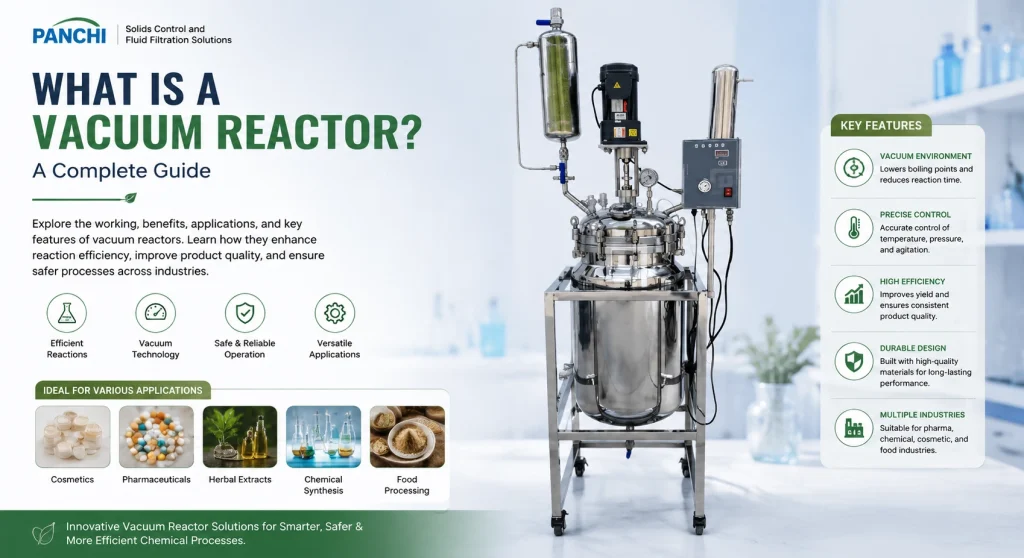
The underlying physics of a Vacuum Reactor relies on the direct correlation between atmospheric pressure and vapor pressure. By utilizing high-capacity vacuum pumps to evacuate air and lower the internal pressure of the vessel, the boiling point of solvents and aqueous solutions drops significantly. This thermodynamic shift allows phase changes, solvent stripping, and chemical reactions to occur at much lower thermal thresholds than they would in an open-atmosphere environment.
A Vacuum Reactor is not merely a tank with a pump attached; it is a highly calibrated Vacuum Processing System where pressure, thermal exchange, and fluid dynamics operate in absolute synergy.
The vacuum system actively pulls air and volatile vapors out of the vessel. By maintaining a controlled vacuum degree (often reaching -0.09 MPa or deeper), the system suppresses the boiling point of the media. This loop is tightly sealed using double mechanical shaft seals to prevent atmospheric ingress, entirely eliminating oxidation risks during processing. This is critical for any Chemical Synthesis Reactor where oxygen might interfere with the reaction trajectory.
Thermal regulation is managed through an external jacket or internal limpet coils that circulate heating oil, steam, or chilled water. Because these vessels endure constant pressure cycling—from deep vacuum to positive pressure discharge—the structural integrity of the vessel walls is paramount. When evaluating baseline requirements for standard industrial mixing, heating, and structural durability (using high-grade 304/316L stainless steel), a reliable stainless steel reactor provides the necessary corrosion resistance and mechanical strength to safely handle dynamic thermal loads.
High-viscosity materials and dense slurries require uniform heat distribution to prevent localized burning (Thermal Degradation Prevention) at the boundary layer. The Vacuum Reactor utilizes custom agitators—such as anchor, paddle, or high-shear turbine blades—driven by variable frequency drives (VFDs). This continuous agitation forces the cooler product from the center of the vessel outward toward the heated jacket, accelerating mass transfer while the Vacuum Processing System continuously pulls trapped air bubbles out of the mixture.
By implementing a Vacuum Reactor, process engineers can unlock capabilities that are impossible in standard vessels.
Heat-sensitive compounds (such as active pharmaceutical ingredients, enzymes, and volatile essential oils) are easily destroyed by high heat. The Vacuum Reactor lowers the required heating temperature, preserving molecular integrity and ensuring the final product meets all bio-active requirements.
Removing oxygen from the headspace prevents oxidative degradation, extending the shelf life and maintaining the color profile of the final product. This is a fundamental benefit of any high-quality Chemical Synthesis Reactor.
The Vacuum Reactor excels at degassing. By pulling a vacuum on high-viscosity creams or resins, the vessel removes trapped air bubbles, resulting in a product with superior density, texture, and stability. This process is essential for meeting Sanitary Stainless Steel Vessel standards in pharmaceutical and food applications.
Upgrading to a negative-pressure processing environment yields immediate improvements in product purity, processing speed, and thermal efficiency.
| Parameter | Standard Atmospheric Processing | Vacuum Reactor Processing |
| Boiling Point | Standard (e.g., Water boils at 100°C) | Suppressed (e.g., Water boils at 40°C – 50°C) |
| Oxidation Risk | High (Oxygen is present in the headspace) | Near-Zero (Oxygen is evacuated) |
| Thermal Degradation | High risk for heat-sensitive compounds | Protected via low-temperature evaporation |
| Degassing Capability | Poor (Air bubbles remain trapped) | Excellent (Vacuum forces dissolved gases out) |
| Energy Efficiency | Requires high live steam/fuel inputs | Lower latent heat requirements reduce overhead |
The controlled thermodynamic environment of a Vacuum Reactor makes it indispensable across multiple heavy-duty and hygienic industries.
For operations that require extreme thermal reactions, vacuum low-temperature evaporation, or complex chemical synthesis under vacuum, utilizing a dedicated high-temperature vacuum stainless steel chemical reactor ensures optimal phase separation. In these extreme environments, lowering the boiling point allows volatile byproducts to be continuously flashed off, driving chemical equilibrium forward without initiating secondary degradation pathways.
In the pharmaceutical sector, these reactors are critical for formulating high-viscosity products like ointments, gels, and sterile creams. The vacuum environment actively degasses the thick matrix, ensuring the final emulsion is perfectly smooth, bubble-free, and stable for exact volumetric dosing. This stage is vital for the Thermal Degradation Prevention of active ingredients that form the base of advanced medicinal products.
Food products containing natural enzymes and bio-actives—such as raw honey, fruit purees, and botanical extracts—suffer severe flavor and nutritional loss if boiled at atmospheric pressure. The Vacuum Reactor allows food engineers to rapidly dehydrate and concentrate these liquids at gentle temperatures, preserving aromatic profiles, preventing caramelization, and meeting strict global food safety standards.
To maximize the efficiency of your equipment and the quality of your harvest, consider these professional field tips:
Honey has high thermal mass; it holds onto heat long after the power is cut. To perfectly lower honey moisture, experienced operators recommend shutting off the heating elements when the moisture is 0.5% away from the target, allowing the vacuum pump to finish the dehydration using the residual heat in the tank.
The link specifies a mirror-polished interior (Ra < 0.4μm). This is not for aesthetics—it is for Clean-In-Place (CIP) efficiency. A smoother surface means less honey “hangs” on the walls, reducing waste between batches and ensuring you meet the most stringent FDA and CE hygiene standards.
One of the “incremental values” of a vacuum system is the preservation of aroma. In an open-air evaporator, your facility smells like honey because the flavor is leaving the product. In a vacuum cycle, those floral esters are trapped within the liquid, resulting in a more robust, “terroir-driven” flavor profile that commands higher prices.
When procurement managers begin evaluating a Vacuum Reactor, they must focus on several technical variables that dictate the long-term ROI of the Vacuum Processing System.
For industries requiring a Sanitary Stainless Steel Vessel, surface finish is not just an aesthetic choice; it is a regulatory requirement. Surfaces polished to Ra < 0.4 microns are significantly easier to clean using Clean-in-Place (CIP) systems, preventing the buildup of biofilms. The use of 316L stainless steel is often preferred in reactors handling corrosive acids or high-salt concentrations to prevent pitting and stress corrosion cracking.
The most common point of failure in a Vacuum Reactor is the shaft seal. Using double-face mechanical cartridge seals with a pressurized barrier fluid ensures that the vacuum remains stable even during high-RPM agitation. This is especially important when handling hazardous solvents, where a seal failure would represent both an environmental hazard and a loss of production integrity.
Modern chemical reactors are moving toward full SCADA integration. The ability to monitor vacuum levels, jacket temperatures, and agitator torque in real-time allows for “Gold Batch” consistency. By logging every variable, quality control teams can ensure that the Thermal Degradation Prevention targets are met for every single batch produced.
Operating a Vacuum Reactor requires a robust understanding of both pressure safety and mechanical maintenance.
Regular Clean-in-Place (CIP) cycles are required to keep the Sanitary Stainless Steel Vessel in peak condition. Automated spray balls integrated into the reactor head ensure that even the underside of the agitator blades and the baffle zones are sterilized.
Every Chemical Synthesis Reactor must be equipped with rupture discs or pressure relief valves (PRVs) that are rated for both vacuum and positive pressure scenarios. These safety devices prevent catastrophic vessel failure if an exothermic reaction leads to an unexpected pressure spike.
Investing in an engineered Vacuum Processing System is not just about the vessel; it is about the entire support infrastructure—the vacuum pump train, the solvent recovery condenser, and the heating/cooling utility interface. By focusing on Thermal Degradation Prevention and precise mass transfer, engineers can significantly reduce raw material waste.
Whether you are scaling up a high-value pharmaceutical process or modernizing an existing food processing line, a Vacuum Reactor offers the precision required for the modern industrial landscape. By integrating the right agitation, vacuum control, and material finish, you can ensure that your plant meets the highest standards of safety, quality, and output.
Q: Can a vacuum reactor process highly flammable solvents safely?
A: Yes, provided the Vacuum Reactor is specified with ATEX-certified or Class I/Div 1 explosion-proof components. The closed-loop nature of the system naturally suppresses fire risk by eliminating oxygen, but all electrical drives and control enclosures must be matched to your specific solvent flash points.
Q: How does vacuum pressure influence reaction speed?
A: By pulling byproducts (such as water or methanol) out of the reaction as vapor, the Vacuum Reactor constantly shifts the chemical equilibrium. This often accelerates synthesis speeds compared to atmospheric reactors where byproducts remain in the liquid phase.
Q: What is the main difference between a vacuum reactor and a vacuum dryer?
A: A reactor is designed for active mass transfer and chemical transformation (mixing, reaction, synthesis), while a dryer is specialized for the final removal of moisture from solids. Vacuum reactors can handle liquid, slurry, and paste phases, whereas dryers are limited to solid/powder state materials.
Q: Why is “Thermal Degradation Prevention” a critical requirement for food manufacturers?
A: Many food ingredients (vitamins, essential oils, enzymes) are thermolabile. High temperatures lead to caramelization and off-flavors. Using a vacuum reactor allows for rapid solvent removal at temperatures as low as 40°C, which effectively locks in the nutritional value and aromatic profiles of natural ingredients.
Selecting the optimal Vacuum Reactor depends on the vapor pressure of your solvent, the viscosity of your reaction mass, and the purity requirements of your final product. If you are exploring how to integrate a Vacuum Processing System into your existing production line, we have prepared technical documentation that details reactor sizing, vacuum loop calculations, and ASME BPE sanitary compliance.


Whatsapp: +8615736768129
Email: [email protected]
Address: Zhengzhou, Henan Province, China
Automatic Vacuum Honey Processing & Filtering Machine
Vacuum Low-Temperature Liquid Extraction & Concentration Unit
Custom Steam Distillation & Heat Reflux Essential Oil Equipment
SS304/316L Low-Temperature Vacuum Scraper Concentrator
QN Spherical Vacuum Concentrator & Alcohol Recovery Unit
Multi-function Stainless Steel Vacuum Distillation & Extraction Unit
Hot Reflux Vacuum Liquid Extraction & Concentration Unit
Single-Effect External Circulation Vacuum Concentrator
SJN Series Double-Effect External Circulation Vacuum Evaporator
We will contact you within one working day. Please pay attention to your email.
Automatic Vacuum Honey Processing & Filtering Machine
Vacuum Low-Temperature Liquid Extraction & Concentration Unit
Custom Steam Distillation & Heat Reflux Essential Oil Equipment
WhatsApp: +8615736768129
Email: [email protected]
Address: Zhengzhou, Henan Province, China


COPYRIGHT© 2026 Zhengzhou Panchi Machinery Equipment Co., Ltd. | Privacy Policy

Our team will respond within 24 hours.
Thanks! We'll get back to you within 24 hours.
Check your inbox (and spam folder) for our reply.