
In today’s global food, biopharmaceutical, fine chemical, and craft brewing markets, terms like “natural,” “minimally processed,” and “additive-free” have evolved into strict regulatory and market entry barriers. Whether dealing with premium Manuka honey from New Zealand, specialized cold-pressed sacha inchi oil from South America, or modern herbal extracts, a product’s core commercial premium depends entirely on one single factor: bioactivity.
Unfortunately, these high-value liquids routinely suffer from high and unstable moisture levels during harvesting or initial extraction, leaving processors with a critical dilemma: how can they efficiently remove excess water and increase density while ensuring that fragile molecular structures, natural color pigments, delicate volatile oils, and core active enzymes remain completely unharmed?
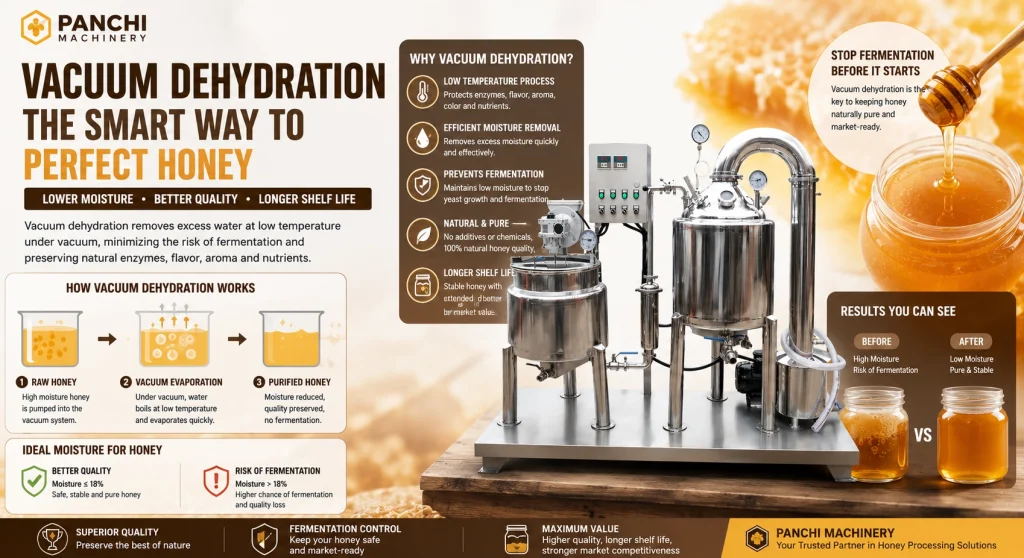
Every day across industrial forums, countless small-to-medium enterprise (SME) owners, beekeepers, and laboratory researchers post the exact same frustrated questions regarding how to lower water content without killing active enzymes. When we analyze these shared cross-industry headaches, they point directly to the fatal flaws of traditional thermal processing, leading us to a pivotal technological shift. The ultimate answer provided by modern fluid engineering is a process revolution driven by Vacuum Dehydration machine.
In global B2B trade and high-end retail supply chains, the processing quality of heat-sensitive fluids dictates an enterprise’s survival. Deep analysis of international trade forums reveals three fundamental bottlenecks currently torturing global buyers:
In many traditional artisan workshops or developing processing centers, open-air atmospheric boiling remains the primary method for water removal, yet for heat-sensitive materials, this approach is a qualitative catastrophe. When processing temperatures exceed 60°C (140°F), the fluid undergoes severe, irreversible caramelization and Maillard reactions.
This represents the most common disaster scenario documented across food science troubleshooting boards, where raw honey freshly harvested, or botanical juices and specialized oils freshly pressed, become breeding grounds for microorganisms—particularly osmophilic yeasts—if they are not subjected to immediate, highly efficient processing.
Honey Fermentation: If honey moisture exceeds 20%, natural yeasts rapidly multiply, breaking down sugars into alcohol and carbon dioxide, which causes massive pressure accumulation inside storage drums, generates a thick layer of white foam on the surface, and ultimately turns the product sour.
Oil Hydrolysis and Rancidity: When trace moisture remains trapped in high-value specialty oils, it triggers hydrolytic rancidity, causing the peroxide value and acid value to spike exponentially until the oil degrades, releasing a pungent, foul odor that completely ruins expensive batches and creates nightmares regarding food safety compliance.
Oil Hydrolysis and Rancidity: When trace moisture remains trapped in high-value specialty oils, it triggers hydrolytic rancidity. This causes the peroxide value and acid value to spike exponentially. The oil degrades, releasing a pungent, foul odor that completely ruins expensive batches and creates nightmares regarding food safety compliance.
On manufacturing management boards, entrepreneurs frequently complain about the pitfalls of manual or semi-mechanized operations, noting that relying on operators to manually monitor temperatures and skim off impurities by hand is incredibly inefficient and highly vulnerable to human error and fluctuating ambient humidity.
Products processed this way lack consistency; one batch achieves the correct density while the next remains water-logged, or one batch retains a golden hue while the next is scorched due to poor flame control. This highly unstable output cannot pass the rigorous standardization audits of multinational supermarkets or international customs, while the continuous labor costs required for manual monitoring eat aggressively into the razor-thin margins of SME producers.a
To solve these global industry bottlenecks, modern food and chemical engineering provides the perfect technical remedy: an integrated system that merges multiple isolated traditional steps into a single cohesive process centered around Déshydratation sous vide.
【Integrated Technical Process Loop】
Raw Fluid Input ➔ Precision Dual-Stage Filtration (120-200 Mesh) ➔ Vacuum Decompression Chamber (Vacuum ≥ 0.092 MPa) ➔ Sub-50°C Gentle Jacketed Heating ➔ Variable-Frequency Automated Agitation ➔ High-Efficiency Dehydration & Defoaming ➔ Crystal-Clear, High-Purity Concentrated Fluid Output
The underlying physics of this system are absolute, dictated by fluid dynamics and phase equilibrium theories showing that the boiling point of a liquid drops as the surrounding atmospheric pressure decreases. Under standard atmospheric pressure, water requires heating to 100°C (212°F) to boil and evaporate; however, when using a powerful vacuum system to pull the pressure level inside a sealed chamber to $\ge 0.092$ MPa, the physical environment changes entirely, compressing the boiling point of the liquid down to between 45°C and 50°C (113°F to 122°F).
At this mild temperature, water begins to boil vigorously and convert into vapor, which is then captured and removed. Utilizing a targeted approach for Heat-Sensitive Liquid Dehydration completely resolves the industry’s historical pain points across three dimensions:
Because the entire processing temperature is locked beneath the safety red-line of 50°C (122°F), the fluid undergoes true injury-free processing. By establishing a standard for Low-Temperature Vacuum Concentration, the biochemical components inside the fluid never experience high-temperature stress, completely bypassing the Maillard reaction.
The concentrated liquid retains the exact breathtaking, translucent original amber or golden color of the raw material, while flawlessly sealing in the pristine bouquet. Achieving this precise state of Low-Temperature Vacuum Concentration is a game-changer for herbal extracts, active enzymes, and high-value honey. Natural active enzymes survive completely unharmed in a 45°C environment. The resulting high-density fluid is not only visually crystal-clear but also achieves flawless marks in bioactivity lab tests, easily passing the most stringent international compliance standards.
Consequently, introducing a mature Low-Temperature Vacuum Concentration production architecture serves as a foundational shield, fundamentally ending quality crises caused by thermal degradation.
An industrial challenge frequently raised by operators is that high-viscosity, high-concentration liquids are prone to extreme surface tension changes during the early stages of vacuum decompression. As water rapidly flashes into vapor, the liquid can foam violently and rush up the vacuum piping, resulting in material loss. For operations focused on Heat-Sensitive Liquid Dehydration, this phenomenon represents a significant engineering hurdle.
High-end machinery counteracts this by integrating variable-frequency automated agitation systems paired with mechanical defoaming mechanisms. Under an intense vacuum, the mixing blades shear the fluid at scientifically calculated angles and variable speeds. This mechanical action instantly breaks surface bubbles, preventing boil-over, while generating a perfect three-dimensional thermal cycle for highly viscous fluids. This eliminates localized overheating and dead zones where burning could occur. With excess moisture thoroughly removed through optimized Heat-Sensitive Liquid Dehydration, the biological environment required for microbial survival is completely eliminated, permanently halting fermentation and rancidity.
Ultimately, mastering the chaotic foaming behavior during Heat-Sensitive Liquid Dehydration represents the true technical watershed separating premium concentration machinery from poorly engineered alternatives.
High-quality processing equipment no longer just handles standalone moisture removal; it condenses liquefaction, pre-heating, high-precision dual-stage filtration, and Déshydratation sous vide into a single, fully enclosed, stainless steel smart system. By running a comprehensive Déshydratation sous vide sequence, the machinery handles the fluid with absolute precision.
Digitalized intelligent control panels monitor and adjust temperature, vacuum depth, and agitation speed in real-time, eliminating the random errors of manual operations. Even operators with minimal mechanical experience can achieve pixel-perfect consistency in density, purity, color, and taste across every single batch with a simple one-button start, proving that automated Déshydratation sous vide effortlessly crosses the technical threshold of factory standardization.
Because the physical and chemical properties of different heat-sensitive fluids vary drastically, rigid, one-size-fits-all machinery simply cannot satisfy the precise processing requirements of global buyers. To overcome the challenges of high viscosity, extreme purity demands, and cross-industry applications, industrial-grade Low-Temperature Vacuum Concentration equipment must offer comprehensive, flexible customizability. Modern manufacturing engineering now allows for 100% deep parametric customization across three core dimensions:
Tailoring Chamber Volume to Production Scales
Depending on an enterprise’s current production capacity and capital budget, total processing volume can be scaled from lightweight boutique units to heavy industrial configurations. Small-scale artisanal workshops or research institutions can utilize a compact 50L unit to handle low-volume, high-frequency R&D testing; growing mid-sized enterprises often opt for a 100L golden standard to balance floor space with core throughput; meanwhile, large-scale fluid factories can deeply customize heavy-duty setups of 200L or more, leveraging flexible volume configurations to perfectly align with their supply chain demands.
The natural impurities, wax particles, or botanical fibers suspended within raw liquids differ significantly, meaning that crude filtration risks clogging the vacuum system or contaminating the final product. Field observations indicate that standard filtration often falls short when handling multi-botanical extractions; therefore, the system supports expansion from standard dual-stage filtration to multi-stage complex assemblies. The mesh fineness can be customized upward from a standard 120 mesh to a food-and-pharmaceutical grade 200 mesh or higher, ensuring that tiny crystals and suspended particulates are thoroughly eliminated before entering the vacuum chamber, while a dual-path design allows for seamless cleaning without losing vacuum or stopping production.
For materials like honey or bone broth reductions—whose viscosity spikes exponentially as moisture is evacuated—standard vacuum setups often experience a drastic drop in extraction speed and internal pressure fluctuations. To counteract this operational bottleneck, factories can customize and increase the vacuum pump’s power and displacement rate based on the fluid dynamics of their specific material, or upgrade to a liquid-ring vacuum pump system engineered for continuous, heavy-duty cycles. This robust vacuum capability not only significantly shortens the processing cycle of each Déshydratation sous vide run but, by maintaining a consistently deep vacuum environment, multiplies overall concentration efficiency.
The commercial value of this infrastructure stretches far beyond the traditional label of a honey processing machine. Across the global fluid sector, it serves as a highly profitable multi-tool in four major high-margin niches, bringing the advantages of Low-Temperature Vacuum Concentration to diverse industrial applications.
Whenever a factory transitions to Low-Temperature Vacuum Concentration, it unlocks the ability to refine high-end botanical juices, liquid herbal pastes, active plant ferments, and enzyme isolates. This versatility proves that Low-Temperature Vacuum Concentration is the definitive path forward for multiple liquid sectors to eliminate thermal damage.
Furthermore, this multi-industry applicability highlights the true potential of Heat-Sensitive Liquid Dehydration across various agricultural sectors. By expanding the deployment of Heat-Sensitive Liquid Dehydration, processors can refine maple sap, coconut water, or raw sea buckthorn juice without destroying natural esters. For enterprises specialized in Heat-Sensitive Liquid Dehydration, this technology ensures that delicate raw materials can be turned into high-density concentrates with a fresh-pressed profile.
To comprehensively evaluate how different fluid matrices behave under reduced pressure, the following analytical matrix breaks down the exact processing outcomes across major industrial applications:
| Industrial Segment | Target Material Fluid Matrices | Conventional Thermal Bottlenecks (Atmospheric Processing) | Breakthrough Outcomes via Low-Temperature Vacuum Systems |
| Craft Brewing & Premium Beverages | Maple sap, coconut water, raw sea buckthorn juice, wild blueberry concentrate, live enzyme cultures | Mass destruction of Vitamin C, volatilization of natural fruit esters, and dark, bitter off-flavors caused by caramelization. | Rapidly increases Brix and thickness at 45°C, 100% preserving pure fruit aromas and vivid original colors with a fresh-pressed profile through optimized Déshydratation sous vide. |
| Biomedical & Herbal Extraction | Botanical medicine extracts, liquid herbal pastes, active plant ferments, enzyme isolates | Evaporation of critical volatile oils, thermal denaturation of core polysaccharides, and a steep drop in therapeutic potency. | Maintains strict temperature ceilings under Sub-50°C, maximizing the extraction and protection of active medicinal compounds for high-potency premium pastes. |
| Premium Botanical Oils | Cold-pressed flaxseed oil, sacha inchi oil, premium walnut oil, avocado oil | Trace moisture triggers swift hydrolytic rancidity, generating foul odors and destroying fragile, unoxidized Omega-3 fatty acids. | Powerfully extracts minute moisture trapped deep within the oil matrix through advanced Déshydratation sous vide,completely eliminating rancidity issues with zero thermal damage to extend shelf life multi-fold. |
| Artisanal Condiments & Liquid Food | Hand-brewed premium soy sauce, artisanal fish sauce, high-density bone broth reductions | Proteins and amino acids suffer over-heating degradation, resulting in a sour, scorched background note and muddy color. | Precisely manages reduced-pressure boiling, locking in original amino acid umami profiles and rich aromas for clear, sediment-free concentrates. |
For global mid-sized processing firms, agricultural cooperatives, or laboratory startup teams, adopting this reduced-pressure technology restructures a business’s financial health across three distinct layers:
Traditional manual processing requires a fractured assembly line of workers hovering over separate melting vats, filtration screens, and open-top boiling pots, a setup involving high recurring labor costs and constant risks of workplace injury. Modern vacuum processing machinery condenses heating, stirring, filtering, and Déshydratation sous vide into a continuous, closed-pipe pipeline. The entire production line can be managed effortlessly by just one operator, slashing front-line labor expenses by over 60% and drastically reducing the financial burden of factory expansion and daily operations.
Before upgrading to core low-temperature tech, many independent beekeepers and fruit processors face the same frustrating cycle: because their raw harvests have high moisture levels, are unstable, and cannot be stored long-term, they are forced to panic-sell their raw materials to multinational brokers and middlemen during peak harvest seasons, trading their hard work for rock-bottom commodity prices. By weaponizing specialized methods for Heat-Sensitive Liquid Dehydration, processors can produce high-density, standardized, exceptionally stable finished products directly in their own facility. This gives them the leverage to bypass predatory middlemen, package their goods directly at the source, and build premium consumer brands, effectively doubling or tripling their net profit margins.
In globalized industrial manufacturing, the more versatile a piece of equipment is, the lower its commercial risk. High-efficiency, compact systems bypass the exorbitant entry barrier and massive custom piping layouts required by massive industrial evaporation towers, allowing smaller enterprises to deploy and monetize compact 50L, 100L, or 200L+ setups instantly. Our operational studies tracking cross-industry installations reveal that because the system functions as a true multi-industry fluid processor, the machinery never sits idle during agricultural off-seasons. In practical scenarios, the massive jump in production yield, the complete elimination of product returns, and the premium brand margins allow enterprises to fully recover their entire capital expenditure within just one to two peak processing seasons.
The global battleground of fluid processing is ultimately a competition of how to extract moisture while preserving one hundred percent of nature’s original intent.
Backed by one hundred percent food-and-pharmaceutical-grade stainless steel construction, low-temperature reduced-pressure concentration processes utilize fundamental physical laws to shatter the destructive limits of traditional open-air heating.
It stands not only as the ultimate cure for beekeepers looking to end the nightmare of fermentation and product returns, but also as the definitive path forward for the global herbal, botanical extraction, premium beverage, and craft food sectors to eliminate thermal damage, achieve absolute standardization, and permanently secure the premium pricing power they deserve.
A: Traditional boiling above 60°C (140°F) triggers thermal damage, causing liquids to darken, lose their natural aroma, and turn bitter. More critically, high heat destroys biological activity—such as killing active enzymes in honey or destroying active compounds in herbal extracts—causing products to fail strict international compliance tests. By lowering pressure ( 0.092 MPa), our system achieves Déshydratation sous vide at a mild 45°C–50°C, perfectly preserving the color, aroma, and native bioactivity completely unharmed.
A: Rapid vaporization under reduced pressure often causes violent surface tension changes, causing high-viscosity liquids to foam up and overflow into the vacuum piping. To overcome this hurdle in Heat-Sensitive Liquid Dehydration, our machinery integrates a variable-frequency automated agitation system with mechanical defoaming mechanisms. The mixing blades shear the fluid at variable speeds to instantly break surface bubbles and prevent boil-over, while creating a 3D thermal cycle that eliminates localized hot spots and material waste.
A: To achieve optimal Low-Temperature Vacuum Concentration for diverse liquid types, the system offers 100% parametric customizability across three core dimensions:


WhatsApp:+8615736768129
Email :inquiry@panchimachinery.com
Adresse : Zhengzhou, Province du Henan, Chine
Machine automatique de traitement et de filtration du miel par vide
Unité d'extraction et de concentration de liquides à basse température sous vide
Équipement personnalisé de distillation à la vapeur et de reflux thermique pour huiles essentielles
Concentrateur à grattoir sous vide à basse température SS304/316L
Concentrateur sphérique sous vide QN et unité de récupération d'alcool
Unité de distillation sous vide multifonction en acier inoxydable et d'extraction
Unité d'extraction liquide sous vide à reflux chaud et de concentration
Concentrateur à circulation externe à effet unique sous vide
Evaporateur à vide à circulation externe à double effet de la série SJN
Réacteur chimique en acier inoxydable sous vide à haute température
Citerne de précipitation d'alcool à vide en acier inoxydable 304SS
Pot de cuisson à double couche en acier inoxydable 304SS à chauffage par vapeur
Marmite de cuisson électrique avec veste chauffante
Marmite de cuisson à haute efficacité avec chauffage au gaz et cuve isolée
Nous vous contacterons dans un délai d'un jour ouvrable. Veuillez surveiller votre courriel.
Machine automatique de traitement et de filtration du miel par vide
Unité d'extraction et de concentration de liquides à basse température sous vide
Équipement personnalisé de distillation à la vapeur et de reflux thermique pour huiles essentielles
WhatsApp : +8615736768129
Email : inquiry@panchimachinery.com
Adresse :Zhengzhou, province du Henan, Chine


DROITS D'AUTEUR© 2026Zhengzhou Panchi Machinery Equipment Co., Ltd.|Politique de confidentialité