
Many industrial buyers assume 316L stainless steel is always better than 304 stainless steel. In reality, that is not always true.
For extraction equipment manufacturers and buyers, choosing between 316L vs 304 stainless steel affects much more than material cost. It impacts corrosion resistance, equipment lifespan, welding performance, cleanability, and long-term ROI.
The wrong material choice can lead to corrosion, contamination, difficult cleaning, or unnecessary overspending. The right choice helps maintain product purity, improve durability, and reduce operating costs.
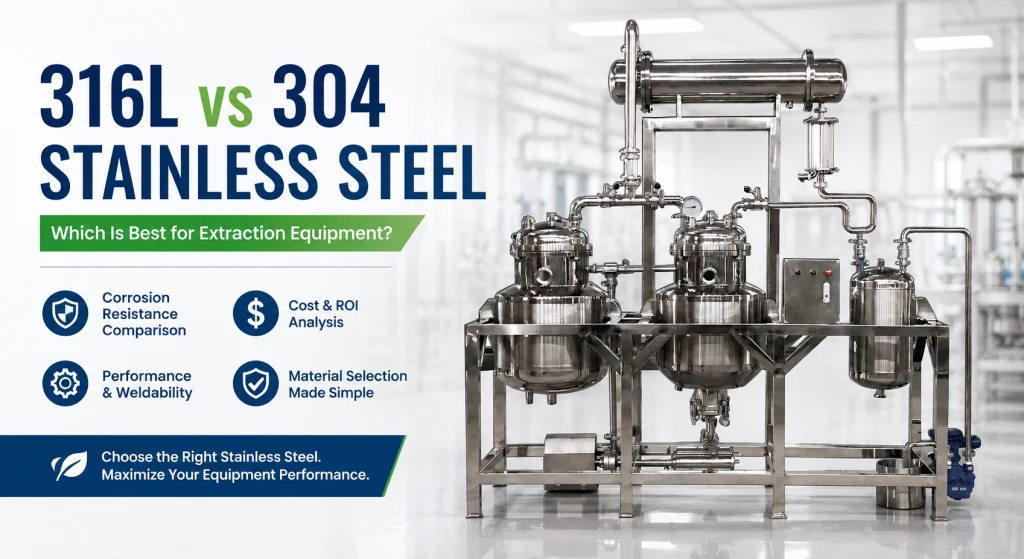
In most botanical, herbal, and ethanol extraction applications, 304 stainless steel is already sufficient. However, in highly corrosive environments such as pharmaceutical processing, acidic solvent extraction, or chloride-heavy cleaning systems, 316L may be the better investment.
This guide compares 316L vs 304 stainless steel across 7 critical differences and explains which material is best for extraction equipment.
316L is better than 304 stainless steel in corrosion resistance because it contains molybdenum and lower carbon content. However, 304 is usually sufficient for water extraction, ethanol extraction, and most food-grade processing equipment.
| Condition | Choose 304 | Choose 316L |
|---|---|---|
| Water extraction | ✅ | |
| Ethanol extraction | ✅ | |
| Acidic solvent | ✅ | |
| Pharmaceutical GMP | ✅ | |
| High chloride exposure | ✅ |
304 stainless steel is the most widely used austenitic stainless steel in industrial processing equipment.
It contains:
304 offers excellent corrosion resistance, good mechanical strength, and strong weldability. It is widely used in food processing, beverage production, herbal extraction, and ethanol-based systems.
For most standard extraction applications, 304 stainless steel applications remain the best balance between performance and cost.
316L is an upgraded version of 316 stainless steel with lower carbon content and improved corrosion resistance.
316L stainless steel properties include:
The addition of molybdenum significantly improves resistance to chlorides, acids, and aggressive cleaning chemicals.
This makes 316L ideal for:
| Element | 304 | 316L |
|---|---|---|
| Chromium | 18–20% | 16–18% |
| Nickel | 8–10.5% | 10–14% |
| Molybdenum | 0% | 2–3% |
| Carbon | ≤0.08% | ≤0.03% |
The biggest difference between 304 vs 316 stainless steel is molybdenum. This element greatly improves corrosion resistance.
This is the most important difference for industrial buyers.
304 resists:
316L performs better against:
If your extraction process includes frequent acid washing or chloride exposure, 316L is safer.
Cost is usually the second biggest factor after corrosion resistance when buyers compare 316L vs 304 stainless steel.
Because 316L contains more nickel, molybdenum, and stricter low-carbon requirements, it costs significantly more to manufacture.
| Material | Relative Cost |
|---|---|
| 304 Stainless Steel | Baseline (100%) |
| 316L Stainless Steel | 120–140% |
For a 500L extraction tank:
| Tank Material | Estimated Price |
|---|---|
| 304 | $8,000–$9,500 |
| 316L | $10,500–$13,000 |
The cost difference can easily reach 20–40%, depending on thickness, welding requirements, polishing grade, and sanitary specifications.
Important: Higher price does not automatically mean better ROI.
Many buyers overpay for 316L when 304 already meets all process requirements.
This is why stainless steel material selection should be based on process conditions rather than assumptions.
Weldability affects equipment strength, hygiene, maintenance, and long-term durability.
Both 304 and 316L have good weldability, but 316L offers a key advantage.
Its ultra-low carbon content reduces carbide precipitation during welding.
This helps prevent intergranular corrosion near weld seams.
| Property | 304 | 316L |
|---|---|---|
| Weldability | Good | Excellent |
| Post-weld corrosion resistance | Moderate | Superior |
| Welding complexity | Lower | Higher |
For highly sanitary equipment, weld quality matters even more than base material.
Poor welding can create:
In pharmaceutical-grade systems, 316L is often preferred because of better welding performance and surface finishing quality.
For extraction equipment, cleanability directly impacts product purity and regulatory compliance.
This is especially important in:
Frequent cleaning exposes equipment to:
304 performs well in standard cleaning conditions.
However, under aggressive CIP or SIP cycles, 316L offers better resistance to pitting and chemical attack.
This makes 316L the preferred choice for high-frequency sterilization environments.
For most buyers, this is the real question—not simply 316L vs 304 stainless steel, but which material delivers the best value for extraction equipment.
The answer depends on solvent, product type, cleaning method, and production requirements.
| Application | 304 | 316L |
|---|---|---|
| Water extraction | ✅ Recommended | |
| Ethanol extraction | ✅ Recommended | |
| Herbal extraction | ✅ Recommended | |
| Acidic solvent extraction | ✅ Recommended | |
| Pharma GMP | ✅ Recommended | |
| High chloride cleaning | ✅ Recommended |
If you are still deciding how material choice affects total equipment configuration, our guide on how to choose extraction equipment explains the complete buyer decision process.
This is where many industrial buyers make poor purchasing decisions.
They assume buying the “best” material always creates the best result.
Not necessarily.
The real question is:
Will 316L reduce enough maintenance or failure risk to justify higher CAPEX?
| Metric | 304 | 316L |
|---|---|---|
| Initial Cost | $9,000 | $12,000 |
| Expected Lifespan | 8–12 years | 12–18 years |
| Maintenance Cost | Higher | Lower |
If your process is non-corrosive, 304 often delivers the highest ROI.
If corrosion causes frequent downtime, 316L may save money long-term.
This section matters because many suppliers oversell 316L.
You probably do not need 316L if your process involves:
In these cases, paying 20–40% more for 316L often brings little practical benefit.
Contrarian Insight: In botanical extraction, 304 is sufficient for the majority of systems.
Better corrosion resistance does not mean better ROI for every process.
Sometimes cleaning agents are more corrosive than the product itself.
Total lifecycle cost matters more than initial material cost.
Bad welding ruins even premium stainless steel.
Material selection should always match solvent, temperature, and cleaning conditions.
For downstream purification processes involving ethanol and precipitation, sanitary design becomes even more critical in equipment such as alcohol precipitation tanks.
Q: Is 316L always better than 304 stainless steel?
A: No. 316L offers better corrosion resistance, but it is not always the better choice. For water extraction, ethanol extraction, and most standard botanical processing, 304 stainless steel is usually sufficient and more cost-effective.
Q: Can 304 stainless steel rust?
A: Yes, under certain conditions. Although 304 has good corrosion resistance, prolonged exposure to chlorides, acidic chemicals, or harsh cleaning agents can eventually cause corrosion or pitting.
Q: Why is 316L more expensive than 304?
A: 316L contains more nickel and 2–3% molybdenum, which improves corrosion resistance. Its ultra-low carbon content also increases manufacturing requirements, making it more expensive than 304.
Q: Is 304 stainless steel food grade?
A: Yes. 304 stainless steel is widely recognized as food grade and is commonly used in food processing equipment, beverage systems, and extraction tanks.
Q: When should I choose 316L for extraction equipment?
A: You should choose 316L when processing corrosive solvents, operating in high-chloride environments, or manufacturing pharmaceutical-grade products that require aggressive CIP or SIP cleaning cycles.
Q: Is 316L required for ethanol extraction?
A: In most cases, no. Standard ethanol extraction systems usually operate well with 304 stainless steel. Unless the process involves corrosive additives or stricter sanitary requirements, 316L is often unnecessary.
If you want the fastest way to decide between 304 and 316L, use this matrix.
| Your Condition | Recommended Material |
|---|---|
| Water extraction | 304 |
| Ethanol extraction | 304 |
| Herbal extraction | 304 |
| Food-grade production | 304 |
| Acidic solvent extraction | 316L |
| Pharmaceutical GMP production | 316L |
| High chloride environment | 316L |
Quick rule: If your process is standard, choose 304. If corrosion risk is high, choose 316L.
When comparing 316L vs 304 stainless steel, the best material depends entirely on your process requirements.
There is no universal winner.
304 stainless steel delivers excellent value for most industrial applications. It offers strong corrosion resistance, good weldability, and lower equipment cost.
316L provides superior resistance to chlorides, acids, and aggressive cleaning chemicals, making it ideal for pharmaceutical, chemical, and high-sanitation environments.
For most extraction equipment buyers, the decision should not be based on material reputation alone.
Instead, evaluate:
Proper stainless steel material selection improves equipment lifespan, reduces maintenance, and prevents costly downtime.
In most botanical extraction applications, 304 remains the smartest and most economical choice.
In corrosive or pharmaceutical-grade applications, 316L becomes the safer long-term investment.
Choosing the right material is only one part of building an efficient processing system.
You also need to optimize:
Panchi Machinery specializes in custom stainless steel processing equipment for botanical extraction, concentration, purification, and downstream processing.
We provide both 304 and 316L equipment based on your actual production requirements—not based on overselling expensive materials.
You can explore our complete equipment solutions in our extraction equipment catalog.
Tell us your raw material, solvent, and production capacity, and our engineers can recommend the most cost-effective stainless steel solution for your plant.
Contact us today for a customized quotation.


Whatsapp: +8615736768129
Email: [email protected]
Address: Zhengzhou, Henan Province, China
Automatic Vacuum Honey Processing & Filtering Machine
Vacuum Low-Temperature Liquid Extraction & Concentration Unit
Custom Steam Distillation & Heat Reflux Essential Oil Equipment
SS304/316L Low-Temperature Vacuum Scraper Concentrator
QN Spherical Vacuum Concentrator & Alcohol Recovery Unit
Multi-function Stainless Steel Vacuum Distillation & Extraction Unit
Hot Reflux Vacuum Liquid Extraction & Concentration Unit
Single-Effect External Circulation Vacuum Concentrator
SJN Series Double-Effect External Circulation Vacuum Evaporator
We will contact you within one working day. Please pay attention to your email.
Automatic Vacuum Honey Processing & Filtering Machine
Vacuum Low-Temperature Liquid Extraction & Concentration Unit
Custom Steam Distillation & Heat Reflux Essential Oil Equipment
WhatsApp: +8615736768129
Email: [email protected]
Address: Zhengzhou, Henan Province, China


COPYRIGHT© 2026 Zhengzhou Panchi Machinery Equipment Co., Ltd. | Privacy Policy

Our team will respond within 24 hours.
Thanks! We'll get back to you within 24 hours.
Check your inbox (and spam folder) for our reply.