
Producing consistent industrial powders requires much more than simply reducing raw materials into smaller particles. Manufacturers must achieve the right balance between particle size, particle size distribution, production efficiency, and product performance. Whether processing botanical extracts, food ingredients, pharmaceuticals, nutraceuticals, or specialty chemicals, stable particle characteristics directly influence extraction efficiency, dissolution rate, mixing uniformity, flowability, and final product quality.
Many production plants attempt to solve quality problems by installing larger mills or increasing grinding speed. In practice, inconsistent powder quality is usually caused by variations throughout the production process rather than the grinding stage alone. Raw material moisture, classifier performance, screening accuracy, airflow, drying conditions, and equipment configuration all contribute to the final particle size distribution.
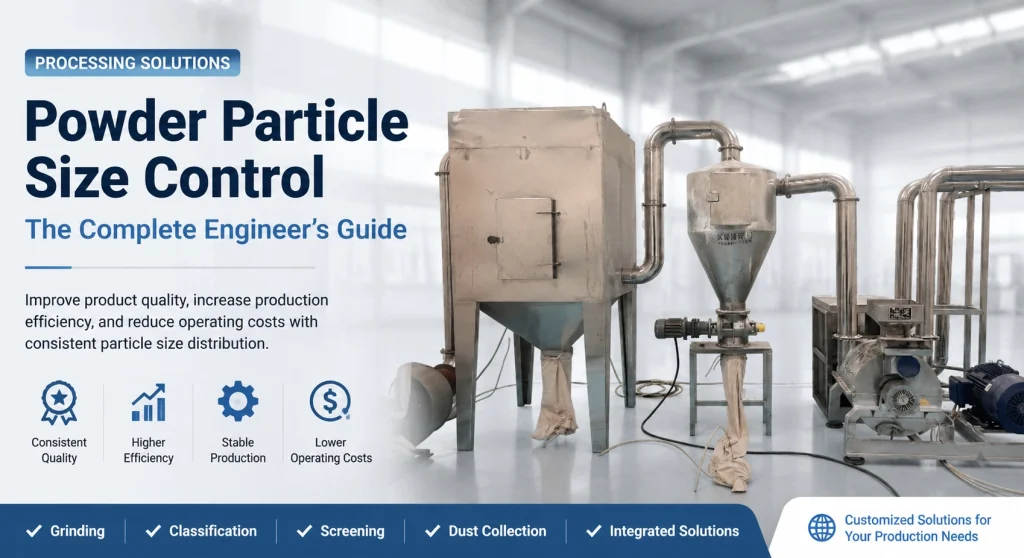
For manufacturers seeking higher efficiency and lower operating costs, controlling particle size throughout the entire production line has become an essential engineering objective. When supported by appropriate powder processing equipment, optimized operating parameters, and reliable powder particle size analysis, a stable production process can significantly reduce waste, improve batch consistency, and increase overall productivity.
In short: Maintaining the correct particle size improves product quality, process stability, downstream efficiency, and long-term manufacturing profitability.
Particle size affects almost every stage of powder production. Oversized particles may reduce extraction efficiency or dissolve more slowly, while excessively fine powders can increase dust generation, material loss, equipment wear, and energy consumption. The objective is therefore not to produce the finest powder possible, but to achieve a consistent particle size distribution that matches the intended application.
Modern manufacturers increasingly rely on integrated production systems that combine grinding, classification, screening, and continuous quality monitoring. This process-oriented approach delivers more repeatable results than optimizing a single machine and helps maintain consistent product performance across every production batch.
Quick Answer
Powder particle size control is the process of maintaining powders within a specified particle size range while ensuring a stable particle size distribution throughout production. By combining effective particle size control methods, suitable powder processing equipment, and accurate powder particle size analysis, manufacturers can improve product quality, increase production efficiency, and reduce long-term operating costs.
Understanding Particle Size Distribution
In short: A consistent particle size distribution is the foundation of stable powder quality, predictable processing performance, and repeatable production results.
Many manufacturers evaluate powder quality using only the average particle size. While this value provides a general indication of fineness, it does not accurately represent how powders behave during production. Two batches with the same average particle size may perform very differently if their particle size distributions are not consistent.
Particle size distribution describes the proportion of fine, medium, and coarse particles within a powder sample. A narrow and well-controlled distribution generally produces better mixing, improved flowability, more predictable extraction performance, and greater batch-to-batch consistency.
For this reason, modern production facilities monitor the complete particle size distribution rather than relying on a single average value. Consistent distribution allows manufacturers to optimize downstream operations including drying, conveying, blending, packaging, and final quality control.
In short: A consistent particle size distribution is the foundation of stable powder quality, predictable processing performance, and repeatable production results.
Many manufacturers evaluate powder quality using only the average particle size. While this value provides a general indication of fineness, it does not accurately represent how powders behave during production. Two batches with the same average particle size may perform very differently if their particle size distributions are not consistent.
Particle size distribution describes the proportion of fine, medium, and coarse particles within a powder sample. A narrow and well-controlled distribution generally produces better mixing, improved flowability, more predictable extraction performance, and greater batch-to-batch consistency.
For this reason, modern production facilities monitor the complete particle size distribution rather than relying on a single average value. Consistent distribution allows manufacturers to optimize downstream operations including drying, conveying, blending, packaging, and final quality control.
Although these two measurements are closely related, they provide very different information about powder quality.
| Parameter | Average Particle Size | Particle Size Distribution |
|---|---|---|
| Purpose | Measures overall particle size | Shows the complete size range |
| Production Value | General reference | Critical for process stability |
| Mixing Performance | Limited indication | Highly influential |
| Flowability Prediction | Low accuracy | High accuracy |
| Quality Consistency | Cannot fully evaluate | Provides complete assessment |
Engineer Insight
Production lines with identical average particle sizes can still produce significantly different product quality if their particle size distributions vary. For most industrial applications, maintaining a stable distribution is far more important than pursuing the smallest possible particle size.
Reliable powder particle size analysis enables manufacturers to verify whether production remains within specification before quality problems reach downstream processes. Instead of identifying issues after packaging or customer inspection, routine particle size measurement provides immediate feedback for process adjustment.
By monitoring particle size throughout production, operators can quickly detect changes caused by raw material variation, equipment wear, classifier performance, airflow fluctuations, or improper operating parameters. Early correction helps reduce waste, improve production efficiency, and maintain consistent product quality.
Rather than serving only as a quality inspection tool, particle size analysis has become an essential component of modern process control, allowing manufacturers to make data-driven adjustments and maintain stable production over long operating cycles.
In short: There is no single particle size control method suitable for every material. The best solution depends on raw material properties, production capacity, target particle size, moisture content, and final product requirements.
Modern powder production combines multiple process steps to achieve consistent quality rather than relying on grinding alone. Grinding reduces particle size, classification separates particles into the required range, screening removes oversized materials, and continuous process monitoring ensures long-term production stability.
| Control Method | Primary Function | Typical Applications |
|---|---|---|
| Grinding | Reduce raw material size | Food, botanical, pharmaceutical, chemical powders |
| Air Classification | Separate particles by size | Fine powders requiring narrow particle size distribution |
| Screening | Remove oversized particles | General powder processing and quality control |
| Process Monitoring | Maintain production consistency | Continuous industrial production lines |
| Powder Particle Size Analysis | Verify product specifications | Laboratory and production quality assurance |
Engineer Insight
Stable production is achieved by controlling the entire manufacturing process—not by installing a more powerful mill. In many cases, optimizing classification efficiency and process parameters produces greater improvements than increasing grinding capacity.
Accurate measurement plays an essential role in maintaining process consistency. Different testing methods provide different levels of precision, speed, and suitability depending on material characteristics and production objectives.
| Method | Advantages | Limitations | Typical Application |
|---|---|---|---|
| Laser Diffraction | Fast, highly accurate, wide measuring range | Higher equipment investment | Pharmaceutical, food, chemical production |
| Sieve Analysis | Simple operation and low cost | Lower accuracy for fine powders | Coarse powders and routine inspection |
| Image Analysis | Measures particle size and shape simultaneously | Longer testing time | Research laboratories and specialty materials |
| If Your Goal Is… | Recommended Solution |
|---|---|
| Improve extraction efficiency | Optimize grinding and particle size distribution. |
| Increase powder uniformity | Combine air classification with routine particle size analysis. |
| Reduce dust generation | Adjust target particle size instead of excessive fine grinding. |
| Improve batch consistency | Monitor particle size throughout production rather than only final inspection. |
| Increase production efficiency | Integrate grinding, classification, screening, and process control into one production line. |
Best Practice
Successful manufacturers view particle size as a process parameter rather than a final inspection result. Continuous monitoring, standardized operating procedures, and integrated equipment deliver more consistent powder quality while reducing energy consumption and production costs.
Once manufacturers understand how particle size is measured and controlled, the next step is selecting equipment capable of delivering consistent production performance. Equipment configuration has a direct impact on production efficiency, operating costs, maintenance requirements, and long-term return on investment. The following section explains how to choose the most suitable powder processing equipment for different production applications.
In short: The best equipment is not necessarily the most powerful—it is the system that consistently delivers the required particle size distribution while meeting your production capacity, product quality, and operating cost objectives.
When selecting powder processing equipment, many buyers compare only motor power, grinding speed, or hourly output. While these specifications are important, they represent only part of the overall solution. A production line designed for stable particle size control should also consider raw material characteristics, moisture content, required particle size range, downstream processing, and future production expansion.
Rather than evaluating machines individually, experienced manufacturers compare complete processing systems capable of integrating grinding, classification, screening, conveying, dust collection, and quality monitoring into one continuous production line.
| Selection Factor | Why It Matters |
|---|---|
| Raw Material Characteristics | Different materials require different grinding technologies. |
| Target Particle Size | Determines the required grinding and classification equipment. |
| Production Capacity | Ensures equipment matches future production demand. |
| Moisture Content | Influences grinding efficiency and powder flowability. |
| Automation Level | Reduces labor requirements and improves consistency. |
| Cleaning & Maintenance | Minimizes downtime and operating costs. |
Buyer’s Tip
Before comparing equipment prices, define your production objectives first. The correct production target should determine equipment selection—not the other way around.
Many factories begin by upgrading only the grinding machine when production problems occur. Although this may temporarily increase capacity, inconsistent particle size often remains because bottlenecks still exist in classification, screening, material conveying, or drying.
An integrated production line improves consistency by allowing every process stage to work together. Instead of treating each machine independently, the system continuously controls material flow, particle separation, and quality monitoring throughout the manufacturing process.
| Comparison | Single Machine | Integrated Production Line |
|---|---|---|
| Particle Size Consistency | Moderate | Excellent |
| Production Efficiency | Limited by manual handling | Continuous operation |
| Labor Requirement | Higher | Lower |
| Energy Utilization | Average | Optimized |
| Long-Term ROI | Moderate | Higher |
Engineer Insight
The most successful powder processing plants rarely optimize one machine at a time. Instead, they improve the entire production workflow, ensuring grinding, classification, screening, conveying, and quality control operate as one integrated system.
Although a complete powder processing line typically requires a higher initial investment than purchasing individual machines, it often produces a significantly lower total cost of ownership over its service life. Reduced labor requirements, lower material waste, improved production stability, and simplified maintenance all contribute to faster payback.
For manufacturers planning long-term production growth, investing in an integrated system also provides greater flexibility for future expansion and easier process optimization as production requirements evolve.
In short: Different products require different particle size targets. Selecting the appropriate range improves product performance while reducing unnecessary processing costs.
| Industry | Recommended Particle Size | Primary Objective | Typical Equipment Configuration |
|---|---|---|---|
| Botanical Extract | 80–150 μm | Improve extraction efficiency | Pin Mill + Air Classifier |
| Food Ingredients | 100–300 μm | Enhance flowability and texture | Hammer Mill + Vibrating Sieve |
| Pharmaceutical | 20–80 μm | Ensure dosage uniformity | Jet Mill + Air Classifier |
| Nutraceutical | 60–120 μm | Improve dispersibility | Pin Mill + Screening System |
| Chemical Powder | Application Specific | Maintain reaction consistency | Classifier Mill + Dust Collection |
Many production issues originate from process decisions rather than equipment limitations.
Buyer’s Advice
The lowest equipment price rarely delivers the lowest production cost. A well-designed processing system usually provides higher productivity, lower maintenance expenses, and more consistent product quality throughout its operating life.
Maintaining consistent particle quality requires continuous process optimization rather than occasional equipment adjustments. Manufacturers that achieve stable long-term performance typically follow standardized operating procedures and monitor key production parameters throughout every production batch.
| Best Practice | Production Benefit |
|---|---|
| Monitor particle size regularly | Reduce batch variation |
| Inspect grinding components | Maintain consistent production capacity |
| Control raw material moisture | Improve grinding efficiency |
| Optimize classifier settings | Maintain stable particle size distribution |
| Record production data | Support continuous process improvement |
Successful powder manufacturing is built on process consistency rather than maximum grinding capacity. By combining suitable equipment, optimized operating parameters, routine quality monitoring, and systematic process improvement, manufacturers can achieve stable product quality while reducing operating costs and increasing production efficiency.
For companies planning new production lines or upgrading existing facilities, evaluating the complete powder processing workflow—including grinding, classification, screening, conveying, dust collection, and process monitoring—often delivers greater long-term value than replacing individual machines.
Engineering Perspective
The highest-performing powder plants are designed as integrated systems where every processing stage supports the next. Consistent product quality is the result of coordinated process control, not simply higher grinding power.
Q: What is the ideal particle size for powder products?
A: There is no universal particle size. The optimum range depends on the application, raw material, and product performance requirements. Food powders, herbal extracts, pharmaceutical ingredients, and chemical products all have different specifications.
Q: Why is particle size distribution more important than average particle size?
A: A narrow particle size distribution produces more consistent flowability, dissolution, mixing, and packaging performance than controlling only the average particle diameter.
Q: Which analysis method is best for fine powders?
A: Laser diffraction is generally preferred for fine powders because it provides fast, accurate, and repeatable powder particle size analysis over a wide measurement range.
Q: Can one grinder process every type of material?
A: No. Material hardness, moisture content, oil content, fiber content, and target particle size all influence equipment selection. Different applications require different grinding technologies.
Q: How often should particle size be tested?
A: Critical production lines typically monitor particle size during production and verify final product specifications through laboratory testing. Testing frequency depends on product quality requirements and process stability.
Q: How can manufacturers improve powder particle size control?
A: The most effective approach combines appropriate particle size control methods, suitable powder processing equipment, preventive maintenance, operator training, and continuous powder particle size analysis throughout the manufacturing process.
Panchi Machinery provides complete powder processing solutions, including grinding, classification, screening, mixing, drying, and integrated production lines for botanical extraction, food, pharmaceutical, and chemical industries. Our engineering team can recommend a customized solution based on your raw materials, target particle size, production capacity, and quality requirements.
Contact Panchi Machinery today to discuss your powder processing project and receive a customized equipment recommendation.


Whatsapp: +8615736768129
Email: [email protected]
Address: Zhengzhou, Henan Province, China
Automatic Vacuum Honey Processing & Filtering Machine
Vacuum Low-Temperature Liquid Extraction & Concentration Unit
Custom Steam Distillation & Heat Reflux Essential Oil Equipment
SS304/316L Low-Temperature Vacuum Scraper Concentrator
QN Spherical Vacuum Concentrator & Alcohol Recovery Unit
Multi-function Stainless Steel Vacuum Distillation & Extraction Unit
Hot Reflux Vacuum Liquid Extraction & Concentration Unit
Single-Effect External Circulation Vacuum Concentrator
SJN Series Double-Effect External Circulation Vacuum Evaporator
We will contact you within one working day. Please pay attention to your email.
Automatic Vacuum Honey Processing & Filtering Machine
Vacuum Low-Temperature Liquid Extraction & Concentration Unit
Custom Steam Distillation & Heat Reflux Essential Oil Equipment
WhatsApp: +8615736768129
Email: [email protected]
Address: Zhengzhou, Henan Province, China


COPYRIGHT© 2026 Zhengzhou Panchi Machinery Equipment Co., Ltd. | Privacy Policy

Our team will respond within 24 hours.
Thanks! We'll get back to you within 24 hours.
Check your inbox (and spam folder) for our reply.