
Understanding how to choose extraction equipment is one of the most important investment decisions for botanical, herbal, pharmaceutical, and food processing manufacturers. The right system can improve extraction yield, reduce solvent loss, increase throughput, and shorten ROI. The wrong system, however, can cause low efficiency, unstable product quality, and high operating costs.
Many buyers focus only on tank size or initial price when comparing equipment. In reality, professional extraction equipment selection requires evaluating raw materials, extraction methods, solvent compatibility, automation level, and long-term operating costs.
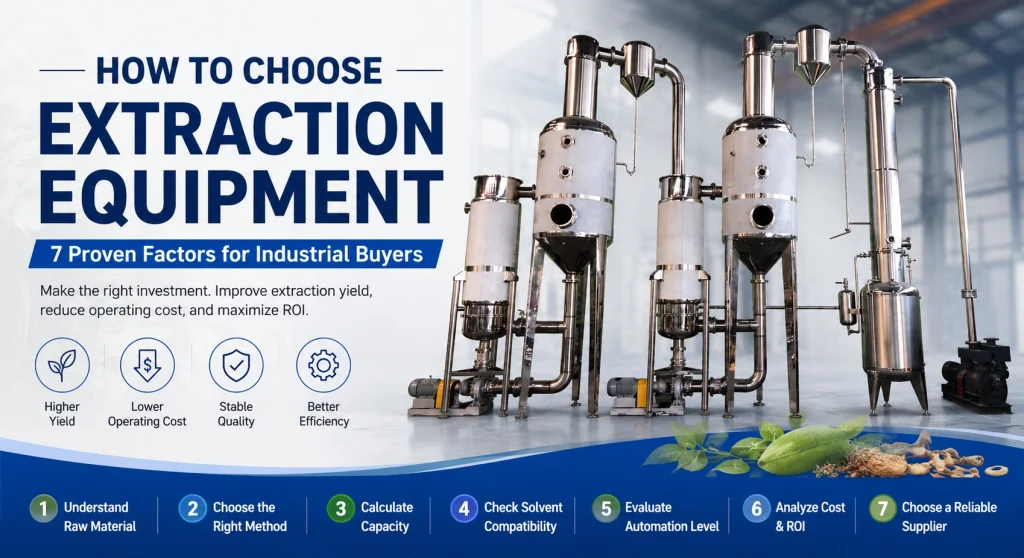
In industrial extraction plants processing 300 L to 5000 L per batch, even a small improvement in extraction efficiency can significantly impact profitability. For example, increasing extract yield by just 3–5% may translate into thousands of dollars in additional annual revenue.
This guide explains how to choose extraction equipment using 7 proven evaluation factors so you can make a smarter purchasing decision and avoid costly mistakes.
Extraction equipment refers to industrial machinery used to separate valuable active compounds, oils, flavors, or functional ingredients from raw materials such as herbs, flowers, roots, seeds, or botanical biomass using water, ethanol, steam, or other solvents.
Depending on production requirements, extraction systems may include multiple integrated modules:
These components work together to maximize compound recovery while maintaining product quality.
For example, in a typical botanical extraction workflow, raw herbs are cleaned and crushed before entering the extraction tank. The extract is then filtered, concentrated, purified, and sometimes sent through alcohol precipitation and solvent recovery stages.
If you want to understand the complete industrial workflow—from raw material preparation to extraction, filtration, concentration, and purification—you can also read our botanical extraction process guide.
The right extraction system affects much more than production capacity. It directly impacts product quality, operating cost, solvent consumption, and plant efficiency.
| Factor | Poor Equipment Choice | Optimized Equipment Choice |
|---|---|---|
| Extraction Yield | Low active compound recovery | Higher extraction efficiency |
| Energy Consumption | High steam/power cost | Lower operating cost |
| Solvent Loss | Excessive ethanol waste | Improved solvent recovery |
| Product Quality | Inconsistent batches | Stable extract quality |
| Maintenance | Frequent downtime | Longer equipment lifespan |
Many factories underestimate long-term operating cost. A cheaper machine may save money upfront but cost far more over 3–5 years due to poor heating efficiency, labor demand, and maintenance requirements.
Expert Insight: Smart industrial buyers evaluate total ownership cost, not just purchase price.
The first step in extraction equipment selection is understanding what material you will process. Different raw materials behave very differently during extraction.
Important material characteristics include:
| Material Type | Extraction Challenge | Recommended System |
|---|---|---|
| Roots | Dense structure | High-temperature reflux extraction |
| Leaves | Lightweight, floating | Agitated extraction tank |
| Flowers | Heat sensitive | Low-temp extraction system |
| Seeds | High oil content | Solvent extraction |
| Wood | Slow compound release | Long-cycle extraction |
For example, flower-based materials often contain delicate volatile compounds that degrade at high temperatures. In these cases, precise temperature control becomes essential.
By contrast, roots and bark usually require stronger heating and longer extraction times to release active ingredients efficiently.
Common mistake: Many buyers purchase generic systems without considering material characteristics, resulting in lower-than-expected yields.
Successful extraction equipment selection starts with understanding how raw material properties influence extraction efficiency and equipment design.
This is a recurring debate on Quora’s Food Science boards. The purist definition of raw honey is honey that hasn’t been heated beyond 45°C.
Because vacuum technology allows a producer to lower honey moisture at exactly these temperatures, the product remains biologically “alive.” In fact, vacuum processing is often more “raw” than air-drying in a hot room, as the latter exposes the honey to hours of oxidation. The vacuum method provides a scientific bridge between artisanal quality and commercial shelf-stability.
Your extraction method determines the core design of your industrial extraction system. Different extraction methods require different tank configurations, heating systems, and downstream equipment.
| Method | Best For | Advantages |
|---|---|---|
| Water Extraction | Herbal medicine | Low solvent cost |
| Ethanol Extraction | Botanical compounds | High extraction efficiency |
| Steam Distillation | Essential oils | Excellent for volatile oils |
| Reflux Extraction | High-value compounds | Improved yield |
Water extraction is commonly used in herbal processing because it is simple and cost-effective. However, it may not extract oil-soluble compounds efficiently.
Ethanol extraction is widely used for botanical extraction equipment because ethanol dissolves both polar and semi-polar compounds effectively.
This method often requires downstream purification equipment such as alcohol precipitation and solvent recovery systems to reduce operating costs.
For plants running ethanol-based production, adding ethanol recovery can significantly reduce solvent waste and improve ROI.
Steam distillation is ideal for essential oils and aromatic compounds. It minimizes thermal damage while efficiently separating volatile compounds.
Reflux systems continuously recycle heated solvent during extraction, increasing mass transfer and improving extraction efficiency.
Contrarian Insight: More advanced extraction methods do not always produce better ROI. Sometimes a simpler system provides faster payback and easier operation.
Production capacity is one of the most overlooked factors in extraction equipment selection, yet it often determines whether a system can support long-term production growth.
To calculate the right capacity, evaluate three numbers:
A simple estimation formula is:
Required Daily Capacity = Batch Size × Number of Daily Batches
For example:
Required processing capacity:
1500 kg/day
Factories expecting rapid expansion should consider scalability when choosing equipment.
Solvent compatibility is one of the most critical yet underestimated factors in extraction equipment selection. The wrong material choice can cause corrosion, contamination, shortened equipment lifespan, and higher maintenance costs.
The first question buyers should ask is simple:
What solvent will be used in production?
Common industrial extraction solvents include:
| Solvent | Compatibility Requirement | Recommended Material |
|---|---|---|
| Water | Low corrosion risk | 304 Stainless Steel |
| Ethanol | Medium corrosion risk | 304 / 316 Stainless Steel |
| Acidic Solvents | Higher corrosion risk | 316 Stainless Steel |
| Mixed Solvents | Depends on formulation | Case-by-case |
Many buyers ask whether 304 stainless steel is sufficient. In most herbal and botanical extraction applications using water or ethanol, 304 stainless steel is adequate and cost-effective.
However, if your process involves highly acidic materials, aggressive solvents, or stricter pharmaceutical-grade requirements, 316 stainless steel may offer better long-term performance.
Expert Insight: Over-specifying material can unnecessarily increase CAPEX by 10–25% without meaningful production benefits.
For multi-product factories, flexible botanical extraction equipment can improve process adaptability and support wider product portfolios.
Automation level directly affects labor requirements, batch consistency, operating efficiency, and long-term production scalability.
When choosing an industrial extraction system, buyers should consider both current production needs and future expansion plans.
| System Type | Advantages | Best For |
|---|---|---|
| Manual | Low CAPEX | Small factories |
| Semi-Automatic | Balanced cost and efficiency | Growing businesses |
| Fully Automatic | High consistency and low labor cost | Large-scale industrial plants |
Manual extraction systems usually have lower initial investment and simpler controls. They work well for small production facilities or businesses testing new product lines.
Semi-automatic systems are often the best ROI option for medium-scale production. They improve consistency without requiring a fully automated plant.
Fully automatic systems reduce labor dependency, improve batch repeatability, and provide precise control over temperature, pressure, and extraction cycles.
Contrarian Insight: Full automation is not always the best investment. Some medium-sized factories recover investment faster with semi-automatic systems.
For manufacturers processing herbs, roots, and flowers, choosing suitable botanical extraction equipment can significantly improve batch consistency and extraction yield.
Extraction equipment cost should never be evaluated based only on purchase price. Smart buyers calculate total cost of ownership over the equipment lifecycle. When comparing suppliers, always analyze extraction equipment cost together with energy consumption, maintenance requirements, and expected service life.
Key cost components include:
| Cost Category | One-Time | Recurring |
|---|---|---|
| Machine Purchase | Yes | No |
| Installation | Yes | No |
| Energy | No | Yes |
| Labor | No | Yes |
| Maintenance | No | Yes |
A practical ROI formula is:
ROI = Annual Profit Improvement ÷ Equipment Investment
For example:
Estimated payback period:
3.2 years
In ethanol-based production, solvent recovery can significantly improve ROI by reducing recurring solvent cost. Plants with high solvent usage often recover investment faster after adding recovery systems.
If your production uses ethanol, understanding solvent recovery efficiency is critical for equipment planning. Learn more in our ethanol recovery equipment guide.
Common mistake: Many buyers underestimate operating cost and over-focus on upfront machine price.
Comparing extraction equipment cost without evaluating long-term operating expenses often leads to poor investment decisions.
Choosing extraction equipment is not only about buying machinery. You are also choosing long-term engineering support, spare parts availability, and process expertise.
A reliable supplier should provide more than standard specifications.
Evaluate suppliers based on:
| Supplier Type | Risk Level | Support Quality |
|---|---|---|
| Trading Company | High | Limited |
| Generic Manufacturer | Medium | Moderate |
| Specialized Extraction Supplier | Low | High |
Suppliers with deep extraction experience can help optimize equipment configuration based on raw material, solvent choice, and production targets.
For example, an ethanol extraction line may require downstream purification equipment such as an alcohol precipitation tank to improve product purity and simplify downstream processing.
When comparing suppliers, ask whether they can provide complete system solutions rather than standalone machines.
Even experienced buyers can make costly mistakes during extraction equipment selection. Avoiding these common issues can save significant time and investment.
The cheapest machine is rarely the most economical long-term choice. Lower-cost equipment often suffers from poor heating efficiency, weaker welding quality, and higher maintenance frequency.
Many buyers assume bigger tanks always mean better productivity. In reality, oversized systems increase energy consumption, cleaning time, and capital investment.
Expert Opinion: Bigger tanks do not always improve throughput. Proper batch planning matters more.
In ethanol extraction, failing to recover solvent creates unnecessary operating cost. High solvent loss can dramatically reduce profit margins.
Poor equipment design can create dead zones, residue buildup, and difficult cleaning procedures, especially when processing sticky or high-viscosity extracts.
Choosing equipment only for current demand may create bottlenecks later. Scalability should always be considered during system design.
A modern industrial extraction system should integrate extraction, purification, concentration, and solvent recovery into one efficient workflow. The ideal equipment configuration depends on your production scale, extraction method, and product requirements.
| Production Scale | Recommended Configuration |
|---|---|
| Small Scale | Extraction tank + filtration |
| Medium Scale | Extraction + concentration + purification |
| Large Scale | Full automated extraction line |
A complete industrial extraction line may include:
For buyers planning a full extraction plant, exploring complete system configurations is often more cost-effective than purchasing standalone machines separately.
You can review more industrial processing solutions in our complete extraction equipment catalog.
Q: What is the most important factor when choosing extraction equipment?
A: The most important factor is matching equipment configuration to your raw material, extraction method, and production capacity. A well-matched system improves extraction efficiency, reduces operating costs, and ensures stable product quality over time.
Q: How much does extraction equipment cost?
A: Extraction equipment cost varies widely depending on capacity, automation, materials, and process complexity. Small systems may cost several thousand dollars, while complete industrial extraction lines can reach six figures.
Q: Should I choose manual or automatic extraction equipment?
A: This depends on production scale and labor cost. Small operations may prefer manual systems, while medium and large factories often benefit from semi-automatic or fully automatic systems for better efficiency and consistency.
Q: Is stainless steel 304 enough for extraction equipment?
A: For most botanical extraction applications using water or ethanol, 304 stainless steel is sufficient. For corrosive solvents or stricter sanitary requirements, 316 stainless steel may be more suitable.
Q: Can one extraction system process multiple materials?
A: Yes, many systems can process different materials such as roots, leaves, flowers, and seeds. However, flexibility depends on heating control, agitation design, and cleaning efficiency.
Q: How do beginners learn how to choose extraction equipment?
A: Beginners should evaluate raw material type, extraction method, production capacity, solvent compatibility, and long-term operating cost before choosing equipment.
A properly configured industrial extraction system should balance production efficiency, operational stability, and future scalability.
Choosing extraction equipment is a strategic investment that affects production efficiency, extract quality, operating cost, and long-term profitability.
The best buyers do not simply compare machine prices. They evaluate the entire production workflow, including raw material characteristics, solvent selection, automation requirements, scalability, and ROI.
By focusing on these 7 proven factors, you can avoid common purchasing mistakes and choose an extraction system that supports sustainable business growth.
Need expert guidance on how to choose extraction equipment for your production line?
Our engineering team can help you evaluate capacity requirements, process flow, and equipment configuration based on your specific materials and production goals.
Contact us today for a customized extraction solution and quotation.


Whatsapp: +8615736768129
Email: [email protected]
Address: Zhengzhou, Henan Province, China
Automatic Vacuum Honey Processing & Filtering Machine
Vacuum Low-Temperature Liquid Extraction & Concentration Unit
Custom Steam Distillation & Heat Reflux Essential Oil Equipment
SS304/316L Low-Temperature Vacuum Scraper Concentrator
QN Spherical Vacuum Concentrator & Alcohol Recovery Unit
Multi-function Stainless Steel Vacuum Distillation & Extraction Unit
Hot Reflux Vacuum Liquid Extraction & Concentration Unit
Single-Effect External Circulation Vacuum Concentrator
SJN Series Double-Effect External Circulation Vacuum Evaporator
We will contact you within one working day. Please pay attention to your email.
Automatic Vacuum Honey Processing & Filtering Machine
Vacuum Low-Temperature Liquid Extraction & Concentration Unit
Custom Steam Distillation & Heat Reflux Essential Oil Equipment
WhatsApp: +8615736768129
Email: [email protected]
Address: Zhengzhou, Henan Province, China


COPYRIGHT© 2026 Zhengzhou Panchi Machinery Equipment Co., Ltd. | Privacy Policy

Our team will respond within 24 hours.
Thanks! We'll get back to you within 24 hours.
Check your inbox (and spam folder) for our reply.