
Searching for an alcohol precipitation tank price but only seeing vague “Contact Us” forms everywhere?
If you are sourcing high-efficiency extraction and solvent recovery equipment for a pharmaceutical, botanical, nutraceutical, or industrial food processing factory, catalog prices alone tell you almost nothing about the true investment required.
A $12,000 basic tank and a $45,000 integrated industrial system may look similar in product photos, but their actual performance can differ dramatically in terms of:
The most important rule in industrial procurement: the cheapest system is rarely the most profitable one.
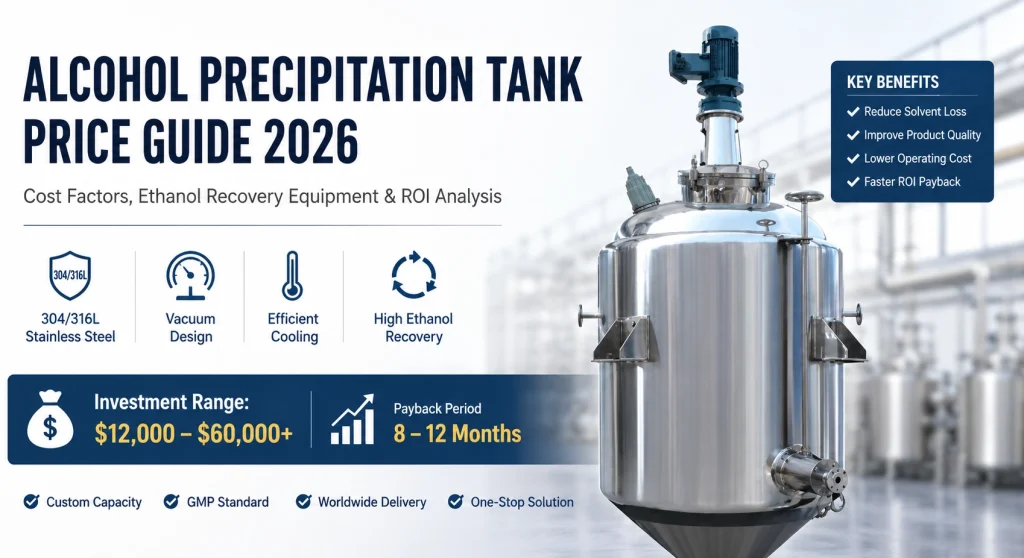
Many buyers focus only on CAPEX (purchase price), but experienced plant owners know that long-term profitability depends heavily on OPEX (operating cost). Poorly engineered tanks often lead to excessive ethanol evaporation, unstable precipitation, contamination risks, and higher labor costs.
That is why evaluating ethanol recovery equipment requires more than comparing price tags. You must understand what drives cost differences and how each configuration affects production performance.
An alcohol precipitation tank is a specialized vessel used in herbal extraction and pharmaceutical processing to separate impurities by adding ethanol into concentrated extracts under controlled conditions.
During the alcohol precipitation process, ethanol is added to concentrated herbal extract. Because alcohol changes solubility properties, unwanted substances such as polysaccharides, proteins, starches, and colloidal impurities precipitate out of the solution.
This purification step is critical in:
Modern systems often integrate:
A professional vacuum alcohol precipitation tank improves both precipitation efficiency and ethanol retention, reducing solvent waste and improving product consistency.
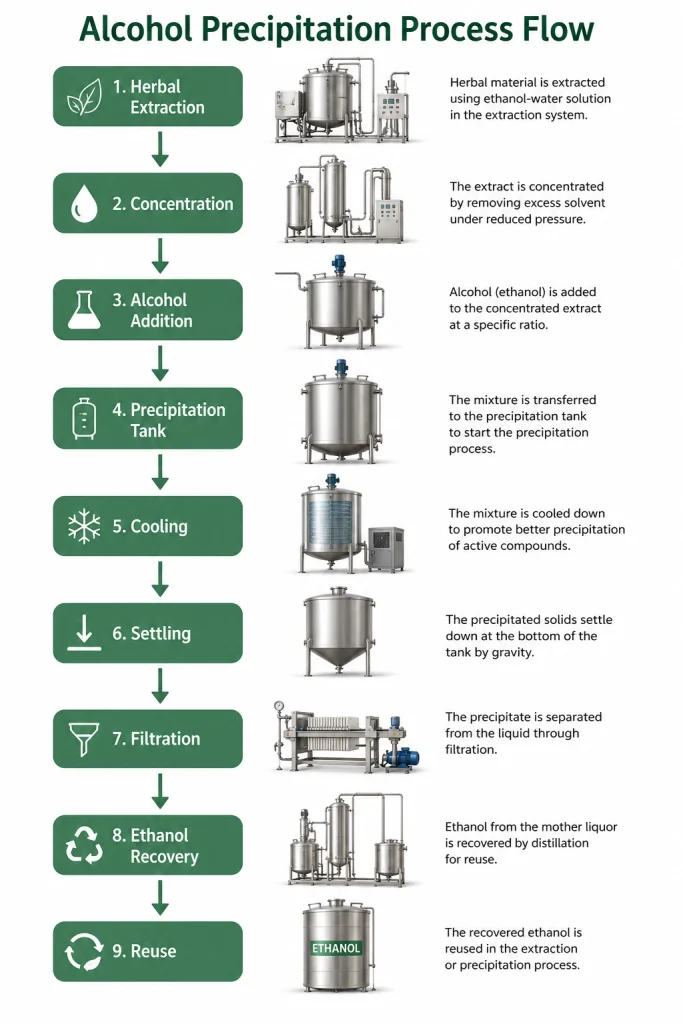
In a typical industrial workflow, herbal extracts are first concentrated to reduce water content. Ethanol is then added inside the precipitation tank to trigger impurity separation.
Temperature control becomes critical at this stage. Lower temperatures improve precipitation quality and reduce ethanol evaporation.
After settling and filtration, the ethanol-rich liquid proceeds into alcohol recovery equipment, where solvent is recovered for reuse.
The better your integrated system design, the higher your solvent recovery rate and the lower your production cost per batch.
The alcohol precipitation tank price depends heavily on tank volume, metallurgy, automation level, vacuum system configuration, and cooling requirements.
| System Configuration | Estimated Price Range (USD) | Suitable Buyer |
|---|---|---|
| Basic Carbon Steel Tank | $12,000–$20,000 | Entry-level processors |
| 304 Stainless Steel Tank | $18,000–$35,000 | Food & botanical factories |
| 316L GMP Tank + Vacuum | $28,000–$60,000+ | Pharma-grade plants |
Global supplier region also impacts pricing:
| Supplier Region | Typical Price |
|---|---|
| China | $15k–45k |
| Europe | $60k–180k |
| USA | $80k–220k |
This is why comparing quotations without checking engineering specs can be misleading.
Larger tanks require more stainless steel, stronger support structures, and more powerful agitators. A 500L unit may cost far less than a 5000L industrial system.
Material selection strongly affects both price and compliance.
For regulated facilities, stainless steel is usually mandatory.
A vacuum alcohol precipitation tank costs more because it requires:
However, vacuum processing provides major benefits:
Cooling is essential during precipitation. Without proper cooling, ethanol evaporates rapidly and precipitation becomes unstable.
Common cooling options include:
Advanced cooling raises system cost but dramatically improves solvent efficiency.
Uniform mixing ensures consistent precipitation. Agitator design depends on viscosity, batch size, and extract properties.
Higher-end systems use VFD-controlled agitators for precise mixing control.
For pharmaceutical buyers, sanitary engineering is non-negotiable.
Premium systems include:
These features increase initial investment but reduce contamination risk.
Automation dramatically affects the final alcohol precipitation tank price.
Manual systems are cheaper but require more operators.
PLC-controlled systems provide:
Many buyers underestimate solvent loss.
Without efficient ethanol recovery equipment, factories may lose 10–25% of ethanol during production through evaporation and discharge.
This becomes extremely expensive at scale.
| Parameter | Poor System | Optimized System |
|---|---|---|
| Ethanol Recovery Rate | 70–80% | 90–95% |
| Solvent Loss | High | Low |
| Operating Cost | High | Low |
That is why advanced alcohol recovery equipment can often pay for itself within months.
A Southeast Asian herbal extraction plant processing 400 kg/day faced three major problems:
After upgrading to an integrated vacuum system with optimized ethanol recovery equipment, results improved significantly:
Annual savings exceeded $42,000.
Payback period:
≈ 11 months
Even experienced procurement teams can make costly mistakes when sourcing ethanol recovery equipment. In most cases, the problem is not choosing the wrong supplier—it is evaluating the wrong metrics.
Many buyers focus exclusively on the purchase quotation and ignore long-term solvent savings. A cheaper system may save $8,000 upfront but cost tens of thousands annually through ethanol loss, unstable recovery, and excessive maintenance.
The most important KPI is recovery rate. A system recovering only 78% ethanol versus one recovering 93% creates a massive cost difference at industrial scale. Even a 5–10% recovery gap can significantly affect annual profitability.
Temperature control directly affects ethanol evaporation. Poor cooling leads to higher solvent loss, unstable precipitation, and inconsistent product quality. This is especially dangerous when processing heat-sensitive botanical extracts.
Some factories buy equipment sized only for current production. Within one or two years, output grows and the system becomes a bottleneck. A properly sized scalable system protects future expansion and reduces reinvestment risk.
Supplier location also affects your final alcohol precipitation tank price. While many global buyers automatically assume higher-priced Western systems are superior, this is not always true. The real comparison should focus on engineering capability, customization, and total project ROI.
| Factor | China Suppliers | Europe Suppliers | US Suppliers |
|---|---|---|---|
| Price | Low–Medium | High | Highest |
| Customization | Excellent | Moderate | Moderate |
| Lead Time | Fast | Medium | Medium |
| ROI Potential | High | Medium | Medium |
Chinese manufacturers such as Panchi Machinery often provide the best balance between engineering quality and capital efficiency. Buyers can access GMP stainless steel systems, custom tank sizing, and integrated alcohol recovery equipment at significantly lower CAPEX compared with Europe or North America.
For most B2B buyers, the best supplier is not the most expensive one—it is the one that delivers the highest long-term operational return.
Annual Savings = Solvent Savings + Labor Savings + Downtime Reduction + Quality Premium
Example for a medium factory:
If the system investment premium is $35,000:
After ROI breakeven, efficiency improvements convert directly into profit.
Lowest CAPEX often means highest OPEX.
Ignoring ethanol recovery equipment leads to hidden losses.
Manual cleaning consumes valuable production hours.
Non-compliant systems can fail audits.
Undersized tanks become production bottlenecks.
Q: What is the average alcohol precipitation tank price?
A: The average alcohol precipitation tank price ranges from $8,000 to $80,000+, depending on capacity, tank material, vacuum integration, cooling design, automation level, and GMP sanitary requirements. Industrial pharmaceutical systems cost significantly more than basic tanks.
Q: Why is a vacuum alcohol precipitation tank more expensive?
A: A vacuum alcohol precipitation tank includes vacuum sealing, pressure-resistant structure, condensers, and advanced control systems. These features improve precipitation efficiency, reduce oxidation, shorten process time, and deliver higher product consistency for regulated manufacturing.
Q: Do I need ethanol recovery equipment?
A: Yes, in most industrial extraction applications. Efficient ethanol recovery equipment can recover 80–95% of ethanol, dramatically reducing solvent consumption and improving long-term profitability, especially for medium and large-scale continuous production plants.
Q: Which material is best: 304 or 316L?
A: 304 stainless steel suits most herbal extraction plants and food applications. 316L is better for highly corrosive or pharmaceutical-grade environments requiring superior chemical resistance and stricter GMP compliance.
Do not compare suppliers using catalog prices alone.
The real alcohol precipitation tank price depends entirely on your process requirements.
Before investing, prepare these inputs:
Panchi engineers can help design a complete solution based on your production goals.
Explore our vacuum alcohol precipitation tank to evaluate technical specifications for industrial-scale extraction lines.
Send your process requirements now and receive:
✅ Engineering consultation
✅ Equipment configuration recommendation
✅ Factory-direct quotation
✅ ROI analysis


Whatsapp: +8615736768129
Email: [email protected]
Address: Zhengzhou, Henan Province, China
Automatic Vacuum Honey Processing & Filtering Machine
Vacuum Low-Temperature Liquid Extraction & Concentration Unit
Custom Steam Distillation & Heat Reflux Essential Oil Equipment
SS304/316L Low-Temperature Vacuum Scraper Concentrator
QN Spherical Vacuum Concentrator & Alcohol Recovery Unit
Multi-function Stainless Steel Vacuum Distillation & Extraction Unit
Hot Reflux Vacuum Liquid Extraction & Concentration Unit
Single-Effect External Circulation Vacuum Concentrator
SJN Series Double-Effect External Circulation Vacuum Evaporator
We will contact you within one working day. Please pay attention to your email.
Automatic Vacuum Honey Processing & Filtering Machine
Vacuum Low-Temperature Liquid Extraction & Concentration Unit
Custom Steam Distillation & Heat Reflux Essential Oil Equipment
WhatsApp: +8615736768129
Email: [email protected]
Address: Zhengzhou, Henan Province, China


COPYRIGHT© 2026 Zhengzhou Panchi Machinery Equipment Co., Ltd. | Privacy Policy

Our team will respond within 24 hours.
Thanks! We'll get back to you within 24 hours.
Check your inbox (and spam folder) for our reply.