
How to choose the right system, avoid expensive mistakes, and maximize long-term ROI.
Most buyers do not lose money because an industrial vacuum evaporator fails—they lose money because they buy the wrong configuration.
This is one of the most common problems in industrial equipment purchasing. Two vacuum evaporators may look similar on paper. Both may claim the same tank volume, stainless steel grade, and vacuum performance. However, once installed in real production environments, their actual performance can be dramatically different.
One system may deliver stable vacuum pressure, excellent solvent recovery, low energy consumption, and fast payback. Another may suffer from poor condenser efficiency, unstable pressure, long evaporation cycles, and frequent downtime. That performance gap directly affects your production cost and profitability.
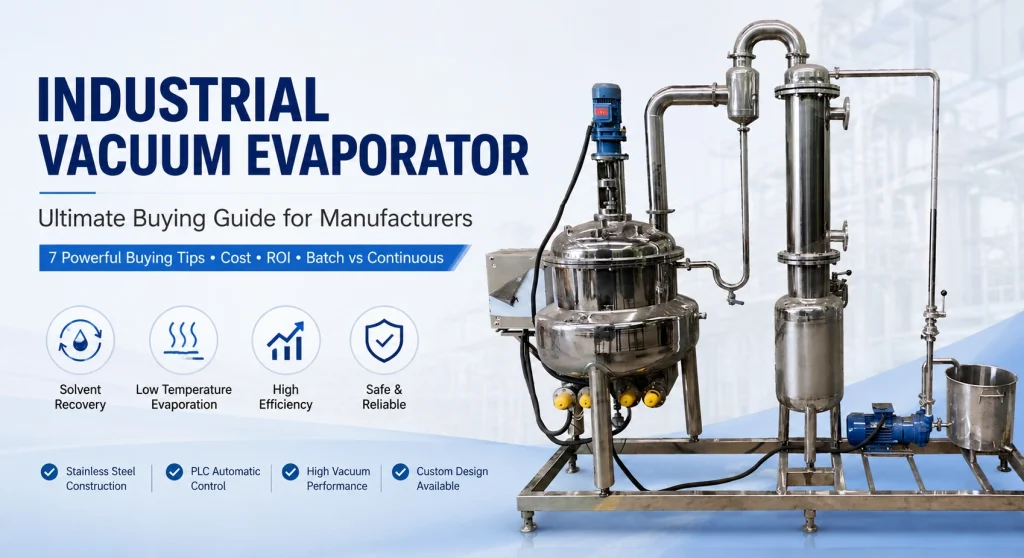
At Panchi Machinery, we have worked with extraction, concentration, and solvent recovery projects across multiple industries. Over the years, one pattern has remained consistent: buyers rarely regret paying more for the right machine, but they often regret saving money on the wrong one.
An industrial vacuum evaporator is widely used in extraction and concentration applications. If you are exploring complete processing solutions, you can also review our extraction concentration equipment lineup for integrated production systems:
This guide focuses on the questions serious buyers ask before purchasing:
An industrial vacuum evaporator is a system designed to remove water or solvents from liquid mixtures under reduced pressure. By lowering pressure inside the vessel, the solvent boiling point decreases, allowing evaporation at much lower temperatures.
This lower-temperature evaporation is especially valuable for heat-sensitive materials because it helps preserve product quality while improving recovery efficiency.
Many manufacturers combine evaporators with upstream extraction units to build a complete vacuum concentration system.
A standard system typically includes:
The working principle sounds simple, but machine design quality determines whether the system becomes a profit center or a long-term cost burden.
Capacity is usually the first specification buyers consider, but many underestimate future expansion.
| Capacity | Typical User |
|---|---|
| 50–100L | Lab / Pilot |
| 200–500L | Small Factory |
| 500–1000L | Medium Production |
| 1000L+ | Large Industrial Plant |
Always calculate capacity based on daily throughput, solvent ratio, and expected growth over the next 2–3 years.
Vacuum degree alone is not enough. Stability matters more.
Some suppliers advertise excellent vacuum numbers but fail to maintain stable pressure under production load. Unstable vacuum reduces evaporation efficiency and increases thermal exposure.
This is one of the most overlooked buying factors.
A weak condenser reduces solvent recovery and increases operating cost. Buyers should always ask about condenser heat exchange area, not just tank size.
Most systems use either 304 or 316L stainless steel.
For pharmaceutical, botanical, and food applications, 316L usually offers better corrosion resistance, hygiene, and service life.
Manual systems may reduce upfront cost but often increase labor dependence and process variability.
PLC-controlled systems improve repeatability and reduce operator error.
If your plant processes multiple materials, CIP-friendly design becomes critical for minimizing downtime.
Machine performance depends heavily on engineering support, commissioning, spare parts availability, and after-sales service.
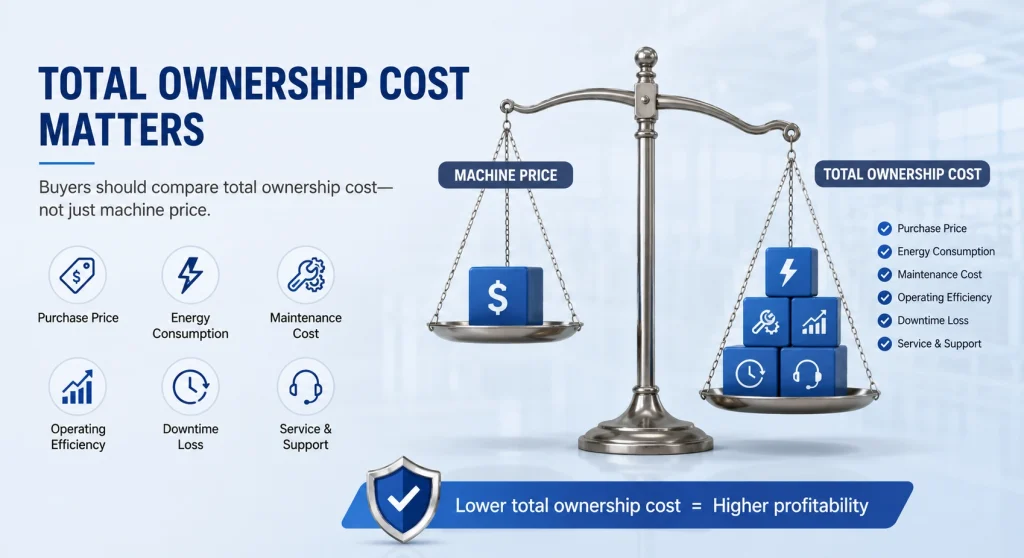
The cheapest quote often becomes the most expensive machine over time.
Low solvent recovery quietly destroys profitability.
Bigger is not always better. Oversized systems waste capital and energy.
Manual operation increases labor cost and inconsistency.
Poor support creates long downtime and expensive maintenance.
One of the most common purchasing questions is whether to choose a batch or continuous evaporation system. The right answer depends entirely on production requirements.
| Factor | Batch Evaporator | Continuous Evaporator |
|---|---|---|
| Flexibility | High | Medium |
| Automation | Medium | High |
| Output Volume | Medium | High |
| Initial Cost | Lower | Higher |
| Recipe Changes | Easy | Limited |
Batch systems are ideal for manufacturers handling multiple products or frequently changing formulations. They provide greater flexibility and easier process control for smaller production runs.
Continuous systems are better suited for large-scale industrial plants with stable production recipes and high throughput requirements.
In general:
Another major buying decision involves selecting between single-effect and multi-effect systems.
Multi-effect systems reuse vapor energy from one stage to the next, significantly reducing energy consumption.
If energy cost is a major concern, multi-effect systems often deliver better long-term ROI.
In modern botanical and pharmaceutical processing, the industrial vacuum evaporator plays a crucial role in concentrating delicate plant extracts without subjecting active bio-compounds to damaging high temperatures. By reducing internal pressure, the boiling point of water and solvents drops significantly (often operating between 45℃ and 60℃), preventing thermal degradation of heat-sensitive ingredients such as flavonoids, alkaloids, and volatile aromatics.
When integrated into a complete processing line, evaporators work seamlessly alongside specialized vacuum mixing tank systems to handle high-viscosity slurries and prevent oxidation during initial blending stages.
Key industrial applications in herbal processing include:
To explore customized configurations, high-efficiency single/double-effect designs, and sanitary GMP-compliant systems tailored to your production scale, visit our complete range of extraction concentration equipment.
| Factor | Vacuum | Atmospheric |
|---|---|---|
| Temperature | Lower | Higher |
| Energy Efficiency | High | Medium |
| Product Protection | Excellent | Limited |
| Heat Damage Risk | Low | High |
Vacuum evaporation is especially important for heat-sensitive materials such as botanical extracts, essential oils, and pharmaceutical compounds.
Atmospheric evaporation may work for robust materials, but it often causes thermal degradation and quality loss when processing sensitive products.
One of the most frequently asked questions is: How much does an industrial vacuum evaporator cost?
The answer depends on capacity, material, automation level, and customization requirements.
| Capacity | Estimated Cost |
|---|---|
| 50–100L | $5,000–15,000 |
| 200–500L | $15,000–40,000 |
| 500–1000L | $40,000–80,000 |
| 1000L+ | $80,000+ |
| Cost Factor | Impact |
|---|---|
| Tank Volume | High |
| Material Grade | Medium |
| PLC Automation | High |
| Condenser Size | Medium |
| Explosion-proof Design | High |
For plants processing viscous extracts, integrating a heating mixing tank before evaporation can improve heat transfer and concentration efficiency.
| Factor | Low-End Supplier | Professional Manufacturer |
|---|---|---|
| Vacuum Stability | Poor | Stable |
| Material Quality | Variable | Controlled |
| Automation | Basic | Advanced PLC |
| After-sales | Weak | Strong |
Chinese manufacturers can provide excellent value when engineering capability and quality control are strong. The key is selecting a professional factory rather than choosing based on price alone.
For most industrial buyers, the real question is not just machine price—it is return on investment.
A properly configured vacuum evaporation system can reduce production cost through:
A simple ROI calculation can be expressed as:
ROI Period = Machine Cost / Monthly Savings
Example:
ROI calculation:
$28,000 / $3,200 = 8.75 months
This means the industrial vacuum evaporator machine pays for itself in less than 9 months.
For plants with high solvent usage or large evaporation volumes, payback can be even faster.
Use this quick decision guide:
| Your Requirement | Recommended Solution |
|---|---|
| < 200L/day production | Batch system |
| > 1000L/day production | Continuous system |
| Need flexible recipes | Batch + PLC |
| Need energy savings | Multi-effect evaporator |
| Heat-sensitive materials | Vacuum evaporation system |
This framework helps buyers quickly narrow down the most suitable configuration.
Q: How much does an industrial vacuum evaporator cost?
A: Small systems typically start around $5,000–15,000, while large industrial systems can exceed $80,000. Final pricing depends on capacity, material grade, automation, and customization requirements.
Q: How long does ROI usually take?
A: Most manufacturers achieve ROI within 8–24 months. High solvent recovery applications may recover investment even faster.
Q: Are Chinese vacuum evaporators reliable?
A: Yes—if purchased from an experienced manufacturer with strong engineering capability, quality control, and reliable after-sales support. Supplier selection matters more than country alone.
Q: What solvent recovery rate is considered good?
A: A well-designed industrial system can often achieve 90%+ recovery, depending on solvent type, condenser efficiency, and operating conditions.
Q: Should I choose 304 or 316L stainless steel?
A: For pharmaceutical, botanical, and food processing applications, 316L is usually preferred because of its superior corrosion resistance and sanitation performance.
Choosing the right industrial vacuum evaporator is not simply about buying a machine—it is about investing in long-term production efficiency, stable quality, and operational profitability.
The best system is not always the cheapest. It is the one that delivers:
Before purchasing, request detailed engineering support rather than relying only on quotations.
A professional manufacturer should help you evaluate:
Making the right decision now can save your factory significant cost for years to come.
If you are evaluating extraction or concentration equipment, our engineering team can help you choose the right configuration based on your material, capacity, and production goals.
Contact Panchi Machinery for:
Complete production line solutions


Whatsapp: +8615736768129
Email: [email protected]
Address: Zhengzhou, Henan Province, China
Automatic Vacuum Honey Processing & Filtering Machine
Vacuum Low-Temperature Liquid Extraction & Concentration Unit
Custom Steam Distillation & Heat Reflux Essential Oil Equipment
SS304/316L Low-Temperature Vacuum Scraper Concentrator
QN Spherical Vacuum Concentrator & Alcohol Recovery Unit
Multi-function Stainless Steel Vacuum Distillation & Extraction Unit
Hot Reflux Vacuum Liquid Extraction & Concentration Unit
Single-Effect External Circulation Vacuum Concentrator
SJN Series Double-Effect External Circulation Vacuum Evaporator
We will contact you within one working day. Please pay attention to your email.
Automatic Vacuum Honey Processing & Filtering Machine
Vacuum Low-Temperature Liquid Extraction & Concentration Unit
Custom Steam Distillation & Heat Reflux Essential Oil Equipment
WhatsApp: +8615736768129
Email: [email protected]
Address: Zhengzhou, Henan Province, China


COPYRIGHT© 2026 Zhengzhou Panchi Machinery Equipment Co., Ltd. | Privacy Policy

Our team will respond within 24 hours.
Thanks! We'll get back to you within 24 hours.
Check your inbox (and spam folder) for our reply.