
Searching for a complete guide to the botanical extraction process?
Whether you are building a new extraction plant, scaling an herbal production line, or optimizing an existing factory, understanding the full industrial workflow is critical for maximizing extract quality, reducing solvent loss, and improving profitability.
Botanical extracts are widely used in pharmaceutical, nutraceutical, food, cosmetic, and herbal supplement industries. Yet many investors and plant owners underestimate how complex a modern botanical extraction process really is.
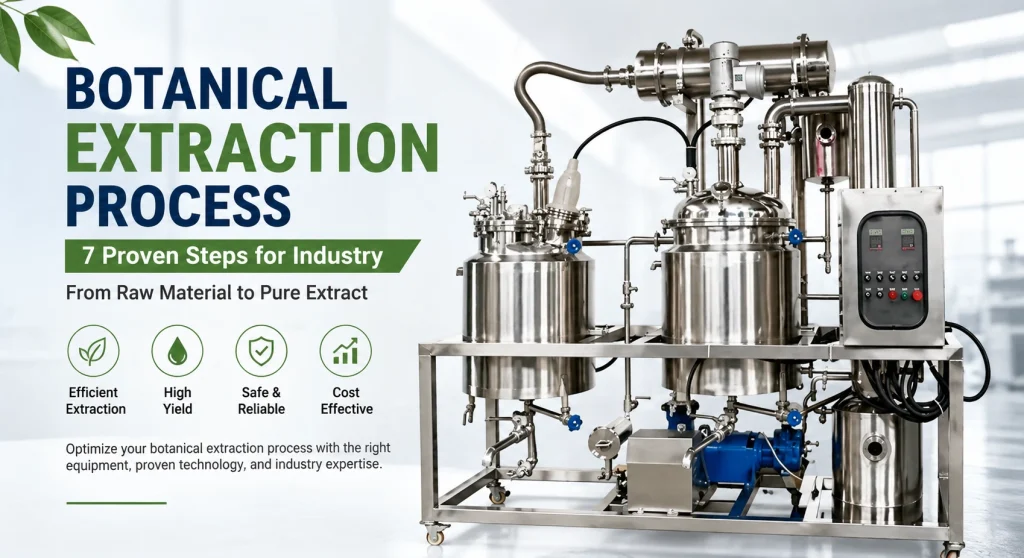
A profitable extraction line is not just about dissolving compounds into a solvent. It is about maximizing yield, preserving active ingredients, minimizing thermal degradation, controlling operating costs, and achieving regulatory compliance.
The best extraction plants do not simply extract more—they extract smarter, faster, and with lower operating costs.
In this guide, we will explain:
The botanical extraction process refers to the industrial method of separating valuable active compounds from plant-based raw materials using solvents, heat, pressure, or specialized extraction technologies.
Target compounds may include:
The purpose is to isolate these compounds while preserving biological activity and minimizing degradation.
Industrial extracts are commonly used in:
The success of a plant extraction process depends heavily on engineering design and process control.
Extraction efficiency directly impacts profitability.
Example:
| Factory | Extraction Yield | Recovered Actives |
|---|---|---|
| Factory A | 80% | 64 kg |
| Factory B | 92% | 73.6 kg |
Difference:
9.6 kg more extract per batch
If extract sells at $120/kg:
$1,152 extra profit per batch
This explains why industrial buyers care deeply about:
| Extraction Method | Best For | Main Solvent |
|---|---|---|
| Water Extraction | Polysaccharides, water-soluble compounds | Water |
| Ethanol Extraction | Flavonoids, alkaloids, phenolics | Ethanol |
| Steam Distillation | Essential oils | Steam |
| CO₂ Extraction | Premium oils | CO₂ |
Suitable for water-soluble compounds such as polysaccharides and proteins. Widely used in mushroom extraction and TCM production.
Ideal for flavonoids, polyphenols, and alkaloids. This is one of the most common industrial botanical extraction methods.
Mainly used for essential oil production from flowers and aromatic plants.
High purity and low oxidation risk, but requires high CAPEX.
Raw materials include:
Preparation includes:
Particle size directly affects solvent penetration and extraction yield. For fibrous roots, dried leaves, and hard botanical materials, using an industrial herbal grinding machine helps achieve uniform particle size for faster and more efficient extraction.
This is the core of the botanical extraction process.
Raw material enters the extraction tank, where solvent dissolves target compounds.
Key variables:
Modern industrial plants typically use integrated botanical extraction equipment with vacuum heating, agitation, and concentration functions to improve extraction yield while minimizing thermal degradation.
Filtration removes:
Extract liquid usually contains excessive solvent.
Vacuum concentration removes excess solvent while protecting heat-sensitive compounds.
Advantages:
Alcohol precipitation removes:
Industrial purification is commonly performed using a alcohol precipitation tank to remove starch, proteins, and unwanted macromolecules while preserving valuable active compounds.
Solvent recovery is critical for cost control.
High-performance recovery systems help:
Final drying converts concentrate into saleable products.
Common methods:
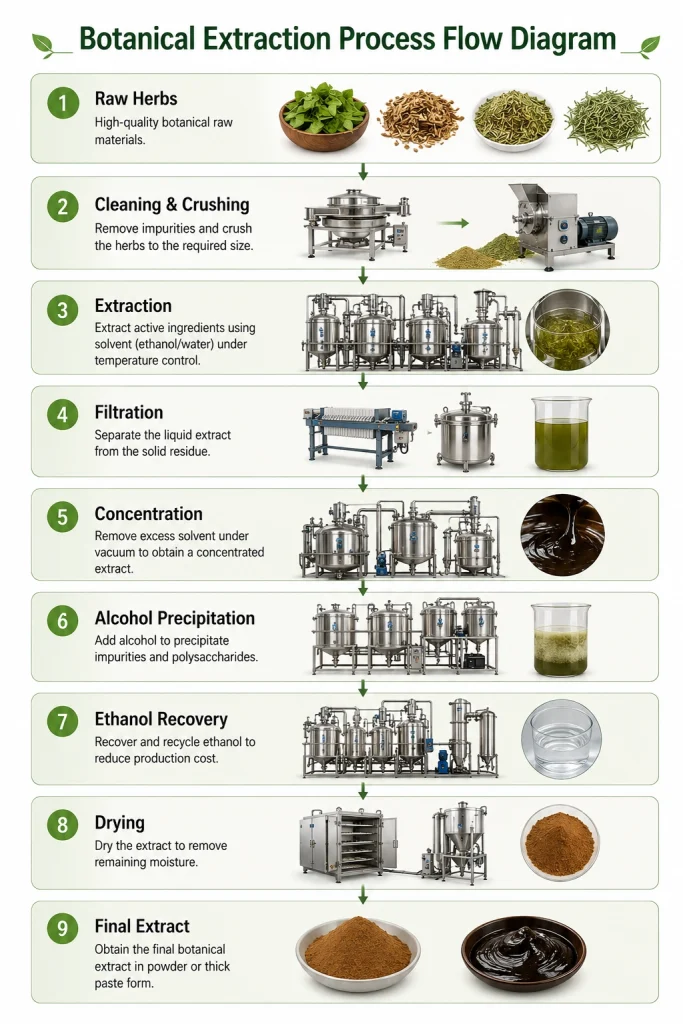
This workflow represents a typical industrial plant extraction process used in modern manufacturing facilities.
Poor sanitary design increases contamination risk and cleaning time.
| Stage | Common Problem | Optimization |
|---|---|---|
| Grinding | Uneven particle size | Use fine grinding system |
| Extraction | Low yield | Optimize solvent ratio |
| Filtration | Slow flow | Upgrade filtration system |
| Concentration | Overheating | Use vacuum concentrator |
| Recovery | Solvent loss | Use efficient condenser |
Optimization at every stage improves overall ROI.
One of the most common buyer questions is:
How much does a botanical extraction plant cost?
The answer depends heavily on capacity, automation level, GMP requirements, and process complexity.
| Plant Scale | Typical Cost Range |
|---|---|
| Pilot Plant | $20,000–$50,000 |
| Medium Production Line | $80,000–$250,000 |
| Large Industrial Plant | $300,000–$1,000,000+ |
Main cost drivers:
Lower CAPEX often means higher long-term OPEX.
Cheap systems may have poor efficiency, higher solvent loss, and higher maintenance costs.
Without proper ethanol recovery, operating cost rises dramatically.
Oversized tanks waste energy. Undersized tanks limit production.
Non-GMP design can cause contamination and audit failures.
Traders often lack engineering support and process knowledge.
Industrial buyers should evaluate more than catalog price.
Key considerations:
Cheap equipment may reduce initial CAPEX but increase long-term OPEX.
Professional buyers focus on lifecycle ROI, not catalog price alone.
A herbal extract manufacturer faced three major problems:
After upgrading the extraction line with:
Results improved dramatically:
| Metric | Before | After |
|---|---|---|
| Yield | 81% | 93% |
| Solvent Loss | High | -40% |
| Downtime | Frequent | Minimal |
Payback period:
Approximately 11 months
Although the core botanical extraction process follows similar principles, actual equipment configuration and processing parameters vary significantly by industry and raw material type.
Different products require different extraction temperatures, solvents, purification steps, and drying technologies.
Traditional herbal medicine production often focuses on extracting water-soluble compounds such as polysaccharides, glycosides, and alkaloids from roots, bark, and medicinal herbs.
Typical raw materials include:
These plants often require:
Alcohol precipitation is particularly important in TCM production because it helps remove starch, proteins, and unwanted macromolecules while preserving active ingredients.
Nutraceutical manufacturers prioritize high-purity extracts with stable active compound concentration.
Common applications include:
Key production priorities include:
This industry often relies heavily on advanced solvent recovery and precise temperature control.
Essential oil production differs significantly from standard herbal extraction.
Instead of maximizing solid extract yield, the focus is preserving volatile aromatic compounds.
Common raw materials:
Critical requirements include:
Steam distillation remains the dominant extraction method for essential oil production.
Food manufacturers use extraction systems to produce natural flavors, pigments, sweeteners, and antioxidants.
Examples include:
In food applications, hygiene and sanitation become especially critical.
Most modern food-grade botanical extraction equipment uses SUS304 or SUS316L stainless steel construction to meet GMP and food safety standards.
Panchi Machinery specializes in industrial extraction and processing systems for pharmaceutical, botanical, nutraceutical, and food industries.
We provide complete turnkey solutions including:
Our systems are designed for:
Rather than selling standalone machines, we help customers build complete production workflows optimized for efficiency and profitability.
During supplier consultations, engineering discussions, and online research, buyers frequently ask practical questions about the botanical extraction process. These questions often appear in Google’s People Also Ask section and B2B industry forums such as Quora.
There is no single “best” method for every material. The most efficient botanical extraction method depends on the target compound, solvent compatibility, extraction yield requirements, and production cost targets.
For example:
In industrial production, the most efficient solution is usually the one that maximizes yield while minimizing solvent consumption and operating cost.
The total time depends on raw material type, extraction method, batch size, and downstream processing requirements.
A standard industrial botanical extraction process may include:
For many factories, a complete batch can take anywhere from 8 hours to over 24 hours.
Extraction yield varies significantly depending on plant species, solvent selection, and process optimization.
Typical industrial ranges include:
Even a 3–5% improvement in extraction yield can generate substantial annual profit for large-scale plants.
Ethanol is widely used because it offers excellent solvency for many active compounds while remaining relatively safe for food, pharmaceutical, and nutraceutical applications.
Advantages of ethanol include:
This is why ethanol extraction remains one of the most popular industrial botanical extraction methods worldwide.
Yes. Small and medium manufacturers can start with pilot or semi-automatic systems before scaling into full industrial production.
Common entry-level plant sizes include:
As production demand increases, these systems can be upgraded into fully automated GMP-compliant lines.
Q: What is the best solvent for botanical extraction?
A: The best solvent depends on target compounds. Water is ideal for polysaccharides and proteins, while ethanol is preferred for flavonoids, alkaloids, and many phenolic compounds due to its strong extraction efficiency.
Q: What equipment is needed for a botanical extraction plant?
A: A complete plant usually includes grinding equipment, extraction tanks, filtration systems, vacuum concentrators, alcohol precipitation tanks, ethanol recovery systems, and drying equipment for final product processing.
Q: How long does the botanical extraction process take?
A: It depends on raw material, solvent, and process design. Industrial extraction may take from several hours to more than a day, including extraction, filtration, concentration, and drying stages.
Q: Is ethanol extraction safe?
A: Yes, when proper explosion-proof design, ventilation, and solvent recovery systems are used. Industrial ethanol extraction plants must follow strict safety and environmental regulations.
Q: How much does a botanical extraction plant cost?
A: Costs vary significantly depending on capacity, automation level, GMP requirements, and solvent recovery systems. Small lines may start at tens of thousands of dollars, while large turnkey plants cost much more.
Planning a new botanical extraction facility?
Before investing in equipment, ensure your botanical extraction process is optimized for yield, efficiency, and profitability.
Send your raw materials and production requirements to Panchi engineers.
Build your extraction plant with confidence—start with the right process design.


Whatsapp: +8615736768129
Email: [email protected]
Address: Zhengzhou, Henan Province, China
Automatic Vacuum Honey Processing & Filtering Machine
Vacuum Low-Temperature Liquid Extraction & Concentration Unit
Custom Steam Distillation & Heat Reflux Essential Oil Equipment
SS304/316L Low-Temperature Vacuum Scraper Concentrator
QN Spherical Vacuum Concentrator & Alcohol Recovery Unit
Multi-function Stainless Steel Vacuum Distillation & Extraction Unit
Hot Reflux Vacuum Liquid Extraction & Concentration Unit
Single-Effect External Circulation Vacuum Concentrator
SJN Series Double-Effect External Circulation Vacuum Evaporator
We will contact you within one working day. Please pay attention to your email.
Automatic Vacuum Honey Processing & Filtering Machine
Vacuum Low-Temperature Liquid Extraction & Concentration Unit
Custom Steam Distillation & Heat Reflux Essential Oil Equipment
WhatsApp: +8615736768129
Email: [email protected]
Address: Zhengzhou, Henan Province, China


COPYRIGHT© 2026 Zhengzhou Panchi Machinery Equipment Co., Ltd. | Privacy Policy

Our team will respond within 24 hours.
Thanks! We'll get back to you within 24 hours.
Check your inbox (and spam folder) for our reply.