
Selecting the right evaporation equipment is a critical decision for manufacturers aiming to improve production efficiency, reduce operating costs, and maintain consistent product quality. Whether you produce herbal extracts, fruit concentrates, dairy products, pharmaceuticals, or specialty chemicals, the comparison between a batch vs continuous evaporator goes far beyond processing capacity—it directly affects long-term productivity and return on investment.
Although both systems remove water or solvents by evaporation, they are designed for different production strategies. A batch evaporator provides maximum flexibility for manufacturers processing multiple products or frequently changing recipes, while a continuous evaporator is built for stable, high-volume production with greater automation and lower operating costs.
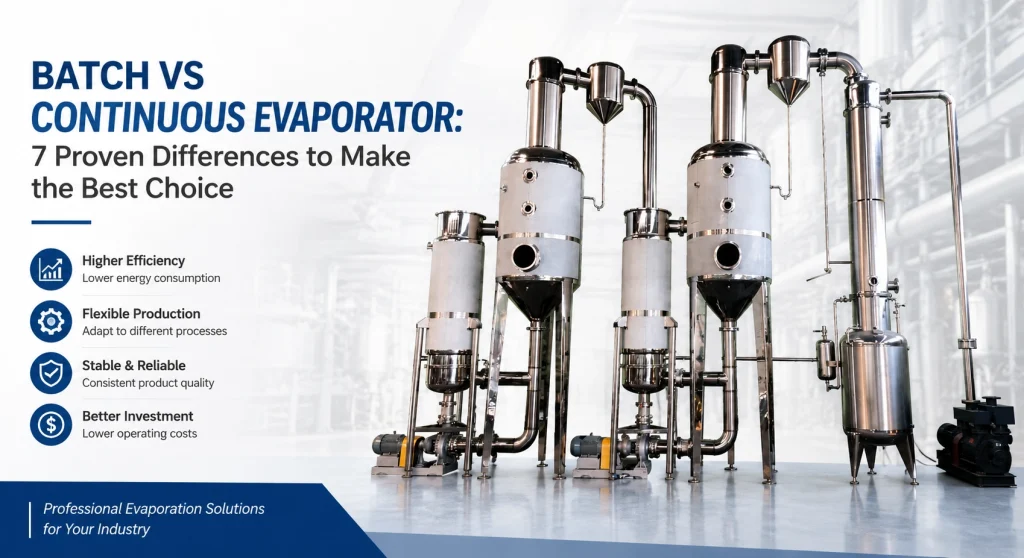
Before selecting an industrial evaporation system, manufacturers should evaluate not only daily production volume but also product characteristics, cleaning requirements, future expansion plans, and overall process efficiency. These factors often determine which solution delivers the best long-term value.
A batch evaporator processes a fixed quantity of liquid during each production cycle. Raw material is loaded into the vessel, heated under atmospheric or vacuum conditions until the desired concentration is reached, and then discharged before the next batch begins.
Because every cycle operates independently, process parameters such as temperature, vacuum level, concentration ratio, and processing time can be adjusted for different products. This flexibility makes batch processing particularly suitable for manufacturers producing multiple formulations or handling heat-sensitive materials.
Typical batch evaporator applications include:
Many botanical processing plants combine a batch evaporator with complete herbal extraction equipment to concentrate plant extracts while preserving active compounds and product quality.
Unlike batch processing, a continuous evaporator operates without interruption. Fresh feed continuously enters the system while concentrated product is discharged at the same rate. Once stable operating conditions are established, the process maintains consistent concentration, temperature, and flow throughout production.
A continuous evaporator is designed for factories that process large volumes of the same product over long production periods. Because heating conditions remain stable, energy utilization is significantly improved compared with repeated batch heating.
Typical applications include:
Many modern systems integrate a vacuum evaporator with multi-effect technology to reduce boiling temperature and improve energy efficiency when processing heat-sensitive products.
| Feature | Batch Evaporator | Continuous Evaporator |
|---|---|---|
| Production Mode | One batch at a time | Continuous operation |
| Daily Capacity | Small to medium | Medium to large |
| Product Flexibility | Excellent | Moderate |
| Automation Level | Medium | High |
| Labor Requirement | Higher | Lower |
| Product Consistency | Good | Excellent |
| Initial Investment | Lower | Higher |
| Operating Cost | Higher | Lower |
| Best Application | Multiple products and frequent changeovers | Large-scale standardized production |
While this comparison provides a useful starting point, selecting the right system requires a deeper understanding of production goals, operating costs, and future expansion plans. In the following sections, we’ll compare the batch vs continuous evaporator in detail, including energy efficiency, production capacity, automation, maintenance, and overall return on investment.
Understanding the differences between a batch vs continuous evaporator helps manufacturers select equipment that matches both current production needs and long-term business objectives. While both systems concentrate liquids by removing water or solvents, they differ in productivity, flexibility, operating costs, and scalability.
Rather than asking which technology is better, manufacturers should ask which solution best fits their products, production schedule, and future expansion plans.
Production volume is often the first factor when comparing a batch evaporator with a continuous evaporator.
A batch system processes one production cycle at a time. Once the target concentration is reached, the product is discharged before the next cycle begins. This creates unavoidable downtime between batches, making it more suitable for small to medium production volumes.
A continuous evaporator maintains a constant product flow. Raw material enters continuously while concentrated product leaves the system without interrupting production. This allows factories to operate efficiently for long production runs with significantly higher output.
Recommended Choice
| Production Scale | Recommended System |
|---|---|
| Pilot production | Batch Evaporator |
| Small and medium production | Batch Evaporator |
| Large-scale industrial production | Continuous Evaporator |
Not every factory produces the same product every day.
Manufacturers processing botanical extracts, pharmaceutical ingredients, or specialty food products often need to change recipes several times a week. A batch evaporator makes these changes simple because each production cycle is independent.
By comparison, a continuous evaporator performs best when processing the same product continuously. Frequent product changes require cleaning, parameter adjustments, and production downtime, reducing overall efficiency.
If production flexibility is a priority, batch processing usually provides the greatest operational advantage.
Energy costs represent a significant portion of an evaporation system’s operating expenses.
Each time a batch evaporator starts a new production cycle, the product must be reheated to the required evaporation temperature. Repeated heating increases steam consumption and extends processing time.
A continuous evaporator operates under stable thermal conditions, allowing heat to be used more efficiently. Many systems are also integrated with a multi-effect evaporator, where secondary steam from one effect is reused to heat the next stage, reducing overall steam demand and operating costs.
For factories operating every day, improved thermal efficiency can significantly reduce annual utility expenses.
Consistent product quality is essential for industries such as food processing, pharmaceuticals, and botanical extraction.
With a batch evaporator, product quality depends on maintaining the same operating conditions for every production cycle. Modern PLC controls improve repeatability, but slight differences between batches may still occur.
A continuous evaporator maintains constant temperature, vacuum, and flow conditions throughout production, resulting in more uniform concentration and product quality.
Manufacturers supplying international markets or producing standardized ingredients often prefer continuous processing for its consistency.
Labor availability has become an important consideration for many manufacturers.
A batch evaporator generally requires more manual involvement during loading, unloading, monitoring, and cleaning.
A modern continuous evaporation system integrates automatic feeding, vacuum control, temperature monitoring, concentration adjustment, and PLC control into one process. Once production starts, only limited operator supervision is required.
Higher automation reduces labor costs while improving production stability and traceability.
Comparing equipment prices alone rarely leads to the best purchasing decision.
A batch evaporator usually requires a lower initial investment, making it attractive for startups, pilot plants, or companies with limited production capacity.
A continuous evaporator has a higher purchase price but often delivers lower long-term operating costs through:
Manufacturers should evaluate the total cost of ownership rather than focusing only on the initial equipment investment.
Equipment should support not only today’s production requirements but also tomorrow’s growth.
If production demand is expected to increase over the next several years, investing in a scalable industrial evaporation system can reduce future upgrade costs and production interruptions.
Many manufacturers also integrate a vacuum concentration evaporator into their production line to improve evaporation efficiency when processing heat-sensitive products, allowing capacity to increase without compromising product quality.
Planning for expansion during the equipment selection stage often results in a lower overall investment across the equipment’s lifecycle.
| Your Priority | Recommended Choice |
|---|---|
| Frequent product changes | Batch Evaporator |
| Small production batches | Batch Evaporator |
| Lower initial investment | Batch Evaporator |
| High production capacity | Continuous Evaporator |
| Maximum automation | Continuous Evaporator |
| Lower long-term operating costs | Continuous Evaporator |
| Stable product quality | Continuous Evaporator |
| Future production expansion | Continuous Evaporator |
The comparison shows that there is no universal solution for every manufacturer. The right choice depends on balancing production flexibility, operating efficiency, investment budget, and long-term business strategy. In the next section, we’ll explore how to select the most suitable evaporation system based on your industry, product characteristics, and production goals.
After understanding the differences between a batch vs continuous evaporator, the next step is determining which solution best matches your production requirements. Instead of focusing only on equipment specifications, manufacturers should evaluate their entire production process, from raw material characteristics to future capacity expansion.
The right industrial evaporation system should improve efficiency today while remaining flexible enough to support future business growth.
Every product behaves differently during evaporation. Factors such as viscosity, solid content, foaming tendency, and heat sensitivity all influence equipment selection.
For example, botanical extracts, pharmaceutical ingredients, and natural food concentrates often require low-temperature processing to preserve active compounds, color, and flavor. In these applications, integrating a vacuum evaporator into the production line helps reduce the boiling temperature while maintaining product quality.
Manufacturers should also consider cleaning requirements and recipe changes. Products that require frequent cleaning or multiple formulations generally benefit from flexible processing configurations, while standardized products are better suited for long, uninterrupted production runs.
The purchase price is only one part of the investment.
A complete evaluation should include:
In many cases, equipment with a higher initial investment delivers lower operating costs over several years. Looking beyond the purchase price helps manufacturers make more profitable long-term decisions.
Many factories purchase equipment based on current production demand, only to find that capacity becomes a limitation within a few years.
When selecting an industrial evaporation system, consider:
Choosing equipment with expansion capability often avoids costly production upgrades later.
Different industries have different production priorities. Matching the evaporation process to the application improves both efficiency and product quality.
| Industry | Recommended Solution | Primary Focus |
|---|---|---|
| Botanical Extraction | Flexible vacuum evaporation | Product quality |
| Essential Oil Processing | Vacuum concentration | Heat-sensitive materials |
| Food & Beverage | Continuous production | High capacity |
| Dairy Processing | Automated evaporation | Consistent quality |
| Pharmaceutical Manufacturing | Controlled evaporation | Precision and hygiene |
| Chemical Processing | Continuous operation | Maximum productivity |
This comparison provides a useful starting point, but every project should be evaluated according to its specific process requirements.
Standard equipment does not always provide the best performance.
Production capacity, product characteristics, utility conditions, and factory layout vary from one manufacturer to another. For this reason, many companies choose customized evaporation solutions rather than off-the-shelf equipment.
An integrated solution may include:
Combining these systems improves production efficiency while reducing manual operation and energy consumption.
For manufacturers building a complete processing line, integrating the evaporator with herbal extraction equipment and downstream concentration units creates a more efficient workflow while simplifying daily operation.
Choosing between a batch vs continuous evaporator is ultimately a business decision rather than simply a technical one.
Factories producing multiple high-value products may prioritize flexibility and shorter production runs, while manufacturers focused on large-scale output often benefit from greater automation and lower operating costs.
The most successful projects begin with a clear understanding of production goals, product requirements, and future expansion plans. Evaluating these factors before purchasing equipment helps maximize return on investment while reducing operating risks over the equipment’s service life.
Rather than selecting equipment based solely on capacity or purchase price, manufacturers should invest in a solution that supports long-term productivity, product quality, and sustainable growth.
Every production process is different, and there is no one-size-fits-all evaporation system.
Whether you’re designing a new processing line or upgrading existing equipment, selecting the right solution requires careful evaluation of production capacity, product characteristics, energy efficiency, and future expansion requirements.
Panchi provides customized evaporation solutions for botanical extraction, food processing, pharmaceutical manufacturing, and chemical applications. From compact vacuum concentration units to fully integrated evaporation systems, our engineering team works closely with customers to recommend equipment based on actual production needs—not standard specifications.
If you’re planning a new project or comparing different evaporation technologies, contact our engineers to discuss your application and receive a customized process recommendation.
Q: What is the difference between a batch and a continuous evaporator?
A: The main difference is how the system operates. A batch evaporator processes one fixed volume of liquid at a time, while a continuous evaporator feeds and discharges product continuously without stopping. Batch systems are better suited for flexible, small-volume production, whereas continuous evaporators are designed for large-scale manufacturing with higher efficiency, stable product quality, and lower operating costs.
Q: Which evaporator is more energy efficient?
A: In most industrial applications, a continuous evaporator is more energy efficient because it operates under stable conditions and can be integrated with multi-effect evaporation or heat recovery systems. Batch evaporators require repeated heating for every production cycle, which generally increases steam consumption. However, for small production volumes or frequent product changes, a batch system may still be the more economical choice.
Q: When should I choose a batch evaporator?
A: A batch evaporator is recommended when production involves multiple products, frequent recipe changes, or relatively small processing volumes. It is widely used for herbal extracts, pharmaceutical ingredients, essential oils, and specialty food products where flexibility is more important than maximum production capacity.
Q: Which industries use continuous evaporators?
A: Continuous evaporators are commonly used in industries that require high-volume, stable production, including fruit juice concentration, dairy processing, starch manufacturing, food ingredients, chemical processing, and industrial wastewater treatment. Their high automation level and consistent product quality make them ideal for continuous manufacturing environments.
Q: How do I choose the right evaporator for my production line?
A: Selecting the right evaporator depends on several factors, including production capacity, product characteristics, energy consumption, automation requirements, and future expansion plans. Evaluating the total cost of ownership—not just the initial equipment price—helps manufacturers choose an evaporation system that delivers the best long-term return on investment. If you’re unsure which solution fits your application, consulting an experienced equipment supplier is the best way to identify the most suitable system.


Whatsapp: +8615736768129
Email: [email protected]
Address: Zhengzhou, Henan Province, China
Automatic Vacuum Honey Processing & Filtering Machine
Vacuum Low-Temperature Liquid Extraction & Concentration Unit
Custom Steam Distillation & Heat Reflux Essential Oil Equipment
SS304/316L Low-Temperature Vacuum Scraper Concentrator
QN Spherical Vacuum Concentrator & Alcohol Recovery Unit
Multi-function Stainless Steel Vacuum Distillation & Extraction Unit
Hot Reflux Vacuum Liquid Extraction & Concentration Unit
Single-Effect External Circulation Vacuum Concentrator
SJN Series Double-Effect External Circulation Vacuum Evaporator
We will contact you within one working day. Please pay attention to your email.
Automatic Vacuum Honey Processing & Filtering Machine
Vacuum Low-Temperature Liquid Extraction & Concentration Unit
Custom Steam Distillation & Heat Reflux Essential Oil Equipment
WhatsApp: +8615736768129
Email: [email protected]
Address: Zhengzhou, Henan Province, China


COPYRIGHT© 2026 Zhengzhou Panchi Machinery Equipment Co., Ltd. | Privacy Policy

Our team will respond within 24 hours.
Thanks! We'll get back to you within 24 hours.
Check your inbox (and spam folder) for our reply.