
Selecting the right powder processing equipment is one of the most important decisions when designing or upgrading a powder manufacturing facility. Whether producing food ingredients, botanical extracts, pharmaceutical powders, nutraceuticals, or specialty chemicals, the equipment you choose directly affects product quality, production efficiency, operating costs, and long-term profitability.
Many buyers compare machines based primarily on capacity, motor power, or purchase price. While these specifications are important, they rarely determine whether a production line will consistently meet quality requirements. Factors such as raw material characteristics, target particle size, moisture content, automation level, and future production expansion often have a greater impact on long-term performance than the grinding machine itself.
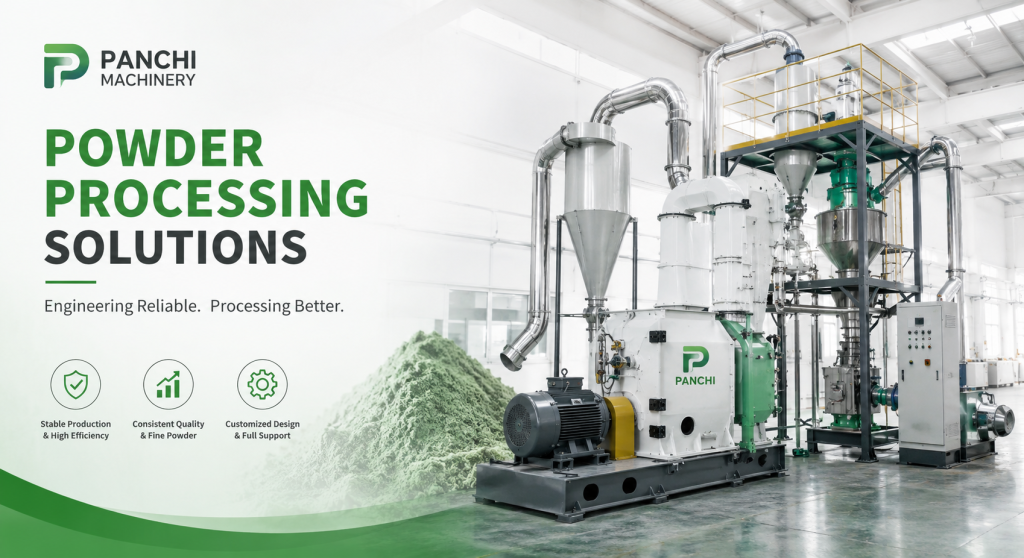
Understanding how to choose powder processing equipment requires evaluating the complete production process rather than a single machine. A well-designed powder processing line integrates grinding, classification, screening, conveying, dust collection, and process control to deliver stable product quality while minimizing waste and energy consumption.
In short: The right equipment improves product consistency, lowers operating costs, increases production efficiency, and supports future business growth.
Industrial powder production has become increasingly demanding. Customers expect tighter quality tolerances, consistent particle size distribution, and reliable batch-to-batch performance. At the same time, manufacturers face rising energy costs, stricter environmental regulations, and growing pressure to improve productivity.
These challenges cannot usually be solved by purchasing a larger grinder alone. Instead, successful manufacturers invest in complete industrial powder processing solutions that balance capacity, precision, automation, and operational flexibility. Selecting equipment based on the entire production workflow reduces bottlenecks and creates a more reliable manufacturing process.
Quick Answer
How to choose powder processing equipment begins with understanding your material characteristics, required particle size, production capacity, and quality objectives. Rather than comparing machines only by output or price, manufacturers should evaluate complete process performance, equipment compatibility, maintenance requirements, and long-term operating costs. An integrated powder processing line often delivers higher efficiency and better return on investment than purchasing individual machines separately.
| Selection Factor | Why It Is Important |
|---|---|
| Raw Material | Determines the suitable grinding technology. |
| Target Particle Size | Influences equipment selection and process design. |
| Production Capacity | Ensures the system meets current and future demand. |
| Automation Level | Improves consistency while reducing labor costs. |
| Integrated Processing Line | Optimizes overall production efficiency and product quality. |
Why This Guide Matters
Choosing powder processing equipment is no longer about selecting the largest or fastest machine. Modern manufacturing requires a balanced solution that combines reliable grinding performance, efficient material handling, stable process control, and scalable production capacity. This guide explains the engineering principles and practical selection criteria used by experienced manufacturers to make informed investment decisions.
This guide is designed for professionals responsible for selecting, upgrading, or optimizing industrial powder processing systems.
Whether you are building a new production line or replacing existing equipment, choosing the right solution requires balancing product quality, production efficiency, operating costs, and future expansion. The information below is intended to help decision-makers evaluate equipment from both an engineering and business perspective.
By the end of this guide, you’ll understand how to evaluate powder processing equipment based on real production requirements rather than marketing specifications.
Selecting equipment should follow a structured engineering process rather than focusing on a single specification.
| Step | Key Question | Decision Focus |
|---|---|---|
| 1 | What material will be processed? | Material hardness, moisture content, abrasiveness, and bulk density. |
| 2 | What is the required finished particle size? | Select appropriate grinding and classification technology. |
| 3 | What production capacity is required? | Match equipment size with current and future demand. |
| 4 | How automated should the production line be? | Evaluate labor savings, process consistency, and scalability. |
| 5 | What supporting systems are required? | Screening, conveying, dust collection, and process control. |
| 6 | What is the expected long-term operating cost? | Compare energy efficiency, maintenance, spare parts, and total cost of ownership. |
Engineer’s Tip
The first question should never be “Which grinding machine should I buy?” Instead, ask “What production result do I need?” Defining product specifications, capacity requirements, and process objectives before comparing equipment helps avoid costly purchasing mistakes and leads to a more efficient production system.
Choosing the right machine is only the beginning. The highest-performing manufacturers optimize the entire production workflow, ensuring that grinding, classification, screening, conveying, dust collection, and quality control operate as one coordinated system. This integrated approach improves production stability, reduces downtime, and creates a foundation for future expansion.
In the next section, we’ll compare the major types of powder processing equipment, explain how each technology works, and help you determine which solution best matches your production goals and material characteristics.
In short: There is no universal machine suitable for every powder processing application. The right solution depends on material characteristics, required particle size, production capacity, and downstream process requirements.
Modern powder manufacturing involves much more than grinding raw materials into smaller particles. An efficient production system integrates multiple processing stages to achieve stable product quality, consistent throughput, and lower operating costs. Understanding the function of each type of equipment helps manufacturers build a production line that delivers long-term performance instead of simply increasing capacity.
Rather than comparing machines based only on output, experienced buyers evaluate how each piece of equipment contributes to the overall production process. This system-level approach improves product consistency while minimizing bottlenecks and unnecessary energy consumption.
| Equipment | Primary Function | Typical Applications |
|---|---|---|
| Hammer Mill | Coarse to medium grinding | Herbs, grains, spices, food ingredients |
| Pin Mill | Fine grinding with narrow particle distribution | Sugar, starch, botanical powders, seasonings |
| Air Classifier Mill | Grinding and classification in one system | Fine chemicals, pharmaceuticals, mineral powders |
| Jet Mill | Ultra-fine grinding without excessive heat | Pharmaceuticals, specialty chemicals, battery materials |
| Vibrating Sieve | Particle size screening and quality control | Finished powder inspection and grading |
| Air Classifier | Separate powders into different particle size ranges | High-precision powder processing |
| Dust Collection System | Recover fine powder and improve workplace safety | Continuous industrial production |
| Conveying System | Automatically transfer materials between processes | Integrated powder processing lines |
Engineer Insight
High-quality powder production depends on how well these machines work together. Even the most advanced grinding equipment cannot consistently deliver excellent results if classification, screening, or material conveying becomes the production bottleneck.
Equipment selection and particle size requirements are closely connected. Before comparing different grinding technologies, it is helpful to understand how particle size affects product quality and production efficiency. Read our guide on powder particle size control to learn how particle size influences the entire manufacturing process.
Each grinding technology offers distinct advantages depending on the material being processed and the desired product specification.
| Grinding Technology | Advantages | Best For | Considerations |
|---|---|---|---|
| Hammer Mill | Simple structure, high throughput, economical | General-purpose grinding | Less suitable for ultra-fine powders |
| Pin Mill | Produces finer and more uniform particles | Food, botanical and nutraceutical powders | Requires relatively dry materials |
| Air Classifier Mill | Excellent particle size control with integrated classification | High-value industrial powders | Higher initial investment |
| Jet Mill | Ultra-fine grinding with minimal heat generation | Heat-sensitive and high-purity materials | Higher operating cost |
Different grinding technologies produce different particle size distributions. If you want to understand how particle size consistency influences extraction efficiency, mixing performance, and product quality, our upcoming guide on particle size distribution explains the engineering principles in greater detail.
The characteristics of the raw material should always determine equipment selection.
| Material Characteristic | Recommended Solution |
|---|---|
| High fiber content | Hammer Mill followed by screening |
| Heat-sensitive material | Jet Mill or temperature-controlled grinding system |
| High sugar or sticky materials | Pin Mill with appropriate cooling measures |
| Ultra-fine powder production | Air Classifier Mill with precision classification |
| Large-capacity continuous production | Integrated powder processing line with automated conveying and dust collection |
Best Practice
Avoid selecting equipment based solely on the target particle size. Material hardness, moisture content, oil content, temperature sensitivity, and required production capacity should all be evaluated together. A properly matched system typically delivers higher productivity, lower maintenance costs, and more consistent product quality throughout its service life.
Selecting the appropriate machine is only one part of the decision-making process. Equally important is understanding the engineering factors that influence long-term operating performance, including capacity planning, energy efficiency, automation, maintenance requirements, and future production expansion. The next section explains these critical selection criteria in detail.
In short: Selecting the right equipment requires evaluating the entire production process instead of comparing individual machine specifications. A balanced system delivers better efficiency, more consistent product quality, and lower lifetime operating costs.
While equipment brochures often emphasize motor power, throughput, or rotational speed, experienced manufacturers focus on process compatibility. The best solution is one that matches your material properties, production objectives, and future expansion plans while maintaining stable operation over many years.
Before making an investment, evaluate the following engineering factors to ensure the equipment supports both current production requirements and long-term business growth.
| Selection Factor | Questions to Ask | Business Impact |
|---|---|---|
| Raw Material | Is the material fibrous, oily, sticky, abrasive, or heat-sensitive? | Determines grinding technology and equipment configuration. |
| Target Particle Size | What particle size range must be achieved consistently? | Influences grinding, classification, and screening requirements. |
| Production Capacity | Does the equipment support future expansion? | Reduces the need for costly upgrades later. |
| Automation | How much manual operation is acceptable? | Improves productivity while reducing labor costs. |
| Cleaning & Maintenance | How quickly can the system be serviced? | Minimizes production downtime. |
| Energy Efficiency | What is the expected energy consumption per ton? | Lowers long-term operating expenses. |
Buyer’s Tip
Never select equipment based only on hourly capacity. A machine capable of producing higher output but generating excessive waste, inconsistent particle size, or high maintenance costs may become the more expensive solution over its operating life.
Many manufacturers initially purchase a single grinding machine because it appears to require a lower investment. However, as production volumes increase, standalone equipment often creates bottlenecks that limit efficiency and product consistency.
A complete powder processing line integrates multiple production stages into one coordinated system. Material flows continuously from feeding and grinding through classification, screening, conveying, dust collection, and final packaging. This reduces manual handling while improving production stability.
| Comparison | Standalone Machine | Integrated Powder Processing Line |
|---|---|---|
| Initial Investment | Lower | Higher |
| Production Efficiency | Moderate | High |
| Labor Requirement | Higher | Lower |
| Product Consistency | Depends on manual operation | Highly repeatable |
| Automation | Limited | Fully expandable |
| Future Capacity Expansion | More difficult | Easier to scale |
| Total Cost of Ownership | Often higher over time | Usually lower over the equipment lifecycle |
Engineering Perspective
The objective is not to own more machines—it is to create a production system where every stage operates efficiently together. Balanced system design typically delivers greater productivity than simply increasing grinding capacity.
The consequences of selecting unsuitable equipment often extend far beyond the purchase price. Poor equipment matching can reduce productivity, increase maintenance costs, and affect customer satisfaction through inconsistent product quality.
| Common Mistake | Potential Consequence |
|---|---|
| Choosing equipment only by price | Higher maintenance and operating costs. |
| Ignoring material characteristics | Poor grinding performance and excessive wear. |
| Undersized production capacity | Production bottlenecks during business growth. |
| Oversized equipment | Higher energy consumption and unnecessary investment. |
| No integrated dust collection | Material loss, housekeeping issues, and safety risks. |
| Limited automation | Higher labor costs and inconsistent production. |
Evaluating equipment based on total lifecycle value rather than purchase price helps manufacturers reduce operational risks and improve profitability over many years of production.
Equipment investments should support not only today’s production targets but also future expansion. Manufacturers often increase capacity, introduce new products, or upgrade quality standards within a few years. Selecting equipment with modular expansion capability helps avoid costly production interruptions and repeated capital investment.
When discussing equipment with suppliers, ask whether the production line can accommodate additional classifiers, conveying systems, screening equipment, or automation upgrades as your business grows. Planning for expansion at the beginning is generally more economical than redesigning the entire production line later.
Best Practice
Think beyond the first year of production. Equipment that supports future capacity expansion, process optimization, and automation upgrades usually delivers the highest return on investment throughout its service life.
With the key engineering considerations established, the next section examines how integrated system design improves productivity, reduces operating costs, and delivers a faster return on investment compared with purchasing individual machines independently.
In short: While a complete powder processing line requires a higher initial investment, it typically reduces operating costs, improves production efficiency, and generates a faster return on investment over its service life.
Many manufacturers focus primarily on purchase price when evaluating equipment. However, the purchase cost represents only a small portion of the total investment. Energy consumption, labor requirements, maintenance, production downtime, spare parts, material losses, and product consistency all contribute to the total cost of ownership.
An integrated production line minimizes these hidden costs by connecting each processing stage into one continuous workflow. Automated material transfer, stable process control, and optimized equipment matching help manufacturers produce more qualified products with fewer resources.
| Cost Category | Standalone Equipment | Integrated Powder Processing Line |
|---|---|---|
| Initial Investment | Lower | Higher |
| Labor Cost | Higher due to manual handling | Lower through automation |
| Energy Efficiency | Moderate | Optimized across the entire process |
| Material Loss | Higher | Reduced through continuous conveying and dust collection |
| Maintenance Planning | Individual machines serviced separately | Centralized maintenance management |
| Overall ROI | Longer payback period | Typically faster long-term return |
Buyer’s Advice
When comparing quotations, evaluate the total cost of ownership instead of the equipment price alone. A system with a slightly higher purchase cost often delivers significantly greater savings through lower labor, higher productivity, and improved product consistency.
Different industries require different processing solutions because raw material characteristics and product specifications vary considerably.
| Industry | Primary Production Objective | Recommended Equipment Configuration |
|---|---|---|
| Botanical Extraction | Improve extraction yield and maintain active compounds | Hammer Mill or Pin Mill + Vibrating Sieve + Dust Collection |
| Food Processing | Consistent particle size and hygienic production | Pin Mill + Air Classifier + Stainless Steel Conveying System |
| Pharmaceutical | Precise particle size and contamination control | Jet Mill + Air Classifier + Fully Enclosed System |
| Nutraceutical | Uniform powder quality and continuous production | Pin Mill + Screening + Automated Feeding System |
| Chemical Powder | High-capacity continuous operation | Air Classifier Mill + Cyclone Separator + Pulse Dust Collector |
Selecting equipment according to industry requirements reduces engineering risks and helps ensure the production line consistently meets product quality standards.
Experienced buyers evaluate suppliers as carefully as they evaluate equipment.
Before making a purchasing decision, discuss the following questions with potential equipment manufacturers:
Engineering Perspective
The best equipment supplier is not simply the company offering the lowest quotation. Look for a partner capable of understanding your production process, recommending suitable equipment configurations, and supporting your factory throughout the equipment lifecycle.
As product quality requirements continue to increase, manufacturers need production systems that combine efficiency, flexibility, and scalability. Investing in well-designed equipment today helps reduce operating costs, improve product consistency, and simplify future expansion.
Whether establishing a new production facility or upgrading an existing line, successful projects begin with understanding the complete manufacturing process rather than selecting individual machines independently. A carefully engineered powder processing line creates long-term value by improving production stability, reducing waste, and supporting sustainable business growth.
Q: What is the most important factor when choosing powder processing equipment?
A: The most important consideration is whether the equipment matches your material properties, target particle size, production capacity, and quality requirements. Selecting equipment based only on price or capacity often leads to higher long-term operating costs.
Q: Should I buy a single grinding machine or a complete powder processing line?
A: For small-scale production, a standalone machine may be sufficient. However, manufacturers planning continuous production, higher capacity, or consistent product quality usually achieve better results with an integrated powder processing line.
Q: How can I reduce operating costs after installing new equipment?
A: Optimize process parameters, perform preventive maintenance, monitor equipment performance regularly, and automate material handling wherever practical. These improvements often provide greater savings than increasing grinding capacity alone.
Choosing the right equipment is an investment in your factory’s future. By evaluating raw materials, production objectives, automation requirements, and long-term operating costs together, manufacturers can build efficient production systems that remain competitive for many years.
If you’re planning a new project or upgrading an existing facility, Panchi Machinery can help design a customized powder processing solution based on your materials, production capacity, and product specifications. From individual machines to complete integrated powder processing lines, our engineering team works with manufacturers to improve efficiency, product consistency, and long-term return on investment.
For manufacturers planning continuous production, an integrated processing system often provides higher efficiency than standalone equipment. Explore our Powder Processing Line to see how grinding, conveying, screening, and dust collection can be integrated into one automated solution.
The appropriate equipment depends on your material characteristics, required particle size, production capacity, and automation goals. Below are several processing solutions commonly selected by industrial manufacturers.
| Production Requirement | Recommended Solution |
|---|---|
| General Powder Grinding | Hammer Mill System |
| Fine Powder Production | Pin Mill System |
| Ultra-Fine Grinding | Air Classifier Mill |
| Complete Automated Production | Integrated Powder Processing Line |
Every powder manufacturing project has unique production requirements. Selecting the right equipment depends on raw material characteristics, target particle size, production capacity, automation level, and future expansion plans.
Our engineering team can help evaluate your application and recommend a customized solution that balances production efficiency, product quality, and long-term operating costs.
Contact Panchi Machinery today to discuss your powder processing project and receive a tailored equipment recommendation.


Whatsapp: +8615736768129
Email: [email protected]
Address: Zhengzhou, Henan Province, China
Automatic Vacuum Honey Processing & Filtering Machine
Vacuum Low-Temperature Liquid Extraction & Concentration Unit
Custom Steam Distillation & Heat Reflux Essential Oil Equipment
SS304/316L Low-Temperature Vacuum Scraper Concentrator
QN Spherical Vacuum Concentrator & Alcohol Recovery Unit
Multi-function Stainless Steel Vacuum Distillation & Extraction Unit
Hot Reflux Vacuum Liquid Extraction & Concentration Unit
Single-Effect External Circulation Vacuum Concentrator
SJN Series Double-Effect External Circulation Vacuum Evaporator
We will contact you within one working day. Please pay attention to your email.
Automatic Vacuum Honey Processing & Filtering Machine
Vacuum Low-Temperature Liquid Extraction & Concentration Unit
Custom Steam Distillation & Heat Reflux Essential Oil Equipment
WhatsApp: +8615736768129
Email: [email protected]
Address: Zhengzhou, Henan Province, China


COPYRIGHT© 2026 Zhengzhou Panchi Machinery Equipment Co., Ltd. | Privacy Policy

Our team will respond within 24 hours.
Thanks! We'll get back to you within 24 hours.
Check your inbox (and spam folder) for our reply.