
Choosing the right evaporation technology is a critical decision for manufacturers working with food ingredients, botanical extracts, pharmaceuticals, chemicals, and other heat-sensitive products. Many companies compare vacuum evaporation vs atmospheric evaporation when they need to improve concentration efficiency, reduce energy consumption, and maintain final product quality.
Although both technologies remove liquid components through evaporation, they operate under different conditions and create different production results. Atmospheric evaporation uses normal pressure and generally requires higher temperatures, while vacuum technology reduces operating pressure to achieve evaporation at lower temperatures.
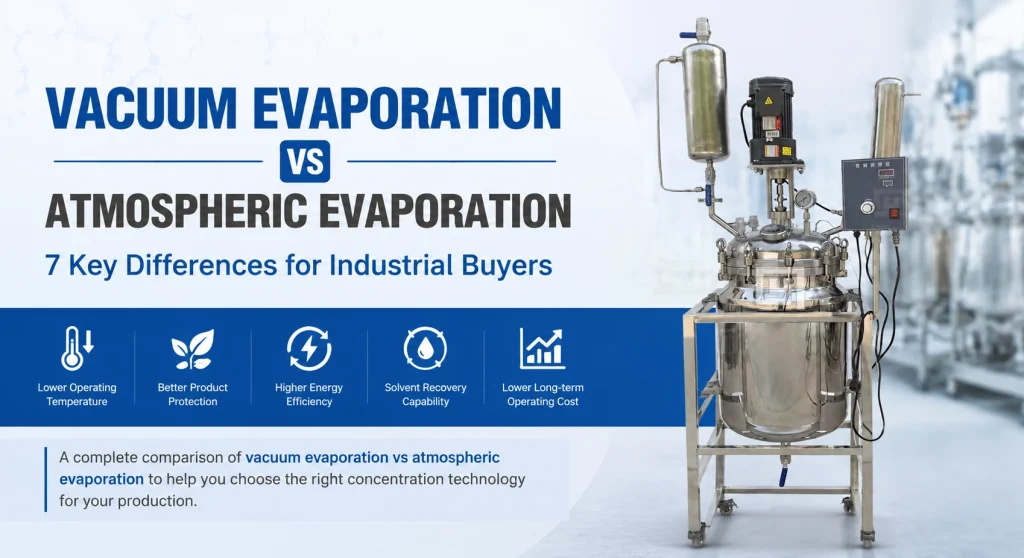
Understanding vacuum evaporation vs atmospheric evaporation helps manufacturers select a suitable solution based on material characteristics, production requirements, and long-term operating costs. The correct choice is not only related to equipment investment but also affects product stability, energy efficiency, and production profitability.
Modern manufacturers increasingly require advanced concentration solutions because many products contain valuable heat-sensitive compounds. In these applications, the vacuum evaporation process provides advantages by reducing thermal stress and improving process control.
The vacuum evaporation process is an industrial concentration method that removes solvents or water under reduced pressure. By lowering the pressure inside the evaporation chamber, the boiling point of the liquid decreases, allowing evaporation to occur at lower temperatures.
Compared with traditional heating methods, vacuum evaporation provides better control over temperature-sensitive materials. This technology is widely used in botanical extraction, pharmaceutical production, food processing, and chemical concentration where maintaining product quality is important.
A typical industrial vacuum evaporator includes several key components:
During operation, the vacuum system reduces internal pressure while the heating system provides controlled thermal energy. The generated vapor is then condensed and collected, allowing efficient concentration or solvent recovery.
The working principle behind the vacuum evaporation process is based on the relationship between pressure and boiling temperature. When atmospheric pressure is reduced, liquids can evaporate at lower temperatures compared with conventional evaporation conditions.
This principle creates several production benefits:
For manufacturers processing botanical extracts, essential oils, and pharmaceutical ingredients, low temperature evaporation is often a key requirement because excessive heat can damage valuable components.
One major difference in vacuum evaporation vs atmospheric evaporation is the temperature required during operation. Atmospheric systems normally rely on higher temperatures to generate evaporation, while vacuum systems can achieve concentration under milder conditions.
The use of low temperature evaporation helps protect:
For this reason, many manufacturers select an industrial vacuum evaporator when product quality has a direct impact on market value.
Atmospheric evaporation is the traditional evaporation method that operates under normal atmospheric pressure. The process usually requires direct heating to increase liquid temperature until evaporation occurs.
This method has been widely used because of its simple structure and relatively low initial investment. For applications involving heat-resistant materials and basic water removal, atmospheric evaporation can still provide a practical solution.
However, when comparing vacuum evaporation vs atmospheric evaporation, the limitations of atmospheric systems become more noticeable in advanced industrial applications.
Because atmospheric evaporation usually requires higher temperatures, manufacturers may experience:
For simple concentration tasks, these disadvantages may be acceptable. However, industries handling high-value materials often require more precise temperature control and improved efficiency.
A professional evaluation of vacuum evaporation vs atmospheric evaporation should consider more than the evaporation method itself. Manufacturers need to analyze temperature requirements, energy consumption, product quality, equipment investment, and future production goals.
| Comparison Factor | Vacuum Evaporation | Atmospheric Evaporation |
|---|---|---|
| Operating Pressure | Reduced pressure environment | Normal atmospheric pressure |
| Operating Temperature | Lower temperature operation | Higher temperature required |
| Product Protection | Better for heat-sensitive materials | Higher thermal exposure |
| Energy Efficiency | Improved control and efficiency | Higher heating demand |
| Solvent Recovery | Suitable with recovery systems | More difficult for sensitive solvents |
| Application Range | Advanced industrial production | Basic evaporation requirements |
This comparison shows why vacuum evaporation vs atmospheric evaporation has become an important decision for modern manufacturers. The selected technology should match the product value, production scale, and required quality standards.
When evaluating vacuum evaporation vs atmospheric evaporation, industrial buyers should consider the complete production process instead of focusing on only one technical parameter. Factors such as temperature control, energy consumption, material characteristics, and equipment reliability directly influence production performance.
The most significant difference between these two technologies is operating temperature. A vacuum system reduces the pressure inside the evaporation chamber, allowing liquids to evaporate at lower temperatures.
This advantage makes low temperature evaporation especially valuable for products containing sensitive compounds. Botanical extracts, pharmaceutical ingredients, and food materials often require gentle processing conditions to prevent quality loss.
In comparison, atmospheric evaporation normally requires higher temperatures because the process operates under normal pressure. For heat-resistant materials, this approach can be acceptable, but it may not be suitable for premium products where active components must be preserved.
For this reason, many manufacturers choose an industrial vacuum evaporator when product quality and consistency are more important than the lowest initial equipment cost.
Energy efficiency is another important factor in vacuum evaporation vs atmospheric evaporation. Although vacuum equipment requires additional components such as vacuum pumps and control systems, the overall process can achieve better thermal efficiency when designed correctly.
The lower operating temperature reduces unnecessary heat input and allows manufacturers to optimize energy usage. A properly designed vacuum evaporation process can reduce heat loss while maintaining stable evaporation performance.
Atmospheric evaporation may appear simpler because it requires fewer components. However, higher heating temperatures and longer processing times can increase operating expenses during continuous production.
| Energy Factor | Vacuum Evaporation | Atmospheric Evaporation |
|---|---|---|
| Heating Temperature | Lower operating temperature | Higher temperature required |
| Heat Loss | Better controlled | Higher possibility |
| Process Stability | Higher automation potential | More dependent on operator control |
Many industrial products cannot tolerate excessive heat exposure. During concentration, thermal degradation may reduce product effectiveness, flavor, color, or chemical stability.
The vacuum evaporation process solves this challenge by creating a controlled environment where evaporation occurs under reduced temperature conditions.
Typical applications include:
For these industries, vacuum evaporation vs atmospheric evaporation is not simply a technology comparison. It directly affects final product value and production reliability.
Solvent recovery is an important consideration for many extraction and chemical processing applications. A complete evaporation system should not only remove liquid components but also maximize valuable solvent recovery.
An industrial vacuum evaporator combined with an appropriate condenser system can efficiently recover solvents such as ethanol during concentration processes.
Compared with conventional evaporation methods, vacuum systems provide better control over vapor generation and condensation conditions. This helps manufacturers reduce raw material waste and improve production economics.
Modern evaporation systems are designed with advanced control features to improve consistency and reduce manual operation requirements.
A complete vacuum concentration equipment solution may include:
These functions allow manufacturers to maintain repeatable production conditions. This is particularly important for industries requiring strict quality control.
When comparing vacuum evaporation vs atmospheric evaporation, purchase price should not be the only consideration. The total cost of ownership includes energy consumption, labor requirements, maintenance, production efficiency, and product loss.
An atmospheric evaporation system may have a lower initial investment, but higher operating temperatures and longer processing cycles can increase long-term expenses.
A well-designed vacuum concentration equipment system may provide better value over time because it improves efficiency, protects product quality, and supports more demanding applications.
The demand for advanced concentration technology continues to grow as manufacturers process more valuable and temperature-sensitive materials. The vacuum evaporation process is widely used across multiple industries because it provides accurate control and reliable results.
Botanical extraction manufacturers often handle complex mixtures containing active natural compounds. Excessive heating can negatively affect extract quality.
An industrial vacuum evaporator helps concentrate extracts under controlled conditions while maintaining valuable components. This makes vacuum technology suitable for herbal extracts, plant ingredients, and natural products.
Food manufacturers use evaporation systems for concentration of juices, flavors, and functional ingredients. Maintaining natural characteristics is a key production requirement.
The combination of controlled temperature and efficient evaporation makes vacuum systems an effective solution for premium food processing applications.
Pharmaceutical and chemical industries often require precise concentration control. Small changes in temperature or processing conditions can influence product quality.
For these applications, vacuum evaporation vs atmospheric evaporation evaluation usually favors vacuum technology because it provides better process control and lower thermal stress.
The increasing adoption of the industrial vacuum evaporator is driven by several production advantages:
For companies planning long-term production development, selecting suitable vacuum concentration equipment can provide advantages beyond basic evaporation performance.
Selecting the correct evaporation technology requires a clear understanding of product requirements, production targets, and future business plans. The decision between vacuum evaporation vs atmospheric evaporation should not be based only on equipment price. Manufacturers need to evaluate processing temperature, energy consumption, product value, and long-term operating performance.
For simple applications involving heat-resistant materials and basic water removal, atmospheric evaporation may provide a practical solution. However, industries processing valuable extracts, sensitive ingredients, or solvent-based products often require more advanced technology.
A professional evaluation of vacuum evaporation vs atmospheric evaporation should consider the following questions:
Vacuum evaporation is usually recommended when product quality and process control are important. A properly designed industrial vacuum evaporator provides controlled operating conditions that help manufacturers achieve stable concentration results.
Typical situations where vacuum technology is preferred include:
In these applications, low temperature evaporation helps reduce thermal degradation and protects valuable product characteristics.
Atmospheric evaporation can still be suitable when the material is stable under higher temperatures and the production objective focuses mainly on simple liquid reduction.
Common applications include:
However, manufacturers should carefully evaluate whether lower initial investment may result in higher long-term operating costs.
Choosing the right vacuum concentration equipment requires detailed process information. A reliable equipment supplier should analyze the complete production condition before recommending a suitable solution.
The first step is understanding the material being processed. Important information includes:
Different materials require different evaporation conditions. A solution designed for water concentration may not be suitable for high-value botanical extracts.
Manufacturers should define both current and future production requirements before selecting equipment.
Important parameters include:
Selecting an appropriate industrial vacuum evaporator capacity helps avoid production limitations in future expansion.
The available utilities directly affect evaporation performance. Buyers should evaluate:
Proper utility matching ensures stable operation and improves overall energy efficiency.
Modern production facilities increasingly require automated operation and sanitary design.
Important features include:
These functions improve consistency and reduce manual operation requirements.
Many purchasing mistakes occur because buyers compare only machine specifications instead of evaluating the complete production process.
The lowest purchase price does not always represent the lowest production cost. Equipment performance, energy consumption, maintenance requirements, and product losses all influence long-term profitability.
A higher-quality industrial vacuum evaporator may provide better value because it improves efficiency and supports more demanding applications.
Some materials lose quality when exposed to excessive heat. Without proper temperature control, manufacturers may experience reduced product value.
This is why low temperature evaporation has become an important requirement for many modern industries.
Production requirements often change after market expansion. Choosing equipment only for current demand may limit future development.
A professional equipment evaluation should consider:
When comparing vacuum evaporation vs atmospheric evaporation, buyers should evaluate total ownership cost rather than only initial investment.
The complete cost includes:
Although vacuum systems may require higher initial investment, the vacuum evaporation process can provide long-term advantages through better temperature control, improved recovery efficiency, and higher product protection.
Q: Is vacuum evaporation always better than atmospheric evaporation?
A: No. Vacuum evaporation is not suitable for every application. Atmospheric evaporation remains practical for heat-resistant materials where low investment is the main priority. Vacuum evaporation provides greater advantages when product quality, energy efficiency, and solvent recovery are important.
Q: Why does vacuum evaporation reduce boiling temperature?
A: Vacuum evaporation lowers the pressure inside the evaporation chamber. Because boiling temperature depends on pressure, liquids can evaporate at lower temperatures under vacuum conditions.
Q: Which industries commonly use vacuum evaporation?
A: Vacuum evaporation is widely used in botanical extraction, pharmaceuticals, food processing, chemical production, dairy processing, and essential oil-related applications where gentle concentration is required.
Q: Can vacuum evaporation recover solvents?
A: Yes. When combined with suitable condensation and recovery systems, vacuum evaporation can help recover solvents such as ethanol and reduce raw material costs.
Q: How do I select the right evaporation equipment?
A: The correct equipment depends on material characteristics, production capacity, heating source, target concentration, and automation requirements. A professional supplier should evaluate the complete process before recommending a model.
Q: What is the difference between vacuum evaporation vs atmospheric evaporation?
A: The main difference between vacuum evaporation vs atmospheric evaporation is operating pressure. Vacuum evaporation reduces boiling temperature, while atmospheric evaporation uses normal pressure and generally requires higher temperatures.
The choice between vacuum evaporation vs atmospheric evaporation depends on your product characteristics, production goals, and long-term business strategy.
Atmospheric evaporation remains a practical option for simple and heat-resistant applications. However, manufacturers processing valuable, sensitive, or solvent-based materials often benefit from advanced evaporation technology because it provides better control, improved efficiency, and stronger product protection.
Panchi provides customized evaporation and extraction solutions designed according to different industrial requirements. Our engineering team can evaluate your material characteristics, production capacity, and process objectives to recommend suitable vacuum concentration equipment and complete processing solutions.
Contact Panchi to discuss your evaporation requirements and find the right industrial solution for your production line.


Whatsapp: +8615736768129
Email: [email protected]
Address: Zhengzhou, Henan Province, China
Automatic Vacuum Honey Processing & Filtering Machine
Vacuum Low-Temperature Liquid Extraction & Concentration Unit
Custom Steam Distillation & Heat Reflux Essential Oil Equipment
SS304/316L Low-Temperature Vacuum Scraper Concentrator
QN Spherical Vacuum Concentrator & Alcohol Recovery Unit
Multi-function Stainless Steel Vacuum Distillation & Extraction Unit
Hot Reflux Vacuum Liquid Extraction & Concentration Unit
Single-Effect External Circulation Vacuum Concentrator
SJN Series Double-Effect External Circulation Vacuum Evaporator
We will contact you within one working day. Please pay attention to your email.
Automatic Vacuum Honey Processing & Filtering Machine
Vacuum Low-Temperature Liquid Extraction & Concentration Unit
Custom Steam Distillation & Heat Reflux Essential Oil Equipment
WhatsApp: +8615736768129
Email: [email protected]
Address: Zhengzhou, Henan Province, China


COPYRIGHT© 2026 Zhengzhou Panchi Machinery Equipment Co., Ltd. | Privacy Policy

Our team will respond within 24 hours.
Thanks! We'll get back to you within 24 hours.
Check your inbox (and spam folder) for our reply.