
Ginkgo biloba extract is one of the most widely used botanical ingredients in pharmaceutical, nutraceutical, and health supplement industries. The leaves of the Ginkgo biloba tree contain valuable active compounds, especially flavonoid glycosides and terpene lactones, which are responsible for many commercial applications.
However, producing high-quality ginkgo biloba extract is not simply a matter of soaking plant materials with solvents. Industrial manufacturers must overcome several challenges during extraction, purification, and concentration processes.
These challenges include:
For manufacturers producing standardized botanical extracts, selecting the right ginkgo biloba extraction equipment plays a critical role in improving flavonoid recovery and maintaining product purity.
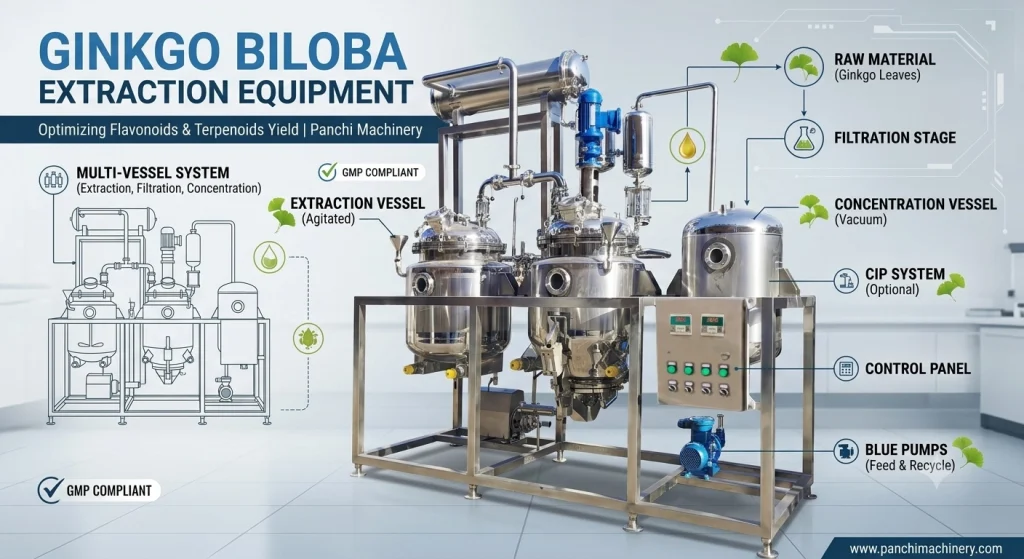
Modern extraction systems are designed to provide better control over key parameters, including:
By optimizing these factors, manufacturers can achieve higher extraction efficiency while protecting valuable botanical compounds.
Ginkgo biloba leaves contain a complex mixture of natural compounds. While flavonoids are the primary target components, the raw extract may also contain unwanted substances such as chlorophyll, waxes, tannins, and other plant-based impurities.
A successful extraction process must maximize the recovery of desired compounds while minimizing the transfer of unwanted materials.
This balance is one of the main reasons why industrial producers rely on specialized extraction systems rather than traditional extraction methods.
The commercial value of ginkgo biloba extract mainly comes from two groups of active ingredients:
Flavonoid glycosides are important quality indicators for standardized ginkgo extracts.
Industrial extraction systems must provide suitable conditions to improve flavonoid recovery while preventing unnecessary degradation.
Factors affecting flavonoid extraction include:
A well-designed flavonoid extraction system helps manufacturers achieve stable extraction performance and consistent product quality.
Terpene lactones are another important group of active compounds found in ginkgo biloba leaves.
Because these compounds may have different solubility characteristics compared with flavonoids, extraction conditions must be carefully controlled.
An optimized extraction process ensures that multiple valuable compounds can be recovered efficiently.
The performance of extraction equipment directly influences production efficiency and final extract quality.
Traditional extraction methods may face limitations such as:
Industrial ginkgo biloba extraction equipment solves these problems through optimized mechanical design and process control.
Important equipment features include:
Proper mixing and circulation improve contact between botanical materials and extraction solvents.
This helps increase mass transfer efficiency and allows more active compounds to enter the extract solution.
Temperature control is essential because excessive heat may affect sensitive botanical components.
Modern systems use jacketed vessels and precise temperature monitoring to maintain stable extraction conditions.
After extraction, plant residues must be separated efficiently from the liquid extract.
Better filtration and separation systems improve:
A complete industrial extraction line usually includes multiple processing stages:
Raw material preparation
↓
Solvent extraction
↓
Filtration
↓
Purification
↓
Solvent recovery
↓
Final concentration
Each stage affects the quality and efficiency of the final product.
For example, after extraction and filtration, manufacturers often use vacuum concentration equipment to remove solvents under lower temperature conditions.
This helps preserve heat-sensitive compounds while achieving the desired extract concentration.
For companies producing botanical ingredients at commercial scale, the extraction system is not only a production tool but also a key factor affecting profitability, product consistency, and market competitiveness.
A successful ginkgo biloba extraction process requires precise control from raw material preparation to final extract concentration. Each stage influences flavonoid recovery, impurity removal, and overall production efficiency.
For industrial manufacturers, extraction is not an isolated operation. It is a complete workflow involving preparation, solvent extraction, filtration, purification, solvent recovery, and concentration.
The selection of suitable ginkgo biloba extraction equipment allows manufacturers to achieve better process stability and consistent extract quality.
The first stage begins with preparing dried ginkgo biloba leaves.
Raw materials typically require:
Proper preprocessing improves extraction efficiency by increasing the contact area between plant materials and solvents.
If the leaf particles are too large:
If particles are excessively fine:
Therefore, particle size must be optimized according to the extraction method and equipment design.
In industrial production, preprocessing equipment is often integrated with the extraction line to ensure stable material quality before entering the extraction stage.
The extraction stage is where valuable compounds such as flavonoid glycosides and terpene lactones are transferred from plant materials into the solvent phase.
Common solvents used for ginkgo biloba extraction process include:
During this stage, important parameters include:
A well-designed extraction vessel improves solvent contact and enhances mass transfer efficiency.
Modern herbal extraction equipment typically uses:
These features help maintain consistent extraction conditions across different production batches.
Temperature control is one of the most important factors affecting flavonoid recovery.
Excessive temperature may reduce the stability of sensitive compounds, while insufficient temperature may lower extraction efficiency.
Industrial extraction systems use jacketed vessels to provide:
Mixing performance is equally important.
Effective agitation helps:
However, excessive agitation may increase energy consumption and create unnecessary mechanical stress.
Therefore, the mixing system should be designed according to:
After extraction, the mixture contains:
The next step is separating the extract solution from the remaining plant materials.
Efficient filtration improves:
Common separation methods include:
The selected method depends on:
A well-designed separation system reduces material loss and improves overall recovery rates.
After filtration, the crude extract may still contain unwanted substances such as:
Additional purification steps may be required to improve extract quality.
Purification methods may include:
The purpose is to increase the ratio of desired compounds while reducing unnecessary components.
For standardized ginkgo extracts, purification directly affects:
After extraction and purification, solvent recovery becomes an important part of industrial production.
A reliable recovery system helps manufacturers:
Vacuum-based recovery technology is commonly used because it allows solvent removal at lower temperatures.
This helps protect valuable botanical compounds during processing.
Combining extraction equipment with a vacuum concentration equipment solution provides a more complete production workflow.
Benefits include:
The final stage focuses on adjusting extract concentration and preparing the product for further processing.
Depending on application requirements, manufacturers may produce:
Vacuum concentration is widely used because it minimizes thermal impact while achieving efficient solvent removal.
A complete extraction line connects all stages:
Raw material preparation
↓
Solvent extraction
↓
Filtration
↓
Purification
↓
Solvent recovery
↓
Vacuum concentration
↓
Final ginkgo biloba extract
By selecting the right ginkgo biloba extraction equipment, manufacturers can improve flavonoid recovery, maintain purity, and create a more efficient industrial production process.
Improving flavonoid recovery requires more than optimizing extraction parameters. The design and configuration of the production system directly influence extraction efficiency, product purity, and long-term operating performance.
For commercial-scale manufacturers, selecting suitable ginkgo biloba extraction equipment means evaluating not only extraction capacity but also temperature control, material compatibility, automation level, cleaning requirements, and integration with downstream processes.
A well-engineered extraction system helps manufacturers achieve:
Material selection is one of the most important factors in industrial botanical extraction equipment.
Because ginkgo biloba extraction involves solvents and high-value plant compounds, processing equipment must provide excellent corrosion resistance and hygienic performance.
Industrial extraction systems commonly use:
SUS316L is often preferred for pharmaceutical and high-purity botanical applications because it provides better resistance against chemical corrosion and supports stricter sanitary requirements.
A high-quality herbal extraction equipment design should include:
These features help prevent contamination and improve the reliability of repeated production cycles.
For manufacturers producing standardized ginkgo biloba extracts, sanitary design is directly related to product consistency and regulatory compliance.
Solvent circulation plays a key role in improving flavonoid recovery.
During extraction, active compounds must efficiently transfer from plant materials into the solvent phase.
A poorly designed system may result in:
Advanced ginkgo biloba extraction equipment improves solvent contact through:
The extraction vessel should provide sufficient interaction between plant materials and solvent while avoiding excessive mechanical impact.
This balance improves mass transfer efficiency and supports higher flavonoid extraction performance.
Temperature management is critical when processing botanical materials.
Although increasing temperature can improve extraction speed, excessive heat may negatively affect sensitive compounds.
A reliable extraction system uses:
These components allow operators to maintain stable extraction conditions.
Benefits include:
For high-value botanical extracts, precise temperature control is one of the most important equipment selection factors.
After extraction, the liquid mixture contains both target compounds and plant residues.
An efficient separation system helps maximize recovery while improving extract clarity.
Industrial systems may integrate:
The filtration stage affects:
A well-designed production line ensures that filtration works smoothly with extraction and concentration processes.
This reduces production bottlenecks and improves overall workflow efficiency.
After extraction and purification, concentration is required to remove excess solvent and increase active ingredient concentration.
Traditional high-temperature evaporation methods may affect sensitive botanical compounds.
For this reason, many manufacturers integrate vacuum concentration equipment into their extraction systems.
Vacuum concentration provides:
This is especially valuable for ginkgo biloba extraction process because flavonoids and other active compounds require careful handling during concentration.
By combining extraction and vacuum concentration technologies, manufacturers can create a more complete production solution.
Solvent usage represents a significant operating cost in botanical extraction.
A properly designed recovery system allows manufacturers to recycle solvents after processing.
A complete solvent recovery solution helps:
For ethanol-based extraction applications, solvent recovery can significantly improve economic efficiency.
Integrating a recovery system with ginkgo biloba extraction equipment allows manufacturers to manage the entire extraction cycle more effectively.
Modern botanical extraction plants increasingly require automated production control.
Automation systems can monitor and adjust:
A PLC-based control system provides:
For pharmaceutical and nutraceutical manufacturers, process documentation is important for maintaining consistent product standards.
Different manufacturers may require different extraction system configurations depending on:
Important selection considerations include:
Small pilot production and large commercial extraction plants require different equipment sizes and automation levels.
The equipment should match the selected solvent system and extraction technology.
The flavonoid extraction system should connect smoothly with:
For pharmaceutical-grade applications, equipment should meet appropriate hygienic design expectations.
A properly selected flavonoid extraction system improves not only recovery performance but also production reliability and scalability.
By combining sanitary construction, precise process control, solvent management, and concentration technology, manufacturers can build an efficient ginkgo biloba extract production line.
For manufacturers producing standardized ginkgo biloba extracts, achieving high flavonoid recovery requires a complete production system rather than a single extraction vessel.
PCM provides customized ginkgo biloba extraction equipment solutions designed for botanical extraction, pharmaceutical, and nutraceutical applications.
Each system is engineered according to specific production requirements, including:
By combining extraction, filtration, solvent recovery, and concentration technologies, PCM helps manufacturers build efficient and reliable botanical processing lines.
A complete PCM extraction solution can include:
The extraction vessels are designed for stable processing conditions with features such as:
These features support consistent extraction performance and help maintain product quality during repeated production cycles.
For high-value botanical ingredients, equipment design directly affects:
Ginkgo biloba production requires careful handling throughout the entire process.
After extraction and filtration, the extract solution usually requires concentration to achieve the desired active ingredient level.
PCM integrates vacuum concentration equipment into extraction solutions to provide gentle solvent removal under reduced temperature conditions.
This helps manufacturers:
For ethanol-based extraction applications, PCM can also integrate solvent recovery solutions to reduce solvent consumption and improve production economics.
Modern botanical extract manufacturers require equipment that supports hygienic production standards.
PCM focuses on providing herbal extraction equipment with:
These designs help manufacturers improve:
By considering extraction, purification, and concentration as one complete workflow, PCM helps customers develop scalable flavonoid extraction system for ginkgo biloba and other botanical materials.
A: Industrial production typically uses extraction vessels, heating and mixing systems, filtration units, solvent recovery systems, and concentration equipment. PCM provides customized ginkgo biloba extraction equipment based on production requirements.
A: Advanced flavonoid extraction system improves flavonoid recovery through better solvent contact, precise temperature control, optimized mixing, and efficient separation processes.
A: Ethanol-water extraction is commonly used for ginkgo biloba because it can effectively extract flavonoid glycosides and other valuable botanical compounds while supporting industrial production.
Producing high-quality ginkgo biloba extract requires precise process control and reliable equipment integration. From solvent extraction and filtration to concentration and recovery, each stage influences flavonoid purity and production efficiency.
PCM provides customized extraction solutions that help manufacturers improve recovery performance, maintain product consistency, and scale their botanical production.
Contact PCM to discuss your ginkgo biloba extraction requirements and develop an engineered solution for your production goals.


Whatsapp: +8615736768129
Email: [email protected]
Address: Zhengzhou, Henan Province, China
Automatic Vacuum Honey Processing & Filtering Machine
Vacuum Low-Temperature Liquid Extraction & Concentration Unit
Custom Steam Distillation & Heat Reflux Essential Oil Equipment
SS304/316L Low-Temperature Vacuum Scraper Concentrator
QN Spherical Vacuum Concentrator & Alcohol Recovery Unit
Multi-function Stainless Steel Vacuum Distillation & Extraction Unit
Hot Reflux Vacuum Liquid Extraction & Concentration Unit
Single-Effect External Circulation Vacuum Concentrator
SJN Series Double-Effect External Circulation Vacuum Evaporator
We will contact you within one working day. Please pay attention to your email.
Automatic Vacuum Honey Processing & Filtering Machine
Vacuum Low-Temperature Liquid Extraction & Concentration Unit
Custom Steam Distillation & Heat Reflux Essential Oil Equipment
WhatsApp: +8615736768129
Email: [email protected]
Address: Zhengzhou, Henan Province, China


COPYRIGHT© 2026 Zhengzhou Panchi Machinery Equipment Co., Ltd. | Privacy Policy

Our team will respond within 24 hours.
Thanks! We'll get back to you within 24 hours.
Check your inbox (and spam folder) for our reply.