
Choosing the right extraction technology is one of the most important decisions for essential oil and botanical ingredient manufacturers.
When evaluating CO2 extraction vs steam distillation, companies are not only comparing two extraction methods. They are deciding which technology can better support:
Both technologies are widely used in the natural extraction industry, but they work based on completely different principles.
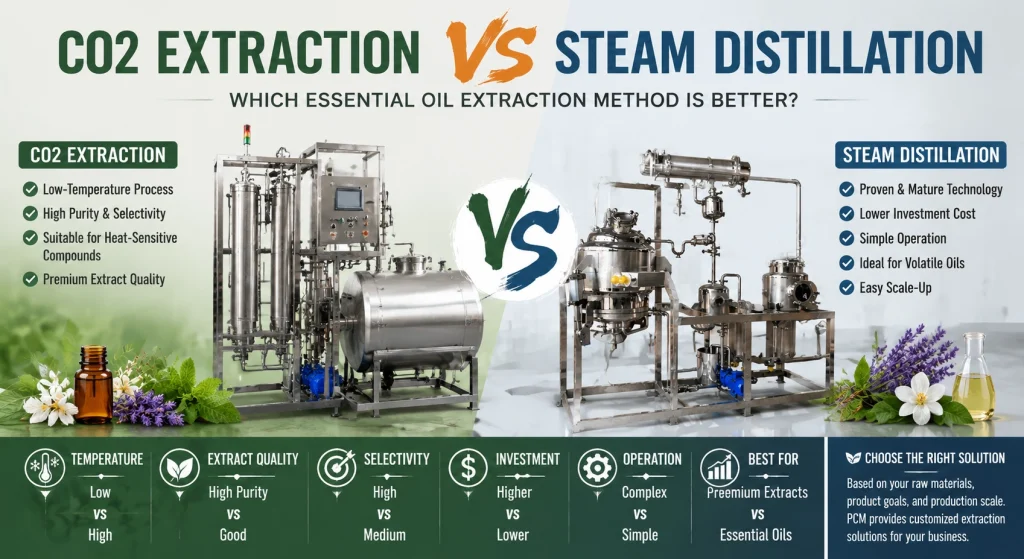
Steam distillation uses steam and heat to release volatile aromatic compounds from plant materials. It is a proven industrial method with simple operation and strong scalability.
The CO2 extraction method uses pressurized carbon dioxide to dissolve and separate specific compounds. It offers advantages for heat-sensitive materials and premium botanical extracts.
Therefore, the best choice depends on the raw materials, target compounds, production requirements, and final product positioning.
Before choosing an extraction solution, manufacturers should understand the fundamental differences between these two essential oil extraction methods.
| Factor | Steam Distillation | CO2 Extraction |
|---|---|---|
| Extraction Medium | Steam and water vapor | Carbon dioxide |
| Main Principle | Vaporization and condensation | Pressure-controlled compound extraction |
| Operating Temperature | Higher | Lower temperature possible |
| Pressure Requirement | Low pressure | High pressure |
| Equipment Complexity | Simple structure | More advanced system |
| Investment Cost | Lower | Higher |
| Best Application | Traditional essential oils | Premium botanical extracts |
The comparison of CO2 extraction vs steam distillation shows that neither technology is universally better.
Steam distillation is usually preferred for reliable commercial essential oil production, while CO2 extraction is often selected for specialized applications requiring higher selectivity and compound preservation.
Steam distillation is one of the most established essential oil extraction methods used worldwide.
The basic principle is that steam passes through plant materials and carries volatile aromatic compounds into a condensation system.
The process usually includes:
A complete steam distillation equipment system normally includes:
Because the process is relatively simple and reliable, steam distillation remains one of the most common solutions for commercial essential oil production.
Steam distillation has been used for essential oil production for decades.
Manufacturers benefit from:
This makes it suitable for companies looking for a stable and practical extraction solution.
Compared with high-pressure extraction technologies, steam distillation equipment usually requires lower initial investment.
Advantages include:
For commercial essential oil production, especially at medium and large scale, this cost advantage is significant.
Steam distillation is widely used for:
These materials contain volatile aromatic compounds that can be effectively separated through steam extraction.
The CO2 extraction method uses carbon dioxide as an extraction medium to dissolve target compounds from plant materials.
When CO2 reaches specific pressure and temperature conditions, it can enter a supercritical state.
In this state, CO2 has properties between a gas and a liquid, allowing it to penetrate plant structures and extract valuable compounds.
The process typically includes:
A typical system includes:
One of the biggest advantages of supercritical CO2 extraction is its ability to operate at lower temperatures.
This can help preserve:
CO2 extraction is often selected for premium products where purity and compound selectivity are important.
Applications include:
Understanding the operating principles behind different extraction technologies is essential when selecting the right production solution.
Although both steam distillation and CO2 extraction are used to obtain valuable compounds from plants, their processing mechanisms are fundamentally different.
The main difference in CO2 extraction vs steam distillation is the extraction medium and operating conditions.
Steam distillation uses steam and heat to release volatile compounds from plant materials, while the CO2 extraction method uses pressurized carbon dioxide to selectively dissolve and separate target compounds.
The process begins with generating clean steam.
The steam temperature and flow rate are controlled according to:
Stable steam supply is important because inconsistent steam flow may affect extraction efficiency.
The generated steam enters the distillation chamber and passes through the botanical materials.
During this stage:
The steam carries these aromatic compounds away from the plant structure.
For materials such as lavender, rosemary, eucalyptus, and peppermint, steam distillation can effectively extract volatile essential oils.
The vapor mixture moves into the condenser.
The condenser reduces temperature and converts vapor into liquid.
The collected liquid contains:
Because oil and water have different densities, they can be separated using an oil separator.
This simple separation process is one reason why steam distillation equipment remains popular in commercial essential oil production.
The CO2 extraction method uses carbon dioxide as an extraction solvent.
When carbon dioxide reaches specific temperature and pressure conditions, it enters a supercritical state.
In this condition, CO2 has unique properties:
This allows manufacturers to extract compounds that may not be efficiently recovered through traditional steam methods.
The system first converts carbon dioxide into a high-pressure extraction medium.
The operating parameters depend on:
Pressure control is one of the most important factors in supercritical CO2 extraction.
The supercritical CO2 enters the extraction chamber and contacts the plant materials.
During this stage, CO2 dissolves selected compounds, including:
Compared with steam extraction, this process can operate at lower temperatures, helping preserve certain heat-sensitive ingredients.
After extraction, the CO2 solution enters the separation unit.
By adjusting pressure and temperature:
A closed CO2 cycle reduces consumption and improves system efficiency.
| Process Stage | Steam Distillation | CO2 Extraction |
|---|---|---|
| Extraction Medium | Steam | Carbon dioxide |
| Main Driving Force | Heat and vapor transfer | Pressure-controlled dissolution |
| Temperature Range | Higher | Lower possible |
| Pressure Requirement | Low | High |
| Main Target | Volatile essential oils | Selective botanical compounds |
| Equipment Complexity | Simpler | More advanced |
The difference between these two essential oil extraction methods is also reflected in equipment design.
A commercial steam distillation system focuses on:
The equipment structure is relatively straightforward, making it suitable for large-scale essential oil production.
A CO2 extraction system requires more advanced engineering, including:
Because of the additional pressure-control requirements, CO2 extraction equipment usually involves higher investment and more complex operation.
The choice between these two technologies depends on the final product requirements.
Steam distillation is often preferred when manufacturers need:
The CO2 extraction method may be preferred when manufacturers require:
Therefore, the decision between CO2 extraction vs steam distillation should be based on raw materials, target compounds, and commercial objectives rather than technology preference alone.
When selecting an extraction technology, manufacturers need to evaluate more than just extraction capability. Factors such as product quality, investment cost, processing efficiency, and production goals all influence the final decision.
The comparison of CO2 extraction vs steam distillation shows that both technologies have unique advantages. Steam distillation remains a reliable choice for traditional essential oil production, while CO2 extraction provides advanced capabilities for specialized botanical applications.
The following seven differences can help manufacturers select the most suitable solution.
The biggest difference between these two technologies is the extraction principle.
Steam distillation relies on heat and steam transfer.
During the process:
This method works especially well for plants containing high levels of volatile essential oils.
Examples include:
Because the technology is mature and easy to operate, steam distillation equipment remains one of the most widely used solutions for commercial essential oil production.
The CO2 extraction method uses carbon dioxide under controlled pressure and temperature conditions.
When CO2 reaches a supercritical state, it can penetrate plant structures and dissolve specific compounds.
This allows manufacturers to extract:
Compared with steam distillation, supercritical CO2 extraction provides greater control over compound selectivity.
Temperature is one of the most important factors affecting natural compound preservation.
Steam distillation requires heat to generate vapor.
Although many essential oils remain stable during the process, some sensitive compounds may experience changes due to higher temperatures.
Therefore, steam distillation is more suitable for:
One major advantage of supercritical CO2 extraction is the ability to operate at relatively low temperatures.
This helps protect:
For premium botanical products where maintaining original characteristics is important, CO2 extraction may provide additional advantages.
Extraction yield does not always mean better quality. The best method depends on which compounds the manufacturer wants to obtain.
Steam distillation mainly targets volatile compounds.
Advantages:
However, some non-volatile compounds may remain in plant residues.
The CO2 extraction method offers adjustable extraction selectivity.
By controlling:
manufacturers can target different compound profiles.
This makes CO2 extraction attractive for high-value botanical extracts requiring specific characteristics.
Cost is an important factor for commercial production.
Steam distillation systems generally require:
The equipment structure is relatively straightforward, including:
For many essential oil producers, this makes steam distillation a practical industrial solution.
CO2 extraction requires more advanced equipment design.
A typical system includes:
The initial investment is usually higher due to the complexity of high-pressure operation.
However, for premium products with higher market value, the additional investment may be justified.
Both technologies can be used for commercial production, but their applications are different.
Steam distillation is commonly used for:
Its advantages include:
CO2 extraction is often selected for:
It is suitable for companies focusing on product differentiation and premium markets.
Operational complexity directly affects production management.
Advantages:
This makes it suitable for manufacturers that prioritize reliability and operational simplicity.
CO2 systems require more specialized knowledge.
Operators need to understand:
Although more complex, advanced control systems can improve automation and repeatability.
Modern manufacturers increasingly consider environmental impact when selecting essential oil extraction methods.
Steam distillation uses water and heat energy.
Sustainability depends on:
CO2 extraction uses carbon dioxide as the extraction medium.
Advantages include:
However, energy requirements for high-pressure operation should also be considered.
| Factor | Steam Distillation | CO2 Extraction |
|---|---|---|
| Technology maturity | Very mature | Advanced |
| Investment cost | Lower | Higher |
| Operation difficulty | Easier | More complex |
| Temperature | Higher | Lower possible |
| Best for | Essential oils | Specialty extracts |
| Scalability | Excellent | Good |
| Compound selectivity | Moderate | High |
The decision between CO2 extraction vs steam distillation depends on the manufacturer’s product positioning and production strategy.
For companies producing conventional essential oils at commercial scale, steam distillation remains a reliable and economical choice.
For manufacturers targeting premium botanical extracts and sensitive compounds, the CO2 extraction method may provide additional benefits.
In the next section, we will explain how to choose the right extraction technology based on raw materials, production requirements, and business objectives.
Choosing the right extraction technology is a critical decision for manufacturers entering essential oil or botanical extract production. While CO2 extraction vs steam distillation is often presented as a technology competition, the better choice depends on the raw materials, target compounds, production scale, and business objectives.
A successful extraction project should not focus only on extraction yield. Manufacturers also need to consider:
The first factor to consider is the type of plant material being processed.
Different materials contain different chemical compounds, and not every extraction method performs equally for all applications.
Steam distillation is ideal for plants rich in volatile aromatic compounds.
Common examples include:
These materials release essential oils effectively when exposed to steam.
For manufacturers producing conventional essential oils, steam distillation equipment provides a proven and reliable solution.
The CO2 extraction method is often selected for materials containing sensitive or valuable compounds.
Examples include:
Because supercritical CO2 extraction allows lower-temperature processing, it can help preserve compounds that may be affected by traditional heating methods.
The final application strongly influences extraction technology selection.
If the goal is producing traditional essential oils for:
steam distillation is usually a practical choice.
Advantages:
For products requiring higher selectivity and compound preservation, CO2 extraction may be more suitable.
Applications include:
The CO2 extraction method provides greater control over extracted compounds, making it attractive for premium product development.
Equipment investment is one of the biggest differences between these technologies.
A steam distillation system generally requires:
For companies starting essential oil production or expanding conventional capacity, this approach often provides better cost efficiency.
CO2 extraction systems require more advanced engineering.
Additional requirements include:
Although the investment is higher, the technology may provide better returns for manufacturers targeting premium markets.
Production planning is another important factor.
For many small and medium essential oil manufacturers, steam distillation offers advantages:
Companies focused on differentiated products may consider CO2 extraction.
The technology provides:
A detailed analysis of production goals is necessary before selecting between these two essential oil extraction methods.
Equipment reliability directly affects production efficiency.
Steam distillation systems usually have simpler structures:
Maintenance requirements are relatively straightforward.
CO2 systems require more specialized management.
Operators need knowledge of:
For companies without experienced technical teams, the additional complexity should be carefully considered.
There is no universal answer to which extraction method is better.
The correct choice depends on your business model.
Choose steam distillation equipment when you need:
✅ Commercial essential oil production
✅ Lower equipment investment
✅ Stable industrial operation
✅ Simple maintenance
Choose CO2 extraction when you need:
✅ Premium botanical extracts
✅ Low-temperature processing
✅ Higher compound selectivity
✅ Specialty product development
For most industrial essential oil production projects, steam distillation remains one of the most practical solutions because of its reliability, scalability, and cost efficiency.
PCM provides customized steam distillation solutions designed according to:
A properly designed distillation system can help manufacturers achieve stable production while controlling operating costs.
For companies comparing CO2 extraction vs steam distillation, the key is not choosing the most advanced technology, but choosing the technology that best matches the product strategy and manufacturing goals.
Selecting the right extraction technology is only the first step. For commercial essential oil production, equipment design, manufacturing quality, and process integration directly affect production efficiency and long-term operating performance.
PCM provides customized steam distillation equipment solutions for essential oil manufacturers, herbal processing companies, and natural ingredient producers.
Instead of using a standard machine configuration, PCM designs extraction systems according to:
This ensures that the final system matches the customer’s actual production requirements.
PCM steam distillation systems are manufactured using industrial-grade stainless steel materials, including:
The equipment can be customized with sanitary internal surfaces to support:
This makes the system suitable for industries requiring reliable and hygienic processing environments.
A complete steam distillation solution includes multiple integrated components:
Each component works together to create an efficient extraction workflow.
The distillation chamber allows steam to contact plant materials, while the condenser efficiently converts aromatic vapor into liquid form for oil separation.
Different manufacturers have different production goals.
PCM can customize:
Whether for pilot production or commercial-scale manufacturing, the system can be configured according to output requirements.
The condenser plays an important role in essential oil recovery.
A properly designed condensation system improves:
For manufacturers comparing CO2 extraction vs steam distillation, steam distillation remains an attractive option because of its simpler structure and reliable industrial operation.
The main difference is the extraction principle.
Steam distillation uses steam and heat to release volatile essential oils from plant materials, while the CO2 extraction method uses pressurized carbon dioxide to extract specific compounds.
Steam distillation is commonly used for traditional essential oil production, while CO2 extraction is often selected for premium botanical extracts.
Neither method is universally better.
Steam distillation is often preferred for:
The CO2 extraction method may be more suitable for:
The best choice depends on raw materials and production objectives.
Steam distillation equipment is commonly used for aromatic plants containing volatile oils, including:
The final equipment configuration depends on plant characteristics and expected production output.
For most commercial essential oil production, steam distillation usually requires lower investment and simpler operation.
CO2 extraction may involve higher equipment costs but can provide advantages for specialized products requiring advanced extraction performance.
Manufacturers should evaluate product value, market positioning, and production scale before selecting a solution.
The comparison of CO2 extraction vs steam distillation shows that both technologies have important roles in modern plant extraction.
Steam distillation provides:
CO2 extraction provides:
For manufacturers producing essential oils at commercial scale, PCM’s customized steam distillation equipment provides a practical and reliable solution.
With professional engineering support, stainless steel manufacturing capabilities, and customized system design, PCM helps customers build efficient extraction solutions that match their production goals.


Whatsapp: +8615736768129
Email: [email protected]
Address: Zhengzhou, Henan Province, China
Automatic Vacuum Honey Processing & Filtering Machine
Vacuum Low-Temperature Liquid Extraction & Concentration Unit
Custom Steam Distillation & Heat Reflux Essential Oil Equipment
SS304/316L Low-Temperature Vacuum Scraper Concentrator
QN Spherical Vacuum Concentrator & Alcohol Recovery Unit
Multi-function Stainless Steel Vacuum Distillation & Extraction Unit
Hot Reflux Vacuum Liquid Extraction & Concentration Unit
Single-Effect External Circulation Vacuum Concentrator
SJN Series Double-Effect External Circulation Vacuum Evaporator
We will contact you within one working day. Please pay attention to your email.
Automatic Vacuum Honey Processing & Filtering Machine
Vacuum Low-Temperature Liquid Extraction & Concentration Unit
Custom Steam Distillation & Heat Reflux Essential Oil Equipment
WhatsApp: +8615736768129
Email: [email protected]
Address: Zhengzhou, Henan Province, China


COPYRIGHT© 2026 Zhengzhou Panchi Machinery Equipment Co., Ltd. | Privacy Policy

Our team will respond within 24 hours.
Thanks! We'll get back to you within 24 hours.
Check your inbox (and spam folder) for our reply.