
The demand for efficient plant extraction solutions is increasing as manufacturers in the pharmaceutical, nutraceutical, and natural ingredient industries seek better ways to improve extraction efficiency while reducing production costs.
Traditional extraction methods often face several challenges:
For manufacturers producing herbal extracts, these limitations can affect production efficiency and final product quality.
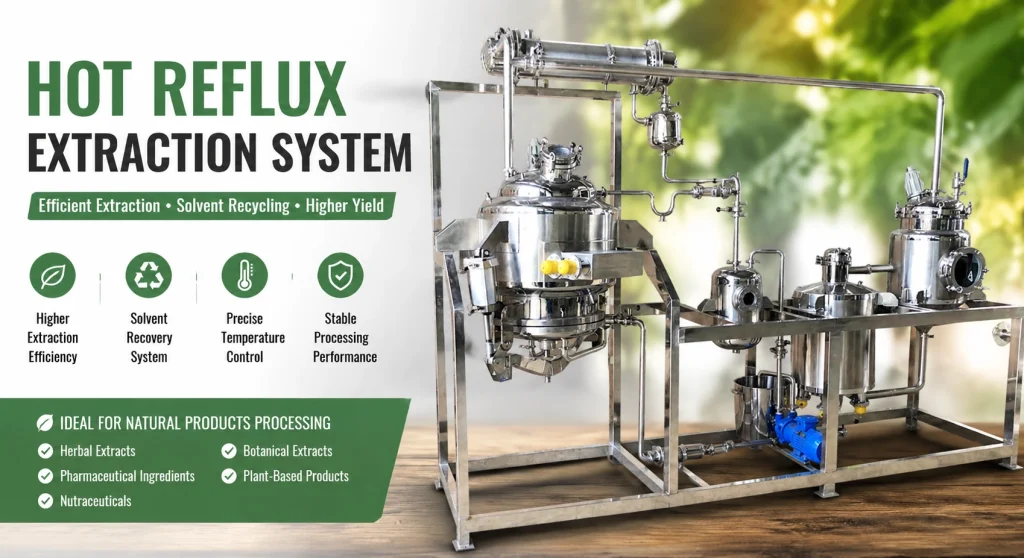
A hot reflux extraction system provides a more controlled extraction approach by combining heating, solvent circulation, condensation, and repeated extraction cycles within a closed processing system.
Unlike conventional extraction methods where solvents are used only once, a reflux-based system allows evaporated solvent vapor to be condensed and returned to the extraction vessel. This continuous circulation improves contact between the solvent and plant materials, helping manufacturers achieve more stable extraction performance.
For companies processing herbs, roots, leaves, flowers, and other botanical materials, understanding how this technology works is essential for selecting the right extraction solution.
A hot reflux extraction system is an industrial extraction unit that uses controlled heating and solvent reflux circulation to extract valuable compounds from raw materials.
The basic principle is:
This process creates a closed-loop extraction environment, reducing solvent loss while maintaining stable operating conditions.
A complete system usually includes:
Compared with open extraction methods, a reflux configuration provides better control over temperature, solvent usage, and processing stability.
Modern extraction manufacturers face increasing requirements for:
A properly designed hot reflux extraction process helps address these challenges by improving solvent utilization and maintaining continuous contact between the raw material and extraction medium.
For example, during herbal extraction, active compounds are released gradually from plant structures. Continuous solvent circulation helps maintain concentration differences between the plant material and solvent, supporting more effective compound transfer.
This makes reflux extraction especially valuable for:
Traditional extraction methods often require repeated solvent replacement or manual intervention.
Common problems include:
In conventional systems, large amounts of solvent may be required because extraction efficiency decreases as the solvent becomes saturated with extracted compounds.
A reflux system continuously returns condensed solvent back into the extraction vessel, improving solvent utilization.
Traditional extraction may require extended soaking or multiple extraction cycles.
A controlled hot reflux extraction process improves solvent-material contact, which can shorten processing time while maintaining extraction quality.
Temperature stability plays an important role in extraction performance.
Excessive heat may damage sensitive compounds, while insufficient temperature may reduce extraction efficiency.
A modern reflux system allows manufacturers to control:
A hot reflux extraction system is widely used in industries requiring efficient separation of valuable compounds from natural materials.
Typical applications include:
Herbal manufacturers use reflux extraction for processing:
The controlled extraction environment helps produce consistent herbal extracts for further concentration and formulation.
Natural health product manufacturers require reliable extraction methods to obtain active ingredients from botanical sources.
Reflux extraction supports stable production of:
Companies producing botanical ingredients often need scalable extraction solutions that can handle different raw materials.
A well-designed system allows manufacturers to adjust parameters according to material characteristics and production requirements.
Understanding the working principle is essential when selecting a suitable extraction solution. A hot reflux extraction system is designed around a closed-loop solvent circulation process, where heating, evaporation, condensation, and reflux return work together to improve extraction efficiency.
Unlike simple soaking extraction, the reflux method continuously renews the solvent contacting the raw materials. This allows manufacturers to maintain a more stable extraction environment while reducing solvent waste.
The complete hot reflux extraction process usually includes five main stages:
Extract collection and further processing
The first stage of the hot reflux extraction process is preparing the plant materials.
Raw materials may include:
Before extraction, materials are usually processed through:
Proper preparation improves solvent penetration and increases contact between plant materials and extraction solvent.
For example, smaller particle sizes provide a larger surface area, allowing the solvent to penetrate plant structures more effectively.
After preparation, the materials are loaded into the extraction vessel of the reflux extraction equipment.
After loading, the solvent is added into the extraction tank.
The heating system gradually increases the temperature according to the characteristics of the raw materials and solvent.
Common heating methods include:
During this stage:
The extraction temperature is a critical parameter.
Too low:
Too high:
Therefore, a properly designed hot reflux extraction system provides accurate temperature control to maintain stable processing conditions.
One of the key features of reflux extraction is the continuous solvent circulation process.
When the solvent reaches its evaporation temperature, vapor rises from the extraction tank and enters the condenser.
The condenser removes heat from the vapor and converts it back into liquid form.
A typical condensation system includes:
The condensed solvent then returns to the extraction vessel.
This cycle allows the system to reuse solvent continuously rather than losing it through evaporation.
The reflux circulation stage is the core of the hot reflux extraction process.
The condensed solvent flows back into the extraction tank and repeatedly contacts the plant materials.
This continuous circulation provides several advantages:
Fresh solvent continuously contacts the raw materials, helping dissolve more target compounds.
Because solvent is recovered and reused inside the system, manufacturers can reduce additional solvent requirements.
This is especially important when processing expensive organic solvents.
A closed reflux system minimizes environmental exposure and provides better control over:
For industrial production, this improves batch-to-batch consistency.
After the extraction cycle is completed, the liquid extract is separated from the plant residue.
Depending on the production process, the next steps may include:
In larger production systems, an integrated solvent recovery system can further improve efficiency by recovering remaining solvent from the extract or processing residues.
This helps manufacturers:
A professional reflux extraction equipment configuration usually contains several integrated units.
The extraction tank is the main processing chamber where plant materials contact the solvent.
Important design factors include:
The condenser controls solvent vapor recovery.
Its performance directly affects:
The heating system maintains the required extraction temperature.
Modern systems may include:
This allows operators to optimize extraction conditions for different materials.
A closed-loop design is one of the major differences between advanced reflux systems and traditional extraction methods.
It provides:
For manufacturers producing herbal extracts at commercial scale, a well-designed hot reflux extraction system provides a more reliable solution compared with basic extraction methods.
As natural ingredient markets continue to grow, manufacturers are looking for extraction technologies that can improve efficiency while maintaining product quality. A hot reflux extraction system provides a controlled and repeatable solution by combining heating, solvent circulation, and condensation technology.
Compared with conventional extraction approaches, reflux-based systems offer better control over processing conditions and improved utilization of extraction solvents.
The following are the major benefits that make this technology valuable for modern herbal and pharmaceutical production.
One of the biggest advantages of a hot reflux extraction system is improved extraction efficiency.
During traditional extraction, the solvent gradually becomes saturated with extracted compounds, reducing its ability to continue dissolving target ingredients.
In contrast, the reflux method continuously returns condensed solvent back into the extraction vessel. This creates repeated contact between fresh solvent and plant materials.
Benefits include:
For manufacturers producing valuable botanical extracts, higher extraction efficiency can directly improve production economics.
Solvent cost is an important consideration in commercial extraction production.
A conventional extraction process may require frequent solvent replacement, increasing operating expenses.
A modern hot reflux extraction process uses a closed-loop circulation design:
Solvent Heating
↓
Vapor Generation
↓
Condensation
↓
Reflux Return
↓
Continuous Extraction
This recycling mechanism reduces solvent loss and improves resource utilization.
When combined with an integrated solvent recovery system, manufacturers can further reduce solvent consumption and improve overall production sustainability.
Many herbal and natural ingredients contain temperature-sensitive active compounds.
Excessive heating may cause:
A professional hot reflux extraction system allows manufacturers to control:
This provides a more stable environment for extracting valuable compounds while reducing thermal damage.
For applications involving pharmaceutical ingredients and high-value botanicals, precise temperature management is especially important.
Production efficiency is a major concern for commercial extraction plants.
Traditional extraction methods often require:
The continuous circulation principle of reflux extraction improves solvent-material interaction, helping shorten processing time.
A well-designed hot reflux extraction process can help manufacturers increase production capacity without significantly increasing equipment footprint.
Consistency is critical for pharmaceutical, nutraceutical, and herbal product manufacturers.
Variations in:
can lead to differences between production batches.
Automated reflux extraction equipment provides better control over processing parameters, helping manufacturers achieve more repeatable results.
This is especially important for companies producing standardized herbal extracts.
A major advantage of herbal reflux extraction technology is its flexibility.
It can be applied to various botanical materials, including:
Common applications include:
Manufacturers use reflux extraction to obtain active compounds from medicinal plants.
The controlled environment helps improve extraction stability and supports further processing.
Nutraceutical companies require reliable extraction methods for producing:
A stable extraction process helps maintain ingredient quality.
Many cosmetic formulations use botanical extracts as active ingredients.
Reflux extraction can support the production of:
Laboratory extraction results do not always translate directly into commercial production.
A scalable reflux extraction equipment design allows manufacturers to move from small-scale testing to industrial production more efficiently.
Important scale-up factors include:
A properly designed system helps companies expand production while maintaining process stability.
| Application | Main Benefit |
|---|---|
| Herbal medicine | Stable active compound extraction |
| Nutraceuticals | Consistent natural ingredient production |
| Cosmetics | Reliable botanical extract processing |
| Pharmaceuticals | Controlled and repeatable extraction |
| Natural products | Efficient commercial production |
A hot reflux extraction system provides manufacturers with a practical solution for improving extraction efficiency, reducing solvent waste, and achieving more stable production results.
By combining controlled heating, solvent circulation, and recovery technology, this extraction method helps companies build a more efficient and scalable production process.
Choosing suitable extraction equipment requires more than comparing tank capacity or equipment price. A reliable extraction solution should match the characteristics of raw materials, production targets, and long-term operating requirements.
For manufacturers planning to invest in a hot reflux extraction system, several technical factors should be evaluated before making a decision.
Different plant materials have different structures and require different extraction conditions.
Important factors include:
For example, hard roots may require stronger solvent penetration and longer processing time, while delicate flowers may require gentler temperature control.
A suitable hot reflux extraction process should be optimized according to the specific botanical materials being processed.
Production capacity is another important consideration when selecting reflux extraction equipment.
Manufacturers should evaluate:
Small systems may be suitable for laboratory testing or pilot production, while commercial extraction plants usually require larger extraction vessels with automated control systems.
Choosing the correct capacity helps avoid:
Heating performance directly affects extraction efficiency.
A professional hot reflux extraction system should provide stable temperature control through:
Precise temperature management is especially important for herbal extraction because some active compounds are sensitive to excessive heat.
A well-designed system balances extraction efficiency with compound preservation.
The condenser is one of the most important components in reflux extraction.
A high-performance condenser improves:
In addition, an integrated solvent recovery system helps manufacturers reduce solvent loss and improve production economics.
For large-scale operations, efficient solvent recovery can significantly reduce long-term operating costs.
For pharmaceutical, food, and nutraceutical applications, equipment hygiene is essential.
Manufacturers should consider:
High-quality reflux extraction equipment should support stable operation while meeting industry requirements for cleanliness and durability.
| Factor | Hot Reflux Extraction System | Traditional Extraction |
|---|---|---|
| Solvent utilization | Higher through circulation | More solvent loss |
| Processing control | Better temperature and time control | More variable |
| Extraction efficiency | More consistent | Depends on operation |
| Automation | Easier integration | More manual operation |
| Scale-up | Suitable for industrial production | More limitations |
The main advantage of a reflux system is the ability to create a controlled and repeatable extraction environment.
An extraction system is not only a combination of tanks and pipelines. The design of each component affects the final production performance.
A complete industrial solution should consider:
For manufacturers entering commercial production, selecting the right hot reflux extraction system can improve efficiency, reduce operating costs, and create a more stable manufacturing process.
A complete PCM reflux extraction solution can integrate multiple processing functions into one system.
The equipment can be manufactured using:
The internal surfaces can be polished to improve:
This makes the system suitable for industries requiring high hygiene standards.
PCM designs extraction systems with coordinated components, including:
An integrated solvent recovery system helps reduce solvent loss and improves production efficiency.
By recovering and recycling solvents during processing, manufacturers can lower operating costs while improving process sustainability.
Different manufacturers have different production requirements.
PCM can customize:
This modular approach allows companies to expand production capacity according to market demand.
Choosing the correct hot reflux extraction system requires understanding both equipment and process technology.
PCM engineers can help evaluate:
A properly optimized system helps manufacturers achieve:
A hot reflux extraction system is an extraction unit that uses heating, condensation, and solvent circulation to repeatedly extract valuable compounds from plant materials.
The closed-loop reflux design improves solvent utilization and provides more stable extraction conditions.
The hot reflux extraction process continuously returns condensed solvent back into the extraction vessel.
This repeated solvent circulation improves contact between solvent and raw materials, helping increase extraction efficiency and reduce solvent consumption.
Herbal reflux extraction can be used for many botanical materials, including:
The final equipment configuration depends on the characteristics of the raw materials and target compounds.
When selecting reflux extraction equipment, manufacturers should consider:
A customized solution is usually more effective than selecting equipment based only on volume.
A successful extraction project requires the right combination of process knowledge and equipment design.
A professionally configured hot reflux extraction system can help manufacturers improve extraction efficiency, reduce solvent consumption, and achieve consistent production quality.
With customized extraction vessels, optimized reflux circulation, and integrated recovery solutions, PCM supports customers in building reliable industrial extraction systems for herbal and natural product processing.


Whatsapp: +8615736768129
Email: [email protected]
Address: Zhengzhou, Henan Province, China
Automatic Vacuum Honey Processing & Filtering Machine
Vacuum Low-Temperature Liquid Extraction & Concentration Unit
Custom Steam Distillation & Heat Reflux Essential Oil Equipment
SS304/316L Low-Temperature Vacuum Scraper Concentrator
QN Spherical Vacuum Concentrator & Alcohol Recovery Unit
Multi-function Stainless Steel Vacuum Distillation & Extraction Unit
Hot Reflux Vacuum Liquid Extraction & Concentration Unit
Single-Effect External Circulation Vacuum Concentrator
SJN Series Double-Effect External Circulation Vacuum Evaporator
We will contact you within one working day. Please pay attention to your email.
Automatic Vacuum Honey Processing & Filtering Machine
Vacuum Low-Temperature Liquid Extraction & Concentration Unit
Custom Steam Distillation & Heat Reflux Essential Oil Equipment
WhatsApp: +8615736768129
Email: [email protected]
Address: Zhengzhou, Henan Province, China


COPYRIGHT© 2026 Zhengzhou Panchi Machinery Equipment Co., Ltd. | Privacy Policy

Our team will respond within 24 hours.
Thanks! We'll get back to you within 24 hours.
Check your inbox (and spam folder) for our reply.